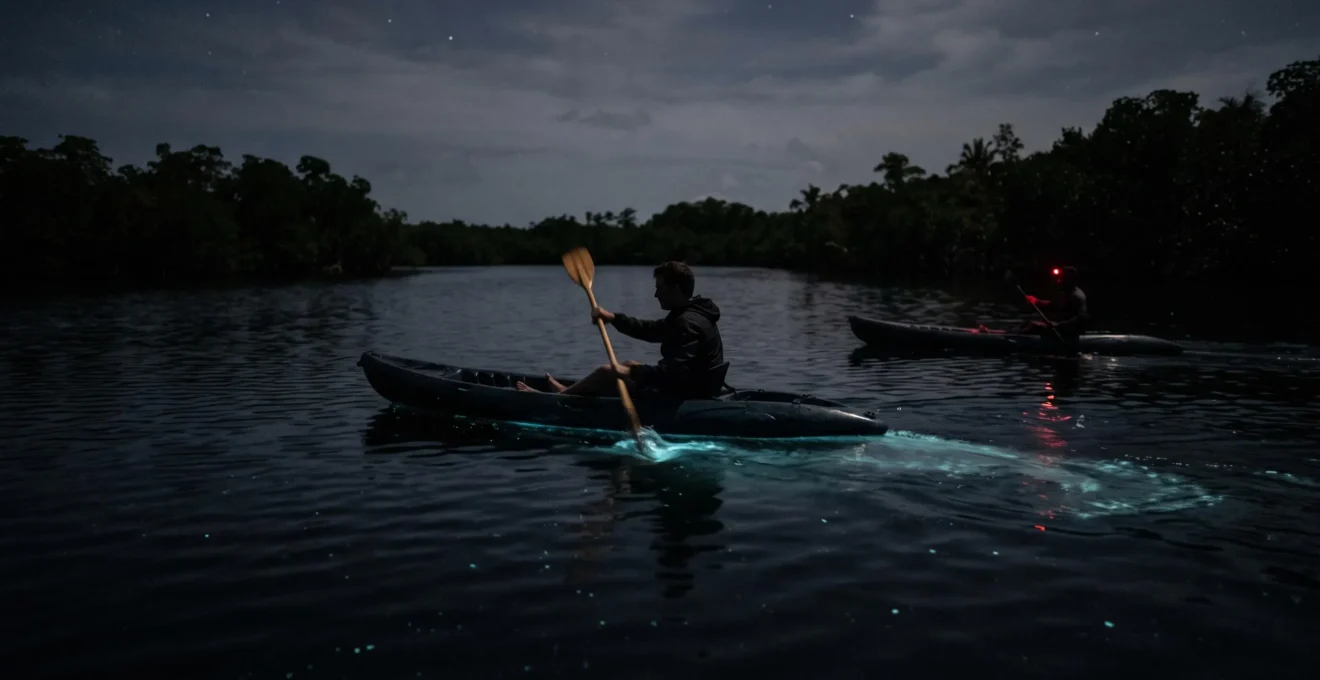
You have booked a night-time excursion to a famous bioluminescent bay. The photographs promised electric-blue water, luminous paddle trails and an unforgettable spectacle. Yet once your kayak reaches the lagoon, almost everything looks black. Was the tour a waste of money, or were the conditions simply wrong?
Bioluminescence is a natural phenomenon, not an illuminated attraction that switches on at a scheduled departure time. Microscopic organisms can produce brief flashes of light when water moves around them, but what you actually see depends on darkness, organism abundance, local conditions and how the excursion is conducted.
For UK travellers planning a holiday in Puerto Rico, Mexico or another coastal destination, choosing the right night can matter more than choosing the most photogenic operator. Understanding what makes the glow visible also helps protect the fragile habitats responsible for it.
Before booking a bioluminescent bay tour
- Prioritise darkness: check moonrise and moonset, not just the lunar phase. Bright moonlight and artificial lighting make faint flashes harder to distinguish.
- Assess the actual conditions: ask about recent visibility, local weather, group size and flexible rescheduling before paying.
- Protect the lagoon: respect swimming restrictions, minimise unnecessary lighting and keep chemical products out of the water.
- Why Does Bioluminescence Look Weak on Bright-Moon Nights Even in the Right Lagoon?
- How to Choose a Bioluminescence Tour Using 4 Checks Instead of Trusting Photos?
- Which Is Better for Bioluminescence: Kayaking Quietly or a Motorboat Tour?
- The Mistake That Kills the Glow in Bioluminescent Water Before You Even Notice It
- When Should You Schedule Bioluminescence for the Darkest Water and Best Odds?
- Why Does Reef Visibility Drop Fast After Windy Days Even in Crystal-Clear Mexico?
- How to Prepare for a Mangrove Tour in Mexico Without Being Eaten Alive by Insects?
- How to Choose a Mexican Reef for Snorkelling When You’re Not a Strong Swimmer?
Why Does Bioluminescence Look Weak on Bright-Moon Nights Even in the Right Lagoon?
Bioluminescence often appears weak under a bright moon because moonlight reduces the contrast between the organisms’ flashes and the surrounding water. The organisms do not necessarily stop producing light. Instead, your eyes struggle to distinguish their relatively faint glow against a brighter background. Choosing an hour when the moon is below the horizon can dramatically improve viewing conditions.
Many bioluminescent bays contain dinoflagellates, microscopic plankton that produce light through chemical reactions. Their flashes can be triggered by water movement, including the passage of a paddle. On a dark night, even subtle flashes can stand out against otherwise black water.
Moonlight changes what the observer perceives. It illuminates the water surface and surrounding scenery, reducing the apparent brightness of the flashes relative to their background. Nearby artificial lighting creates a similar problem and can interfere with the dark adaptation needed for faint-light observation.
The National Park Service information on dinoflagellates and bioluminescence recommends observing on dark nights, particularly before moonrise or after moonset. Its advice concerns Point Reyes and Tomales Bay in California, but the underlying importance of darkness is relevant to bioluminescence viewing elsewhere.
A full moon does not automatically ruin the entire night. If moonrise occurs after your excursion, you may still enjoy a dark viewing window. Likewise, a moon that has already set will not brighten the water. Clouds can sometimes reduce direct moonlight, although cloud cover also varies in thickness and effect.
Use the lunar calendar as a first filter, then check the actual times the moon will be visible.
| Moon conditions | Viewing outlook | Booking decision |
|---|---|---|
| Near full moon | Higher risk of poor contrast while the moon is above the horizon | Look for a tour before moonrise or after moonset |
| Quarter moon | Variable; some hours can be considerably darker than others | Compare departure time with moonrise and moonset |
| Near new moon | Generally favourable natural darkness | Prioritise this period if your dates are flexible |
| Moon below the horizon | Potentially good darkness regardless of the calendar label | Check local artificial lighting and weather as well |
The most useful question for an operator is not simply whether tours run at full moon. Ask whether the scheduled excursion takes place while the moon is above the horizon and how visibility typically compares with darker nights. Some companies may still operate during less favourable conditions, so availability alone should never be treated as a guarantee of a visible glow.
Moonlight is one of the easiest variables to investigate before travelling. It is not the only one, however: even a dark lagoon can disappoint when the organisms are sparse or the excursion is poorly suited to the location.
How to Choose a Bioluminescence Tour Using 4 Checks Instead of Trusting Photos?
Choose a bioluminescence tour by checking the lagoon’s biological reliability, the time spent in suitable viewing areas, the group’s operating practices and the company’s response to poor conditions. Promotional photographs are not reliable evidence of what you will see with your eyes. A credible operator should explain environmental uncertainty rather than promise glowing water on every departure.
A spectacular blue photograph can result from a long exposure, intensive image processing or an artificially enhanced representation. Camera sensors can accumulate faint light over time, whereas human vision experiences the glow directly and continuously. Not every promotional photograph is manipulated, but even an authentic long-exposure image is not a dependable prediction of unaided visibility.
For a meaningful comparison, ask four questions.
- What type of bay produces the glow? A lagoon supporting a relatively persistent dinoflagellate population may offer a different experience from an open coastline where bioluminescence depends on temporary plankton blooms. Ask whether observations are common throughout the year or concentrated in a particular season.
- Where does the tour actually spend its viewing time? A long excursion through picturesque mangroves may involve only a brief period in the main observation area. Ask how long visitors normally spend where bioluminescence is most readily observed.
- How are groups and water movements managed? Smaller groups can make it easier to follow safety instructions, avoid crowding and observe subtle light patterns. Quiet paddling can reveal flashes, but excessive disturbance is not a proven way to create a stronger display.
- What happens when conditions are poor? Ask about postponement, cancellation and refunds. A company that openly discusses moonlight, weather and recent observations provides more useful information than one that relies exclusively on its gallery.
Consider a hypothetical choice between two operators. One sells a fixed-date excursion with vivid images but offers no information about recent sightings. The other explains the moonrise time, describes the expected conditions and provides clear rescheduling terms. The second operator offers a better basis for an informed decision, even though neither can guarantee the glow.
Protection rules matter too. Some well-known lagoons operate under restrictions intended to protect their ecosystems. Requirements for access, boat type, swimming and permitted activities vary by location. Check the current local rules rather than assuming that every lagoon allows the same excursion format.
Your five-step tour booking checklist
- Check the lunar phase and local moonrise time. Save a screenshot showing the moon’s position during your intended tour.
- Ask whether sightings occur regularly or seasonally at that particular site. Record the operator’s explanation.
- Confirm how much time is allocated to the principal observation area. Keep the written itinerary.
- Request the expected group size, vessel type and any restrictions on lighting or paddling. Save the response.
- Read the cancellation and rescheduling policy before paying. Keep a copy of the applicable booking terms.
The checklist does not eliminate natural variability. It helps distinguish information that can be checked before purchase from impressions created by attractive marketing.
Once you have identified a suitable lagoon and responsible operator, the next choice is how to travel across the water. Kayaks and motorboats offer different advantages, particularly for visitors concerned about stability, mobility or physical effort.
Which Is Better for Bioluminescence: Kayaking Quietly or a Motorboat Tour?
Kayaking is often a compelling choice for experiencing bioluminescence because paddles and hull movement can trigger visible flashes close to the observer. Motorboat tours can be more practical over long distances or for travellers who cannot comfortably paddle. Neither format guarantees a brighter display: the location, water conditions, permitted activities and quality of the guide are more important than the vessel alone.
Dinoflagellates can emit light when water movement triggers their response. This means that a kayak paddle passing through suitable water may produce a brief luminous trail, while movement along the kayak hull can reveal additional flashes.
A motorboat also disturbs water, especially around its propeller and wake. It would be inaccurate to claim that engine turbulence necessarily switches off bioluminescence. Indeed, moving boats can produce luminous wakes when appropriate organisms are present.
The distinction is primarily experiential. Kayakers observe the water from a low position, close to their paddle and the small-scale flashes around it. Motorboat passengers may observe broader wake patterns from a raised seat, depending on the vessel and surrounding darkness.
| Consideration | Kayak tour | Motorboat tour |
|---|---|---|
| Viewing perspective | Close to the paddle, hull and water surface | Higher viewpoint, potentially broader view of the wake |
| Physical effort | Requires paddling unless assisted | Generally less demanding for passengers |
| Mangrove access | May suit narrow channels where kayaking is allowed | Access depends on channel width and vessel restrictions |
| Wind and rain | More exposed; paddling can become difficult | Comfort varies with vessel size and shelter |
| Accessibility | Boarding and balance may be challenging | Potentially easier, but accessibility must be confirmed |
| Environmental considerations | No propeller during paddling | Engine use, wakes and access restrictions require attention |
For a relatively sheltered lagoon with short paddling distances, a guided kayak excursion can provide a memorable close-up experience. A stable tandem kayak may be worth asking about if you prefer to paddle with a companion.
In a large open bay, however, a motorboat may make more sense. Its range allows passengers to reach suitable observation areas without demanding an extended paddle. For older travellers or people with limited mobility, practical access and stability may outweigh the appeal of sitting closer to the water.
Whichever vessel you choose, do not assume that continuously stirring the water produces a progressively brighter spectacle. Bioluminescent flashes are brief biological responses, and the effect of repeated stimulation varies with the organisms and their condition.
A useful observation technique is to alternate gentle movement with quiet watching, following your guide’s instructions. Allow your eyes to adjust to darkness, notice any naturally occurring flashes and then observe what happens when a paddle or hull moves through the water. There is no established universal waiting period that guarantees a stronger glow after remaining still.
The best vessel is one that allows you to experience natural flashes safely without unnecessary disruption. That principle becomes even more important when considering whether visitors should enter the water themselves.
The Mistake That Kills the Glow in Bioluminescent Water Before You Even Notice It
One preventable mistake is entering a protected bioluminescent lagoon without respecting restrictions on swimming, personal-care products and contact with the water. Sunscreen, insect repellent and other substances can introduce unwanted chemicals into aquatic habitats. However, it is not scientifically established that one swimmer immediately kills enough dinoflagellates to leave a visibly dark patch. The responsible choice is to minimise contamination and follow local rules.
The organisms responsible for bioluminescence form part of a much larger aquatic ecosystem. Water quality, nutrient availability, circulation and ecological conditions influence these communities. Preventing unnecessary contamination is therefore sensible even when the precise effects of an individual visitor cannot be measured visually.
Swimming also physically disturbs the water. Movement can trigger flashes rather than automatically suppress them, but that does not make swimming harmless or permissible. Repeated human activity may disturb habitats, introduce contaminants or conflict with conservation requirements.
In Puerto Rico, the guidance from Discover Puerto Rico distinguishes between its three celebrated bioluminescent destinations: Mosquito Bay in Vieques, Laguna Grande in Fajardo and La Parguera in Lajas.
The organisation’s recommendations for protecting bioluminescent bays identify swimming restrictions at Mosquito Bay and Laguna Grande and advise visitors to minimise artificial lighting, avoid unnecessary contact with water and prepare insect protection before the excursion. Permissions at La Parguera differ, so visitors should confirm current requirements with local authorities and operators.
Do not assume that a tour offering swimming is automatically suitable for every lagoon. What is allowed in one location may be prohibited in another, even when both are marketed as bioluminescent experiences.
Responsible preparation begins before boarding. Use clothing for protection wherever practical. If sunscreen or insect repellent is necessary, follow its label and the operator’s conservation guidance, applying it away from the water rather than spraying products over the lagoon.
Do not interpret labels such as « reef-safe » as a guarantee that a product has no ecological impact. Product formulations differ, and a marketing description does not establish harmlessness to dinoflagellates. Similarly, applying repellent earlier reduces the risk of introducing fresh product during departure but does not prove that residues become environmentally harmless.
Avoid scooping water, touching vegetation or disturbing mangrove margins unless an authorised guide specifically permits the activity. Mangroves are functioning habitats, not simply a backdrop for photographs.
Tourism can create a difficult management challenge: visitors want close contact with the phenomenon, while the destination depends on ecological conditions remaining suitable. There is no evidence in the supplied sources that visitor contamination follows a predictable cycle of diminishing glow and worsening reviews, but preventing unnecessary impacts is a precaution that benefits both conservation and the long-term visitor experience.
Protecting the lagoon will not guarantee a bright display on your particular night. It does ensure that the pursuit of a memorable experience is not treated as a reason to disregard the ecosystem that makes it possible.
When Should You Schedule Bioluminescence for the Darkest Water and Best Odds?
Schedule a bioluminescence excursion for a naturally dark period, ideally near a new moon or when the moon is below the horizon. Then consider the destination’s local viewing season and recent weather. These factors can improve your chances, but no date guarantees visible bioluminescence because organism abundance and environmental conditions vary naturally.
The most effective planning method combines three independent checks: darkness, biological seasonality and short-term environmental conditions.
First, identify the darkest usable hours. A new-moon period is an attractive starting point because moonlight is generally limited. Yet a different lunar phase can also work well if your tour occurs before moonrise or after moonset.
Check the time of sunset and the end of astronomical twilight rather than assuming the water becomes maximally dark immediately after sunset. The sky continues to darken after sunset, with the duration depending on location and season. A tour that starts too early may sacrifice a useful period of darkness.
Second, consider local seasonal patterns. Bioluminescent organisms do not follow a single global tourism calendar. Some coastal displays are seasonal, while particular tropical lagoons may support more persistent populations. The National Park Service identifies summer and autumn as favourable at Point Reyes, but that recommendation must not be transferred automatically to Mexico or Puerto Rico.
Ask local guides about recent sightings and how the lagoon’s conditions typically change during the year. Specific observations are more informative than the claim that warm months are universally best.
Third, examine recent weather. Strong winds may make paddling uncomfortable and change water movement. Heavy rainfall can alter salinity, runoff and circulation in some lagoon systems. Whether these changes increase or reduce visible bioluminescence depends on the location and organisms involved.
Weather should therefore be used as a risk assessment, not as a simplistic rule that rain always weakens the glow.
Hypothetical booking comparison
Imagine two available departures. Tour A operates near a new moon, but the operator reports rough conditions and cannot confirm whether kayaking will be comfortable. Tour B falls several days later, when the moon will set before the excursion and the forecast suggests calmer weather.
Tour B may be the more sensible option even though its lunar phase looks less favourable on a calendar. This is an illustrative planning scenario, not a documented comparison of actual tour results.
For UK travellers booking a limited holiday, the practical solution is to reserve a suitable slot in advance while preserving some flexibility. Review the local forecast and moonrise or moonset times again 24–48 hours before departure. Where possible, avoid placing the excursion on your final holiday evening, when a weather-related cancellation would leave no room to reschedule.
An operator willing to recommend postponement may be helping you make a better decision. A cancellation is disappointing, but it can be preferable to paying for an outing whose conditions are plainly unsuitable.
Even the best combination of moonlight, season and weather leaves uncertainty. The same lesson applies to another popular tropical water experience: snorkelling above reefs that look crystal-clear in photographs but may become difficult to see after unsettled weather.
Why Does Reef Visibility Drop Fast After Windy Days Even in Crystal-Clear Mexico?
Reef visibility can deteriorate after windy weather because waves and currents disturb sediment, increasing the amount of suspended material in the water. These particles scatter and obstruct light, making underwater scenery appear cloudy. Rainfall runoff and plankton can also affect clarity. A reef’s reputation for transparent water does not guarantee good snorkelling conditions on the day you visit.
Along Mexico’s Caribbean coastline, including the Riviera Maya, visitors often expect consistently clear turquoise water. Yet a photograph taken during calm conditions may say little about the state of the water after rough weather.
Wind transfers energy to the sea surface, generating waves that can stir loose sediment in shallow coastal areas. Where waves reach the seabed, suspended particles may remain in the water until conditions permit them to settle or currents carry them elsewhere.
NOAA‘s explanation of water turbidity identifies sediment, plankton and other suspended material as factors that obstruct light and reduce water clarity. This establishes the underlying physical principle, although it does not provide a Mexico-specific forecast or an exact recovery period after windy weather.
Runoff after rainfall may introduce additional suspended material into coastal waters. Biological activity can also influence clarity, but it would be misleading to claim that every windy spell produces a plankton bloom within a fixed number of days.
The central planning principle mirrors bioluminescence viewing: recent local conditions are more informative than a destination’s promotional reputation.
Before booking a Mexican snorkelling trip, examine the previous 48–72 hours of wind and weather as a practical screening window, rather than a scientifically established threshold for visibility. Then check the latest local sea conditions, including swell, currents, rainfall and any operator advisories.
Distinguish between the Caribbean coast, exposed Pacific locations and sheltered bays. Their wave patterns and local geography differ. Even nearby snorkelling sites can experience noticeably different conditions on the same day.
If visibility looks poor, ask whether the operator can use a more sheltered site or reschedule the excursion. An inland or leeward alternative may be useful where permitted and suitable, but shelter does not automatically ensure safe or clear water.
Water clarity is not merely a photographic concern. For weaker swimmers, wind, waves and reduced visibility can also make an excursion more demanding. Mangrove tours bring another environmental consideration: managing exposure to biting insects without contaminating sensitive lagoons.
How to Prepare for a Mangrove Tour in Mexico Without Being Eaten Alive by Insects?
Prepare for a Mexican mangrove tour by wearing lightweight long sleeves and trousers, bringing an appropriate insect repellent and applying it before boarding. Mosquito activity varies by species, weather and location, so sunset is not universally the worst time. Physical protection is especially useful during lagoon excursions because it reduces exposed skin without requiring additional products near the water.
Mangroves often provide sheltered, humid environments where biting insects may be present. Tour departure points, still-water margins and waiting areas can all expose visitors to bites. Some mosquitoes are particularly active around dusk, while others bite during daylight or throughout the night.
For a night-time bioluminescence excursion, choose breathable, loose-fitting clothing that covers your arms and legs. Lightweight trousers and a long-sleeved top can help reduce exposed skin without making tropical evening temperatures unnecessarily uncomfortable.
A hat can provide additional coverage, although it does not replace properly applied repellent where insects are active. Avoid relying on fragrance-free clothing or the absence of perfume as a proven mosquito-prevention method.
The CDC recommendations for preventing mosquito bites advise wearing loose-fitting long sleeves and trousers and using registered repellents according to their labels. The guidance identifies several active ingredients, including DEET, picaridin and IR3535.
DEET is an established repellent option, but it should not automatically be described as superior to every alternative in all circumstances. Appropriate product choice depends on the formulation, labelled protection, user needs and applicable travel-health guidance.
When both sunscreen and insect repellent are needed, apply sunscreen first, followed by repellent, according to product instructions. Do not put permethrin products intended for clothing directly onto skin.
For bioluminescent lagoons, prepare away from the water. Destination guidance for Puerto Rico recommends applying insect protection at least 30 minutes before an excursion and favouring creams or balms over aerosols. This is a practical conservation precaution, not proof that chemical residues cease to present environmental concerns after 30 minutes.
Ask your Mexican tour operator whether mosquitoes or other biting insects are currently troublesome, whether covered waiting areas are available and what protective clothing is appropriate. Also check whether the excursion involves exposed windy sections, where a lightweight outer layer could improve comfort.
Repellent can help protect travellers from bites, while sensible application practices reduce opportunities for products to enter the lagoon. Neither objective should be neglected in favour of the other.
A well-prepared mangrove tour is more comfortable and more respectful of its surroundings. For travellers combining lagoon excursions with daytime snorkelling, the final decision is whether a reef location also matches their confidence and ability in the water.
What to check before entering Mexican coastal waters
- Choose environmental conditions that match your abilities, not simply a destination with attractive photographs.
- Check the latest information from guides about wind, visibility, currents and access restrictions.
- Prioritise suitable flotation, supervision and an activity that does not require you to exceed your swimming ability.
How to Choose a Mexican Reef for Snorkelling When You’re Not a Strong Swimmer?
If you are not a strong swimmer, choose a sheltered Mexican snorkelling location with supervised access, suitable flotation equipment and conditions that match your ability. Shallow water alone does not guarantee safety. Currents, sudden depth changes, waves and fatigue can create hazards even close to shore. Confirm that the guide accommodates inexperienced swimmers before booking.
Mexico offers varied coastal environments, from reef-fringed Caribbean shores to exposed Pacific bays. The safest choice for a hesitant swimmer is not necessarily the most famous reef or the site with the most impressive underwater photographs.
Start by identifying whether the proposed snorkelling area is sheltered from prevailing wind and swell. Protected reef lagoons and calm bays can be more manageable than exposed sites, but their conditions still need to be assessed locally.
Look for designated snorkelling areas, clearly explained entry and exit points, appropriate supervision and a guide who understands your limitations. A shore-accessible site may offer easier logistics than a boat excursion, provided the actual entry conditions are safe.
Do not equate shallow water with low risk. Reef channels, breaking waves, uneven seabeds and wind-driven movement can create hazards that are not obvious from the beach. Water that looks waist-deep may become considerably deeper only a short distance away.
For people who cannot swim independently, snorkelling may not be appropriate without specialist supervision and suitable support. A buoyancy aid or life jacket can assist flotation, but it is not a substitute for swimming ability, professional assessment or an appropriate activity plan.
Ask whether the operator provides properly fitted flotation equipment, whether the equipment suits snorkelling and whether a guide can remain close enough to assist. Make sure you understand how to breathe safely through the snorkel, clear your airway and signal for help. If you cannot manage those basics comfortably, consider a supervised introductory session or a glass-bottom boat alternative.
Guided excursions in authorised sections of protected reef areas may offer organised access and clearer operating rules. Protection status alone, however, does not guarantee lifeguards, calm seas or suitability for non-swimmers. Confirm the actual facilities and supervision available.
Recent weather also matters. Wind can make a sheltered site choppier and reduce underwater visibility through sediment resuspension. That combination can increase discomfort and make it harder to navigate or stay oriented, particularly for someone already anxious in the water.
Morning excursions sometimes benefit from calmer local weather patterns, but this is not universal. Check the specific forecast and the operator’s assessment rather than assuming the earliest departure is automatically safest.
A practical booking conversation should establish your swimming ability, the conditions expected at the site, whether flotation is compulsory or available and how the guide manages anyone who becomes tired or uncomfortable. If the operator cannot explain how it accommodates your needs, choose another excursion.
Before leaving for Mexico, identify one supervised activity suited to your actual swimming ability, then confirm the final conditions with the guide on the day. The goal is not to collect the most spectacular photographs, but to experience the marine environment safely, comfortably and without damaging the habitat you came to enjoy.
Can a bioluminescent bay look completely dark even when organisms are present?
Yes. Weak bioluminescence may be difficult to distinguish when moonlight or artificial lighting raises the background brightness. The organisms may still be present and producing flashes, but the visible contrast can be poor. Low organism abundance or unfavourable environmental conditions can also contribute to a disappointing display.
Will taking photographs with a phone show more bioluminescence than you can see?
Sometimes. A camera using a longer exposure may accumulate faint light that is difficult to perceive directly, although results depend on the device, movement and conditions. Handheld photographs can be particularly challenging from a moving kayak. Follow the guide’s lighting rules and avoid using a flash or bright screen that could disrupt other visitors’ night vision.
Is it worth booking a bioluminescence tour if your holiday coincides with a full moon?
It may still be worthwhile if the scheduled tour takes place before moonrise or after moonset. Check the local lunar timetable rather than relying on the phase alone, and ask the operator what viewing conditions are expected. If the moon will remain high throughout the excursion, a darker date is generally preferable when rescheduling is possible.
Can you combine a Mexican mangrove bioluminescence tour with reef snorkelling?
Potentially, provided suitable excursions are actually available at your destination. The two activities require separate assessments: reef snorkelling depends on safe sea conditions, visibility and swimming ability, while bioluminescence viewing depends heavily on darkness, local organism abundance and access rules. Do not assume every Mexican mangrove lagoon is bioluminescent or that all locations support both activities.
Should you cancel a bioluminescence excursion if rain is forecast?
Not necessarily. Light rain does not automatically prevent bioluminescence from being visible, and the effect of recent rainfall varies between lagoons. Heavy rain, strong wind or thunderstorms may create safety problems or alter local water conditions. Ask the operator for its latest assessment, follow weather warnings and use the rescheduling policy when conditions are unsuitable.