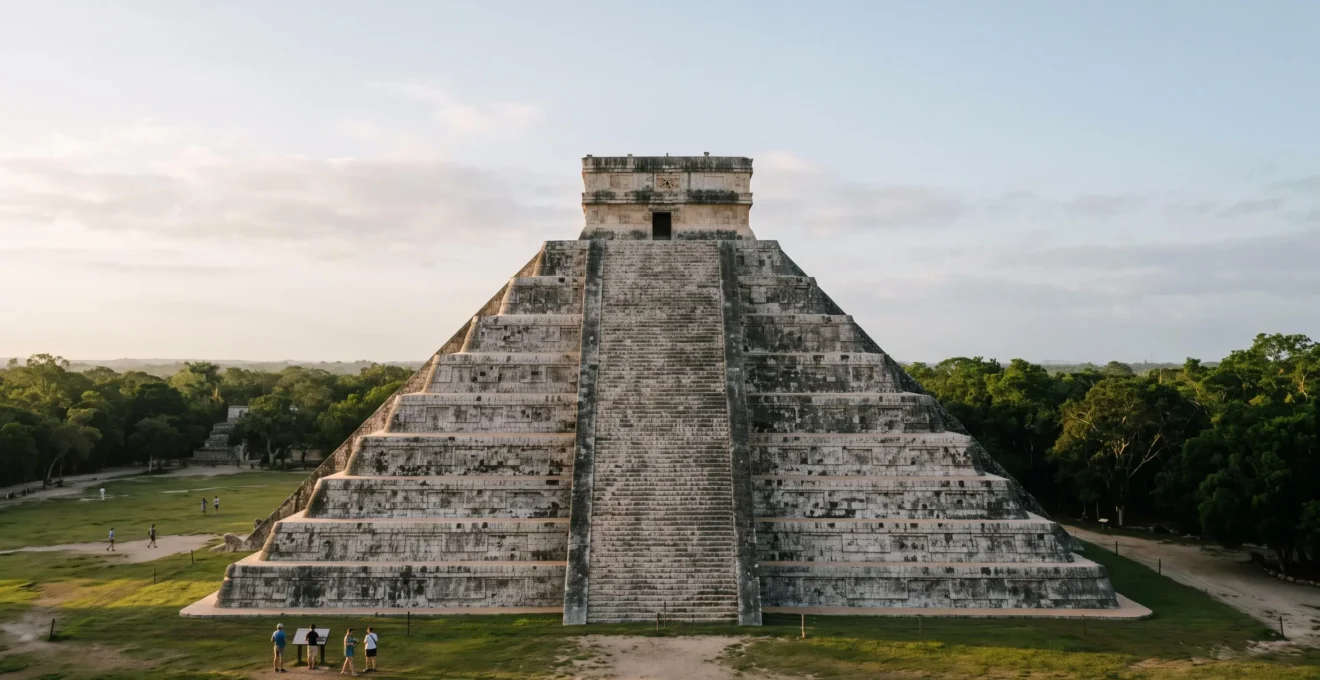
A limestone pyramid in Mexico’s Yucatán Peninsula is more than an impressive staircase rising above the jungle. It belongs to a built environment shaped by geology, Maya political and religious life, architectural traditions, and centuries of change. The building visible today may also contain substantial archaeological restoration.
At Chichén Itzá, a pyramid stands among ceremonial platforms, causeways and an enormous ball court. At Uxmal, elaborate stone mosaics and decorated façades tell a different architectural story. Neither site can be understood simply by counting steps or looking for mysterious astronomical messages.
For travellers who want to understand what they are seeing, a few basic observations make an enormous difference: where buildings stand in relation to one another, how their surfaces were constructed, which carvings carry recognizable information, and which interpretations remain uncertain.
Learning to read a Maya archaeological site also means recognizing its fragility. The same limestone that made monumental construction possible requires careful conservation today.
Understanding Yucatán’s limestone pyramids at a glance
- Start with the site layout: plazas, temples, ball courts and causeways explain more about a Maya city than its largest pyramid alone.
- Look beyond the stone: limestone, lime plaster, carving and restoration all affect what survives and what visitors can interpret.
- Observe responsibly: use official maps, examine details without touching them, and distinguish recognizable imagery from uncertain interpretations.
- Why Are So Many Yucatán Pyramids Made of Limestone, and What Does That Change for Visitors?
- How to « Read » a Mayan Limestone Pyramid Site in 30 Minutes Without a Tour Guide?
- Which Is Better for You: A Big Famous Pyramid Site or a Smaller Jungle-Covered Complex?
- The Small Thing Tourists Do at Pyramids That Can Get Areas Closed Off for Everyone
- When Should You Visit Limestone Pyramids to Avoid 35°C Heat and Harsh Midday Light?
- How to Spot 5 Common Patterns in Mayan Stone Carvings Without Studying Archaeology
- [No additional H2 proposition available — this section does not provide a distinct theme]
- How to Tell What a Mayan Stone Carving Is Showing When the Plaque Tells You Nothing
Why Are So Many Yucatán Pyramids Made of Limestone, and What Does That Change for Visitors?
Limestone dominates many Yucatán Maya monuments because the peninsula contains extensive carbonate rock formations that provided readily available construction material. Maya builders transformed this geological resource into masonry, lime plaster and elaborate architectural decoration. For visitors, understanding the material helps explain both the monuments’ appearance and why their surviving surfaces require protection.
Much of the northern Yucatán Peninsula is a low-lying limestone landscape where water moves through underground systems rather than conventional surface river networks. This geology is documented by USGS research on limestone dissolution in northern Yucatán, which examines groundwater-driven dissolution of carbonate rock.
The abundance of limestone made it an obvious local building resource, although geology alone cannot establish that Maya builders had no alternatives or that material selection carried no cultural significance.
A pyramid is rarely a single mass of carefully cut stone. Maya monumental buildings could incorporate rubble and masonry cores, exterior stonework, and lime-based plaster or stucco finishes. Some were enlarged through successive construction phases, enclosing earlier buildings within later structures.
At Chichén Itzá, for example, El Castillo was constructed over an earlier temple. The structure visible from the plaza therefore represents a particular stage in a longer building history, rather than a monument created in one uninterrupted operation.
These distinctions matter because a pyramid’s present appearance is not necessarily its original appearance. Ancient buildings could have been plastered and coloured, while centuries of weathering and subsequent conservation have changed the surfaces visitors see.
Try observing three surface characteristics from an authorized viewing position. Rounded or pitted edges may indicate weathering. Smoother areas may represent surviving plaster, conservation treatments or replacement materials. Visible joints or changes in texture may reveal distinct building phases or interventions.
However, none of these visual clues proves authenticity on its own. Original stone can have sharp edges, restored stone can look weathered, and ancient plaster may survive beside modern repairs. Archaeological documentation is necessary to establish which elements are original.
Conservation is therefore part of the story. At Uxmal, documented interventions have included structural consolidation, reconstruction and the reuse of lime-based materials. These actions help preserve the architectural evidence, but they also mean the visitor is encountering a carefully maintained archaeological landscape rather than an untouched ruin.
Once the construction material makes sense, the next question is how each building relates to the surrounding city. That spatial relationship often reveals more than the monument’s height or condition.
How to « Read » a Mayan Limestone Pyramid Site in 30 Minutes Without a Tour Guide?
To read a Maya pyramid site in half an hour, begin with its official map, locate the principal plaza and major buildings, then identify recognizable architectural features such as ball courts, causeways and raised platforms. Finish by comparing your observations with the site’s information panels. The aim is to understand relationships, not decode an entire ancient city in thirty minutes.
A useful self-guided visit starts by resisting the temptation to head straight towards the tallest structure. Instead, identify the space around it. Maya monumental complexes often contain different building groups whose arrangement reflects the city’s history, landscape and changing activities.
Your five-step archaeological observation checklist
- Find the official site map. Mark the main pyramid and principal plaza; your result is a simple orientation sketch.
- Identify the building’s facing direction. Use the map or a compass and record the approximate orientation without assuming its purpose.
- Trace the surrounding public spaces. Locate two adjacent platforms, courtyards or connecting routes and note their relative positions.
- Recognize one distinctive architectural feature. Find a ball court, causeway or decorated façade and write down its identifying characteristics.
- Check one interpretation. Compare a statement on a panel or official map with the building itself; record one supported observation and one remaining question.
Begin with orientation. At Chichén Itzá, El Castillo’s principal façade faces north. Its architecture is associated with a celebrated seasonal light-and-shadow phenomenon, but that does not mean every pyramid in the region was designed to mark an equinox.
At Uxmal, astronomical considerations interact with the terrain and the architectural plan. The city’s buildings do not follow one uniformly geometric layout. Orientation is evidence to investigate, not a ready-made explanation.
Next, examine the spaces between buildings. A broad plaza near monumental structures may have supported public gatherings or ceremonial activities, but identifying a specific function requires archaeological evidence. Likewise, a group of smaller buildings should not automatically be labelled residential.
One of the easiest features to recognize is a ball court. Chichén Itzá’s Great Ball Court contains two substantial parallel walls, stone rings and carved architectural details. Once you recognize that configuration, you can place the structure within the larger monumental complex.
Raised Maya causeways, known as sacbe’ob, offer another clue. They link parts of a site and help visitors understand movement through the built environment. A causeway should not automatically be interpreted as a ceremonial boundary or city entrance.
For practical orientation, INAH‘s official Chichén Itzá site map and visitor information identifies major monuments, routes and facilities. Use the available site maps and explanatory signs as your starting point, while recognizing that interpretive materials and access conditions differ between locations.
The method also helps you choose a destination: some sites make their architectural relationships especially easy to see, while others reward visitors who enjoy piecing together a more fragmentary landscape.
Which Is Better for You: A Big Famous Pyramid Site or a Smaller Jungle-Covered Complex?
Choose a major Maya archaeological site if you want extensive monumental architecture, established visitor facilities and a structured introduction to the region’s history. Consider a smaller complex if you prefer a more exploratory visit and are comfortable with less predictable transport, signage and amenities. Neither category guarantees smaller crowds, unrestricted access or a more authentic experience.
Chichén Itzá and Uxmal offer different advantages. The former allows visitors to examine a major ceremonial centre with striking architectural contrasts, while the latter is particularly valuable for understanding Puuc architecture and decorative stonework.
Smaller or less extensively developed sites, including Ek’ Balam and Dzibilchaltún, may provide a different sense of scale and a closer relationship between surviving architecture and vegetation. Mayapán is another historically significant destination, but its current public access must be checked before planning a trip.
Rather than assuming one site is better, compare how you prefer to explore.
| Travel priority | Major archaeological site | Smaller complex |
|---|---|---|
| First introduction to Maya architecture | Often offers prominent monuments and established interpretation | Can be rewarding but may require more preparation |
| Comfort and facilities | Generally a stronger option where services are documented | Facilities vary considerably and need checking |
| Interest in detailed exploration | Excellent for comparing major architectural groups | Can encourage slower observation of a compact setting |
| Transport planning | Often easier to include in established tourist itineraries | May involve a rental car or more complicated connections |
| Physical access to monuments | Subject to conservation restrictions | Also subject to restrictions; climbing is never automatically permitted |
| Shade and walking conditions | Can include large exposed plazas | Vegetation may provide shade, but paths can be uneven |
The conservation contrast is particularly important. A well-restored monument may appear more complete, but restoration does not make it less historically valuable. Conversely, an overgrown or partly excavated structure is not automatically closer to its ancient condition.
Visitors encounter archaeological decisions as well as ancient architecture. Excavation, consolidation, interpretation and public access all influence what is visible.
For travellers based in Mérida or Cancún, the logistical difference can be significant. Chichén Itzá is connected to both cities by established road routes, while visiting several smaller archaeological sites in one day may demand independent driving or carefully planned transfers.
Check current public access, transport options and available facilities before committing. Opening arrangements, restoration work and local restrictions can change, and a site that appears attractive in an old travel guide may not be available on the intended date.
Allocate enough time to engage with the architecture rather than merely reach the site. Someone interested in comparing decorative façades may gain more from a focused Uxmal visit than from rushing through several monuments elsewhere.
Whichever site you choose, your ability to explore it depends partly on how visitors collectively treat the monuments and the boundaries established to protect them.
The Small Thing Tourists Do at Pyramids That Can Get Areas Closed Off for Everyone
Stepping across a protective barrier for a closer photograph may seem harmless, but it can expose fragile archaeological surfaces to unnecessary contact and damage. Climbing restricted buildings, handling carved stone or removing fragments creates similar risks. Conservation restrictions protect evidence that cannot simply be replaced, and ignoring them can contribute to the need for tighter visitor controls.
Limestone and surviving lime plaster are not designed to withstand unrestricted modern tourism. Repeated contact can contribute to mechanical wear, particularly where vulnerable surfaces are already weathered.
That does not mean every touch causes measurable damage, or that a particular staircase was closed because tourists touched it. Such causal claims require site-specific conservation evidence.
The practical distinction is simpler: an authorized path is not the same as unrestricted access to archaeological material.
Several behaviours are especially worth avoiding:
- Climbing unapproved structures: stairs and masonry may be unstable or vulnerable to wear even when they appear solid.
- Crossing barriers: ropes and signs can protect fragile surfaces, excavations and areas undergoing conservation.
- Collecting stones or pottery fragments: removing archaeological material destroys contextual information and may breach heritage protection rules.
- Touching reliefs or applying products to stone: keep hands, sunscreen, insect repellent and other substances away from decorated surfaces.
- Flying drones without authorization: do not assume that a recreational drone is permitted at a protected archaeological site.
There is an important distinction concerning sunscreen. Visitors should still protect their skin from ultraviolet radiation. Apply sunscreen to your body as directed, allow it to settle where practical, and avoid transferring products onto ancient surfaces. Wearing protective clothing and a hat also helps.
Official rules can be more extensive than the familiar prohibition on climbing. INAH’s Chichén Itzá information includes restrictions relating to smoking, pets, food and flash photography, alongside provisions concerning professional photography equipment.
Those requirements illustrate why rules should be checked for the individual destination rather than inferred from another archaeological site.
Responsible behaviour benefits more than the monument itself. Clear boundaries make conservation work more manageable and reduce the possibility that visitor access will need to be restricted further.
Respect for a monument also changes how you photograph and observe it. You can usually learn far more from patient viewing in good light than from stepping onto a prohibited surface.
When Should You Visit Limestone Pyramids to Avoid 35°C Heat and Harsh Midday Light?
For a more comfortable visit and better views of limestone carvings, aim for the earliest authorized entry time, especially during the hotter months. November to February generally offers more comfortable conditions than the hotter spring period. Morning light also reveals shallow stone reliefs more effectively than harsh overhead sunlight, although exact conditions depend on weather and monument orientation.
The Yucatán climate can influence an archaeological visit as much as the site’s size. Long walks through exposed plazas are tiring in high temperatures, particularly when humidity makes cooling through perspiration less effective.
Heat also changes how closely you observe details. When visitors are uncomfortable, they may rush between shaded areas, overlook inscriptions or abandon plans to explore smaller architectural groups.
Time of day and choice of site should be considered together. A substantial complex with exposed walking areas usually benefits from an early start. A smaller site with accessible shaded routes may allow more flexibility, although shaded conditions should never be assumed.
For photography and close observation, low-angle sunlight can help. Shadows falling across carved limestone make shallow relief more legible, while overhead light tends to flatten subtle textures.
The effect varies according to façade orientation. A carving facing away from the morning sun may be easier to study later in the day. Rather than relying on a universal rule, observe how the light reaches the particular wall.
Official schedules are essential. The consulted INAH information for Chichén Itzá lists an 08:00 opening, but official descriptions differ concerning closing and last-entry times. Confirm the applicable schedule before travelling instead of assuming access at sunrise or late afternoon.
For UK visitors planning a Yucatán itinerary, this can mean separating travel time from the visiting window. An early site opening is only useful if your transport gets you there in time.
Carry sufficient drinking water, wear a wide-brimmed hat, choose comfortable closed-toe footwear and use suitable sun protection. Uneven paths, exposed plazas and warm stone surfaces make ordinary city sightseeing footwear less suitable for some archaeological settings.
Hydration needs vary with activity, temperature and personal circumstances; there is no reliable single quantity that suits every visitor.
Check the site’s rules about food and drink, and plan hydration around permitted areas. Do not leave packaging or other materials among the ruins.
Once you can spend time comfortably in front of a monument, the details that initially looked like random decoration become easier to notice and compare.
How to Spot 5 Common Patterns in Mayan Stone Carvings Without Studying Archaeology
Start by looking for five broad visual categories: serpent imagery, calendar signs, human or supernatural figures, organized glyph panels, and geometric architectural decoration. These are useful recognition clues rather than a universal dictionary of Maya art. Their meaning depends on context, period, location and the relationship between an image and its surrounding architecture.
Maya carvings can contain several kinds of information at once. A sculpted façade may communicate ideas about religious belief, political authority, architectural identity and historical events, while also serving a decorative purpose.
At Uxmal, UNESCO‘s World Heritage documentation for Uxmal describes Puuc architecture with relatively plain lower façade sections and richly decorated upper sections. Stone mosaics and representations of Chaac, the rain deity, are among its characteristic features.
That gives visitors a useful starting point: begin with the placement of a carving, then examine its visual characteristics.
- Serpent imagery. Look for elongated bodies, serpent heads and, where identifiable, feather-like elements. Feathered serpent imagery is associated with Kukulkan in relevant Yucatán contexts, but not every carved snake represents the same deity.
- Calendar glyphs. Look for compact signs arranged in structured compositions. Some represent calendar-related information, though recognizing a sign does not establish its date or meaning.
- Human and supernatural figures. Examine clothing, headdresses, gestures and accompanying symbols. Large eyes or elaborate costumes alone cannot distinguish a ruler from a deity.
- Glyph bands and panels. Look for signs grouped into organized blocks, sometimes arranged in rows or columns. These may form part of a written inscription rather than a decorative border.
- Geometric friezes and stone mosaics. Repeated angular shapes, scroll-like elements and patterned arrangements can be characteristic of architectural decoration, particularly in Puuc contexts.
The first practical step is finding the appropriate viewing position. Architectural decoration may occur around entrances, on upper façades, on benches or on dedicated carved panels. Not every lintel or upper wall necessarily contains writing.
The second step is watching the light. A relief that looks almost featureless at midday can become more legible when side lighting creates shadows within the carved surface.
The third step is comparison. A drawing, museum reproduction or documented photograph can clarify an eroded motif. The comparison is meaningful only if it refers to the same object or a properly identified architectural context.
Be especially cautious with damaged sculpture. A rounded surface can obscure the features that distinguished one sign from another. Differences between shallow incision, low relief and fully modelled sculpture also affect how the image appears.
Recognition is not decipherment. Spotting a serpent, a repeated geometric form or a possible glyph is an observation. Assigning a name, date or historical explanation requires stronger evidence.
These categories become more reliable when they are used as questions to investigate rather than labels to attach automatically. The final challenge is deciding what to do when information is incomplete.
[No additional H2 proposition available — this section does not provide a distinct theme]
No separate archaeological theme is assigned to this section. The material needed to understand Yucatán limestone pyramids is already covered through geology, architectural layouts, site selection, conservation, climate and the recognition of carved motifs. Introducing another subject without a distinct evidential basis would risk repeating those explanations or creating unsupported interpretations.
The most useful bridge between recognizing visual patterns and understanding their meaning is a distinction between observation and interpretation.
An observation describes what is actually visible: two parallel walls, repeated stone mosaics, a carved human figure or a panel containing glyph blocks. Such descriptions can often be checked against the monument itself.
An interpretation proposes what those visible characteristics meant within Maya society. That step requires archaeological, historical or linguistic context.
Consider a hypothetical example: a visitor sees a carved figure wearing an elaborate headdress beside a group of signs. It is reasonable to record the figure’s clothing, posture and relationship to the inscription. It is not reasonable to declare that the figure is a particular king or deity without corroborating evidence.
Conservation history creates an additional layer of uncertainty. A damaged panel may conceal crucial details, while restored elements can influence the apparent completeness of an architectural composition.
A careful description remains valuable even when the original meaning is unknown. Archaeological interpretation does not require every visitor to reach a definitive conclusion.
That distinction leads naturally to a practical method for examining a carving when its identifying plaque is missing, damaged or too brief to answer your questions.
Key takeaways before interpreting an unfamiliar carving
- Identify the type of evidence first. A narrative scene, written inscription and decorative frieze should not be interpreted in the same way.
- Record context before meaning. Location, neighbouring images and the condition of the stone can matter as much as the motif itself.
- Accept uncertainty. Recognizing a visual pattern is useful, but a confident historical explanation needs corroboration.
How to Tell What a Mayan Stone Carving Is Showing When the Plaque Tells You Nothing
When a Maya carving has little or no explanation, first determine whether you are looking at a scene, an inscription or architectural ornament. Then document its location and distinctive features before consulting an authoritative comparison. You can often identify the broad type of image, but an exact translation, personal name or historical event may remain impossible without specialist research.
The first question should be about the carving’s structure rather than its meaning. Three broad categories provide a practical starting point.
Narrative scenes contain figures and actions. People, supernatural beings, objects and gestures may be arranged in a composition that records or represents an event. Clothing, postures and accompanying signs can be informative, but the apparent action alone does not establish the historical episode.
Glyph panels contain structured signs forming part of the Maya writing system. Some inscriptions record dates, names, titles and events, although individual texts vary considerably.
Architectural ornament can consist of repeating geometric compositions, stylized faces or symbolic motifs integrated into a building’s decorative programme. Decorative placement does not necessarily mean that a design lacked religious or political significance.
The boundary between these categories is not absolute. A carved panel may combine writing, figures and ornament into a single composition.
Once the broad category is established, work systematically:
- Record the monument, building face and approximate position of the carving.
- Describe visible figures, repeated signs, borders and neighbouring architectural elements without assigning uncertain identities.
- Note damaged or restored areas that may affect interpretation.
- Compare the carving with an official archaeological description or a museum reproduction of the same object.
- Separate confirmed identifications from tentative similarities and unresolved questions.
The most important limitation concerns Maya writing itself. The Smithsonian‘s interactive introduction to Maya calendar glyphs explains that the writing system combines signs representing whole words with signs representing syllables.
This logographic-syllabic system cannot be translated by treating every symbol as an individual alphabetic letter. Reading an inscription also involves language, sign combinations and textual conventions.
Recognizing a calendar-related element may therefore help identify the type of information present, but it does not establish the date or meaning of the complete passage.
When local information is insufficient, the Gran Museo del Mundo Maya in Mérida can provide broader context for Maya cultural history and material culture. Archaeological publications from INAH and documented reproductions of original sculptures can offer more specific comparisons.
Use photographs carefully. Compare the exact monument, its provenance and the relevant sculpted surface wherever possible. A similar-looking motif from another site may reflect a different period or context.
Be particularly wary of explanations that reduce all Maya imagery to a single theme, such as astronomy, sacrifice or hidden prophecy. Maya monuments emerged from complex societies with changing political institutions, religious practices and artistic traditions. Their meanings cannot be recovered through universal visual shortcuts.
On your next visit, choose one carving, make a short observation record and check a reliable archaeological interpretation afterwards. Understanding one object accurately is more rewarding than collecting confident but unsupported explanations for twenty.
Are the limestone pyramids in the Yucatán entirely original?
Not necessarily. Surviving ancient masonry may coexist with reconstructed or consolidated architectural elements. Some pyramids also contain earlier construction phases. Conservation history varies by monument, so a restored appearance does not establish which individual surfaces are ancient. Consult site-specific archaeological documentation for reliable identifications.
Were all Maya pyramids designed around the equinoxes?
No. Astronomy influenced aspects of Maya architecture, but building orientation also relates to local topography, urban development and other cultural considerations. The famous seasonal light-and-shadow phenomenon at Chichén Itzá should not be treated as a universal explanation for Maya pyramid design.
Can visitors climb Maya pyramids in the Yucatán?
Permission depends on the particular archaeological zone and monument. Never assume that an existing staircase is open to visitors. Follow current INAH notices, barriers and instructions, and confirm access arrangements before travelling. A previously accessible structure may later be restricted for conservation or safety reasons.
Why do some Maya stone carvings look unfinished or difficult to recognize?
Weathering, erosion, damaged surfaces, missing architectural elements and conservation history can all affect legibility. Some sculptures were also designed to be viewed as parts of larger architectural compositions. An indistinct carving should not automatically be classified as unfinished or poorly executed.
Is it possible to understand Maya hieroglyphs without learning a Maya language?
Beginners can recognize certain sign categories and learn how inscriptions are organized through museum resources. Accurate reading, however, requires an understanding of the writing system and the languages represented. Identifying an isolated symbol is not equivalent to translating a complete inscription, and professional epigraphic interpretations remain the most reliable reference.