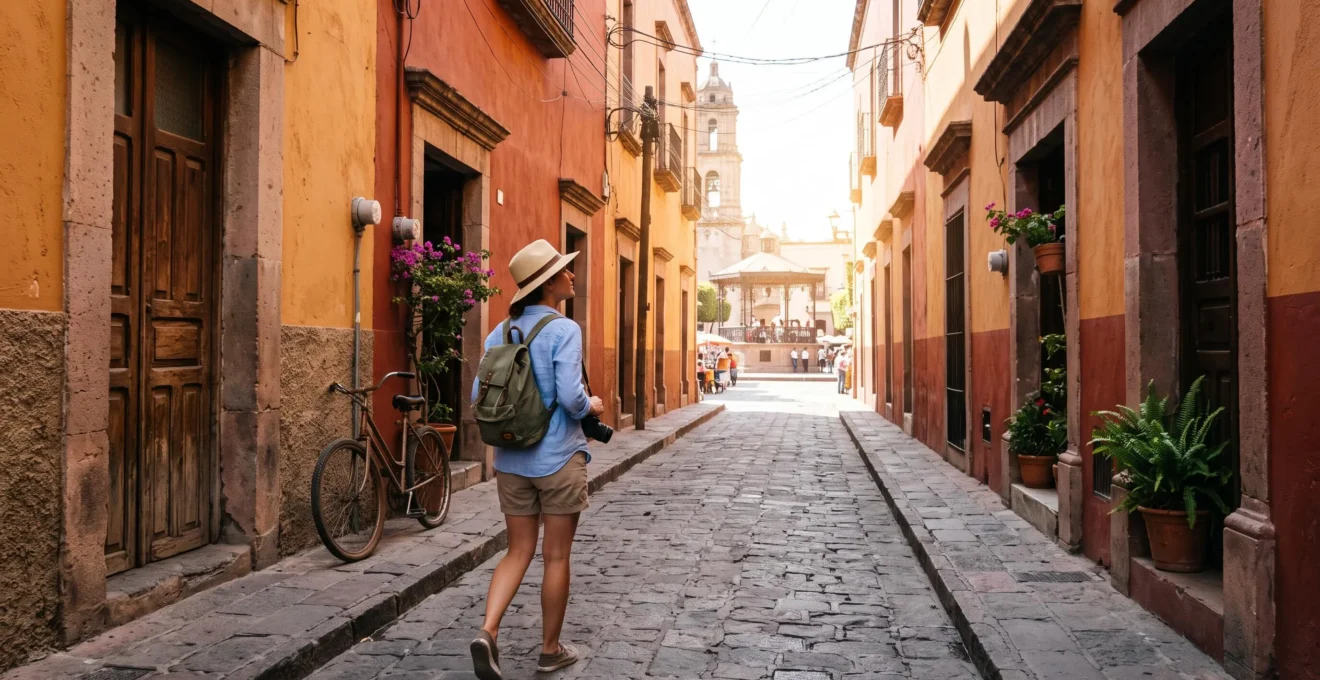
Two nights in a Mexican colonial town can feel wonderfully unhurried or unexpectedly exhausting. The difference rarely comes down to how many churches, museums or colourful streets appear on a sightseeing list. It comes down to the distance between your hotel, a pleasant square, somewhere to eat and the streets you actually want to explore.
For travellers who enjoy architecture without turning every holiday into a walking marathon, Oaxaca is an excellent all-round starting point. Its historic grid provides a practical framework for compact neighbourhood walks, and its cultural life offers reasons to linger rather than race between monuments. Guanajuato delivers a more dramatic, winding urban experience, but its hills demand more careful planning. Puebla offers a more structured alternative, particularly when the wider journey points towards Veracruz.
The best choice depends on your tolerance for slopes, the season, your preferred evening atmosphere and whether the town sits naturally along your route. With only two nights, a good café and the right street can matter more than another famous landmark.
The essentials for a walkable colonial-town break
- Choose for terrain and rhythm: Oaxaca offers a historic grid, Guanajuato offers winding hillside streets, and Puebla offers a structured centre with a distinct architectural identity.
- Build each day around one neighbourhood: explore nearby streets in the morning, retreat during difficult heat and return outside for the evening.
- Book for your two evenings: verify the real walking distance to the main plaza, likely street noise and whether the town remains active after dinner.
- Why Do Some Colonial Towns in Mexico Feel Cooler and More Walkable Even at 2 pm?
- How to Plan a Colonial Town Day in Mexico Without Doing 18,000 Steps by Accident?
- Which Is Better for a 2-Night Stay: Historic Centre Hotels or Outskirts in a Colonial Mexican Town?
- The Mistake That Makes a Colonial Mexico Weekend Feel Empty After 6 pm
- When Should You Insert a Colonial Town Stop Between Mexico City and the Coast Without Wasting a Day?
- How to Pick 3 Highland Cities That Feel Different From Each Other on a 10-Day Trip?
- How to Read a Colonial Town’s Night-Time Character Before You Book Your 2-Night Stay
- How to Build a Central Highlands Route in Mexico That Doesn’t Feel Like the Same City 4 Times
Why Do Some Colonial Towns in Mexico Feel Cooler and More Walkable Even at 2 pm?
Some Mexican colonial towns feel easier to explore at midday because their elevation moderates temperature and their buildings create useful shade. Highland destinations such as Guanajuato and San Miguel de Allende generally offer a different thermal experience from lowland towns such as Valladolid or Campeche. However, elevation alone cannot guarantee comfort: street exposure, season, humidity and walking effort also matter.
The first distinction is between altitude and latitude. Travellers sometimes assume that two Mexican towns at broadly similar latitudes will feel alike. Yet a town high in the central mountains can have noticeably different conditions from a low-lying town on the Yucatán Peninsula.
Guanajuato illustrates the elevation factor particularly clearly. The UNESCO account of Guanajuato’s historic street layout places the town at 2,084 metres above sea level and describes its development among hills and winding valleys.
That altitude is relevant to climate, although UNESCO’s heritage description does not measure how comfortable the streets feel at 2 pm.
Oaxaca and San Miguel de Allende are also highland destinations, while Valladolid and Campeche belong to different, generally warmer lowland settings. Coastal Oaxaca presents another climate pattern again. These contrasts are useful when choosing a stop, but actual weather forecasts remain essential.
Street geometry offers the second clue. Continuous façades along narrow streets can create ribbons of shade as the sun moves. A broad square without trees or covered walkways may offer impressive views but little protection when the sun is high.
Before booking, open a street-level map and look for three features:
- Continuous building frontages that may shade pedestrian routes at different hours.
- Arcades, trees or covered edges around the central plaza.
- Short connections between shaded streets, cafés and indoor stopping points.
A satellite image can reveal street width, vegetation and open spaces. Street-level imagery helps assess arcades and building height, but neither proves that a particular pavement will be shaded at your visiting hour.
Season changes the calculation. In the central highlands, April and May can bring demanding afternoon heat before the summer rains. December may make daytime walking more pleasant, although evenings and early mornings can become chilly.
A practical planning rule is to consider higher-elevation towns when travelling during hotter months, then check local forecasts rather than treating altitude as a promise of cool weather.
The commonly described siesta rhythm also deserves care. Some businesses pause during hotter afternoon hours, while others operate continuously. Mexico does not have one universal afternoon closing schedule.
Rather than assuming that everything closes, plan a flexible indoor break when the sun feels strongest. You can then return to the streets when the light softens.
A town that feels pleasant at midday is a useful advantage, but the most rewarding two-night stay also depends on how far you walk once you arrive.
How to Plan a Colonial Town Day in Mexico Without Doing 18,000 Steps by Accident?
To avoid an exhausting day in a Mexican colonial town, choose one central café, market or plaza as your walking anchor and explore nearby streets rather than chasing scattered attractions. Keep most planned stops within a 15–20-minute walk of that anchor, and change neighbourhoods no more than once during the day. This limits unnecessary backtracking without imposing a rigid step target.
The problem with an accidental 18,000-step day is not necessarily the number itself. Some travellers enjoy that distance. The problem is covering it unintentionally through repeated journeys between attractions that were never geographically grouped.
A colonial town is particularly deceptive on a map. A short line between two landmarks might represent a straightforward walk across a grid of streets. In a hillside town, the same apparent distance can involve steep lanes, uneven paving or staircases.
The contrast between Oaxaca and Guanajuato is instructive.
According to UNESCO’s description of Oaxaca’s historic centre, the city retains a checkerboard street layout organised around a central plaza. Its historic area covers approximately five square kilometres and contains 247 blocks.
That does not mean every street is flat or equally comfortable, but the grid gives travellers a useful basis for organising compact loops.
Guanajuato developed differently. Its winding street network follows rugged terrain, making elevation changes more important when judging a route.
For either town, the strongest planning method is to organise a day into two small geographical chapters rather than one enormous circuit.
Imagine a hypothetical morning in Oaxaca. Start near Santo Domingo, explore a few surrounding streets, stop for coffee and visit one cultural attraction. Return towards the central area for lunch rather than crossing town to see another landmark immediately.
In the afternoon, either remain in the same neighbourhood or make one deliberate change of base. The aim is to spend more time experiencing places than travelling between them.
The one-hour radius rule is a useful planning concept, not a measured walking standard: begin from one anchor, allow manageable outward walks and leave enough time to return comfortably. A 15–20-minute maximum outward walk is a sensible starting point for many visitors, but adjust it for slopes, weather and personal mobility.
Pay particular attention to route profiles. Mapping applications may show the distance between two places while obscuring how difficult a steep climb feels in afternoon heat. Check elevation changes, pedestrian access and whether your return route is uphill.
There is also a psychological advantage to this approach. With only two nights available, travellers often worry that sitting in a square means missing out.
In a historic town, however, observing how a plaza functions is part of understanding its architecture. Streets are not simply corridors between monuments. They are the principal attraction.
Build your compact colonial-town walking plan
- Mark your hotel and main plaza: save a map showing the actual walking connection between them.
- Choose a morning anchor: identify one café, market or square and record no more than a small cluster of nearby stops.
- Check the terrain: review slopes, stairs and street-level conditions, producing a route with known difficult sections.
- Choose your midday retreat: mark an indoor stop or your hotel and save an easy return route.
- Plan your evening separately: save one dinner option and one nearby place for a relaxed stroll, with opening hours verified.
A well-organised walking day becomes much easier when your accommodation is positioned for both a midday break and an evening return.
Which Is Better for a 2-Night Stay: Historic Centre Hotels or Outskirts in a Colonial Mexican Town?
For most two-night visits to a Mexican colonial town, a hotel within easy walking distance of the main plaza is the more practical choice. It allows you to return during afternoon heat, freshen up before dinner and enjoy evening streets without arranging another journey. The outskirts can be better when parking, a pool, quiet surroundings or a particularly comfortable room matter more than spontaneous walking.
The decision is not simply about finding the lowest room rate.
Consider the shape of a short stay. You arrive, settle in and perhaps have only a few hours before dinner. The following day is your main opportunity to explore. On the third day, departure preparations already compete with sightseeing.
A central hotel makes these fragments of time usable. You can step outside for coffee, return when the sun becomes uncomfortable and take another short walk after dinner.
That flexibility is particularly valuable in warmer months.
Yet central does not always mean peaceful. Hotels directly overlooking a lively plaza may be exposed to conversations, music, bells, deliveries or early-morning street activity. The intensity varies considerably by property, location and date.
The most useful compromise is often accommodation a street or two away from the busiest square.
Before booking, examine the entrance location rather than relying on the property’s neighbourhood label. Search results may describe a hotel as being in the historic centre even when the walking route to the principal plaza is longer or less convenient than expected.
A practical comparison looks like this:
| Decision factor | Historic centre | Outskirts |
|---|---|---|
| Evening exploration | Usually easier to enjoy spontaneously if the main streets are nearby | May require transport or a longer return walk |
| Midday break | Convenient when the hotel is genuinely central | Less convenient if returning involves a separate journey |
| Noise | Potential exposure to plaza activity and deliveries | May be quieter, depending on the road and property |
| Parking and access | Can be restricted or awkward in narrow streets | Often worth investigating for travellers with a car |
| Space and leisure facilities | Varies; historic buildings can have compact layouts | May offer more room, gardens or a pool |
The outskirts become attractive when the town is compact enough that your actual hotel-to-plaza walk is still comfortable. A useful screening test is whether the whole journey takes roughly 20 minutes or less on a realistic pedestrian route.
That is a traveller’s convenience threshold, not a formally established definition of a walkable town. A steep 20-minute walk can feel less attractive than a longer, mostly level one.
If you are driving through Mexico, also verify parking arrangements and luggage access. Some historic properties require a short walk from the nearest vehicle drop-off point.
For a two-night stay without a car, prioritise walking time over advertised neighbourhood names. Look at recent comments about noise, heat in the rooms, stairs and the route back after dinner.
Once the hotel is settled, the next question is what the town actually offers after the daytime attractions close.
The Mistake That Makes a Colonial Mexico Weekend Feel Empty After 6 pm
The mistake is planning every activity around daytime landmarks and assuming that a memorable evening will happen automatically. Museums and other visitor attractions have limited opening hours, while a town’s later social life follows different rhythms. A satisfying two-night stay needs an evening plan built around the plaza, local dining and the atmosphere you actually want, rather than another sightseeing checklist.
A colonial town changes character as the light fades.
The façades that appeared harshly illuminated at midday take on softer colours. Restaurants prepare for dinner, people gather in public spaces and streets that seemed quiet in the afternoon may become social places.
But not every destination behaves the same way, and the day-to-evening transition is not an official timetable.
For example, the INAH‘s official visitor information for the Museo de las Culturas de Oaxaca lists Tuesday-to-Saturday hours of 10:00–16:00. Another official INAH listing has shown different hours, so the institution’s current schedule should be confirmed before visiting.
The broader lesson is clear: daytime attractions cannot be assumed to remain open for an evening visit.
Instead, treat the paseo — the relaxed practice of strolling and spending time in public spaces — as a possible centrepiece of the evening.
In towns where this social rhythm is active, the principal square may provide a richer sense of place than another guided monument visit. You might sit at a café, watch families gather, enjoy dinner nearby and take a short walk before returning to your hotel.
Some streets may be pedestrian-only, permanently or at particular times, but this should be checked locally rather than assumed.
The crucial difference lies in the town’s evening profile.
Oaxaca, as a regional capital with a substantial cultural and dining scene, offers more possibilities for travellers who enjoy choosing between different evening activities.
Guanajuato, with its university identity and unusually shaped historic centre, offers a different potential atmosphere. Its streets and plazas invite exploration, though individual events and venues must be checked for the dates of a stay.
Smaller towns may favour a slower dinner-and-plaza routine, especially on weekdays. That can be ideal for travellers looking for calm but disappointing for those expecting an active late evening.
A second mistake is packing only for the afternoon.
Highland conditions can change considerably after sunset. A town that feels warm during the day may become cool enough for a light jumper or jacket, particularly during the drier, cooler part of the year.
For UK travellers accustomed to carrying a layer for changing weather, that small habit is worth preserving in Mexico.
Plan both evenings with different purposes: one for wandering and dining close to the main square, the other for an activity or neighbourhood with a different atmosphere.
This gives the short stay a natural progression without requiring a crowded timetable.
That evening-first perspective becomes even more valuable when a colonial town forms part of a longer journey towards the coast.
When Should You Insert a Colonial Town Stop Between Mexico City and the Coast Without Wasting a Day?
A colonial-town stop between Mexico City and the coast makes sense when it lies close to your actual travel corridor and gives you enough time to enjoy its evening atmosphere. A two-night stop is generally more satisfying than a hurried sightseeing detour, although a single overnight break can work when the journey itself needs splitting. The right town depends on which coast you are travelling towards.
Mexico’s geography makes this a more complicated choice than the phrase « on the way » suggests.
The Pacific, Gulf and Caribbean coasts lie in very different directions from Mexico City. A destination that works naturally on one itinerary may be a substantial diversion on another.
Puebla is especially relevant to the Mexico City–Veracruz corridor. Its historic position on that route is documented by UNESCO, making it a geographically coherent candidate for travellers heading towards Veracruz and the Gulf.
However, its historical transport role is not proof of a particular present-day travel duration. Current road conditions, bus departures and door-to-door times must still be checked.
Taxco can be considered on some southern or south-western journeys, but it should not automatically be treated as an efficient stop for every Pacific destination. Its suitability depends on the precise route.
Similarly, Oaxaca can provide a valuable cultural stop for travellers planning a journey towards the Oaxacan Pacific coast. Yet reaching the coast involves mountain geography and journey times that deserve realistic allowances.
For travellers heading towards Cancún, Playa del Carmen or other Caribbean destinations, a central-highlands town is not automatically a convenient intermediate stop. The journey may involve a flight or a very different overland route.
The simplest way to avoid wasting time is to compare the entire itinerary rather than just the distances between famous destinations.
- Calculate the door-to-door journey without the colonial-town stop.
- Calculate the journey with the stop, including any return to the main transport corridor.
- Identify whether the additional travel replaces a rest day or consumes a day you wanted at the coast.
- Allow for transfers, check-in, luggage collection and realistic road conditions.
A stop that adds substantial travel but offers only a rushed afternoon may not be worth the diversion.
There is, however, a useful alternative: the broken-journey overnight.
Imagine a hypothetical itinerary where you reach a town in late afternoon, check into a central hotel, enjoy an unhurried evening and depart after breakfast or during the following morning.
This does not provide the depth of a full two-night visit, but it can transform a difficult travel day into a more memorable journey.
It works best when onward transport is straightforward and the town’s evening life is genuinely appealing.
Beware of schedules built around optimistic arrival times. Mountain roads, traffic and bus connections can turn a planned afternoon of exploring into little more than a late dinner.
For a genuine two-night stay, keep the first evening light, reserve the second day for compact walking and use the final morning for a simple departure.
If your holiday remains in the highlands rather than continuing towards the coast, choosing contrasting cities becomes the more important planning challenge.
How to Pick 3 Highland Cities That Feel Different From Each Other on a 10-Day Trip?
Choose three Mexican highland cities by varying their terrain, daily pace and cultural character rather than selecting them for colourful façades alone. A useful combination might include a winding hillside town, a structured historic city and a destination strongly associated with food or local crafts. Give each stop at least two nights and leave adequate time for transfers.
The danger of visiting several colonial cities in succession is visual repetition.
Many share painted façades, churches, central squares and historic buildings. These similarities reflect elements of their architectural heritage, but they do not reveal what each place feels like during an ordinary afternoon.
To find genuinely different experiences, compare three dimensions.
| Dimension | Possible city | Distinctive experience to prioritise |
|---|---|---|
| Winding hillside terrain | Guanajuato | Exploring a historic street network shaped by valleys, slopes and mining history |
| Grid-planned cultural centre | Oaxaca | Neighbourhood walks, food culture and a historic city organised around its central plaza |
| Structured architecture and decorative traditions | Puebla | Exploring a Renaissance-grid historic centre and architectural details associated with azulejo tiles |
These are contrasting travel profiles, not a claim that any city has only one identity.
Puebla, for instance, has a substantial culinary tradition as well as its architecture. Oaxaca combines its urban grid with a wider regional culture. Guanajuato’s hillside geography is inseparable from the history of its streets.
The point is to give each city a different reason for being on your itinerary.
Ten days require careful pacing. Three stops can work when transfers are realistic and no city is reduced to a hurried arrival followed by an early departure.
A hypothetical allocation could give three nights to the first destination, three to the second and three to the third, leaving the remaining time for a transfer or departure. The exact distribution depends on transport connections.
A more compact two-night-per-city pattern creates additional flexibility, but it also increases the proportion of the holiday spent packing and moving.
Consider energy levels as well as travel time. If steep streets are an important reason for visiting Guanajuato, put your longer exploratory walks early in the holiday, while you are fresh.
Reserve a more relaxed destination, or a less demanding day, for the latter part of the trip.
There is also a useful pre-booking check. Read recent reviews that describe the streets after dinner and the effort involved in walking between neighbourhoods.
A visitor who remembers a city for evening food and easy wandering has experienced something different from one who remembers climbing steep lanes and discovering unusual views.
These experiential distinctions are much more useful than a ranking based only on the number of monuments.
The final decision should include how each city feels at night, because even structurally different historic centres can produce surprisingly similar evenings.
How to Read a Colonial Town’s Night-Time Character Before You Book Your 2-Night Stay
To understand a Mexican colonial town’s evening atmosphere before booking, look for evidence of activity around its principal square, restaurants, university districts and local events. Compare weekday and weekend patterns, then read recent traveller reviews specifically mentioning what happens after dinner. For a two-night visit, this research matters more than a vague promise of a « lively historic centre ».
A town’s daytime reputation is an imperfect guide to its night-time character.
A destination famous for its architecture may become very quiet after its attractions close. Another may have a more visible evening social scene because of its role as a regional capital, university town or dining destination.
These are useful signals, not guarantees.
Start with the main plaza. Use recent photographs and street-level information to check whether its edges contain restaurants, cafés or other places where people can comfortably spend time.
Continuous café seating can indicate the potential for social activity, but verify the hours of individual establishments. A square lined with cafés does not necessarily remain busy late into the evening.
Next, distinguish weekday atmosphere from weekend atmosphere. A Friday evening may involve noticeably different activity from a quiet Tuesday.
University calendars can also influence the atmosphere in student-oriented areas. Public holidays and festivals may bring performances or larger gatherings, but they can also affect hotel prices, street access and restaurant availability.
A local event calendar is therefore more informative than an undated travel article describing a destination as permanently festive.
Read recent reviews with focused questions in mind:
- Do travellers describe pleasant activity around the plaza after dinner?
- Are cafés and restaurants concentrated within an easy walk of the hotel?
- Is the atmosphere described as sociable, noisy, quiet or family-oriented?
- Are comments tied to weekends, festivals or particular seasons?
- Do guests mention difficult or uncomfortable walks back to their accommodation?
It helps to separate **evening activity** from nightlife. A town may have an enjoyable paseo and relaxed dining without late-night bars or entertainment.
Equally, a busy rooftop terrace does not necessarily mean the surrounding streets offer an appealing walking experience.
For a short stay, think about your two evenings separately.
The first often begins after travel, when you may want a meal and an easy stroll near the hotel. The second offers more freedom for an event, a different neighbourhood or a longer dinner.
If both evenings depend on finding somewhere active at the last moment, the chance of disappointment increases.
For travellers who prefer quiet, reverse the test. Search for recent mentions of plaza noise, church bells, amplified music and room insulation, especially where a hotel overlooks a main square.
The ideal night-time atmosphere is not necessarily the busiest one. It is the one that fits your expectations.
Once each destination has a distinct daytime and evening identity, the remaining task is to arrange them into a route that feels coherent rather than repetitive.
Key takeaways before building your route
- Give each town a different purpose: hillside exploration, food-led wandering, architecture or a slower plaza experience.
- Arrange demanding walking days around your energy levels, not simply the apparent proximity of cities.
- Check real transport connections before committing to a route that looks convenient on a map.
How to Build a Central Highlands Route in Mexico That Doesn’t Feel Like the Same City 4 Times
Build a varied Mexican central-highlands route by alternating the physical and cultural character of your stops. Follow a demanding hillside city with somewhere easier to explore, and vary the emphasis between architecture, food, crafts and evening atmosphere. Then check actual transport connections: a geographically attractive sequence can still involve long journeys or awkward transfers.
The most common planning error is treating the highlands as a collection of interchangeable historic centres.
On paper, a route containing several colonial towns may seem irresistible. Each destination offers beautiful buildings, atmospheric squares and distinctive streets.
But if every stop follows the same routine — church in the morning, museum after lunch, plaza in the evening — the differences may begin to disappear.
The solution is to design the experience before the route.
Begin by writing one short description of each proposed destination without mentioning its name.
For example:
- A winding city where the terrain itself creates the adventure.
- A walkable historic grid where food and neighbourhood life shape the day.
- An architecturally distinctive city where decorative details and structured streets reward slower exploration.
These descriptions can correspond to Guanajuato, Oaxaca and Puebla respectively, although the precise selection should reflect the wider itinerary.
If two towns have almost identical descriptions, consider whether both are necessary.
The next step is sequencing.
Guanajuato’s rugged historic terrain makes it a sensible candidate for the part of the holiday when you have more energy for slopes and exploratory walking.
A later stay in a more easily navigated central district can provide a contrast, particularly if it includes a slower pace and longer breaks.
Oaxaca’s grid makes neighbourhood-based planning practical, while Puebla offers a different architectural context. Neither should be assumed universally flat or effortless to explore.
However, variety should not override transport reality.
Guanajuato, Puebla and Oaxaca are not three adjacent districts. Travelling between them can involve substantial distance, and the most convenient connections depend on the precise departure and arrival points.
A route that looks like a tidy sequence on a national map may require long road journeys or changes of transport.
That is why an attractive theoretical itinerary should pass two tests before booking.
First, the experiential test: does each stop offer a recognisably different landscape, rhythm or cultural focus?
Second, the logistical test: can you travel between stops without repeatedly sacrificing the best walking hours to transport?
Consider this hypothetical route-building process:
- Choose one primary destination based on the experience you most want, rather than on a list of famous cities.
- Add a contrasting second stop that connects reasonably with the first.
- Test a third city against both variety and onward transport requirements.
- Allocate travel days explicitly, including room check-out, station transfers and arrival buffers.
- Remove a stop if the final itinerary offers too little time to enjoy the places after reaching them.
A two-city holiday with comfortable connections can be more rewarding than an ambitious four-city circuit.
The same principle applies to daily movement. A slow morning in a square, a short neighbourhood walk and an atmospheric evening may communicate more about a place than a succession of increasingly similar museums.
For UK travellers planning a relatively short holiday in Mexico, this distinction is especially important. Long-haul travel already consumes time and energy, and the temptation to squeeze every attractive town into one trip can undermine the relaxed experience that made the destination appealing.
If your priority is a single two-night stop, Oaxaca is a strong option for a compact, food-oriented urban experience. Guanajuato is compelling when winding terrain and dramatic street layouts are part of the attraction. Puebla offers a useful alternative for architecture-focused visitors, especially where its geographical position suits the wider route.
The best choice is the town whose streets, evenings and practical connections fit the journey you actually want.
Choose one town as your priority, mark a hotel near the places you want to experience, and plan one manageable walking loop for your first full day. If the route still leaves time for an unhurried evening and a comfortable departure, you have the foundations of a two-night stay worth making.
Is Oaxaca or Guanajuato easier to explore on foot?
Oaxaca is often the more straightforward choice for organising walks around a central grid, while Guanajuato requires closer attention to slopes and winding streets. UNESCO documents these contrasting urban layouts, but neither description guarantees comfortable pavements or step-free access. Check your specific hotel-to-attraction routes before choosing.
Do you need a hire car for two nights in a Mexican colonial town?
Not necessarily. If your accommodation is close to the main historic streets and your interests are concentrated in the centre, walking and occasional local transport may be sufficient. A car becomes more useful for onward journeys or attractions outside town, but central parking and narrow street access need checking.
Are cobblestone streets difficult with wheeled luggage?
They can be. Uneven paving, steps and steep lanes may make wheeled bags awkward, particularly around older buildings. Before booking, ask the accommodation about the nearest vehicle drop-off point, entrance steps and whether staff can assist with luggage.
Is a two-night stay enough to experience a Mexican colonial town?
Two nights can be enough for a satisfying introduction if you concentrate on one or two neighbourhoods rather than attempting to visit every attraction. The format works particularly well when the first evening is reserved for a gentle stroll, the full day for exploration and the final morning for a relaxed departure.
What should you pack for walking in Mexico’s highland towns?
Comfortable shoes with reliable grip, sun protection, water and light layers are practical essentials. Bring an additional layer for cooler evenings, particularly in higher-elevation destinations. Check the forecast for your actual travel dates, as conditions vary by town, season and elevation.