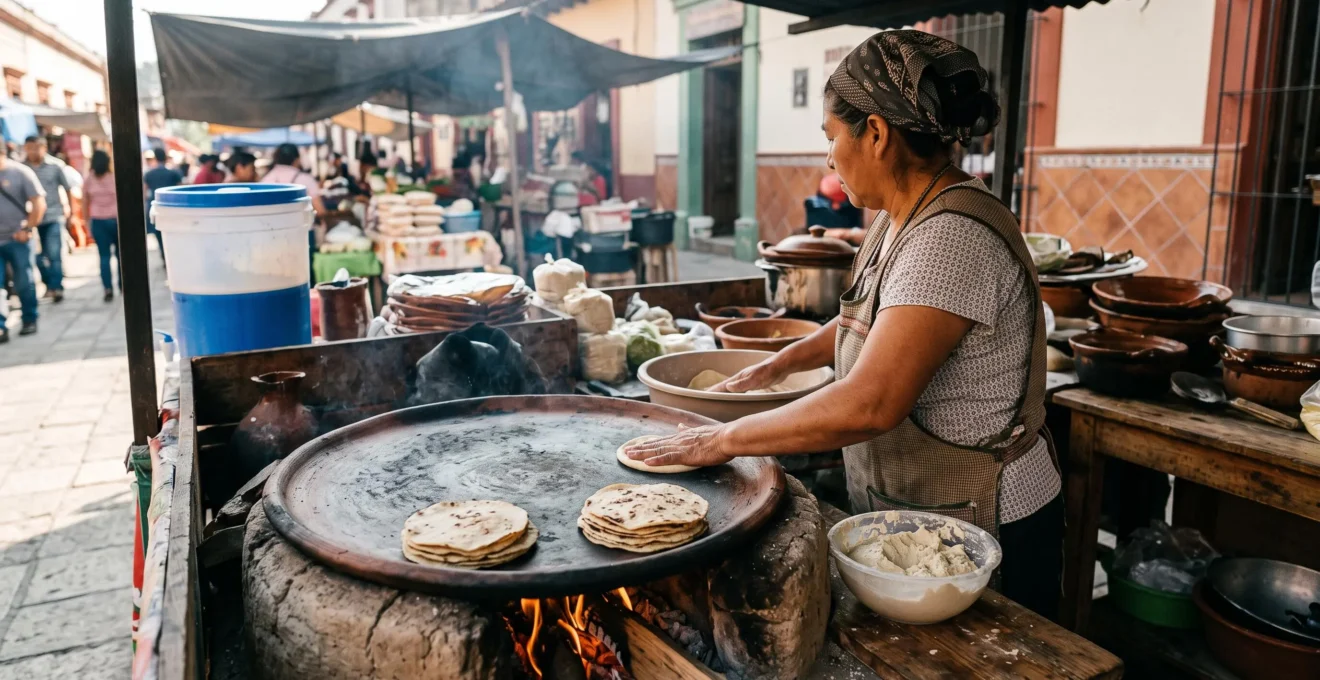
A tortilla lifted from a dark earthen griddle can look deceptively simple: a few toasted freckles, a soft curve and a faint cloud of steam. Yet the surface beneath it tells a story about Mexican maize, regional cooking traditions and the decisions vendors make every day.
The traditional comal de barro is a clay griddle used to cook tortillas and roast ingredients such as chillies and tomatoes. Unlike the steel or cast-iron surfaces familiar to many UK travellers, earthenware responds differently to heating and develops its own cooking surface through repeated use.
That distinction matters, but it does not automatically make clay-cooked food tastier. The maize, moisture, fuel, cooking technique and timing all influence the result. Oaxaca offers particularly well-documented examples of clay-comal cooking, while traditions in western Mexico demonstrate how earthen griddles fit into a broader culinary practice.
Knowing what to look for helps travellers recognise the equipment, choose freshly cooked tortillas and appreciate regional food without mistaking a traditional-looking stall for proof of a particular preparation method.
Clay comals in Mexico: the essentials
- Clay changes the cooking experience, not the definition of quality. A seasoned earthen griddle can produce gently toasted tortillas, but masa, fuel and technique also matter.
- Watch the cooking rather than the signage. A visibly used clay comal and tortillas prepared in small batches reveal more than an advertised claim of authenticity.
- Judge the complete plate. Fresh nixtamal masa, careful tortilla cooking and well-prepared salsa are distinct qualities worth recognising.
- Why Do Clay Griddles Create a Different Toasted Flavour Than Metal in Mexican Cooking?
- How to Tell if a Vendor Uses a Clay Griddle Without Asking Awkward Questions
- Which Produces Better Street-Food Texture: Clay Griddles or Metal Plancha Setups?
- The Marketing Claim That Tricks Travellers Into Paying More for Ordinary Street Food
- When Should You Eat Clay-Griddle Tortillas to Get Them Hot, Not Reheated and Dry?
- How to Spot Fresh Nixtamal Tortillas in Mexico Using 5 Sensory Clues
- How to Tell if a Salsa Was Really Made in a Stone Mortar Using 3 Quick Clues
- How to Find Real Molcajete-Style Salsas in Mexico Without Falling for Tourist Theatre
Why Do Clay Griddles Create a Different Toasted Flavour Than Metal in Mexican Cooking?
Clay griddles can give Mexican tortillas a different toasted character because their thickness, heating behaviour and conditioned surfaces affect how food loses moisture and browns. Unlike a metal plancha designed for rapid, responsive cooking, a traditional clay comal is often heated gradually. However, there is no controlled evidence in the supplied research proving that clay itself consistently produces a superior or uniquely identifiable flavour.
A comal de barro is an earthenware cooking surface, often broad, round and relatively low. Its cooking area may look matte, darkened or lightly coated by the treatments accumulated through use. A steel plancha generally has a more recognisably metallic construction, while cast iron may carry a dark seasoned finish that can initially resemble clay.
The distinction becomes clearer when watching the edge of the griddle and its relationship to the fire. Earthenware has a ceramic body rather than a metal plate, even when soot or seasoning obscures its original colour.
The flavour mechanism is more complicated than clay simply adding earthiness. As tortilla dough meets a heated surface, moisture evaporates, starches undergo changes and toasted aromas can develop through heat-driven reactions, including browning where conditions allow. These processes occur on metal as well as clay.
The surface temperature, cooking duration and moisture content of the masa help determine whether the tortilla remains supple, develops toasted patches or dries excessively. A poorly heated clay comal can produce disappointing results, just as carefully controlled metal can produce excellent tortillas.
Traditional clay comals also change as cooks use them. In Saveur’s feature on traditional Oaxacan kitchen tools, the seasoned surface of a clay comal is described as developing a carbonised patina that can contribute to the character of foods such as tlayudas.
This process should not be confused with the seasoning of cast iron, even though both involve conditioning a cooking surface. A newly made clay griddle and one used repeatedly over coals may behave and smell differently, but the effect cannot be separated automatically from fuel, food and preparation.
A 2022 study of tortilla-making in Chiapas recorded approximately 250°C in its observed cooking process. That is a contextual observation, not a universal clay-comal temperature or a recommended setting for every tortilla.
The useful question is therefore not whether clay always wins against metal, but whether the surface suits the food being prepared. The next challenge is recognising that surface at a working stall.
How to Tell if a Vendor Uses a Clay Griddle Without Asking Awkward Questions
Look for a broad earthen disc positioned above a flame or embers, then examine its edge and surface while the vendor works. Clay often appears matte, darkened and ceramic rather than metallic. Watching tortillas cook directly on that surface is stronger evidence than hearing a particular sound or seeing handmade dough. When uncertain, a brief, polite Spanish question is entirely appropriate.
The easiest moment to observe a comal is while waiting to order. Look beyond the food towards the cooking surface itself. A traditional earthen disc may have a thick rim and an irregular, well-used appearance. Some are visibly cured or coated, so a dark or pale surface alone is not conclusive.
Unlike many commercially manufactured metal griddles, a traditional clay comal may have no metal handles. However, handle absence is only a supporting clue: handleless metal cooking surfaces also exist.
Other signals help complete the picture:
- Tortillas are placed directly on a broad, round ceramic surface.
- Chillies or tomatoes are roasted alongside tortilla preparation.
- The vendor turns tortillas as toasted spots form, without using a separate metal griddle for that particular stage.
- The equipment appears to be actively heated rather than displayed beside the stall.
Hand-patting masa can be interesting to watch, but it does not establish what the griddle is made from. Traditional tortilla makers may use presses, and hand-shaped tortillas can be cooked on metal.
The smell of warming maize and roasting chillies may be delightful, but neither is a reliable material test. Similarly, a muted cooking sound could reflect the food’s moisture content or surface temperature rather than prove the comal is clay.
There is no need to treat asking a question as an intrusion. During a natural pause, try “¿Su comal es de barro?” — “Is your griddle made of clay?” A simple “gracias” afterwards is sufficient. Avoid interrupting someone handling hot food or serving a queue.
Remember that a stall can use several cooking methods. Tortillas may come from a clay comal while meat is cooked on steel and salsa is prepared elsewhere. That does not make the stall deceptive; it means its different components have different preparation histories.
A five-step clay-comal observation checklist
- Check the griddle edge: identify whether the visible body looks ceramic or metallic; record your first observation rather than assuming from colour.
- Watch a tortilla cook: establish which surface actually touches the dough; identify clay, metal or an uncertain material.
- Notice the heat source: look for visible flame or embers and note whether the surface is actively cooking food.
- Follow one completed order: identify which components are prepared on the comal and which are cooked elsewhere.
- Confirm politely if necessary: ask “¿Su comal es de barro?” and use the answer to resolve any uncertainty.
Once the material is clear, the next question is whether its cooking characteristics suit the texture you actually want to eat.
Which Produces Better Street-Food Texture: Clay Griddles or Metal Plancha Setups?
Neither clay nor metal consistently produces better Mexican street-food texture. A well-managed clay comal can make soft, gently toasted tortillas and effectively roast salsa ingredients, while a metal plancha offers responsive heating for fast cooking and crisp browning. The best choice depends on the dish, the thickness of the surface, the fuel and the cook’s technique rather than material alone.
For tortillas made from fresh masa, texture depends heavily on moisture retention and how the two surfaces of the tortilla set during cooking. Evenly distributed heat can encourage patches of browning while leaving the centre flexible.
On a plancha, a cook may achieve similar results by adjusting the temperature, cooking time and placement of each tortilla. Metal is not inherently incapable of producing the blistered, pliable texture associated with traditional griddle cooking.
Conversely, thick earthenware that requires gradual heating can be less responsive to sudden changes in demand or temperature. Experienced cooks compensate by controlling the fuel and working with the accumulated heat of the surface.
A comparison is most useful when organised by food rather than by an abstract ranking of materials.
| Food or cooking task | Clay comal | Metal plancha |
|---|---|---|
| Fresh corn tortillas | Traditional option for controlled toasting and soft, lightly blistered results | Can produce equally flexible tortillas with suitable heat and timing |
| Whole chillies and tomatoes | Useful for gradual roasting and surface charring | Suitable for roasting, with responsive heat control |
| Tlayudas | Established Oaxacan cooking method, including long sessions on seasoned clay | Alternative for toasting and crisping, depending on preparation |
| Grilled meats | Possible, but depends on the specific clay equipment | Well suited to direct-contact browning and frequent cooking cycles |
| Mixed orders and rapid turnover | Requires planning around available surface heat and capacity | Often practical where quick temperature adjustments and multiple cooking zones are useful |
One important exception is the Oaxacan tlayuda. Its association with traditional clay griddles makes it misleading to categorise crisp tlayudas as a metal-only speciality. The same food can be prepared using different equipment, with results influenced by the cook.
Hybrid arrangements deserve equal attention. A vendor might toast tortillas on clay, warm a filling over coals and finish another component on metal. Such arrangements may reflect the practical strengths of each technique.
Choose according to the sensory experience you seek. If watching fresh masa transform into a tortilla is the main attraction, seek a stall where tortillas are prepared in front of you. For sizzling meat and pronounced contact browning, a metal cooking surface may deliver exactly what you want.
The equipment is only part of the experience. Marketing can exaggerate its importance, particularly when visitors associate traditional-looking cooking tools with premium food.
The Marketing Claim That Tricks Travellers Into Paying More for Ordinary Street Food
Claims such as “artisanal”, “traditional” or “hecho a mano” may describe genuine preparation methods, but the words alone cannot verify how a tortilla was made or cooked. Before paying a premium, watch whether the advertised technique is actually used. Handmade dough, nixtamalised maize and clay-comal cooking are separate characteristics, and a stall may offer one without the others.
The potentially misleading claim is not necessarily a direct falsehood. It is the implication that rustic presentation or a handmade label guarantees a specific preparation process, superior flavour or higher ingredient quality.
For example, hecho a mano means handmade. It does not automatically mean that the maize was nixtamalised on site, that the tortillas were cooked on clay or that the salsa was prepared in a stone mortar.
Likewise, a clay comal positioned near the entrance may be functional, decorative or used for only one part of the menu. The only reliable way to establish its role is to observe what actually happens.
Take a minute while waiting for an order. Look for fresh masa being shaped, tortillas placed on the cooking surface and the finished food transferred to customers. If the tortillas are already prepared and merely reheated, that may still make a perfectly enjoyable meal, but it is a different process.
There is no sound basis for claiming that tourist-area stalls routinely overcharge for clay-comal cooking. Equally, the presence of traditional equipment does not prove that a higher price is justified.
A small-batch operation may involve additional labour or a more limited output. Those are plausible reasons for different prices, not verified universal cost differences between clay and metal.
Pay for the experience you can identify, rather than relying on descriptive vocabulary alone. This approach also avoids the reverse mistake: rejecting an excellent traditional stall because its signage looks modern or professionally designed.
Appearance and authenticity are not opposites. A tidy counter can serve carefully prepared traditional food, while a deliberately rustic setting can use entirely conventional equipment.
The most satisfying evidence usually arrives with the tortilla itself, especially when it has just left the hot cooking surface.
When Should You Eat Clay-Griddle Tortillas to Get Them Hot, Not Reheated and Dry?
Eat clay-comal tortillas as soon as possible after they are cooked, ideally when you can see a fresh batch being prepared. The best opportunity is linked to the vendor’s production rhythm, not a universal hour of the day. A tortilla that has just left the griddle is more likely to retain its intended warmth and flexibility than one repeatedly reheated or left uncovered.
Fresh tortillas lose heat after cooking, while their moisture and starch structure continue changing during cooling and storage. Reheating can improve a cooled tortilla, but excessive heating or poor holding conditions can leave the edges dry and the centre less flexible.
Clay’s heat retention may help maintain a working cooking temperature, although keeping a tortilla on a hot comal for too long can also dry it. Freshly cooked does not mean indefinitely held on the griddle.
At markets and roadside stalls, watch for the moment a cook starts shaping new portions of masa. This is a more useful signal than arriving at a fixed time and assuming all morning tortillas are fresh.
Early service may offer a good opportunity at vendors that prepare small batches as demand arrives. Other stalls maintain frequent production throughout the day. Similarly, an afternoon tortilla is not automatically stale if it has just been made.
Freshly cooked tortillas may display irregular toast marks, a supple fold and occasional puffing as steam becomes trapped between their cooked surfaces. The precise appearance varies with masa composition, thickness and technique.
A completely puffed tortilla is not essential for good quality. Nor does a uniformly pale surface prove reheating: the desired degree of browning varies among cooks and tortilla styles.
By contrast, cracking edges, rigidity and a noticeably dry mouthfeel suggest that the tortilla may have lost too much moisture, whether from prolonged cooking, storage or repeated reheating.
If the situation allows, ask for one recién hecha — freshly made — or say “¿Me puede dar una recién salida del comal, por favor?” This requests a tortilla just off the griddle without presuming the vendor can prepare one immediately.
A busy stall may already be serving a steady succession of fresh batches. In that case, accepting the normal service rhythm is often the simplest route to an excellent tortilla.
Temperature and texture provide immediate evidence of how recently a tortilla was cooked. Understanding the maize dough beneath those sensations adds another dimension to judging its quality.
How to Spot Fresh Nixtamal Tortillas in Mexico Using 5 Sensory Clues
Fresh nixtamal tortillas often have a distinct cooked-maize aroma, supple texture, gentle toasting and a satisfying corn flavour. Their shape and surface may also reveal how they were formed and cooked. However, no combination of sensory clues can conclusively prove that masa was freshly nixtamalised rather than prepared from dried nixtamalised corn flour. Observation is useful; certainty requires information about preparation.
Nixtamalisation is the traditional process of cooking maize in alkaline water, commonly using calcium hydroxide, before processing it into masa. This changes the grain’s physical and chemical characteristics and supports the preparation of tortillas.
A Journal of Ethnic Foods study of traditional tortilla-making in Chiapas documented considerable variation in maize preparation, nixtamalisation and cooking methods across the communities studied.
The researchers interviewed 30 women across three regions and recorded the use of both clay and iron comals. Their findings are a useful reminder that Mexican tortilla traditions are diverse, rather than variations of one supposedly perfect method.
Five sensory clues can help travellers assess a tortilla:
- Aroma: notice the smell of cooked maize when the tortilla is warm. A rich corn aroma is appealing, though not exclusive to freshly milled masa. A faint alkaline note may occur but is not a mandatory sign.
- Shape: hand-formed tortillas may show irregular edges or slight differences in thickness. Machine-pressed tortillas can also be made from fresh nixtamal, so regularity is not evidence of poor quality.
- Touch and flexibility: a well-cooked tortilla should generally bend comfortably without immediately cracking. This reflects moisture and preparation as well as freshness.
- Surface: light brown patches, occasional blisters or puffing can indicate effective cooking. Their absence does not automatically mean the tortilla is old.
- Flavour: look for a recognisable maize character that suits the variety and preparation. Mineral or alkaline notes may be noticeable, but they cannot independently identify the production process.
A further clue comes from the supply chain. A working molino, or mill, processing cooked maize into wet masa can provide direct evidence that nixtamal preparation is taking place nearby. Customers carrying containers of fresh masa are another sign of an active maize-processing tradition.
Neither observation proves that every neighbouring vendor uses that masa. Ask about the source if it matters to your choice.
It is also important not to dismiss masa harina. Industrially dried nixtamalised corn flour is a legitimate ingredient used to make tortillas. Tortillas prepared from it are not automatically artificial, nutritionally inferior or lacking in flavour.
When freshly prepared masa meets a well-managed clay comal, visitors can appreciate both maize processing and traditional cooking equipment in the same experience. Their combination is compelling, but neither characteristic on its own establishes an absolute quality ranking.
Once the tortilla is understood, the salsa offers a different opportunity to recognise how tools shape texture and flavour.
How to Tell if a Salsa Was Really Made in a Stone Mortar Using 3 Quick Clues
To assess whether a Mexican salsa was prepared in a stone mortar, examine its texture, taste its ingredient definition and look for evidence of active grinding. A coarse consistency with visible chilli fragments can be compatible with molcajete preparation, but it is not definitive proof. Seeing the salsa actually prepared in the mortar provides stronger evidence than its appearance or the serving vessel alone.
The traditional molcajete is a stone mortar used with a pestle called a tejolote. Ingredients are crushed and ground against the vessel’s rough interior rather than processed by rapidly rotating blender blades.
The difference in mechanical action can influence particle size and how ingredients break apart. However, salsa texture also depends on cooking, ingredient choice, grinding time and the consistency the cook wants to achieve.
Use three clues together:
- Uneven texture: look for pieces of roasted tomato, chilli skin, seeds or other ingredients of differing sizes. This is consistent with manual grinding, although a blender used briefly can produce a similarly coarse result.
- Distinct ingredient character: notice whether roasted chillies, garlic and tomatoes retain recognisable flavours. This may make a salsa particularly satisfying, but the taste cannot conclusively identify the equipment used.
- Evidence of preparation: observe whether ingredients are being ground in a molcajete, especially if the resulting salsa is served directly from that preparation. A mortar containing residue may support the observation, but displayed equipment alone proves little.
These clues are especially interesting when the salsa begins with ingredients roasted on a comal. Heating and grinding are different stages, and each can contribute to the final taste.
Smithsonian Magazine’s account of Wixárika cooking traditions describes a preparation in which tomatoes and chillies were roasted on a clay comal before being crushed in a molcajete.
That documented sequence explains why the two traditional tools are often discussed together. The comal cooks and roasts; the molcajete crushes and combines. They perform separate tasks rather than representing interchangeable signs of authenticity.
Be wary of drawing firm conclusions from photographs or presentation. A restaurant may serve blended salsa inside a stone mortar, while another establishment may use a molcajete during preparation but transfer the salsa to an ordinary bowl.
The most useful final step is to bring these observations together and identify places where travellers have a realistic chance of seeing the techniques in action.
What to remember before choosing a stall
- Look for an observable preparation sequence: maize dough being shaped, tortillas cooking and salsa ingredients being handled.
- Use regional evidence carefully: Oaxaca and western Mexico offer documented examples, but traditions vary even between neighbouring communities.
- Value what reaches the plate: well-made food matters more than rustic décor, fashionable authenticity claims or ceremonial equipment.
How to Find Real Molcajete-Style Salsas in Mexico Without Falling for Tourist Theatre
Start with markets, small restaurants and stalls where salsa preparation is visible, particularly when roasted ingredients are ground during service. Oaxaca and parts of western Mexico offer documented examples of traditional comal and molcajete cooking, but no venue type guarantees a particular technique. The most reliable approach is to observe the preparation and evaluate the salsa served, rather than trust decorative equipment.
A useful place to begin is a working mercado, where several vendors may prepare food within view of customers. Traditional fondas, small establishments serving everyday meals, can also offer opportunities to encounter freshly prepared salsa.
However, venue categories are not authenticity certificates. A market stall may use a blender for practical reasons, while a more formal restaurant may prepare its salsa carefully in a molcajete.
Regional context matters. Oaxaca offers a well-documented example at Tacos del Carmen, a family-run street-food establishment described in Gastro Obscura’s profile of Tacos del Carmen in Oaxaca.
A documented clay-comal stall in Oaxaca: Tacos del Carmen
A March 2025 editorial profile describes two earthenware comals heated by oak coals at Tacos del Carmen. The cooking surfaces are reported to be cured with lime, and the establishment prepares foods including tacos, quesadillas and empanadas using freshly ground nixtamalised masa.
The account also describes fillings heated separately over the coals, showing how a traditional stall can use more than one cooking technique. It establishes a specific example of clay-comal preparation, not the prevalence of the method throughout Oaxaca. Travellers should verify current operating arrangements before making a special journey.
In western Mexico, Wixárika cooking traditions provide another important reference. The Smithsonian’s documented demonstration involved nixtamal, tortilla preparation on clay and ingredients crushed in a molcajete. It illustrates a connected food tradition, although a cultural demonstration cannot establish what today’s everyday street vendors generally use.
Rather than searching for one universal style of Mexican salsa, pay attention to regional differences. Blended, cooked, raw, strained and mortar-ground preparations can all form part of legitimate Mexican cooking traditions. The absence of a molcajete is not evidence of an inferior salsa.
The question of tourist theatre is best approached without assuming bad faith. A mortar displayed prominently may be part of service or presentation, and visible grinding may be a genuine preparation step. But a brief demonstration does not prove that every portion served was made the same way.
A practical assessment can be made while choosing an order. First identify the cooking surface. Then watch how the tortillas are made and whether a fresh batch is available. Finally, look at the salsa’s texture and, where possible, observe its preparation.
These observations do not guarantee every ingredient’s origin or quality. They do, however, help distinguish what you have personally witnessed from what a menu, display or advertisement merely suggests.
For a fuller understanding of the meal, remember that the tools belong to cooks and living regional traditions. Their value is not simply their age or their resemblance to a traveller’s expectation of Mexican food. It lies in how they are used to prepare something worth eating.
On your next Mexican market visit, choose one stall where you can comfortably observe the preparation, order a freshly cooked tortilla and try the salsa without rushing to categorise it. Ask one respectful question if necessary, then judge the food on its own merits. That is a more rewarding encounter with regional cooking than collecting supposed signs of authenticity.
Are clay comals still used in Mexican street-food cooking?
Yes. Documented examples include traditional tortilla-making practices in Chiapas and clay-comal cooking at Tacos del Carmen in Oaxaca. Nevertheless, the available evidence does not establish how frequently clay comals are used across contemporary Mexican street-food businesses. Iron and other metal cooking surfaces are also part of Mexican cooking traditions.
Can UK travellers buy a traditional clay comal in Mexico?
Traditional clay comals are among the kitchen tools associated with Oaxacan pottery and cooking traditions. If considering one for home use, establish whether it is made for cooking, what conditioning it requires and whether it is suitable for the intended heat source. Decorative pottery should not be assumed safe for direct cooking, and food-contact suitability should be confirmed with the maker or seller.
Does cooking on a clay comal make a tortilla smoky?
It can contribute to a smoky eating experience when the cooking setup involves wood or charcoal, but clay itself is not a source of smoke flavour in the way burning fuel is. Heat conditions, the surface’s accumulated patina and the ingredients may also influence perceived flavour. A smoky note does not prove that the tortilla was cooked on clay.
Is a molcajete the same thing as a metate?
No. A molcajete is a mortar used to crush and grind ingredients, often for salsa. A metate is a larger grinding stone traditionally used with a handheld stone to process ingredients such as maize. Both are grinding tools, but their design and common culinary applications differ. Neither is a griddle: tortillas are cooked on a comal.
Do you need to speak Spanish to recognise traditional tortilla-making?
No. Watching the preparation process can reveal the cooking surface, whether tortillas are made in small batches and how the finished food is served. A little Spanish is helpful for clarification, especially phrases such as “¿Su comal es de barro?” for asking about clay and “¿Las tortillas son recién hechas?” for asking whether the tortillas are freshly made.