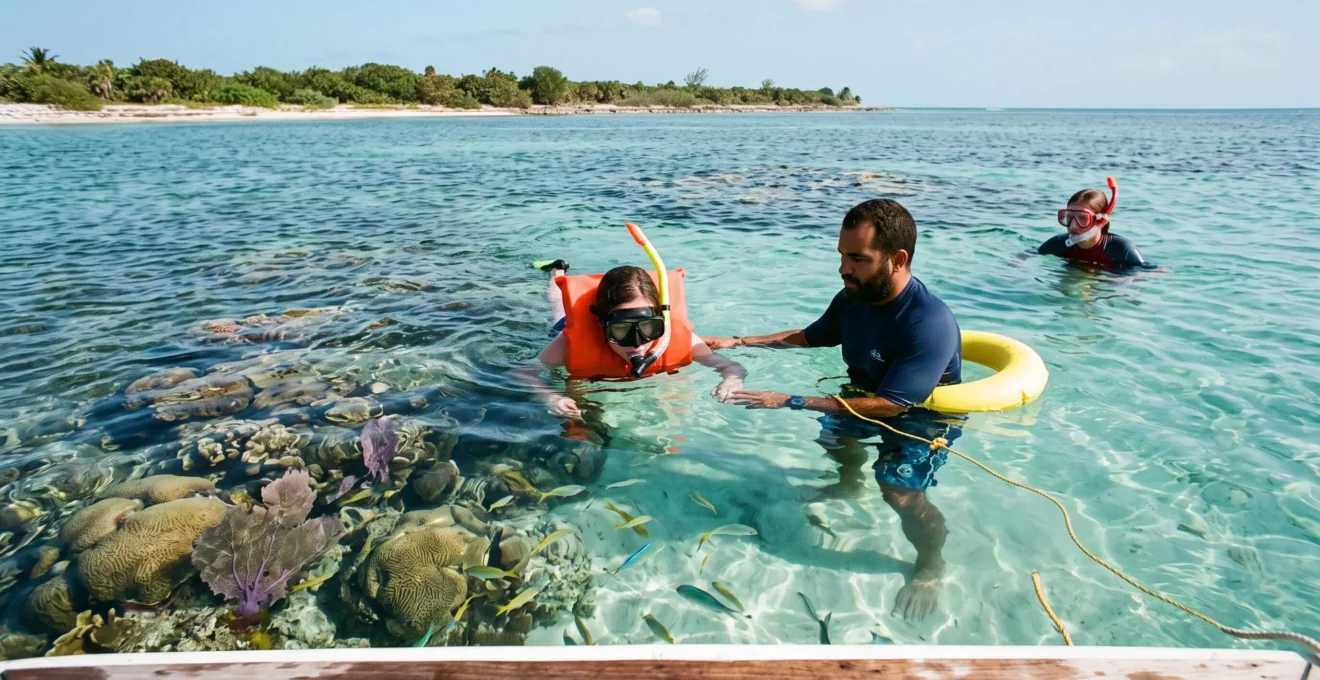
Mexico’s Caribbean reefs offer encounters with colourful fish, sea turtles and remarkable coral formations, but the most spectacular location is not necessarily the best place for someone who struggles with swimming. A calm-looking bay can develop uncomfortable surface chop, while an offshore reef with exceptional visibility may expose visitors to currents and challenging boat entries.
For less confident swimmers, choosing a suitable reef means evaluating water movement, visibility, supervised access and exit options before considering the wildlife. Akumal, Mahahual and Cozumel offer different types of reef experiences, and their suitability depends on the exact location and daily conditions rather than reputation alone.
Tour quality matters just as much. An attentive guide in the water, a properly fitted flotation vest and a clear cancellation policy can make the difference between a manageable introduction and an unsafe outing. Conservation rules also influence where and how visitors can snorkel.
The objective is not to find a universally safe reef. It is to choose an experience that matches your swimming ability, the day’s conditions and the protections established for Mexico’s marine ecosystems.
Choosing a Mexican reef when swimming confidence is limited
- Prioritise sheltered, supervised areas with manageable currents, clear exits and flotation equipment.
- Check recent wind conditions and ask operators about visibility, guide ratios, park fees and weather cancellations.
- Respect protected-area rules, maintain distance from coral and choose operators that use responsible mooring practices.
- Why Does Reef Visibility Drop Fast After Windy Days Even in Crystal-Clear Mexico?
- How to Vet a Reef Snorkel Tour in Mexico in 10 Minutes Without Overpaying?
- Which Is Better for Beginners: A Shallow Lagoon Reef or an Offshore Reef Wall in Mexico?
- The Reef-Day Mistake That Ruins Snorkelling in the First 15 Minutes
- When Should You Go Snorkelling on Mexico’s Reefs for Calmer Water and Fewer Boats?
- Which Is Better for Wildlife: Kayaking Through Mangroves or Taking a Quiet Boat Tour?
- How to Pick a Reef-Friendly Snorkel Operator in Mexico Using 4 Non-Obvious Checks?
- Why the Reef You’re Snorkelling Today Might Not Exist in 10 Years Without Better Tourist Choices
Why Does Reef Visibility Drop Fast After Windy Days Even in Crystal-Clear Mexico?
Reef visibility can deteriorate after windy weather because waves and water movement lift fine sediment from the seabed, leaving particles suspended in the water. Shallow sandy areas are particularly vulnerable. Even after the wind drops and sunshine returns, underwater conditions may remain cloudy until suspended material settles or disperses.
Mexico’s Caribbean coastline can look dazzlingly turquoise from a beach photograph while offering disappointing visibility beneath the surface. Strong wind creates surface chop and promotes sediment resuspension, especially where waves reach shallow sandy bottoms. Sediment may also enter reef areas through coastal runoff or disturbed seabeds.
Recovery is not instantaneous. Depending on sediment characteristics, continuing swell, currents and local geography, a location may remain murky for a day or several days after unsettled weather. There is no reliable recovery period that applies to every Mexican reef.
Reef structure changes the likely response. Shallow environments around Akumal or Mahahual can contain sandy sections where wave action reduces clarity. Offshore reef environments around Cozumel may avoid some shallow-water sediment disturbance, although exposed offshore sites can still experience rough conditions, suspended particles and difficult currents.
A reef wall should therefore not be assumed to recover faster solely because it is deeper. Local exposure and the day’s marine conditions remain decisive.
Before booking, review the following evidence:
- Previous 48 hours: examine wind direction, wind strength and wave forecasts, not just tomorrow’s sunshine.
- Recent observations: look for clearly dated photographs or reports from visitors and guides, while remembering that photographs cannot establish current conditions.
- Operator confirmation: ask when the site last had good underwater visibility and whether conditions have changed since that visit.
- Alternative site: ask whether the operator can select a more sheltered location or postpone the excursion.
For hesitant swimmers, poor visibility has a psychological consequence beyond disappointing photographs. Losing sight of the seabed or nearby reef can make orientation feel difficult and amplify anxiety. Visibility alone does not establish whether someone will drift, however; currents and surface conditions create that physical hazard.
The Divers Alert Network’s snorkeling and scuba-diving safety guidance identifies currents, waves, water inhalation and boat traffic as important hazards, and recommends checking local conditions before entering the water.
If reliable information is unavailable, favour a sheltered, supervised introduction or reschedule rather than relying on the apparent colour of the sea.
How to Vet a Reef Snorkel Tour in Mexico in 10 Minutes Without Overpaying?
Assess a Mexican snorkelling tour by asking about the number of guests per in-water guide, flotation equipment, cancellation conditions and the complete price. A low advertised fare is not automatically good value. For less confident swimmers, supervision and a clear procedure for rough seas matter more than promotional photographs or the number of reef stops.
A useful operator assessment takes approximately ten minutes if questions are asked in a consistent order.
- Ask for the actual guest-to-guide ratio. Request the number of participants assigned to each guide in the water. “Small group” has no precise meaning without numbers.
- Confirm direct water supervision. Ask whether a trained guide enters the water, stays with the group and can assist someone who becomes distressed.
- Check flotation equipment. Confirm the availability of suitable, correctly sized life jackets or appropriate buoyancy aids, and whether staff help guests fit them.
- Ask about cancellation decisions. The operator should explain how wind, swell, currents and visibility influence departures, and what happens if conditions deteriorate.
- Request the final written price. Compare park fees, equipment, transport, boat arrangements and refund terms using the same categories.
There is no universal guest-to-guide ratio that guarantees safety, and a guide’s certification or training should be checked rather than assumed from marketing descriptions. Someone unable to swim independently should disclose this before booking: some tours are unsuitable regardless of vest availability.
Marine park fees deserve particular attention. At Cozumel Reefs National Park, CONANP’s supplied visitor information lists an entrance fee of MXN 225 per person per day. That figure should be reconfirmed before travel, along with any applicable exemptions and whether the operator includes it in the quoted price.
Boat design also affects comfort. Consider the stability of boarding arrangements, the ease of getting back aboard, shade, seating and whether the vessel has suitable provisions for assisting distressed guests. A cheaper trip on a crowded boat might offer less individual attention, although price alone cannot establish an operator’s safety standards.
Warning signs include vague answers about supervision, no clear cancellation or refund policy, or demands for full cash payment without written booking confirmation. Photographs showing widely dispersed groups may justify further questions, but are not proof of unsafe practices.
Your five-point snorkel tour verification checklist
- Request the number of guests per in-water guide and record the stated ratio in your booking notes.
- Confirm the guide’s relevant training and whether they remain in the water; save the operator’s written answer.
- Ask which flotation sizes are available and how guests are assisted; record the equipment arrangements.
- Obtain the operator’s weather cancellation and refund conditions in writing.
- Request an itemised final quote including park charges, equipment and transport; compare it against another quote on identical terms.
Choose the trip whose suitability can be explained and documented, not merely the one with the most attractive underwater photographs.
Which Is Better for Beginners: A Shallow Lagoon Reef or an Offshore Reef Wall in Mexico?
A sheltered shallow reef is generally a more manageable starting point for a weak swimmer because it may offer shorter distances, easier exits and less exposure to open-water conditions. Offshore reef walls can provide impressive underwater scenery, but boat access, deeper water and possible currents require greater confidence. Neither format is automatically safe in every condition.
Shallow coastal areas around Akumal or Mahahual offer examples of the first format, although individual snorkelling zones differ in depth, access and permitted activities. Cozumel’s offshore reefs illustrate the second, with boat-based visits and sites where the seabed can drop away steeply.
The practical comparison is more useful than a simple ranking of locations.
| Decision factor | Shallow lagoon or bay reef | Offshore reef wall |
|---|---|---|
| Depth below the swimmer | Often shallower, although depth varies and standing may be prohibited or harmful | May involve deep water and steep drop-offs |
| Currents | Sheltered locations may offer less exposure, but local currents remain possible | Potential for stronger currents and drift-oriented excursions |
| Entry and exit | Some locations permit supervised beach entry | Often requires boat entry and recovery |
| Visibility | Can deteriorate quickly where waves disturb sand | May remain clearer in some conditions, but not guaranteed |
| Boat exposure | Depends on designated zones and local traffic | Boat transit and surface support are usually central to the experience |
| Best-fitting visitor profile | Someone seeking a gradual, closely supervised introduction | Someone comfortable afloat in deep water and with boat procedures |
The counterintuitive point is that shallow water can create problems of its own. Wind-driven sediment may reduce visibility, and heavily used bays can have vessel traffic, constrained access areas or delicate coral close to the surface.
Equally, an offshore reef should not be dismissed purely because it is deep. A well-managed excursion in calm conditions may suit an experienced snorkeller who is comfortable floating at the surface, provided the operator has assessed the person’s abilities and the site’s currents. Depth still matters for anyone distressed by not seeing the bottom.
Consider four self-assessment questions before selecting either environment:
- Can you remain calm while floating? If not, begin with supervised instruction in a controlled environment rather than a reef excursion.
- Do you become distressed when the bottom disappears? Prioritise a sheltered site with visible shallow features.
- Can you swim 50 metres continuously? Use the answer to discuss your capabilities honestly, not as a validated pass-or-fail safety test.
- Can you enter and exit a boat comfortably? If uncertain, favour a suitable beach-entry activity with professional supervision.
There is also a useful intermediate choice: a protected beach-entry reef with clearly designated swimming areas, or a carefully selected, calm-weather boat trip with close guide support. Availability depends on local conditions and regulations.
A trial session close to shore can provide a realistic assessment before committing to a more demanding excursion.
The Reef-Day Mistake That Ruins Snorkelling in the First 15 Minutes
The most damaging beginner mistake is entering the sea before checking equipment, practising breathing and agreeing on how to request assistance. A leaking mask or unexpected movement can trigger distress almost immediately. A short, supervised acclimatisation period helps identify problems while returning to shore or stopping the activity remains straightforward.
Many visitors concentrate on reaching the reef quickly. They collect their equipment, follow the group into the water and discover an uncomfortable mask or unfamiliar snorkel only after leaving a manageable entry point.
For someone already worried about their swimming ability, this sequence creates avoidable pressure. Water entering a mask can interrupt breathing rhythm, while an incorrectly adjusted vest may feel restrictive or fail to provide the expected support.
A practical first-quarter-hour routine can help, although it is a suggested preparation sequence rather than a formally validated safety protocol.
- Before entering: check that the mask seals comfortably, the snorkel is secure and the flotation equipment fits correctly.
- At a supervised shallow entry point: test flotation and learn how to maintain a comfortable body position without kicking continuously.
- While supported: practise placing the face in the water and breathing slowly through the snorkel, then returning to an upright position.
- Before moving away: agree on clear signals for stopping, returning and requesting immediate assistance.
- At the beginning of the swim: remain near the guide in the calmest designated area and reassess before progressing.
These steps should only be attempted where the entry conditions are suitable and competent supervision is available. Waist-deep water does not automatically eliminate risks from waves, uneven footing or sudden depth changes.
Communication should be simple enough to work despite noise, waves and limited visibility. Establish a clearly understood signal for needing assistance and another for ending the session. Ask the guide to demonstrate how they respond and how they help someone return to the entry point or boat.
A buddy provides additional awareness but is not a replacement for a trained guide or suitable safety arrangements. For a non-swimmer, professional instruction in a controlled setting may be more appropriate than recreational reef snorkelling.
Another common error is joining the most demanding part of a group excursion before learning whether the conditions feel comfortable. Start in the gentlest permitted area, stay within the supervised zone and progress only if breathing and flotation remain controlled.
If anxiety persists, water is repeatedly entering the airway or the current feels unmanageable, stop and request assistance. Continuing to avoid embarrassment is not a reasonable safety decision.
Starting calmly protects confidence and reduces uncontrolled fin movements that could otherwise disturb the seabed or damage nearby coral.
When Should You Go Snorkelling on Mexico’s Reefs for Calmer Water and Fewer Boats?
Early mornings and periods of settled weather are useful starting points when choosing a Mexican reef excursion, but neither guarantees calm seas or fewer boats. On the Caribbean coast, late spring and early summer can offer favourable conditions in some locations, while winter winds and the Atlantic hurricane season introduce different risks. Local forecasts should always take priority.
Timing operates on two separate scales: the broader seasonal pattern and the conditions during the hours you intend to enter the water.
Across parts of Mexico’s Caribbean coast, winter cold fronts and northerly winds can cause choppy water and disrupted boat schedules. Late spring and early summer may provide calmer periods, but weather varies from one destination to another.
The Atlantic hurricane season extends from June through November. That calendar describes a period of tropical-cyclone risk, not a prediction that every day will be stormy. Tropical systems, distant swells and local thunderstorms can affect conditions even when the immediate coastline appears sunny.
For day-to-day planning, an early departure may avoid some afternoon wind development and the busiest periods at popular sites. However, morning conditions are not consistently calmer everywhere, and several operators may schedule their first departures at similar times.
Combine three timing factors rather than relying on a single recommended month:
- Season: consider prevailing weather patterns, storm risks and visitor demand.
- Time of day: request the operator’s assessment of winds, currents and boat traffic during the proposed excursion.
- Day of the week: compare expected visitor numbers, recognising that weekend demand and local tourism patterns differ between destinations.
A relatively quiet, less famous reef visited in suitable conditions may be more enjoyable for a hesitant swimmer than a heavily promoted location during a busy departure window.
Wildlife interests introduce another compromise. Whale shark tourism around areas associated with Isla Mujeres and Holbox is seasonal, broadly concentrated between late spring and early autumn, but the exact authorised periods and access arrangements require current verification. Wildlife activity does not guarantee safe sea conditions or sightings.
Turtle nesting and hatching patterns also vary by species and beach. Nesting areas may have protection measures that restrict visitors, lighting or access. These are conservation requirements rather than inconveniences to bypass.
For protected reefs, check designated areas, temporary restrictions and applicable rest periods shortly before travel. Older travel articles may not reflect current park decisions.
Maintain flexibility in the itinerary: the safest choice may be a later departure, a sheltered alternative or no reef entry at all that day.
Which Is Better for Wildlife: Kayaking Through Mangroves or Taking a Quiet Boat Tour?
Mangrove kayaking is well suited to travellers who want slow, close observation of coastal habitats without entering open water, provided they can paddle safely and the conditions are suitable. A stable, professionally operated boat may be preferable for someone with limited paddling ability or mobility. Both can reveal wildlife, but the species and viewing opportunities differ.
Mexico’s coastal mangroves support complex ecosystems where exposed roots provide shelter for juvenile fish and other aquatic organisms. Birds may forage or rest along channel edges, while some habitats also support larger animals that require particular caution.
A kayak allows slow movement along suitable, authorised channels. Its low profile and lack of an engine can reduce some forms of disturbance and make quieter observation possible. Paddlers may notice birds among roots or movements near the waterline that would be easy to overlook during a faster excursion.
However, being quieter does not guarantee wildlife sightings or an absence of disturbance. Approaching too closely, blocking an animal’s route or entering sensitive areas can still cause harm.
Small boat tours can cover greater distances and, where routes permit, reach open lagoon sections that may be difficult or inappropriate to access by kayak. Electric propulsion or careful low-speed operation may reduce certain noise and wake impacts, although environmental performance depends on the vessel and the operator’s behaviour.
For weak swimmers, the critical distinction is that remaining aboard a suitable vessel avoids voluntary snorkelling exposure, but kayaking and boating still carry capsize, immersion, weather and other risks. Properly fitted life jackets, safe operating conditions and competent guides remain essential.
Choose kayaking if you are comfortable maintaining balance, handling a paddle and following instructions for an unexpected immersion. Consider a stable guided boat if paddling would be physically difficult, the route is lengthy or additional onboard assistance is needed.
Wildlife observation should always take place from a respectful distance. Crocodiles and other potentially dangerous animals must never be approached, pursued or attracted with food.
Protected destinations such as Sian Ka’an and Ría Lagartos can have access and activity rules that differ by zone. Ask the operator which route is authorised, whether a locally recognised guide is required and what restrictions apply to motors, wildlife encounters and landing places.
Do not assume every mangrove route requires exactly the same permit or certification: the applicable requirements depend on the location and activity.
When reef snorkelling conditions are unsuitable, a well-managed mangrove excursion can provide a meaningful coastal wildlife experience without forcing an uncomfortable swim.
How to Pick a Reef-Friendly Snorkel Operator in Mexico Using 4 Non-Obvious Checks?
A genuinely reef-conscious snorkel operator should demonstrate responsible mooring, active supervision of wildlife interactions, specific waste and sun-protection practices, and transparent compliance with park permits and fees. These operational details provide stronger evidence than general claims about being environmentally friendly. Ask how the practices work on an actual trip, not simply whether the company supports conservation.
The following four checks help distinguish measurable behaviour from marketing language.
1. Ask exactly how the boat is secured. Dropping an anchor onto coral can break living structures, while appropriate fixed moorings avoid direct anchor contact with the reef. Request confirmation that the vessel uses authorised mooring buoys where available and follows the relevant site’s anchoring rules.
At Cozumel Reefs National Park, published regulations prohibit anchoring and identify mooring infrastructure for authorised vessels. An operator should be able to explain its arrangements without vague assurances that anchoring is done carefully.
2. Ask what guides actually enforce in the water. Responsible guiding includes controlling group movement, keeping appropriate separation from wildlife, preventing touching and feeding, and responding when guests approach coral too closely.
Ask how many participants each guide supervises, what relevant training they hold and what happens if someone repeatedly disregards reef-protection instructions. A printed code of conduct is useful, but operational enforcement is the more meaningful signal.
3. Verify the precise sunscreen and waste rules. Claims that a product is reef-safe do not establish that it is harmless or permissible in a protected area.
For example, Cozumel Reefs National Park’s published visitor rules prohibit sunscreen use. A tour operator cannot replace that restriction with a general recommendation to use mineral sunscreen. Ask about the specific destination’s requirements and practical alternatives, such as suitable sun-protective clothing and shade outside the water.
Also check whether the vessel provides waste collection and prevents food packaging and other rubbish from entering the sea.
4. Confirm permits, park access and fee handling. Ask whether the operator and guides hold the authorisations applicable to the protected area, and request an itemised explanation of any park charges.
The CONANP’s official Cozumel Reefs National Park visitor regulations describe requirements for authorised boats and guides, prohibit anchoring, touching reefs and disturbing marine life, and instruct visitors to maintain at least 1.5 metres from the reef.
These requirements apply to that protected area and should not be presented as universal Mexican snorkelling law. The same official information also advises visitors to respect reef rest periods, which may affect the available itinerary.
A provider that can explain applicable rules and identify its authorisations offers more meaningful reassurance than one relying solely on an environmental badge.
Environmental responsibility and swimmer safety should reinforce each other: organised groups, appropriate flotation and controlled movement can help protect both guests and fragile reef habitats.
Key takeaways before choosing your reef
- Conservation rules are part of the destination decision, not optional extras that apply only after booking.
- Good supervision helps prevent accidental coral contact as well as unsafe behaviour in the water.
- Responsible tourism can reduce avoidable local damage, but it cannot by itself eliminate climate-related threats to coral reefs.
Why the Reef You’re Snorkelling Today Might Not Exist in 10 Years Without Better Tourist Choices
Mexico’s coral reefs face overlapping pressures from marine heatwaves, coral bleaching, declining water quality and direct physical damage. Tourism practices can reduce some local impacts, particularly anchoring damage, contact and sediment disturbance. However, no reliable evidence establishes that a specific Mexican reef will disappear within exactly ten years, and tourism choices alone cannot reverse global warming.
Corals are living organisms that depend on environmental conditions remaining within tolerable limits. During marine heat stress, many corals expel the symbiotic algae that contribute to their nutrition and colour, producing the pale appearance commonly described as bleaching.
Bleaching does not necessarily mean a coral has died, but prolonged or repeated stress can impair survival and recovery. Water pollution, excessive sediment and physical disturbance may add to the damage.
Coastal development and runoff can introduce additional pressures by changing water quality and increasing sediment loads. Anchors, careless fin movements and direct contact create more immediate, localised impacts.
For visitors, the most recognisable warning signs may include unusually pale corals, visibly broken structures, extensive algae coverage or relatively few fish in an area that appears heavily used.
These observations have important limits. Fish abundance, algae and coral colour vary naturally, and a casual snorkelling visit cannot replace scientific ecological monitoring. A single observation should not be used to diagnose the health of an entire reef.
The practical opportunity is to reduce direct harm wherever possible. NOAA Fisheries’ shallow coral reef habitat conservation guidance advises visitors to keep hands and fins away from coral, avoid disturbing sediment and use appropriate mooring arrangements rather than anchoring directly on reefs.
These principles connect directly to the decisions involved in choosing a snorkelling experience. A swimmer who is comfortable with flotation equipment is less likely to make uncontrolled movements near coral. A guide who controls the group’s route can help prevent people from entering sensitive areas. A properly moored vessel avoids damaging reef structures with an anchor.
None of these individual choices guarantees reef survival. Their value lies in reducing avoidable, cumulative pressures on ecosystems already exposed to wider environmental threats.
Conservation responses may include designated mooring systems, restrictions on access, temporary reef rest periods and coral restoration initiatives. Coral nurseries and restoration projects can support specific conservation objectives, but outcomes depend on the methods, local conditions and whether the underlying stressors are addressed.
Protected areas may change their rules as environmental conditions and management priorities evolve. Visitors should therefore confirm access restrictions, authorised routes and current park requirements before each excursion.
The future of a reef depends on much more than tourist behaviour. Climate action, effective coastal management, wastewater controls and long-term habitat protection remain central to conservation. Tourist decisions are a meaningful but limited contribution.
For your next Mexican reef trip, choose an operator who can explain current sea conditions, demonstrate credible safety procedures and follow the local conservation rules. If those assurances are missing, change the excursion or postpone the swim: protecting yourself and avoiding preventable reef damage are compatible decisions.
Can you snorkel in Mexico if you cannot swim confidently?
Limited swimming confidence does not automatically prevent every supervised introductory activity, but a flotation vest is not a substitute for swimming ability or professional supervision. Tell the operator exactly what you can and cannot do. If you cannot swim independently, consider instruction in a controlled environment first. Avoid open-water reef excursions unless a qualified provider has assessed your needs and can offer an appropriately managed activity.
Are full-face snorkel masks better for nervous beginners?
Not necessarily. Ease of use, fit, breathing performance and the ability to remove equipment safely matter more than the appearance of the mask. Equipment design and suitability vary, and beginners should receive instruction before using unfamiliar gear. Ask a qualified instructor about conventional mask-and-snorkel options and avoid equipment that causes breathing discomfort or is difficult to remove.
Should a weak swimmer choose a boat tour or snorkel from the beach?
A sheltered beach-entry location may offer a more gradual introduction and an easier return to shore. However, beach entries can also have waves, currents, uneven terrain and restricted zones. Boat trips may provide direct guide support but require comfortable entry and recovery procedures. The better option depends on the individual’s abilities, local conditions and available supervision.
Can you touch the seabed to rest while snorkelling near a reef?
Do not stand on coral or rely on the seabed as a resting place. Contact can damage living organisms, and fin movements can disturb sediment. Some protected areas impose specific minimum distances from reef structures. If you need support, signal your guide and use the approved flotation or exit arrangements rather than attempting to stand on the reef.
Do Mexican marine parks always charge a separate snorkelling entrance fee?
No single fee arrangement applies to every Mexican reef destination. Charges, exemptions, permits and booking inclusions depend on the protected area and operator. Cozumel Reefs National Park has published visitor entrance charges, but the current amount and its inclusion in a commercial tour should be verified directly before booking. Request a written itemised price to avoid unexpected costs.