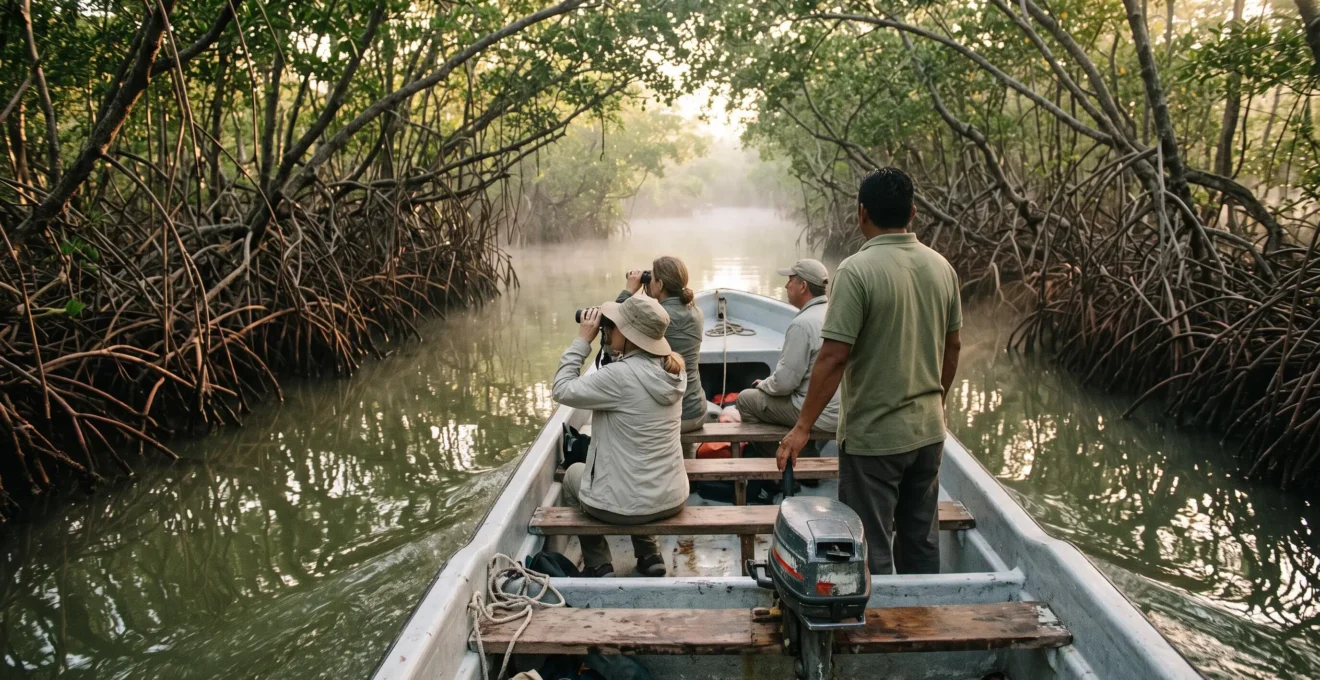
A heron stands motionless between tangled roots. A kingfisher flashes across a narrow channel. Somewhere beyond the vegetation, something moves through the shallow water. Mexico’s mangrove forests can deliver extraordinary wildlife encounters, but enjoying them requires different expectations from visiting a beach or taking a conventional sightseeing cruise.
The difference often begins before departure. Travellers who choose a suitable guide, departure time and access method may spend a memorable morning observing coastal wildlife. Those who book an unsuitable excursion can instead encounter oppressive humidity, biting insects, muddy boarding points and very little visible wildlife.
The most important decision is choosing the right tour for the conditions and your physical comfort, rather than selecting whichever excursion is cheapest or most convenient. For UK visitors unfamiliar with tropical wetlands, understanding the environment before booking makes the experience both more rewarding and more responsible.
Mexico mangrove tours: essential decisions
- Choose a knowledgeable local guide and an appropriate departure time before comparing prices or boat types.
- Prepare for insects, humidity, muddy access and potentially limited facilities, even on relatively comfortable excursions.
- Check reserve access, seasonal bird movements and local water conditions before committing to a fixed itinerary.
- Why Are Mexican Mangroves Considered More Important Than Coral Reefs for Coastal Survival?
- How to Prepare for a Mangrove Tour in Mexico Without Being Eaten Alive by Insects?
- Which Is Better for Wildlife: Kayaking Through Mangroves or Taking a Quiet Boat Tour?
- The Mangrove Mistake That Guarantees You See Zero Wildlife and Come Back Covered in Mud
- When Should You Book a Mangrove Tour for Migrating Birds Without Suffering Peak Humidity?
- How to Plan a Mexican Reserve Visit Without Arriving to Find the Trail Closed?
- Which Is More Rewarding for Birdwatchers: Coastal Mangroves or Cloud Forests in Mexico?
- Which Mexican Ecosystem Should You Visit First if You Only Have 3 Nature Days?
Why Are Mexican Mangroves Considered More Important Than Coral Reefs for Coastal Survival?
Mangroves are vital to Mexico’s coastal resilience because their roots stabilize shorelines, slow moving water, retain sediments and shelter aquatic wildlife. Coral reefs also protect coastlines and support marine biodiversity, so neither ecosystem can universally be called more important. Their roles differ, and mangroves provide particularly visible protection where forests border vulnerable coastal land.
A mangrove forest functions like living coastal infrastructure. Its intricate roots interact with tidal currents and create conditions in which suspended sediment can settle. Over time, this helps maintain coastal soils and reduces erosion from waves, currents and storm-related water movement.
According to NOAA‘s explanation of mangrove forests, these coastal plants are adapted to oxygen-poor soils, and their root systems provide food and shelter opportunities for fish and other organisms.
That ecological function explains why a mangrove excursion may look less glamorous than a reef visit. The water can appear brown or green, submerged roots occupy narrow channels, and exposed sediment becomes especially noticeable when water levels fall. Organic material can also produce strong earthy smells, particularly around muddy areas.
These characteristics are not necessarily signs of pollution or environmental neglect. They can be ordinary features of a functioning tidal wetland, although visibly contaminated water or unusual discharges should never be dismissed as natural.
For travellers, mangroves and coral reefs offer different experiences:
| Consideration | Mangrove excursion | Coral reef excursion |
|---|---|---|
| Primary experience | Coastal birds, roots, waterways and wetland wildlife | Underwater marine life and reef formations |
| Swimming ability | Often unnecessary on guided boat tours | Often relevant to snorkelling or diving activities |
| Typical visibility | Wildlife observed above or beside often turbid water | Underwater viewing depends on water clarity |
| Physical access | Potentially suitable for seated visitors, depending on boarding arrangements | Varies significantly by vessel and water activity |
| Environmental concerns | Root damage, wildlife disturbance and inappropriate navigation | Reef contact, anchoring damage and marine disturbance |
Mangrove trips may therefore be a practical choice for families, older travellers and people who prefer remaining out of the water. However, a stable vessel and manageable boarding point matter far more than the ecosystem’s apparent accessibility.
Low-impact behaviour is equally important. Visitors should avoid trampling exposed roots, touching wildlife, littering or asking boat operators to approach animals closely. Engine operation and noise should be managed responsibly, while navigation must follow local rules.
Once the ecological value of these forests is clear, the next challenge is preparing for their very real physical conditions without turning a wildlife excursion into an endurance test.
How to Prepare for a Mangrove Tour in Mexico Without Being Eaten Alive by Insects?
Prepare for a Mexican mangrove tour with lightweight protective clothing, suitable insect repellent, secure footwear and a waterproof bag. Match your equipment to the excursion: a seated boat trip usually demands less physical preparation than kayaking or walking through wetlands. Expect some combination of humidity, sun exposure, insects and muddy access, rather than assuming every excursion will be uncomfortable.
The most effective insect strategy combines several layers of protection. Loose-fitting long sleeves and trousers reduce exposed skin, while an appropriate repellent protects uncovered areas. A fine head net may provide additional comfort where biting insects are particularly troublesome.
The CDC mosquito-bite prevention recommendations identify DEET and picaridin as established repellent ingredients when products are used according to their labels. Clothing and equipment treated with permethrin can provide another protective barrier, but permethrin products intended for fabric must never be applied directly to skin.
Do not assume mosquitoes only bite around sunrise or sunset. Different species are active at different times, so daytime protection remains relevant. Apply sunscreen before skin repellent when both are appropriate, and confirm any restrictions imposed by the protected area. Some reserves restrict products that visitors might otherwise routinely use.
Mud requires similar practical preparation. A path that looks firm can become slippery near the water, while loose sandals may disappear into soft sediment. Strapped water shoes or old trainers with reasonable grip are more dependable than flip-flops. Footwear should be compatible with the operator’s safety instructions.
Pack quick-drying clothes, a spare change for the return journey and a dry bag for electronics. For kayaking, keep valuables attached or securely stored rather than balancing them on an open deck.
Equipment needs change considerably depending on how the tour operates.
| Equipment | Seated boat | Kayak or walking trail |
|---|---|---|
| Insect protection | Essential | Essential |
| Secure footwear | Useful for boarding | Particularly important |
| Dry bag | Recommended | Strongly recommended |
| Drinking water | Bring an appropriate supply | Bring enough for greater exertion |
| Spare clothing | Useful | Often especially useful |
| Physical preparation | Usually modest | Depends on paddling distance or trail conditions |
Less obvious discomforts deserve attention too. Open boats may have limited shade, remote launches may lack toilets, and mobile reception can be unreliable. Ask about journey length, rest opportunities, drinking water and boarding arrangements before booking, especially when travelling with children or someone with limited mobility.
Once personal comfort is covered, the next decision is how to travel through the channels without compromising the wildlife encounters that made the excursion appealing.
Which Is Better for Wildlife: Kayaking Through Mangroves or Taking a Quiet Boat Tour?
Kayaking can offer quieter access to narrow mangrove channels, while a carefully operated boat makes wildlife observation accessible to a wider range of visitors. Neither automatically produces better sightings. Guide knowledge, group behaviour, tidal conditions and the ability to approach wildlife without disturbance often matter more than whether the vessel uses paddles or a motor.
Kayaks have an obvious advantage in some waterways: they can move slowly with limited mechanical noise. Their smaller size may allow access to channels that larger tour boats cannot navigate, provided the route is permitted.
However, kayaking also demands attention. Paddlers must control their craft, maintain balance and watch for obstacles. Beginners may spend so much time managing their boat that they overlook wildlife nearby. In narrow passages, inexperienced paddling can also bring visitors uncomfortably close to roots or animals.
A quiet guided boat offers a different advantage. Passengers can concentrate on watching birds while the operator handles navigation. This can be particularly valuable for photographers carrying equipment, families and travellers who cannot comfortably paddle.
Motorboats are not necessarily inappropriate, but excessive speed, unnecessary engine noise and close approaches to wildlife can undermine the experience. Ask whether the operator slows down around viewing areas and respects designated navigation routes.
| Criterion | Guided kayak | Quiet guided boat |
|---|---|---|
| Noise | Little mechanical noise | Depends on propulsion and operation |
| Physical effort | Moderate to substantial depending on route | Generally low once aboard |
| Narrow channels | Potential access where permitted | Limited by vessel size and local rules |
| Photography | Requires stable equipment handling | Often easier from a stable vessel |
| Group comfort | Best for willing, capable paddlers | Often better for mixed abilities |
| Wildlife encounters | Depends on guide and conditions | Depends on guide and conditions |
The guide is often the deciding factor. A capable naturalist can identify calls, interpret feeding behaviour and recognise when an animal should be left undisturbed. Knowledge of local crocodile habitat is particularly important: crocodiles must be observed from a safe distance, never approached for photographs or encouraged to react.
Before choosing an operator, ask whether the excursion includes a trained naturalist, how large the group will be, which routes are permitted and whether wildlife observation is the principal purpose rather than an incidental activity.
Smaller groups can create better conditions for quiet observation, but paying for a private departure does not guarantee additional sightings. A shared tour with an excellent guide may outperform an expensive private trip with little natural-history expertise.
Wildlife remains unpredictable. Changes in tide, weather, nesting activity and animal movements can produce dramatically different experiences along the same route.
Even the right vessel cannot compensate for every poorly planned departure, particularly when the itinerary prioritises convenience over suitable wildlife-viewing conditions.
The Mangrove Mistake That Guarantees You See Zero Wildlife and Come Back Covered in Mud
The biggest avoidable mistake is choosing a large, poorly guided midday mangrove excursion purely because it is cheap or immediately available. Heat, noise, crowded viewing areas and unsuitable access can combine to make the trip uncomfortable. These conditions never guarantee zero wildlife, but they can substantially reduce the quality of observation and leave travellers frustrated.
Imagine a hypothetical traveller who arrives at a coastal resort, books the first available group excursion and departs around midday without asking about the guide or route. At the launch point, they discover soft mud, minimal shade and no convenient toilets. Once aboard, passengers talk loudly while the boat moves quickly between stops.
There may still be wildlife in the surrounding forest. The problem is that the circumstances provide few opportunities to observe it patiently.
Timing is an important consideration. Early morning often offers comfortable light and a relatively peaceful atmosphere for birdwatching. Late afternoon can also be productive at suitable locations, although the preferred period depends on local species, weather, access rules and tides.
Group behaviour matters just as much. A crowded boat can make it difficult for everyone to see the same animal, and repeated noise may cause sensitive wildlife to retreat. A knowledgeable guide should establish expectations before departure and explain why sightings can never be promised.
Another common source of disappointment is confusing natural conditions with poor service. Mud, shallow water and insects may be intrinsic to a wetland visit. Unexpected unsafe boarding arrangements, inadequate safety equipment or misleading descriptions are different issues and should not be dismissed as simply part of nature.
Five checks to complete before booking a mangrove tour
- Confirm the departure time. Save written confirmation of the proposed start time and ask why it suits local wildlife observation.
- Verify the group size. Obtain the operator’s stated maximum passenger number and note whether the departure is shared or private.
- Establish the guide’s background. Record the guide’s wildlife expertise, language and familiarity with the reserve’s access rules.
- Check the route and conditions. Request the planned launch point, vessel type, approximate duration and any tide-related limitations.
- Clarify what is included. Keep a written summary of safety equipment, access fees, facilities, cancellation terms and realistic wildlife expectations.
If you have already booked a questionable excursion, contact the organiser before departure. Ask whether an earlier slot, smaller group or more wildlife-focused guide is available. Some reserves may offer alternative authorised walking routes, but never assume an independent guide can bypass restricted access.
Changing your plan may be worthwhile if the operator cannot explain basic safety arrangements. A disappointing wildlife forecast is one thing; missing essential safeguards is another.
Once the operator and route have passed these checks, seasonal migration and weather become the next variables worth considering.
When Should You Book a Mangrove Tour for Migrating Birds Without Suffering Peak Humidity?
For many Mexican coastal destinations, the cooler part of the year can offer a comfortable balance between birdwatching and humidity, particularly where northern migratory birds spend the winter. However, migration dates and local weather vary by region and species. Choose your reserve first, check its bird calendar, then arrange an appropriate morning departure rather than relying on one nationwide seasonal rule.
Mexico supports resident birds alongside populations that migrate between different parts of the Americas. Some arrive for the northern winter, while others pass through during seasonal movements. Consequently, a coastal reserve may have very different birdwatching opportunities at different times of year.
Audubon‘s overview of bird conservation in Mexico identifies coastal wetlands and mangroves as important habitats for feeding, resting and reproduction, alongside the country’s numerous forest and terrestrial ecosystems.
For UK travellers planning around winter holidays, a coastal mangrove tour can therefore be an appealing possibility. Conditions in particular destinations may be less humid than during their wetter months, and visiting birds may complement resident wildlife.
Nevertheless, winter is not universally the best season for every species or reserve. Nor does the rainy season mean an absence of birds. Local rainfall patterns, breeding cycles and migration routes need to guide the choice.
Tide timing adds another consideration. Falling water can expose muddy feeding areas used by certain shorebirds, whereas higher water changes access and redistributes activity within the channels. The ideal tide depends on the birds sought and the local geography; low tide is not automatically best.
Ask a local bird guide two practical questions: which species are currently being observed, and which departure time offers the best combination of water conditions and wildlife activity?
Booking ahead is prudent during popular holiday periods, particularly when small-group departures are limited. Allow flexibility in the itinerary for heavy rain, unsafe navigation conditions or temporary reserve restrictions.
Avoid choosing a departure based solely on the advertised temperature. Shade, wind, humidity, duration and access conditions can all influence comfort. An early trip may also expose visitors to active mosquitoes, so insect protection remains necessary.
Even an excellent seasonal plan can fail if the reserve entrance, trail or water route is unavailable when you arrive.
How to Plan a Mexican Reserve Visit Without Arriving to Find the Trail Closed?
Prevent access problems by checking official reserve information, contacting the responsible authority or authorised operator, and confirming the specific entrance and route shortly before travelling. Protected-area opening hours do not guarantee that every trail or channel is accessible. Keep an alternative activity nearby and verify permits, fees, transport arrangements and visitor restrictions in advance.
Mexican protected areas differ considerably in how visitors enter and explore them. Some have designated walking trails, others use managed waterways, and certain activities depend on authorised operators or local access arrangements.
Sian Ka’an Biosphere Reserve in Quintana Roo illustrates why details matter. CONANP‘s official Sian Ka’an visitor information describes designated trails, navigation areas and transport arrangements, together with regulations restricting unauthorised trail use and wildlife disturbance.
The published information lists visiting hours of 7:00 a.m. to 6:00 p.m. and an admission charge of 225 Mexican pesos per person per day, subject to applicable exemptions or discounts. These are published details rather than a live confirmation of access or an assurance that the fee will remain unchanged.
The approach to Punta Allen is also described as involving a 50-kilometre dirt road from the Arco Maya access point. Road conditions and travel time require separate confirmation, especially after heavy rain.
Visitor regulations deserve careful attention. At Sian Ka’an, the published rules prohibit entering or using sound equipment and restrict sunscreen use. Do not assume that ordinary beach-tour supplies are automatically permitted inside a protected area.
Before departure, check restrictions on products, equipment, transport and access with the authority or authorised operator. Protective clothing and other permitted measures may need to take priority where particular products are prohibited.
A reliable verification chain begins with the protected area’s official information. Next, contact the reserve office, authorised guide or local cooperative responsible for your intended route. A final check through your accommodation can help establish whether recent weather has affected road or water access.
For Sian Ka’an, CONANP publishes the contact email [email protected] and telephone number +52 (983) 8340265. Those contact details offer a more direct way to request current guidance than relying entirely on an old English-language travel article.
Ask whether booking is mandatory, which payment methods are accepted and whether the quoted price includes admission, guide services and transport. Cash-only payment and limited capacity should be treated as possibilities to verify, not universal rules for Mexican reserves.
Choose authorised local services where required, follow designated routes and avoid operators offering to bypass access restrictions. Using legitimate local guiding services can support community livelihoods, although the exact contribution to conservation depends on the organisation and its arrangements.
With access settled, travellers can consider whether a coastal wetland is actually the best ecosystem for their wildlife interests or whether a different habitat would prove more rewarding.
Which Is More Rewarding for Birdwatchers: Coastal Mangroves or Cloud Forests in Mexico?
Coastal mangroves are often more rewarding for casual birdwatchers who value relatively open viewing areas and accessible guided excursions. Cloud forests can appeal more to dedicated birders seeking specialised forest species and challenging observation. Neither habitat is universally superior: the better choice depends on target birds, mobility, season, guide quality and tolerance for difficult conditions.
Mangroves offer a distinctive combination of waterways and coastal vegetation. Travellers may encounter herons, kingfishers, ibises or birds of prey, depending on region and season. Crocodiles and other wetland animals can add interest to the outing, although their presence in a reserve never guarantees an encounter.
Observation can be relatively straightforward when birds perch beside open channels or feed along exposed banks. A guided boat also allows companions with different interests to share the experience without committing to a demanding hike.
Cloud forests offer a contrasting environment. Moist mountain slopes and dense vegetation create habitats for specialised bird communities, including species with restricted geographical distributions in some regions.
Watching them usually requires more patience. Birds may remain hidden within the canopy, move through overlapping branches or reveal themselves primarily through calls. Early starts, careful listening and a knowledgeable guide can be especially valuable.
Forest trails may be steep, slippery or uneven. Cooler temperatures at higher elevations can feel pleasant after the coast, but damp clothing, rain and muddy paths remain realistic possibilities.
| Criterion | Coastal mangroves | Cloud forests |
|---|---|---|
| Typical viewing | Open waterways, shorelines and vegetation edges | Dense canopy, forest gaps and mountain trails |
| Birdwatching interests | Wetland and coastal species | Forest specialists and potential regional endemics |
| Physical demands | Can be modest on suitable boat tours | Often greater on walking routes |
| Main discomforts | Insects, humidity and sun exposure | Slippery trails, rain and uneven terrain |
| Non-birder companions | Often easier to accommodate | Best when companions enjoy forest walking |
| Timing considerations | Local tides and bird movements | Weather, visibility and bird activity |
The distinction is particularly useful when travelling with a mixed group. Someone interested in occasional bird sightings may find a comfortable mangrove boat trip more satisfying than several hours searching dense forest for a difficult species.
Serious birders should instead begin with a target-species list and consult local observations. Habitat choice should follow the birds being sought rather than an assumed ranking of ecosystems by total biodiversity.
Combining both habitats can be rewarding where geography permits, but they should not be treated as automatically neighbouring attractions. Mexico’s distances and terrain can make a seemingly simple combination impractical within a short break.
When only a few nature days are available, that choice becomes an itinerary problem: allocate time to what is realistically accessible and preserve room for unpredictable weather.
Key takeaways before planning your three days
- Prioritise the wildlife activity with the strictest combination of access, water conditions and weather requirements.
- Choose ecosystems within a realistic travel area rather than assembling distant reserves into an unworkable itinerary.
- Keep one flexible period for changed conditions, missed wildlife opportunities or a more comfortable repeat visit.
Which Mexican Ecosystem Should You Visit First if You Only Have 3 Nature Days?
Start with a well-planned mangrove excursion if it offers suitable local conditions, accessible guiding and wildlife that interests your group. Use the second day for a contrasting habitat within practical travelling distance, then preserve the third day for flexibility. If your main goal is a particular forest bird, reverse that priority and build the itinerary around its habitat instead.
Three nature days are enough for memorable experiences, but not necessarily for visiting several widely separated Mexican ecosystems. The key is to distinguish time available for wildlife observation from time consumed by transport.
In a coastal base with accessible mangrove reserves, a sensible opening day might involve a guided morning boat excursion followed by a less demanding afternoon. This leaves time to assess the local weather and decide whether another wetland visit is worthwhile.
A second day could focus on a different nearby habitat, such as a coastal forest, lagoon edge or other authorised nature trail. A cloud forest should replace that option only if the location and journey are genuinely practical.
The third day should remain adaptable. It can accommodate an excursion postponed by weather, a second attempt to observe a target species or a slower activity for tired companions.
Consider how different travellers might allocate their limited time.
| Traveller profile | Suggested sequence | Main consideration |
|---|---|---|
| Families with children | Comfortable mangrove boat, easy nature trail, flexible day | Shorter outings and manageable facilities |
| Wildlife photographers | Guided mangrove morning, contrasting nearby habitat, flexible return | Light, stability and enough observation time |
| Casual nature lovers | Mangrove excursion, second local ecosystem, relaxed third day | Variety without excessive transfers |
| Dedicated birders | Priority target habitat, complementary habitat, targeted return | Species goals and local expert guidance |
These are planning frameworks, not geographically verified itineraries. For example, combining a Yucatán Peninsula mangrove reserve with a distant high-elevation cloud forest may require substantial road travel or additional transport. The fact that both habitats exist in Mexico does not mean they can reasonably fit into the same three-day trip.
Check journey times for your actual accommodation and selected entrances, not merely the distance between place names on a map. Include the final approach road, boarding arrangements, trail access and potential delays.
Before locking in the schedule, confirm whether the priority excursion can operate under the forecast conditions. Travellers who build an entire holiday around one fixed boat departure risk losing their main wildlife opportunity if access is suspended.
Ultimately, the decision separating an enjoyable mangrove adventure from a miserable one is rarely about finding the most picturesque waterway. It is about selecting an appropriate operator, timing and activity while accepting the realities of a living wetland.
Choose your preferred reserve, ask an authorised local guide about current access and wildlife conditions, then book the earliest suitable departure that fits your abilities. Leave room for nature to be unpredictable: quiet observation, sensible preparation and realistic expectations are what make the experience worthwhile.
Do you need to know how to swim for a mangrove boat tour in Mexico?
Swimming is not normally part of a seated sightseeing boat excursion, but you should never assume swimming ability is irrelevant to water safety. Ask the operator about buoyancy aids, boarding assistance, emergency procedures and any swimming requirements. Non-swimmers should disclose their needs before booking and choose an excursion with appropriate safety arrangements.
Are crocodiles dangerous during guided mangrove excursions?
Crocodiles are wild animals that require substantial respect and distance. Some Mexican mangrove reserves contain crocodile populations, but sightings are not guaranteed. Remain inside the designated viewing area, avoid entering the water unless explicitly permitted and never feed, approach or provoke an animal. Follow the guide’s instructions and any reserve-specific safety rules.
Can children enjoy a mangrove excursion without kayaking?
Yes. A suitable guided boat tour may allow children to observe birds, mangrove roots and coastal habitats without paddling. Confirm minimum ages, correctly sized lifejackets, shade, journey length and toilet arrangements beforehand. Children still need appropriate insect protection, and adults should select a departure consistent with their attention span and heat tolerance.
Is it safe to take a camera or mobile phone into mangrove channels?
Cameras and phones can be taken on many excursions, but splashes, rain, mud and accidental immersion are realistic hazards. Use a properly closed waterproof dry bag, secure equipment when travelling by kayak and avoid changing lenses in exposed wet conditions. Do not depend on mobile reception for emergency communication in remote areas.
What should you do if rain cancels your Mexican mangrove tour?
Contact the operator to confirm whether the departure is postponed, cancelled or available on another date. Check the agreed cancellation terms and avoid entering closed waterways independently. If the weather remains unsuitable, consider an authorised alternative activity nearby. Building a flexible day into the itinerary makes these changes much easier to manage.