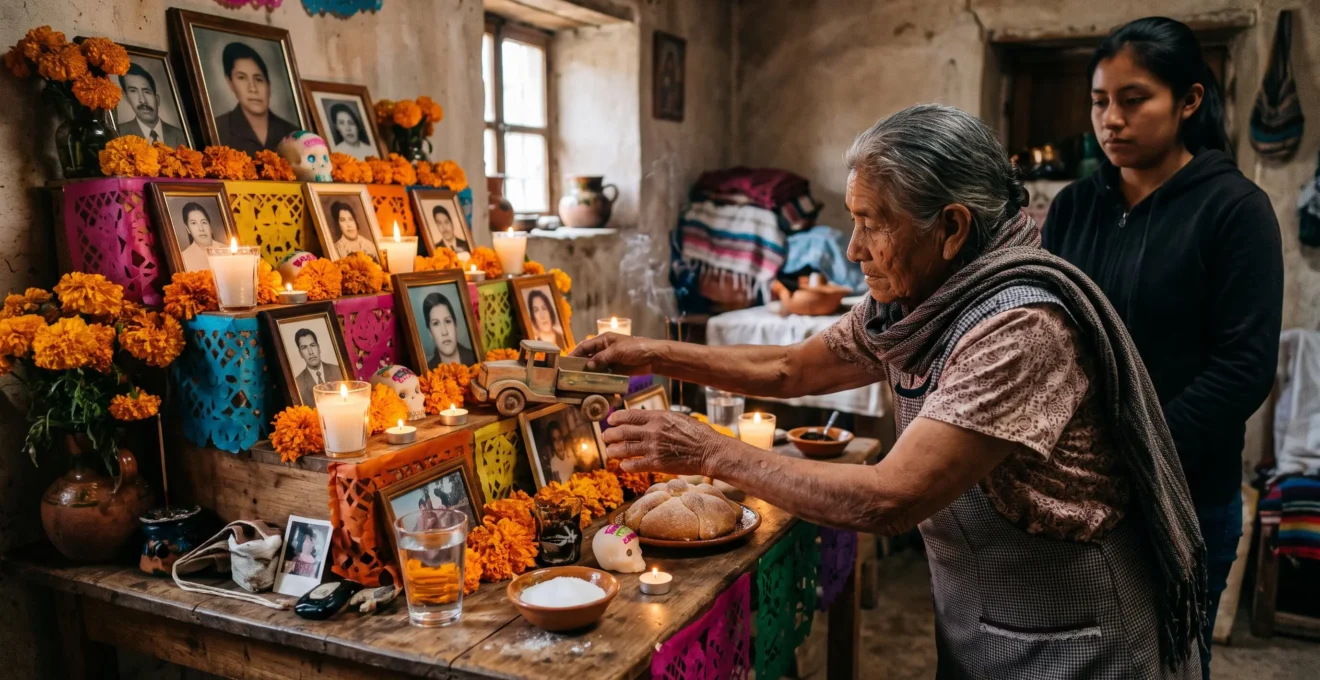
A photograph of a grandmother rests beside her favourite food. Candles illuminate a trail of orange marigold petals, while a glass of water stands ready for a returning spirit. To a traveller, the arrangement may look like an extraordinary piece of Mexican folk art. To the family who assembled it, it may be an intimate conversation with someone they have lost.
During Día de Muertos, or Day of the Dead, commemorative altars known as ofrendas occupy homes, cemeteries, schools and public spaces across Mexico. Although visitors are often welcomed into celebrations, that welcome does not automatically extend to handling offerings, photographing mourners or entering private ritual spaces.
The essential distinction is between an altar created for public interpretation and one maintained for family remembrance. Learning to recognise that distinction allows travellers to appreciate Mexico’s living traditions without turning grief into a tourist attraction. It also opens more rewarding possibilities: exploring flower markets, meeting artisans and attending community-organised celebrations where visitors are genuinely expected.
Day of the Dead altar etiquette at a glance
- Never touch, move, eat or add anything to an altar without explicit permission from its caretakers.
- Public exhibitions are generally appropriate places to learn and photograph within the stated rules; family altars and cemetery vigils require greater restraint.
- Markets, organised cultural events and community-led experiences offer meaningful encounters without demanding access to private mourning.
- Why Is Every Object on a Mexican Commemorative Altar Placed With Specific Meaning?
- How to Observe a Commemorative Altar in Mexico Without Crossing Boundaries You Can’t See?
- Which Altar Experience Is Appropriate for Tourists: Public Festival Displays or Private Home Altars?
- The Altar Mistake That Makes Families Stop Sharing Their Traditions With Visitors
- When Can You See Commemorative Altar Traditions in Mexico Without Intruding on Private Grief?
- How to See Marigold Harvesting and Altar Building in Mexico Instead of Just the Final Display?
- Which Is Better for First-Timers: A Market Day Visit or a Homestay in an Indigenous Community?
- How to Visit Indigenous Villages in Mexico Respectfully Without Turning It Into « Human Tourism »?
Why Is Every Object on a Mexican Commemorative Altar Placed With Specific Meaning?
Objects on a Mexican Day of the Dead altar are selected to honour deceased people, symbolically welcome their returning spirits and sustain a connection with family memory. Water, food, flowers, candles and photographs can each communicate something different. Their arrangement varies by community and household, so an altar should be understood as a personal offering rather than a fixed decorative formula.
One educational model presents an altar across three symbolic levels: heaven, earth and nourishment, and the underworld and the path between realms. The Mexican Ministry of Education‘s interactive Day of the Dead altar illustrates this structure through candles, photographs, salt, bread, food, water, flowers and personal belongings.
In that presentation, the upper level contains candles, a photograph and salt. The middle level holds food, fruit, pan de muerto, water, copal and a decorative skull. The lower level includes marigolds, candles, a floral arch and personal objects. These components have ritual associations, rather than serving merely as visual embellishments.
- Photographs and personal belongings identify or recall particular people, making the offering profoundly individual.
- Water and food symbolically welcome and nourish the returning deceased, frequently through dishes associated with their lives.
- Candles and cempasúchil marigolds help represent the path between the worlds of the living and the dead.
- Salt, incense and bread carry symbolic meanings that depend on the specific practice and tradition.
Consider a child’s toy placed beside a photograph. A visitor cannot know the full story behind it. Picking it up to inspect its craftsmanship or moving it to create a cleaner photograph could interfere with an act of remembrance addressed to a specific individual.
Mexico’s commemorative traditions are not uniform. Purépecha, Zapotec and mestizo families may observe different local customs, use different arrangements or attach distinct significance to particular offerings. Even neighbouring households can make different choices. A three-tier diagram is therefore an educational example, not a checklist against which every family altar should be judged.
Public altars in museums or schools may explain symbolism for audiences. A domestic altar, by contrast, can remain part of an ongoing relationship between a family and its deceased relatives.
Once an arrangement is recognised as a message to someone loved, the next question changes from what can be photographed to what the family has actually invited visitors to see.
How to Observe a Commemorative Altar in Mexico Without Crossing Boundaries You Can’t See?
Observe a commemorative altar by first identifying whether it is a public display or an active family space. Keep a respectful distance, avoid touching offerings and ask before photographing anything uncertain. Where grieving relatives, household entrances or cemetery rituals are involved, treat privacy as the default, even when no prohibition is posted.
The difficulty is that emotional boundaries are rarely marked with barriers. A doorway decorated with flowers may appear inviting, yet the altar inside might commemorate a recently deceased parent. Similarly, a family gathered near a cemetery offering may be sharing an intimate moment despite occupying an accessible location.
Look for context rather than assuming that visibility equals consent. Event signage, explanatory labels and organised viewing areas suggest a display intended for visitors. Freshly arranged food, relatives tending candles, domestic furniture or an altar extending into a family doorway call for caution. None of these signs alone establishes permission.
Photography deserves particular care. A flash may disrupt a quiet ceremony, while leaning across an offering to improve composition intrudes physically into a meaningful space. Selfies in front of family portraits can turn another person’s remembrance into a backdrop for the photographer’s identity.
Where photographs are appropriate, keep the camera outside the display, avoid flash and exclude identifiable people unless they have agreed to appear. Permission to photograph an installation does not necessarily include permission to publish a person’s image online.
Simple Spanish can help establish respectful communication:
- ¿Puedo tomar una foto del altar? — May I take a photograph of the altar?
- ¿Está permitido acercarse? — Is it permitted to come closer?
- ¿Prefiere que no tome fotos? — Would you prefer that I do not take photographs?
- Muchas gracias por compartir esta tradición. — Thank you very much for sharing this tradition.
Ask without making someone feel obliged to agree. A hesitant response, silence or unclear answer should be treated as a reason not to proceed. Even enthusiastic permission to photograph does not authorise touching anything.
A five-step altar observation checklist
- Identify the setting: note whether the altar is in a public exhibition, a family home or a cemetery. Your result is a clear understanding of the space you have entered.
- Check visible instructions: identify any photography restrictions, barriers or visitor rules before approaching.
- Locate the responsible person: establish whom to ask rather than assuming that another visitor or guide can grant permission.
- Request specific consent: obtain a clear answer about photography, proximity or participation before taking action.
- Review your behaviour before leaving: confirm that offerings remain undisturbed, no private moment was photographed without agreement and any refusal was respected.
Distance, restraint and a willingness to put the camera away often communicate more respect than an elaborate expression of appreciation.
Which Altar Experience Is Appropriate for Tourists: Public Festival Displays or Private Home Altars?
Public festival displays, museum exhibitions and organised community altars are generally the most appropriate choices for visitors who want to learn about Día de Muertos. Private home altars and family cemetery offerings require explicit invitation or permission. A commercial tour cannot automatically grant access to someone else’s mourning, even when the itinerary describes the experience as authentic.
Mexico offers opportunities to encounter altar traditions in settings intended for public participation. These include municipal competitions, cultural centres, school exhibitions and monumental commemorative installations. Such displays can communicate historical context and symbolism while preserving the distinction between public learning and private ritual.
The INAH‘s description of Indigenous festivities dedicated to the dead explains that families place food, flowers, candles and symbolic objects in homes and cemeteries as part of living commemorative traditions. This cultural setting is why an offering at a family grave cannot automatically be treated like a museum exhibit.
The practical differences between visitor settings are significant:
| Consideration | Public festival or museum display | Private home altar or family grave |
|---|---|---|
| Primary purpose | Public interpretation, participation or community presentation | Family remembrance and personal ritual |
| Access | Subject to published opening times and visitor rules | Depends on family consent and local context |
| Photography | Often possible where permitted; consent still applies to people | Ask explicitly; absence of consent means no photograph |
| Offerings | Do not handle unless an activity expressly permits it | Do not touch, rearrange or consume |
| Appropriate interaction | Read explanations, attend talks and ask organisers questions | Follow the family’s lead and accept limited access |
Cemetery celebrations occupy a more complicated middle ground. Some locations receive many visitors, and residents may be accustomed to tourists observing commemorations. However, a publicly accessible cemetery still contains individual graves and emotionally private family gatherings.
When evaluating a tour, ask whether local families have voluntarily agreed to host visitors, whether the community determines group size and access rules, and whether participating hosts benefit financially where the activity is commercial. A guide’s claim to know the area is not equivalent to the household’s permission.
The desire for a supposedly untouched experience can also create an authenticity trap. Travellers may bypass organised public events in search of something more personal, only to end up approaching ceremonies that were never intended for them.
A well-curated public installation can offer substantial cultural understanding without demanding that a family share its most private moments.
The Altar Mistake That Makes Families Stop Sharing Their Traditions With Visitors
The most serious mistake is treating an altar as a photographic prop rather than an offering dedicated to deceased people. Rearranging flowers, lifting personal objects, taking food or posing theatrically beside family portraits can undermine the purpose of the ritual. Repeated disrespect can also make families less willing to welcome visitors, although the effects vary between households and communities.
An altar may contain visually appealing objects that seem harmless to adjust: a candle obscuring a photograph, a piece of bread positioned awkwardly or a toy that would look better on another tier. Yet altering these objects imposes a visitor’s preferred composition on something assembled for a very different purpose.
Consider a hypothetical situation. A visitor enters a home after being invited to see the family’s ofrenda. Wanting a better photograph, they move a plate of food and place their sunglasses beside a framed portrait. They intend no offence, but they have treated an offering with personal meaning as if it were an interchangeable collection of props.
Several behaviours deserve particular attention:
- Taking offerings: food, flowers, sweets or bread placed for deceased relatives are not complimentary samples for visitors.
- Adding objects: placing an unrelated possession on the altar may disrupt the family’s intended arrangement.
- Performing rituals for amusement: imitating ceremonies as entertainment can trivialise practices whose meaning visitors may not understand.
- Directing children towards offerings: curiosity does not justify allowing children to handle items that adults should leave undisturbed.
- Photographing distress: family tears or moments of prayer do not become public material simply because they occur in a visible space.
The impact extends beyond an individual interaction. If households repeatedly find that visitors disregard boundaries, restricting access may become an understandable protective response. Families may prefer to celebrate privately, even where they previously welcomed outsiders. This is a potential consequence of intrusive tourism, not a documented universal trend or an inevitable reaction to every incident.
If a boundary has already been crossed, stop immediately. Return an object only if doing so is appropriate and the family agrees; otherwise leave it untouched and ask what they would prefer. A simple Lo siento, no debí tocarlo — « I’m sorry, I shouldn’t have touched it » — acknowledges the mistake without demanding reassurance.
Do not record the resulting conversation, insist on a detailed cultural explanation or turn an apology into another performance. Accept that someone may remain upset or end the visit.
Respect includes accepting that cultural openness is a choice belonging to the hosts, not an entitlement purchased through travel.
When Can You See Commemorative Altar Traditions in Mexico Without Intruding on Private Grief?
Late October and early November provide opportunities to see Mexican commemorative altars in organised public settings, particularly around Día de Muertos on 1–2 November. Visitors can seek out municipal exhibitions, cultural programmes, markets and designated community displays. The best time is determined by the local event calendar and whether the activity is meant for public viewing rather than family mourning.
Preparation begins before the principal commemorative dates. Markets sell flowers and decorations, craftspeople prepare materials, and public altars start taking shape. These earlier activities often allow visitors to learn about the celebration without entering intimate family spaces.
For a concrete example, Mexico City’s official 2026 Day of the Dead programme identifies several events designed for public attendance:
- 18 October–1 November: the Festival Flores de Cempasúchil along Paseo de la Reforma, with 140 participating flower growers and agroecological producers from Tláhuac, Milpa Alta and Xochimilco.
- 29 October–2 November: the monumental offering in the Zócalo, Mexico City’s central square.
- 29 October–2 November: community offerings at 12 locations across the city.
- Late October–early November: additional cultural activities and commemorations, with dates varying by venue.
These are dates from the 2026 programme, not permanent annual guarantees. Travellers planning a later visit should check the relevant year’s official schedule.
Other regions, including Purépecha communities around Pátzcuaro and Janitzio in Michoacán, observe their own commemorative practices. Their timings, ceremonial arrangements and visitor expectations should not be assumed to match Mexico City’s festivals. Nor should a highly photographed destination be regarded as an unrestricted space for spectators.
Mixquic, within Mexico City, illustrates the need for particular care. The official 2026 visitor guidance recommends requesting permission before photographs, maintaining respectful silence during La Alumbrada and avoiding sitting or stepping on graves. These are destination-specific recommendations, not a universal national photography code.
For cemetery visits, follow designated pathways, respect instructions from residents and organisers, and keep away from intimate gatherings unless invited. Avoid photographing mourners, particularly during prayers or candlelit vigils. A knowledgeable local guide can help interpret customs but should not override family boundaries.
Daytime public setup periods or quieter exhibition hours may provide better opportunities for observation, although access must still be confirmed. A quiet moment is not necessarily a public moment.
For travellers who want to understand how these traditions come together, the period before the finished displays appear can be just as revealing as the commemorations themselves.
How to See Marigold Harvesting and Altar Building in Mexico Instead of Just the Final Display?
Travellers can experience the preparations for Día de Muertos by visiting public flower markets, purchasing cempasúchil marigolds from growers, observing accessible craft demonstrations and arranging authorised agricultural visits. October is particularly relevant because flowers are harvested and sold ahead of the celebrations. These activities reveal the work behind altar traditions without requiring entry into private family rituals.
Cempasúchil flowers play a prominent role in many commemorative displays. Their vivid orange and yellow colours, fragrance and placement along paths or around offerings have symbolic associations with guiding returning spirits.
The work begins long before a visitor encounters a completed altar. Farmers cultivate and harvest flowers, producers transport them to markets, vendors assemble bouquets and artisans create decorations for public and domestic settings.
In its October 2026 production announcement, the Puebla state government reported more than cempasúchil production in Puebla 1,000 hectares 2026 planted with cempasúchil and output exceeding 9,600 tonnes. The government described Puebla as contributing approximately two-thirds of national production, while identifying Atlixco as an important growing area.
Over 9,600 tonnes
Government-reported cempasúchil production in Puebla for the 2026 season. This is an official production estimate, not an independently audited national figure.
Puebla state government, announcement dated 20 October 2026.
In that season, cutting in the Atlixco area was scheduled to begin on 25 October, with sales continuing until 2 November. These dates illustrate how the agricultural calendar connects directly with family and community commemorations.
In Mexico City, Mercado de Jamaica offers a public commercial setting in which visitors can encounter flower sellers and seasonal trade. Municipal festivals and designated producers’ markets can provide additional opportunities to purchase flowers directly from growers.
Watching the construction of public altar decorations can also be worthwhile. Where organisers offer demonstrations, visitors may learn about paper ornamentation, floral arches and the arrangement of offerings without interfering with objects already dedicated to deceased relatives.
A working flower field, however, is not an open-air photo studio. Harvesting is an economic activity, and crops, equipment and workers deserve the same consideration as any other workplace. Never enter cultivated land without permission or interrupt harvesting for staged photographs.
Seek an organised visit through a farmer, cooperative or community tourism initiative that has expressly agreed to receive guests. Ask whether photography is acceptable and whether purchases or participation financially benefit the producers themselves.
Understanding that effort encourages visitors to look beyond the spectacle of colour and towards the people, relationships and livelihoods sustaining the tradition.
Which Is Better for First-Timers: A Market Day Visit or a Homestay in an Indigenous Community?
For most first-time visitors, a public market day is the more manageable introduction to Indigenous community life in Mexico. It offers opportunities to encounter local products and everyday commerce without entering private homes. A community-led homestay can provide deeper cultural exchange, but it requires stronger communication, awareness of household boundaries and a clear invitation from the hosts.
Markets and homestays offer fundamentally different kinds of access. In a market, travellers encounter vendors and customers in a space organised around public exchange. They can purchase locally produced goods, ask appropriate questions and leave when they wish.
A homestay is more personal. Guests may share meals, follow household routines or encounter domestic spaces containing family photographs, commemorative offerings and other meaningful belongings. These experiences can be valuable when the hosting arrangement is genuinely voluntary and thoughtfully organised.
However, paying for accommodation does not provide unrestricted access to every room, ceremony or conversation. A host may welcome guests into the kitchen but not into a room containing a family altar. Visitors need to accept such boundaries without requesting special exceptions.
| Consideration | Public market day | Community-led homestay |
|---|---|---|
| Depth of contact | Brief commercial and social interactions | Potentially sustained household exchange |
| Privacy considerations | Respect vendors and other visitors | Respect domestic life, personal spaces and rituals |
| Language demands | Basic Spanish may support ordinary transactions | More sustained communication or appropriate interpretation may be needed |
| Decision-making | Choose vendors and activities voluntarily | Follow household agreements and community hosting rules |
| Main ethical risk | Treating sellers as photographic subjects | Assuming payment grants access to private cultural life |
Before selecting a homestay, assess your readiness. Can you communicate needs and boundaries respectfully? Are you comfortable following household norms that differ from your own? Can you accept that some cultural practices may remain private, even after several days with your hosts?
Investigate who manages the arrangement. Prefer initiatives where participating residents decide whether to host, set visitor conditions and receive fair payment. Ask how hosts are selected, whether arrangements are transparent and whether guests receive guidance about sacred or commemorative spaces.
A homestay should be presented as a relationship of hospitality and exchange, not as guaranteed access to supposedly authentic domestic life. Travellers should also be prepared to participate in ordinary routines rather than expecting continuous cultural demonstrations.
Whichever format you select, the important measure is not how intimately you observe another household but whether its members retain control over what they choose to share.
What to remember before visiting an Indigenous community
- Choose experiences where residents control access, visitor conduct and the presentation of their own traditions.
- Spend with locally owned businesses and community-managed initiatives rather than assuming every cultural tour benefits residents equally.
- Be willing to leave without photographs, ritual access or personal stories: these are not obligations owed to visitors.
How to Visit Indigenous Villages in Mexico Respectfully Without Turning It Into « Human Tourism »?
Respectful visits to Indigenous villages in Mexico begin with recognising residents as hosts and decision-makers, not cultural exhibits. Choose locally authorised activities, support community-owned enterprises, ask before photographing people or ceremonies and accept restrictions on private spaces. A successful visit should benefit or at least respect the community rather than simply produce memorable images for the traveller.
The boundary between cultural exchange and what is sometimes called human tourism is crossed when people themselves become the spectacle. Photographing residents without consent, expecting ceremonies to be performed on demand or treating ordinary households as exhibits reduces living communities to objects of observation.
Indigenous communities are diverse, with different languages, histories, political arrangements and relationships to tourism. A visitor experience appropriate in one community cannot automatically be transferred to another. Some residents may actively organise tourism, while others may prefer limited access or no tourism at all.
The same principle applies to commemorative altars. A household ofrenda or cemetery vigil in an Indigenous community belongs first to the people maintaining it. It does not become more accessible because the setting is rural, less commercially developed or unfamiliar to foreign visitors.
Before booking a visit, identify who actually controls the experience. Does the community or a locally accountable organisation determine which places can be visited? Are guides residents or people expressly authorised by residents? Can families decline participation? Is the financial arrangement transparent enough to assess whether hosts benefit?
Community involvement in decision-making is particularly important where visitors are invited to observe sensitive cultural practices. Local authority should determine when a tradition is suitable for interpretation, when photographs may be taken and when an encounter should remain private.
Economic choices also matter. Purchasing goods directly from artisans, hiring locally accountable guides and using community-managed accommodation can support residents more directly than relying exclusively on outside intermediaries. Yet buying something does not oblige a seller to pose for photographs or explain their identity.
Meaningful engagement may be simple: listening to a guide discussing local history, buying flowers from a producer, attending a publicly advertised cultural event or learning why a specific space is closed to visitors.
Accepting a refusal without argument can be a particularly important expression of respect. The right to decline is part of genuine consent, not a failure of hospitality.
Before your next visit, choose one community-led public activity, learn its rules and decide in advance that photographs are optional. Approach each commemorative space as something still meaningful to living people, not a scene waiting to be collected. The measure of a respectful encounter is what residents remain free to protect and share, not how much a visitor manages to take away.
Is it disrespectful to photograph a Day of the Dead altar in Mexico?
Not automatically. Photography may be acceptable at public displays where organisers permit it. Family altars, cemetery offerings and mourning ceremonies require greater care. Ask the people responsible before photographing, avoid flash where it could disturb others, and never assume that permission to photograph an altar includes permission to photograph individuals.
Can tourists leave flowers or candles on a Mexican family altar?
Only when the family or organiser explicitly welcomes that contribution. An altar’s offerings are deliberately selected and arranged, so adding an object without permission may interfere with its intended meaning. At a public participatory event, follow the instructions provided for adding flowers or other items.
Are cemetery celebrations during Día de Muertos open to visitors?
Some communities allow respectful visitors to enter cemeteries during commemorations, subject to local rules. Public access does not eliminate the privacy of individual graves or family gatherings. Remain on permitted paths, avoid photographing mourners without consent and observe any restrictions imposed by residents or organisers.
What should you do if a family invites you to see its ofrenda?
Thank your hosts, enter only the spaces they indicate and follow their lead. Do not touch offerings or photograph the altar unless invited or explicitly permitted. If the family shares personal memories, listen respectfully without pressing for details. An invitation to observe is not permission to rearrange, publish or participate in everything.
Can you learn about Día de Muertos without visiting private homes?
Yes. Museum exhibitions, municipal altar displays, public cultural programmes, flower markets and organised craft demonstrations can all provide meaningful insights. They may also help visitors understand the symbolism, agricultural work and community preparations behind the celebration while leaving private family remembrance undisturbed.