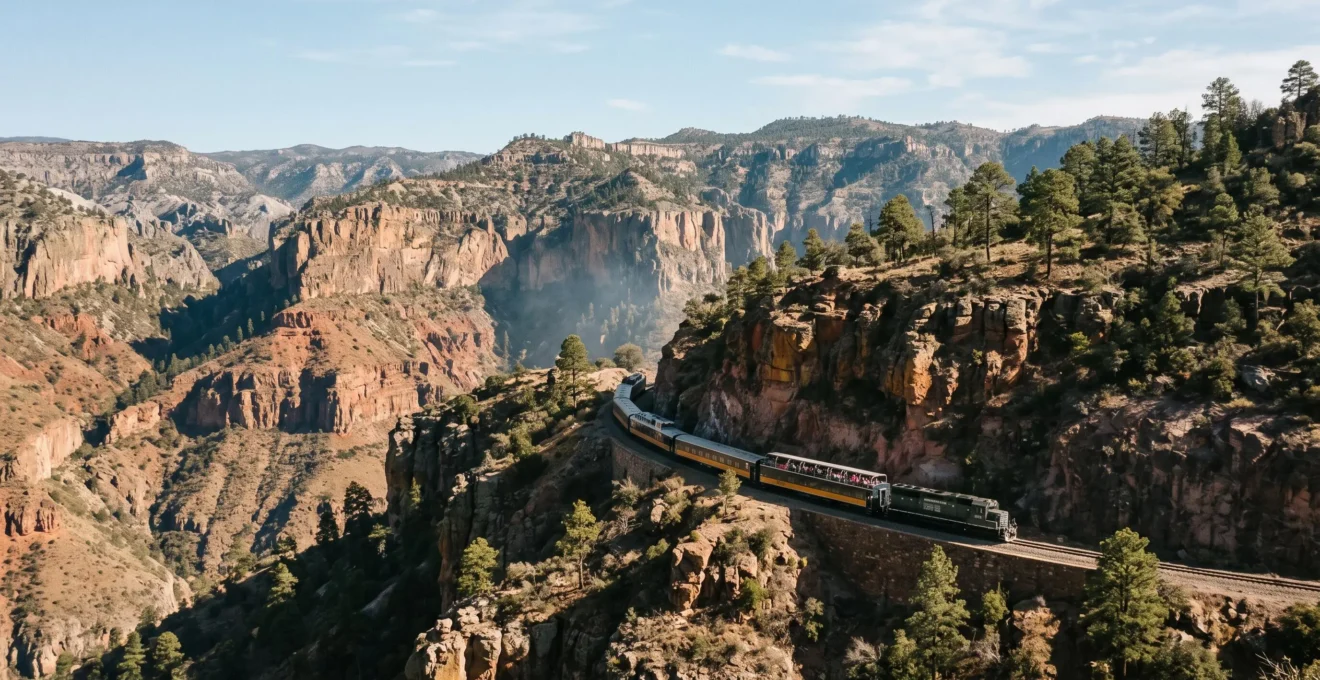
Mexico has passenger trains, but travelling around the country by rail requires a different approach from planning a European railway holiday. There is no comprehensive intercity passenger network linking the country’s principal tourist destinations. Instead, a small number of specific corridors offer journeys that can be rewarding when they fit the itinerary.
Two particularly relevant options are Chepe Express through Copper Canyon in northern Mexico and Tren Maya across parts of the southeast. Both carry passengers, but their geographical coverage, schedules and practical uses differ considerably.
For travellers arriving from the UK, the challenge is not simply finding an attractive railway journey. It is understanding whether that journey connects the places they actually want to visit, whether tickets are available, and how much time transfers add.
The most effective approach is to identify a worthwhile rail segment first, check that it operates on the intended date, and then build a manageable itinerary around it. Where rail offers no practical connection, comfortable buses and domestic flights remain legitimate alternatives rather than compromises to a railway ideal.
Mexico by train: the essentials
- Passenger rail exists on selected corridors, notably Chepe Express and Tren Maya, rather than across a nationwide tourist network.
- Check the exact operating date, stations and ticket conditions before reserving hotels or onward transport.
- Choose trains for journeys that genuinely add value; use buses or flights where they provide better connections and greater flexibility.
- Why Doesn’t Mexico Have Europe-Style Rail for Tourists Outside a Few Corridors?
- How to Decide Between Train, Bus, and Flight in Mexico When Comfort Matters Most?
- Which Gives a Better Experience: A Scenic Rail Segment or a Road-Based Canyon Route?
- The Ticketing Mistake That Strands Travellers at a Mexican Station With No Backup Plan
- When Should You Book Rail Segments in Mexico to Avoid Missing Your Next Hotel Check-In?
- How to Pick 2 Mexican Regions for a 14-Day Trip Without Losing 3 Days to Travel?
- How to Narrow Mexico Down to 2 Destinations Using a 3-Question Travel-Style Filter?
- How to Choose a Mexico Destination When You Have 10 Days and Hate Overplanning?
Why Doesn’t Mexico Have Europe-Style Rail for Tourists Outside a Few Corridors?
Mexico does not have a Europe-style passenger rail network because its modern railway system has been organised predominantly around freight, while long-distance passenger services have been limited for decades. New passenger investment is taking place, but current tourist journeys remain concentrated in specific corridors rather than an interconnected national timetable.
Passenger rail declined substantially during the restructuring and privatisation of Mexico’s railway industry in the 1990s. Freight operations became the principal commercial use of much of the existing infrastructure. Unlike countries maintaining extensive intercity passenger services, Mexico did not preserve a comparable network of regularly scheduled trains between its principal cities.
That historical distinction matters when reading travel advice. A railway line appearing on a map does not demonstrate that passengers can board a train there. Freight tracks, proposed passenger routes and working tourist services must be treated as separate categories.
Two bookable passenger systems illustrate the distinction. Chepe Express operates along the Copper Canyon corridor between Los Mochis and Creel, calling at selected intermediate stations. Tren Maya provides passenger services across parts of southeastern Mexico, including routes involving Palenque, Campeche, Mérida, Cancún, Tulum and Chetumal.
Neither should be mistaken for a national network. Chepe Express is geographically concentrated in the northwest, while Tren Maya serves a separate southeastern region.
Other tourist or heritage services may exist intermittently, but historic names and promotional descriptions are not sufficient proof of current operation. Excursion services such as tequila-region trains require individual confirmation, and older references to Puebla–Cholula passenger operations should not be treated as current booking information.
Meanwhile, investment announcements describe a different category of railway. The Mexican government’s México–Querétaro railway project profile, reviewed in October 2026, describes a route under construction rather than an operating passenger service.
The profile reports 30.38 % overall construction progress as of September 2026 and an implementation period extending from 2025 to 2028. It also contains a separate June 2027 procurement-related milestone. These dates should not be interpreted as a confirmed passenger opening or a timetable available for booking.
Mexico’s scale also shapes transport choices. Long distances, existing coach networks, domestic flights and the complexity of coordinating passenger operations with freight movements make railway travel different from crossing countries with dense passenger networks.
Plan around individual trains that exist, not a nationwide system that might eventually emerge. This distinction makes the next decision—whether rail is actually the most comfortable transport option—considerably easier.
How to Decide Between Train, Bus, and Flight in Mexico When Comfort Matters Most?
The most comfortable way to travel in Mexico depends on the actual route, not the transport category alone. Trains can provide space and enjoyable scenery where passenger services exist, premium buses frequently offer more departure choices, and domestic flights can reduce long journeys. Compare complete door-to-door travel rather than advertised journey times.
Mexico’s premium coach market makes buses particularly relevant to travellers accustomed to rail. Operators such as ETN, Turistar and ADO offer higher-comfort products on selected routes, although seating layouts, reclining arrangements and onboard facilities depend on the service purchased.
A long-distance coach with a suitable reclining seat may be more restful than a railway journey requiring an inconvenient transfer. Equally, a train with viewing areas may offer a better experience than several hours on winding mountain roads.
For practical comparisons, assess each mode against the same criteria.
| Comfort factor | Passenger train | Premium coach | Domestic flight |
|---|---|---|---|
| Seat comfort | Depends on carriage and fare class | Reclining seats on selected services | Depends on airline, aircraft and fare |
| Journey experience | Potentially scenic and relatively relaxed | Practical, but road conditions affect comfort | Useful for long distances, with airport procedures |
| Departure flexibility | Limited to operating corridors and published trains | Often more options on established routes | Depends on airport connections and schedules |
| Motion sensitivity | Rail movement may suit some travellers better | Curving mountain roads may be uncomfortable | Turbulence and flight anxiety may matter |
| Transfers | Some stations require substantial onward travel | Terminal access varies by city | Airport transfers and security add time |
| Overnight options | No general nationwide sleeper-train network | Overnight scheduled coaches on suitable routes | Flight schedules vary |
Station location is an important hidden variable. A journey arriving at Mérida Teya does not automatically end in central Mérida. Similarly, reaching a scenic railway station in Copper Canyon may involve a pre-arranged hotel transfer rather than an immediately available taxi.
Bus terminals such as Mexico City’s Terminal Norte and Puebla’s CAPU can be convenient for relevant routes, but their location and onward transport must still be checked against the accommodation.
Night travel introduces another trade-off. A premium overnight coach can sometimes replace a daytime transfer, but travellers who struggle to sleep while seated should not assume that reclining seats provide an equivalent to a hotel bed.
There is no comparable nationwide overnight passenger railway alternative. Some tourist experiences may have distinctive accommodation arrangements, but these should not be mistaken for regular long-distance sleeper services.
Before booking, compare the total sequence: accommodation checkout, terminal transfer, waiting time, journey, arrival transfer and hotel check-in.
If the railway itself is a major attraction, the additional effort may be worthwhile. Copper Canyon is particularly useful for understanding when the experience can justify choosing rail over a simpler road transfer.
Which Gives a Better Experience: A Scenic Rail Segment or a Road-Based Canyon Route?
Chepe Express is generally the stronger choice when experiencing the railway and observing Copper Canyon from the train are central to the trip. A road-based itinerary offers more control over stopping points and time spent at viewpoints. Travellers who want both experiences can combine a scenic rail segment with road transfers.
Copper Canyon is not one viewpoint or a single road journey. Its mountainous landscape contains multiple canyons, settlements and access routes. The railway and roads provide different perspectives rather than interchangeable sightseeing experiences.
Chepe Express connects Los Mochis, El Fuerte, Bahuichivo, Divisadero and Creel on its published regular-season route. The changing landscape is part of the reason for travelling, rather than merely scenery visible between two cities.
Onboard viewing spaces offer opportunities to observe the terrain without coordinating road stops. Availability and access to particular carriages or viewing areas depend on the train product and booking conditions.
Road-based visits provide a different advantage: the possibility of spending longer at selected viewpoints, arranging short walks and stopping where access is permitted. That flexibility depends on the actual road itinerary and transport provider; ordinary scheduled buses should not be confused with private sightseeing transfers.
Comfort is another consideration. The railway avoids prolonged exposure to some winding mountain roads, which may suit people prone to car sickness. However, train movement, carriage seating and journey length also affect individual comfort.
The strongest compromise may be a hybrid itinerary. For example, a traveller could reserve the Divisadero–El Fuerte rail segment and use pre-arranged road transport for other parts of the trip.
Under the operator’s published regular-season timetable, the service towards El Fuerte is scheduled to leave Divisadero at 09:55 and arrive at 14:35. The timetable is subject to the relevant operating calendar and should not be treated as a guarantee of actual arrival.
Fare comparisons also require care. Tourist rail services may carry a significant premium over some road transport options, but the exact difference depends on the date, fare class and road alternative. A fixed claim that the train always costs several times more would not be justified without comparable quotations.
Instead, ask what the additional fare buys. For someone who primarily wants to photograph scenery from a railway carriage, that experience may justify the cost. For someone focused on hiking and longer viewpoint stops, a well-organised road itinerary may deliver greater value.
Once the preferred segment is clear, the next challenge is operational: obtaining the right ticket and avoiding an assumption that another departure will be available whenever needed.
The Ticketing Mistake That Strands Travellers at a Mexican Station With No Backup Plan
The most consequential ticketing mistake is treating a Mexican tourist train like a frequent intercity bus. Some trains run only on particular days, while intermediate stations may not sell tickets at all. Arriving without the correct reservation can leave travellers unable to board, with limited alternatives for continuing their journey.
Chepe Express provides a particularly clear example. Its regular-season timetable lists departures from Los Mochis towards Creel on Monday, Thursday and Saturday, with services in the opposite direction on Tuesday, Friday and Sunday.
Those are published operating patterns, not permission to assume availability on every corresponding calendar date. Travellers must consult the Chepe Express official departure timetable and confirm their intended service.
The operator also distinguishes between ticket purchasing channels and boarding points. Under its published booking conditions, intermediate stations do not sell tickets. A traveller arriving at Divisadero or another intermediate stop should therefore not expect to resolve an absent reservation by visiting a ticket counter.
Small stations also create a practical recovery problem. An alternative road connection might require a hotel shuttle, an arranged driver or onward travel from another settlement. Availability cannot be assumed, particularly when a train is missed late in the day.
Tickets purchased through third-party websites deserve scrutiny. Resellers are not automatically illegitimate, but the traveller should establish who issues the actual ticket, which operator controls changes, and whether the reservation is confirmed in the railway company’s system.
Before finalising a booking, read the operator’s conditions for modifications, cancellations and disruptions. Chepe’s published conditions restrict voluntary refunds and changes, while arrangements following operational interruptions depend on the circumstances.
Five checks before relying on a Mexican train booking
- Confirm the exact train, date, direction and boarding station; save a screenshot or PDF of the official timetable.
- Complete the reservation through a verified channel and retain the booking confirmation showing every passenger and segment.
- Record the required boarding time and identification documents in a departure-day note.
- Contact the accommodation or a transport provider to identify a realistic fallback transfer; save the contact details and proposed alternative.
- Review the ticket-change rules and hotel cancellation conditions; produce a short written contingency plan covering a missed or cancelled departure.
The checklist is deliberately small. Its purpose is not to organise every hour of the holiday, but to protect the one part of the journey where improvisation may be particularly costly.
A confirmed reservation solves only part of the problem. The next step is coordinating that departure with accommodation and the rest of the trip.
When Should You Book Rail Segments in Mexico to Avoid Missing Your Next Hotel Check-In?
Book Mexican rail segments as soon as the intended travel date, route and accommodation sequence are sufficiently clear, especially for infrequent scenic services. There is no universal booking deadline for every railway. The practical rule is to confirm the train first, then arrange hotels and transfers around its published arrival time.
Chepe Express is particularly sensitive to this sequence because its scheduled operating days constrain the itinerary. The operator states that tickets may be purchased up to one year in advance, although that does not establish availability for every train or guarantee that an early purchase is always necessary.
The Chepe Express ticketing terms and conditions specify important requirements. Passengers must identify their travel dates, boarding and destination stations, and intended stopovers during reservation.
The operator also requires passengers to arrive at the boarding station at least 45 minutes before departure and to carry valid tickets and photographic identification.
Ticket changes and voluntary cancellations face restrictions. Some conditions are particularly restrictive for the Divisadero–Creel section. Because the published English terms contain potentially inconsistent details about penalties and notice periods, any proposed modification should be checked directly with the operator before payment.
Tren Maya has a different operating structure. Its published schedule includes several departures on the Mérida–Cancún corridor, so certain journeys may offer more timing choices than the Chepe scenic railway. However, a published departure does not guarantee a seat on the intended date.
The Tren Maya official train schedules list, for example, a Mérida Teya departure at 07:00 reaching Cancún at 10:31, as well as a Cancún departure at 10:50 reaching Mérida Teya at 14:19. These are scheduled times, subject to verification for the actual journey.
Check the arrival station carefully. Mérida Teya is not the same location as a hotel in central Mérida, and a ticket to Tulum Aeropuerto does not automatically include onward travel to a coastal resort.
A useful hypothetical planning example is a traveller taking Chepe towards Los Mochis and continuing to another hotel that evening. If the next reservation is non-refundable and requires a tightly timed transfer, even a modest operational delay could create an avoidable financial loss.
Booking accommodation near the arrival area or reserving a flexible hotel night can reduce that exposure. During Semana Santa, Christmas and summer holiday periods, it is sensible to check both rail and accommodation availability earlier, without assuming identical demand patterns across every route.
The correct buffer depends on the consequences of disruption. A minor delay may simply affect dinner; a missed onward flight can jeopardise a much larger part of the holiday.
Once the fixed rail day is secured, the wider itinerary should be simple enough that travelling between regions does not consume the holiday itself.
How to Pick 2 Mexican Regions for a 14-Day Trip Without Losing 3 Days to Travel?
For a 14-day Mexico holiday, choose two regions that connect logically through a direct flight, a useful passenger rail corridor or a manageable road journey. Avoid selecting destinations solely because they look attractive individually. The strongest pairing minimises transfers while leaving enough time to experience each place.
Mexico’s geographical scale makes this especially important. Two neighbouring areas may combine into one manageable itinerary, while two distant regions can require flights, terminal transfers and additional overnight stays.
A practical planning allowance is one travel day for each substantial change of region, plus a half-day contingency where the connection is complicated or the consequences of disruption are significant. This is a planning assumption, not a measured average journey time.
For a holiday of 14 days, reserving too many days for movement can quickly erode the time available for sightseeing, rest and spontaneous excursions.
Rail enthusiasts have two useful ways to structure the choice.
- One rail-centred region: Build the holiday around Copper Canyon, using Chepe Express for a selected scenic section and arranging other local movements around the confirmed timetable.
- One interconnected southeastern region: Combine destinations such as Mérida and Cancún, potentially incorporating Tren Maya where the stations, departure times and onward transfers are suitable.
A separate second region can be added when the connection is sufficiently straightforward. For example, a traveller interested in Copper Canyon and a contrasting coastal stay should first verify transport between the chosen rail endpoint and the beach destination, rather than assume that the railway itself completes the connection.
For southeastern Mexico, it may be more practical to treat several nearby destinations as one regional itinerary instead of repeatedly returning to a distant transport hub.
There is also a distinction between geographic closeness and easy transport. Two places may appear relatively near on a map but still require an inconvenient sequence of transfers.
Evaluate each pairing by asking whether the journey provides a direct connection, how long the terminal transfers take, and whether the schedule allows a comfortable arrival.
If neither region intersects a passenger railway, do not force one into the trip. A rail-free itinerary can be the best result of a realistic transport assessment.
With a manageable regional structure established, personal preferences become more useful than adding further destinations.
How to Narrow Mexico Down to 2 Destinations Using a 3-Question Travel-Style Filter?
Reduce Mexico to two destinations by answering three questions: whether transport itself should be a memorable experience, how much itinerary structure feels comfortable, and which climate and landscape suit the travel dates. These answers help distinguish a rewarding scenic railway holiday from a more efficient trip based around cities, beaches or road excursions.
The filter works best before booking accommodation because it prioritises the experience the traveller actually wants, rather than attempting to include every appealing place.
- Is the journey part of the attraction? If travelling through dramatic scenery by train is a central goal, Copper Canyon deserves consideration. If transport is simply a way to reach activities, rail should enter the shortlist only where it offers a practical connection.
- How much scheduling can you tolerate? Infrequent railway services require commitment to specific dates. Travellers who dislike early starts, repeated one-night stays or tightly controlled connections should prefer fewer bases and more flexible local excursions.
- Does the season suit the chosen landscape? Northern mountain regions, highland cities and coastal destinations experience different weather conditions. Check seasonal temperatures and rainfall for the actual destinations and dates rather than relying on a single description of Mexico’s climate.
Copper Canyon presents an additional comfort factor: significant altitude variation along the wider route. Travellers should consider the weather and conditions at both their overnight location and the railway endpoints. Weather at a canyon-rim destination may differ from conditions at lower elevations.
To see how the filter works, consider two hypothetical travellers.
Two hypothetical destination choices
Traveller A: Enjoys scenic transport, prefers a slow pace and wants mountain landscapes. A Copper Canyon itinerary with a confirmed Chepe Express segment and a longer stay near a selected canyon viewpoint may suit this profile.
Traveller B: Values convenience, enjoys varied urban experiences and prefers flexible daily decisions. Two destinations with a direct flight or straightforward coach connection may be more appropriate than travelling to a railway corridor solely to experience a train.
Neither choice is inherently superior. The first allocates more holiday time to the journey; the second reduces dependence on a fixed rail timetable.
This distinction is particularly useful for UK travellers accustomed to rail-based city breaks. In Mexico, a train journey may be an activity worth arranging deliberately rather than the default connection between attractions.
Once these preferences are clear, a short holiday becomes easier to organise without building an unnecessarily detailed daily schedule.
Key decisions before booking
- Give each fixed rail departure a clear purpose: either a valuable scenic experience or a genuinely useful connection.
- Match the number of destinations to your tolerance for transfers, rather than filling every available day.
- Keep flexible activities separate from transport bookings that cannot easily be rearranged at short notice.
How to Choose a Mexico Destination When You Have 10 Days and Hate Overplanning?
For a relaxed 10-day trip to Mexico, choose one main region with several accessible activities and reserve only the essential fixed commitments. If a train is important, confirm that single journey before departure. Leave ordinary excursions, restaurants and flexible local transport decisions until closer to the day whenever availability permits.
The temptation to add Mexico City, Copper Canyon, Mérida and a beach stay into one short visit can produce an itinerary dominated by transfers. A simpler trip gives more time to explore and reduces the consequences of unexpected changes.
For travellers interested in southeastern Mexico, Mérida can serve as a base for exploring the city and arranging selected regional excursions. Tren Maya may provide a useful connection for particular journeys, but station access and the onward leg must be considered before choosing rail over a coach or private transfer.
Guadalajara offers a different possibility: an urban base with opportunities to investigate excursions into the surrounding region, potentially including tequila-country railway experiences when a confirmed tourist service is available. Such excursions should be treated as date-specific products rather than guaranteed daily transport.
The minimum viable itinerary can be built around three decisions.
- Choose a main destination with enough activities to occupy most of the stay.
- Reserve international flights and any genuinely essential rail departure.
- Identify suitable local transport options, leaving non-essential day trips flexible.
Bus operator booking platforms and terminal ticket offices can help with shorter-notice decisions, subject to seat availability. The flexibility of any particular coach journey still depends on its timetable, demand and cancellation conditions.
Rail requires a more deliberate approach. Arriving at a station without a valid reservation may mean there is no usable departure that day, particularly along an infrequent scenic corridor.
The solution is not to plan every hour. It is to separate decisions that can safely wait from those that cannot.
A confirmed scenic train journey, accommodation near the relevant station and a realistic onward transfer may be enough structure to preserve flexibility across the rest of the holiday.
For travellers whose preferred destination has no practical railway connection, there is no need to add one. Mexico offers many worthwhile trips that are better organised by road or air.
Start with a shortlist of two destinations, identify the one fixed transport booking that matters most, and verify it with the operator. Build the remaining days around experiences rather than an obligation to keep moving.
Can you travel from Mexico City to Cancún entirely by passenger train?
No continuous, bookable passenger railway connection between Mexico City and Cancún is established by the operating routes covered here. Tren Maya serves parts of southeastern Mexico, but it should not be mistaken for a train connecting the capital directly to Cancún. Travellers should compare domestic flights and other available transport for the journey.
Does Chepe Express run every day?
No. Its published regular-season schedule lists Los Mochis–Creel services on Mondays, Thursdays and Saturdays and Creel–Los Mochis services on Tuesdays, Fridays and Sundays. Travellers should verify the exact operating calendar before reserving tickets or accommodation.
Can you buy a Chepe Express ticket at Divisadero station?
The operator’s published terms state that intermediate stations do not sell tickets. Passengers should reserve through an official channel before travelling, confirm their boarding station and retain the required ticket and photographic identification.
Is Tren Maya suitable for exploring the Yucatán Peninsula without a hire car?
Tren Maya provides passenger connections involving several destinations across the southeast, including Mérida and Cancún. It can form part of a car-free itinerary, but it does not automatically provide transport between railway stations, accommodation and individual attractions. These onward connections must be verified separately.
Should UK travellers book a Mexican railway journey before flying to Mexico?
Advance reservation is advisable when a particular train is essential to the holiday, especially on infrequent scenic services. Confirm the operating date, ticket conditions and station transfers before committing to non-refundable accommodation. For more frequent services, the appropriate booking lead time depends on availability and the flexibility of the wider itinerary.