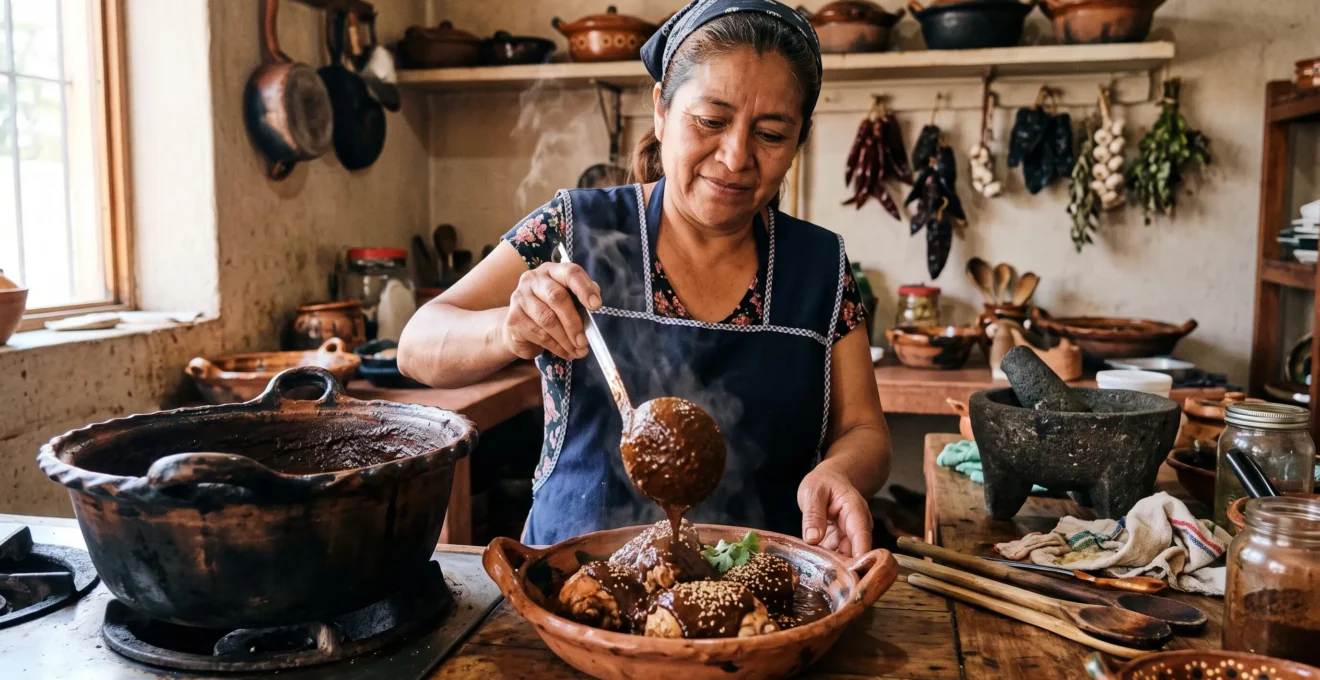
Ordering mole in Mexico can feel surprisingly complicated. One restaurant serves a dark, velvety sauce over chicken; another offers a bright green preparation with herbs; a third lists several unfamiliar varieties without explaining how they differ. None is necessarily more authentic than the others.
The first distinction worth learning is that mole is generally a prepared, multi-ingredient sauce central to a dish, whereas salsa often functions as a condiment. Both categories are diverse, and neither tells you exactly how hot, sweet or rich your meal will be. Long-cooked preparations may feature dried chillies, seeds, spices, fruit or chocolate, but ingredients and methods vary considerably.
For UK travellers, the easiest introduction is not to memorise dozens of names. It is to recognise a few flavour patterns, taste small portions, ask sensible questions and understand when traditional dishes are usually served. That approach opens up the regional cooking of Puebla, Oaxaca, Hidalgo and beyond without turning every meal into a guessing game.
Mexican mole and slow-cooked sauces: the essentials
- Start with a manageable portion of coloradito or a herbaceous mole verde before exploring darker, richer preparations.
- Ask about both chilli heat and flavour, because colour, chocolate and the word mole do not reliably predict spiciness.
- Plan traditional pit-cooked barbacoa for a weekend morning where available, rather than assuming it is an evening barbecue dish.
- Why Can the « Same » Mole Taste Totally Different Two Streets Apart in Mexico?
- How to Taste Slow-Simmered Sauces in Mexico Without Overwhelming Your Palate on Day 1?
- Which Is Better for Beginners: Sauce-Coated Dishes or Sauce on the Side at Mexican Restaurants?
- The Expectation Mistake That Makes UK Travellers Hate Mole After One Bite
- When Should You Try Heavy Slow-Simmered Sauces to Avoid a Sluggish Afternoon in the Heat?
- How to Ask About Chilli Heat in Mexico in 2 Simple Questions Without Sounding Rude?
- How to Find Pit-Oven Barbacoa Before It Sells Out Without Knowing the Area?
- Where Should You Try Pit-Oven Cooking in Mexico if You Can’t Eat Very Late at Night?
Why Can the « Same » Mole Taste Totally Different Two Streets Apart in Mexico?
Two restaurants can serve something called mole poblano yet produce noticeably different flavours because mole is not governed by one compulsory recipe. Family traditions, local ingredients, chilli combinations and preparation methods all influence the result. Even neighbouring kitchens may balance bitterness, sweetness, smokiness and richness differently, so one disappointing tasting should never define an entire mole style.
In many Mexican communities, preparing mole involves knowledge passed between generations. Cooks may adjust the selection of dried chillies, proportions of seeds, roasting techniques or other ingredients according to household preferences. These choices influence not just flavour but also colour, consistency and aroma.
Oaxaca illustrates this diversity particularly well. As explained in Food & Wine‘s feature on Oaxaca’s seven traditional moles, the commonly cited varieties include negro, rojo, coloradito, amarillo, verde, chichilo and manchamanteles. The region’s repertoire extends well beyond these seven names.
A useful starting point is to consider three characteristics together: colour, texture and the ingredients described by the cook. None is a definitive identifier, but their combination helps you anticipate what might arrive.
| Regional context | What you might encounter | What to ask |
|---|---|---|
| Oaxaca | Dark, red, green or yellow preparations; herbs, chillies, fruit or cacao depending on the recipe. | Which mole is lighter, more herbal or less sweet today? |
| Puebla | Mole poblano featuring dried chillies, spices, seeds and sometimes a chocolate note. | Is this version more savoury, bitter or sweet? |
| Michoacán | Local and household mole traditions with varying ingredients and preparation styles. | Is this a regional speciality or the cook’s family recipe? |
Colour can provide a clue, but a dark sauce is not automatically sweeter or hotter than a green one. Similarly, chocolate may add depth without producing a dessert-like flavour.
Another distinction concerns preparation. A restaurant that specialises in a particular family-style mole may offer a different experience from an establishment working with prepared sauce bases or larger batches. However, menu length, pot size and tourist clientele are not reliable tests of authenticity or quality.
Instead, ask which mole is prepared in-house, what distinguishes the day’s version and whether the kitchen has a house speciality. Specific, informative answers are more useful than assumptions based on the restaurant’s appearance.
The most rewarding attitude is to treat every mole as a particular cook’s interpretation. Once that variation becomes expected rather than confusing, the next challenge is discovering how much to taste.
How to Taste Slow-Simmered Sauces in Mexico Without Overwhelming Your Palate on Day 1?
The easiest way to explore Mexican slow-simmered sauces is to increase their intensity gradually. Begin with a small taste of a relatively light preparation, try a spoonful of mole alongside rice or a tortilla, and only then order a dish generously covered in sauce. Spreading tastings across several meals makes individual flavours easier to appreciate.
A first day in Mexico may already involve unfamiliar aromas, eating schedules and chilli levels. Ordering several rich sauces together can make it difficult to identify what you actually enjoy.
Begin with a simple antojito, such as a tortilla-based snack, accompanied by a mild salsa whose heat you have checked. Salsa is not the same as mole, but this gives you a manageable opportunity to become familiar with local chilli flavours.
Next, look for an opportunity to try a small amount of mole. A coloradito can be an approachable choice, while some versions of mole verde offer a fresher, herbaceous contrast. Neither name guarantees a particular heat level.
Rice and tortillas are especially practical companions because they let you alternate between concentrated sauce and relatively neutral mouthfuls. They do not chemically neutralise capsaicin, but they can make the tasting feel less intense by changing the proportion of sauce in each bite.
Water and aguas frescas are common drinks to accompany a meal. A refreshing beverage can provide a pleasant pause, although sugary drinks are not dependable remedies for chilli burn. For particularly spicy food, dairy may offer more relief if available and suitable for your diet.
One avoidable mistake is adding a hot table salsa to a mole before tasting the dish itself. Doing so may obscure the careful balance of spices, nuts, chillies and other ingredients.
Your five-step first-day mole tasting checklist
- Choose one mild-looking antojito and ask about its chilli heat. Record the dish name.
- Select one mole variety to sample in a small portion. Note its name and regional context.
- Take a little sauce with rice or tortilla before adding anything spicy. Identify one dominant flavour.
- Leave extra table salsa off the dish initially. Record whether the original sauce feels mild, medium or hot to you.
- Choose one different mole for another meal. Keep a short two-sauce comparison rather than trying everything at once.
Once you have identified a preparation you enjoy, the next decision is whether to experience it as the cook intended or request greater control over the quantity served.
Which Is Better for Beginners: Sauce-Coated Dishes or Sauce on the Side at Mexican Restaurants?
For a first experience of traditional mole, a properly sauce-coated dish usually gives a better understanding of how the preparation is meant to taste. Requesting sauce separately can still be useful when you are unsure about the chilli level or richness. The better choice depends on whether the sauce is the dish’s defining element or an optional accompaniment.
In chicken with mole, for example, the sauce is not simply a finishing condiment. Its flavour, thickness and interaction with the meat are central to the preparation. A plate with only a few drops of mole may not communicate the intended balance.
By contrast, tacos accompanied by table salsas are often designed to let diners choose their own additions. Asking for these sauces separately is entirely natural.
| Decision factor | Sauce-coated dish | Sauce on the side |
|---|---|---|
| Best use | Traditional mole-centred preparations | Optional salsas or initial small tastings |
| Main advantage | Preserves the cook’s intended combination | Allows control over quantity |
| Potential drawback | Harder to reduce intensity once served | May change the intended eating experience |
| Beginner strategy | Choose a small serving or share | Confirm whether separate service is possible |
Asking politely for an adjustment is generally reasonable, but not every preparation can be altered. A traditional mole’s chilli component is often integrated during cooking, so removing it at the table is not practical.
Two questions are particularly helpful: how spicy is the preparation, and is the sauce already incorporated into the dish? A server can then explain whether a smaller serving, another variety or a separate condiment is available.
Rather than insisting that a traditional sauce be made without chilli, request a recommendation suited to your preferences. That approach gives the kitchen room to offer something appropriate without fundamentally changing a prepared dish.
A good first mole does not have to be a large portion. What matters is tasting enough of the complete preparation to understand its character without feeling obliged to finish something you do not enjoy.
The Expectation Mistake That Makes UK Travellers Hate Mole After One Bite
The biggest expectation mistake is assuming mole will resemble a spicy tomato salsa or a familiar British-style curry sauce. Many moles are thicker and more layered, combining savoury, bitter, smoky, fruity and sometimes sweet notes. Chocolate may appear among the ingredients without making the dish taste like chocolate pudding. Expecting a familiar sauce can obscure what makes mole distinctive.
Three assumptions are worth reconsidering before your first bite.
- Heat: a sauce made with several types of chilli is not necessarily intensely hot. Preparation methods, varieties and proportions influence the result.
- Sweetness: raisins, plantain or chocolate may add sweetness or complexity, but mole is not automatically a sweet dish.
- Texture: mole often coats the food generously rather than behaving like a thin salsa intended for occasional spoonfuls.
Mexico’s official cultural information system illustrates this combination in its official cultural entry on mole poblano. Its representative ingredient description includes ancho, mulato, pasilla and chipotle chillies alongside chocolate, almonds, raisins, sesame, spices and other ingredients. The preparation is traditionally served with chicken and rice.
These ingredients help explain why a dark mole may taste roasted, nutty, savoury and subtly bitter rather than obviously chocolatey. The official description also notes restrained sweetness, an important reminder that chocolate is not a reliable predictor of a sugary sauce.
Temperature and service can influence the experience too. A freshly heated mole may release aromas more readily than the same preparation after cooling. However, neither a glossy appearance nor the temperature alone proves authenticity, freshness or careful cooking.
If possible, choose a kitchen where the staff can explain the preparation and where the dish arrives properly heated. A sauce that has separated, cooled or been held for a long period may offer a different experience, but appearance alone cannot establish why.
An especially useful mental reset is to approach mole as its own culinary category. Instead of asking whether it resembles curry, identify what the particular preparation achieves: toasted chilli depth, herbal freshness, fruit acidity, savoury richness or bitter complexity.
Not enjoying a specific mole is perfectly reasonable. The mistake is concluding from one recipe that the entire category tastes the same.
When Should You Try Heavy Slow-Simmered Sauces to Avoid a Sluggish Afternoon in the Heat?
Rich mole dishes are often easier to appreciate when you have time for an unhurried meal and do not need to start a demanding walk immediately afterwards. In hot weather, a smaller portion at lunch or a relaxed evening meal may feel more comfortable. There is no universal best hour: consider the climate, your appetite and local serving customs.
A substantial plate of meat, thick sauce, rice and tortillas can feel filling, particularly when followed by sightseeing in strong heat. This is a practical comfort consideration, not evidence that mole uniquely causes fatigue or digestive problems.
For travellers planning full days outdoors, the simplest strategy is to match meal size to the itinerary.
- On an intensive walking day, consider a lighter lunch and save a rich mole for a calmer meal.
- On a museum or market day, allow more time for a leisurely lunch, especially if the restaurant specialises in slow-cooked dishes.
- In warm coastal areas, prioritise shade, hydration and portion size rather than assuming heavy dishes must always be avoided.
- In higher-altitude destinations such as Mexico City or Oaxaca City, cooler conditions may make a substantial meal more appealing, although the weather still varies by season and time of day.
Mexican meal schedules also matter. The principal meal, comida, is commonly eaten during the afternoon rather than at the earlier lunchtime typical of many UK households. Restaurants specialising in traditional preparations may therefore be particularly suitable for an afternoon visit.
Travellers who prefer an early dinner should check whether a chosen restaurant serves its mole in the evening. Availability may depend on the establishment and the dish.
Sharing one serving between two people, where permitted, is another practical option. It allows you to discover a rich preparation without committing to a very large meal, especially if you are planning to explore other foods later.
The same scheduling principle applies to traditional barbacoa, but with an important difference: in several central Mexican traditions, pit-cooked barbacoa is particularly associated with the morning and early afternoon.
Food exploration works best as part of the itinerary, not as a challenge to squeeze the heaviest dishes into every available meal.
How to Ask About Chilli Heat in Mexico in 2 Simple Questions Without Sounding Rude?
Two short Spanish questions make ordering much easier: “¿Pica mucho?” asks whether something is very spicy, while “¿Es picante o dulce?” asks whether it is spicy or sweet. Both are polite, straightforward ways to clarify the flavour of an unfamiliar sauce. Because heat tolerance varies, the most useful follow-up is to request a mild recommendation or a small taste when possible.
The first question focuses on intensity:
¿Pica mucho? — “Is it very spicy?”
Approximate pronunciation for English speakers: “PEE-kah MOO-choh?”
The second question helps distinguish flavour profiles:
¿Es picante o dulce? — “Is it spicy or sweet?”
Approximate pronunciation: “ess pee-KAHN-teh oh DOOL-seh?”
This second question is particularly useful when discussing an unfamiliar mole. Bear in mind that spicy and sweet are not mutually exclusive: a sauce may have both characteristics, along with smoky, savoury or bitter notes.
If someone replies “pica poquito”, they mean it is a little spicy. However, that judgement reflects the speaker’s own experience and may not match yours.
A practical way to calibrate your palate is to ask which table salsa is mildest and, if a sample is available, taste a very small amount with a spoon or food. Do not assume that a mild table salsa predicts the heat of a different cooked sauce.
For further clarity, you can say “No como mucho picante” — “I don’t eat much spicy food.” This states your preference without criticising the cooking.
It is also helpful to recognise the difference between asking for less table salsa and requesting that the chilli be removed from a finished mole. The first may be easy; the second may be impossible because the ingredients have already been cooked together.
If you have a food allergy, separate and more detailed ingredient questions are essential. Mole can contain nuts, seeds, wheat-containing ingredients and other allergens, and a conversation about chilli heat does not establish that a dish is safe for you.
A little specific vocabulary creates a more useful conversation than simply asking whether the food is “too spicy”, and makes it easier for restaurant staff to recommend something suitable.
How to Find Pit-Oven Barbacoa Before It Sells Out Without Knowing the Area?
To find traditional pit-cooked barbacoa, start your search in the morning, particularly at weekends in regions known for this style of cooking. Ask local market vendors where barbacoa is served, confirm whether the meat is cooked in an earthen pit and check when service begins. Some producers sell limited batches, but availability and sell-out times vary.
Traditional barbacoa differs from the grilled meat often associated with British or American barbecue. In parts of central Mexico, lamb is slowly cooked in an underground oven, sometimes wrapped in maguey leaves.
Preparation may begin the previous evening, with the meat served the following morning. This helps explain why a place specialising in traditional barbacoa may be busiest at breakfast or brunch rather than at dinner.
The cooking method itself is worth asking about. The word barbacoa does not guarantee that a particular establishment uses an underground pit, and reputable cooks may use different techniques.
For a traveller unfamiliar with the neighbourhood, a practical search starts with human recommendations rather than relying exclusively on tourist restaurant listings.
- Ask at your accommodation whether a local market serves traditional barbacoa on weekend mornings.
- Visit or contact the market early enough to confirm which stalls are operating.
- Ask vendors “¿Dónde hay barbacoa de horno de tierra?” — “Where can I find earth-oven barbacoa?”
- Check whether service is limited to certain days and whether a vendor recommends arriving before a particular time.
- Keep another breakfast or market option available in case the recommended stand is closed or has sold out.
Local queues, visible cooking activity and signs announcing barbacoa may help you identify a promising establishment, but none proves that the meat has been prepared in a pit.
Likewise, all-day availability is not evidence that food has been frozen or industrially produced. Restaurants may prepare multiple batches, employ different cooking methods or organise service differently. Ask about preparation rather than drawing conclusions from opening hours.
Remember that an authentic local experience also depends on ordinary food-service considerations: cleanliness, appropriate handling and properly cooked and held meat matter more than rustic surroundings.
Once you understand the morning-service tradition, it becomes easier to choose regions and markets where pit-cooked barbacoa is culturally established.
Key takeaways before planning a barbacoa morning
- Choose a destination associated with documented pit-cooking traditions rather than assuming every barbacoa restaurant uses an underground oven.
- Prioritise weekend morning availability, but verify the particular vendor’s schedule before travelling.
- Build in flexibility: a market visit can still be rewarding if your preferred barbacoa stand is not operating.
Where Should You Try Pit-Oven Cooking in Mexico if You Can’t Eat Very Late at Night?
Central Mexico offers several practical opportunities to experience traditional pit-cooked barbacoa without eating late. Hidalgo and the Teotihuacan Valley are particularly relevant, with documented traditions of slow-cooked lamb associated with mornings, weekends and celebrations. Mexico City can provide convenient market-based starting points, although individual vendors and preparation methods should be checked before visiting.
In Metztitlán, Hidalgo, the municipality describes a tradition of lamb barbacoa cooked slowly in an earthen oven and wrapped in maguey leaves. The meat is commonly accompanied by consommé, salsa borracha and freshly made tortillas.
The local authority’s traditional gastronomy page for Metztitlán also associates the dish with Sundays, family celebrations and community fairs. This offers a useful cultural starting point, although it is not a current list of individual vendors or their opening times.
The Teotihuacan Valley, in the State of Mexico, offers another documented tradition. Mexico’s National Institute of Anthropology and History describes barbacoa cooked overnight in a pit heated with wood and stones, with preparations associated with weekend morning meals.
Its account identifies Sunday morning at San Juan Teotihuacan market as a traditional opportunity to encounter barbacoa. This is a regional recommendation rather than confirmation that a particular vendor will be operating on your travel date.
For visitors staying in Mexico City, markets and specialised barbacoa establishments can be practical alternatives to travelling farther afield. However, the city has many barbacoa styles, and finding a place serving the dish does not automatically confirm pit-oven preparation.
| Destination | Reason to consider it | Planning consideration |
|---|---|---|
| Metztitlán, Hidalgo | Locally documented earth-oven lamb barbacoa tradition. | Confirm market or festival opportunities and local transport. |
| San Juan Teotihuacan, State of Mexico | Documented weekend-morning barbacoa tradition. | Check Sunday vendor availability before travelling. |
| Mexico City | Convenient access to markets and specialised food establishments. | Verify which vendors actually use traditional pit cooking. |
The most effective itinerary treats barbacoa as a morning food experience rather than a late-night restaurant booking. A weekend market visit can combine a meal with observations of local ingredients, tortillas, accompaniments and regional eating customs.
If you specifically want to see an oven being opened, ask whether visitors are allowed to observe that stage of preparation. Many establishments serve the meat away from the cooking pit, so seeing the process should never be assumed.
Mixiote is another central Mexican preparation worth exploring. It involves seasoned meat cooked in a wrapping, traditionally associated with maguey. Although it shares aspects of regional slow-cooking culture, it should not automatically be described as pit-oven cooking: the cooking equipment and techniques vary.
For an early eater, the main challenge is not staying out late but coordinating transport and vendor availability. Treat the visit as a flexible morning activity, with another food stall or market breakfast as your backup option.
For your next Mexican food outing, choose one regional sauce to explore and one morning market where traditional barbacoa is documented. Confirm the practical details locally, arrive with curiosity rather than a fixed expectation, and let the preparation itself guide what you order next.
Does every Mexican mole contain chocolate?
No. Chocolate or cacao appears in some recipes, including many versions of mole poblano and mole negro, but other varieties rely on combinations of herbs, chillies, seeds, spices and other ingredients without chocolate. The particular recipe matters more than the general name.
Is mole always spicy?
No. Chilli is important in many moles, but the perceived heat varies considerably. Some preparations emphasise roasted, herbal, savoury, fruity or bitter flavours rather than intense heat. Ask about the specific mole before ordering rather than judging its spiciness by colour.
Can vegetarians eat traditional mole?
Some mole sauces can be vegetarian, but this should never be assumed. Recipes may include animal-based stock or other animal ingredients, and the finished dish may contain meat. Ask about both the sauce and its preparation, not simply whether chicken can be omitted.
Is barbacoa the same as carnitas?
No. Traditional barbacoa in parts of central Mexico involves slow-cooking meat, often lamb, in an earth oven. Carnitas typically refers to pork cooked slowly in its own fat or added fat. Both may be served in tacos, but their ingredients and cooking methods differ.
Do you need to book a restaurant to try traditional pit-cooked barbacoa?
Not necessarily. Some traditional barbacoa is sold at markets and stalls without reservations. However, operating days, availability and service practices differ. For a special trip, confirm the vendor’s schedule and whether the desired cooking method is used rather than assuming that weekend service is guaranteed.