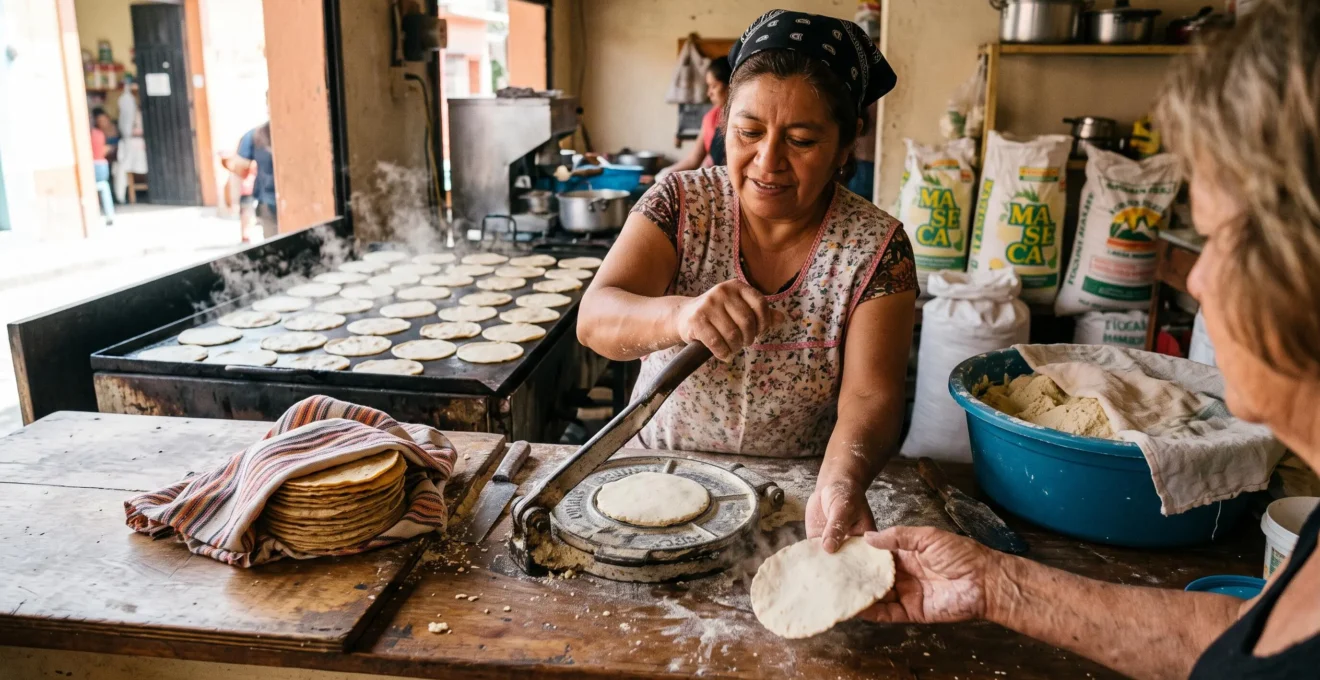
The first properly fresh corn tortilla you taste in Mexico can be surprisingly different from anything labelled a tortilla in a British supermarket. It may smell distinctly of maize, feel soft enough to fold around a filling without splitting, and taste good before anyone adds meat, salsa or cheese.
Much of that difference begins with nixtamalisation, a traditional process in which maize is cooked and soaked in an alkaline solution before being ground into dough called masa. The treatment changes how the grain behaves, including the texture and cooking properties that make corn tortillas possible.
But nixtamalisation is only part of the story. The maize variety, whether the dough is freshly ground or prepared from dried flour, how the tortilla is cooked, and how long it sits before reaching your plate all affect the experience.
You do not need to become a food purist to appreciate those differences. A few sensory clues and some straightforward questions can help you recognise good tortillas, find worthwhile taco stalls and understand why the simplest-looking food sometimes delivers the most memorable bite.
The essentials of finding better tortillas in Mexico
- Nixtamalisation changes maize starch and protein properties, creating masa that can produce flexible tortillas with a characteristic flavour and aroma.
- Judge tortillas by aroma, flexibility, cooking freshness and taste rather than colour or whether they are handmade.
- Look for busy tortillerías and stalls cooking regularly, but remember that excellent tacos can come from traditional and modern kitchens alike.
- Why Does Nixtamalised Maize Make Tortillas More Filling Than Flour Tortillas Back Home?
- How to Spot Fresh Nixtamal Tortillas in Mexico Using 5 Sensory Clues?
- Which Tacos Are Worth Your Calories: Fresh-Masa Taquerías or Packaged-Tortilla Spots?
- The Assumption About Corn Tortillas That Makes UK Travellers Miss the Best Taco Stalls
- When Should You Buy Tortillas in Mexico to Avoid Getting Yesterday’s Dry Stack?
- How to Ask About Chilli Heat in Mexico in 2 Simple Questions Without Sounding Rude?
- How to Tell if a Vendor Uses a Clay Griddle Without Asking Awkward Questions?
- How Clay Griddles Change the Taste of Mexican Street Food and Where You’ll Actually Find Them
Why Does Nixtamalised Maize Make Tortillas More Filling Than Flour Tortillas Back Home?
Nixtamalised maize tortillas can feel more satisfying than the flour tortillas you usually eat at home, but they are not scientifically established as universally more filling. Nixtamalisation changes the maize’s structure and nutritional properties; actual fullness depends on tortilla size, ingredients, fillings and how much you eat.
The difference starts before the dough reaches the griddle. Traditional nixtamalisation involves cooking dried maize kernels in water containing food-grade calcium hydroxide, often called cal or slaked lime. The kernels are then soaked, washed and ground into masa.
This is not the citrus fruit lime. It is an alkaline mineral treatment that changes the maize’s starch and protein characteristics, helps soften the grain and creates dough suitable for making tortillas.
According to a scientific review of nixtamalisation and tortilla production published in 2025, traditional processing commonly involves cooking maize in an approximately 1–2% calcium hydroxide solution for 20–60 minutes, followed by soaking that generally lasts 8–12 hours. These are reported processing ranges, not instructions followed identically by every producer.
The process also affects calcium content and nutritional characteristics, including aspects of protein digestibility and niacin availability. However, improved nutrient availability does not automatically mean greater satiety.
Corn masa and wheat-flour dough behave differently. Wheat tortillas typically rely on gluten-forming proteins to create elasticity. Nixtamalised maize masa develops its workable texture through different changes in the grain, including hydration and starch behaviour.
As a result, comparing a small Mexican street taco with a large British supermarket wrap tells you very little about which food will keep you full longer. A large wheat tortilla may contain more total energy than a small maize tortilla, while taco fillings can substantially change protein, fat and fibre intake.
Geography adds another complication. Wheat-flour tortillas have an established place in northern Mexican cooking. In central and southern Mexico, maize tortillas are especially prominent, although regional practices and individual businesses vary. Even within maize tortillas, fresh masa and industrial nixtamalised flour coexist.
For travellers, the strongest reason to try a freshly prepared maize tortilla is its distinctive taste and texture. Treat any feeling of extra fullness as a personal experience rather than a guaranteed nutritional advantage.
How to Spot Fresh Nixtamal Tortillas in Mexico Using 5 Sensory Clues?
Fresh nixtamal tortillas are best assessed through several clues together: a recognisable maize aroma, a soft fold, warmth from recent cooking, natural-looking variation and a pleasant flavour when eaten plain. None proves how the masa was produced, but together they offer a practical way to judge quality at a Mexican stall.
The science supports paying attention to sensory differences. A Mexican sensory study of fresh and packaged tortillas, published in 2011, compared selected tortilla products using five trained assessors. Fresh tortillas exhibited a characteristic nixtamal aroma, while the packaged products tested showed different sensory properties, including an acetic-acid aroma.
The study concerned specific samples, so it cannot establish a universal test for every tortilla sold in Mexico. It does, however, illustrate why smell and texture deserve attention alongside appearance.
Here are five useful clues to check without turning lunch into an inspection.
- Aroma: A freshly cooked tortilla may have a pronounced maize smell, sometimes accompanied by earthy, toasted or subtly mineral notes. A weak aroma is worth noticing, although ingredients and temperature also influence it.
- Flexibility: A properly cooked, warm tortilla should usually fold comfortably around its filling. Cracking can indicate drying, cooling or an unsuitable texture, but it does not identify the dough’s origin.
- Warmth and steam: Steam rising from a fresh batch is a useful sign of recent cooking. Its absence is not conclusive, particularly if the tortilla has been held warm or reheated.
- Colour: White, yellow and blue maize can all produce excellent tortillas. Natural variation is normal, and a uniform appearance is not proof of industrial production.
- Plain flavour: Take a bite without salsa. The tortilla should contribute something enjoyable of its own rather than acting solely as an edible wrapper.
One important distinction is often missed: fresh masa and masa harina are not the same production method, but both can be made from nixtamalised maize. Masa harina is dried nixtamalised maize flour that is rehydrated to make dough. It can produce good tortillas when prepared and cooked carefully.
The practical tasting test is simple: order a taco, take a small bite of the exposed tortilla before adding salsa, and notice whether it has flavour and bends naturally. If you are buying tortillas separately, tasting one plain is even easier.
Do not judge a tortilla simply because it looks unusually pale. A tortilla still cooking may appear different from one ready to serve. Likewise, a blue maize tortilla can be completely traditional even if it looks unfamiliar.
Once you can recognise a tortilla that contributes flavour rather than merely holding a filling, choosing between taco stalls becomes much more interesting.
Which Tacos Are Worth Your Calories: Fresh-Masa Taquerías or Packaged-Tortilla Spots?
Choose a fresh-masa taquería when the tortilla itself is a major part of what you want to experience, particularly if you can see dough being pressed and tortillas cooking regularly. But a packaged-tortilla spot can still serve an excellent taco. Freshness, filling quality, preparation and food hygiene matter more than a single authenticity label.
At a promising taquería, observe the working counter before ordering. A tortilla press, covered masa, an active comal or frequent deliveries from a nearby tortillería can reveal how the operation works. None is a guarantee of quality, and a stall without a visible press may still use freshly prepared tortillas made elsewhere.
Customer turnover is another useful practical clue. When tortillas are cooked or replenished repeatedly, there may be less time for them to cool and lose flexibility. However, busy counters are not automatically better, and a quieter business may prepare smaller batches carefully.
It helps to compare the choices without treating either as inherently good or bad.
| What to check | Fresh-masa taquería | Packaged-tortilla spot |
|---|---|---|
| Tortilla flavour | Opportunity to taste recently prepared maize dough | Can still be pleasant, especially if properly heated |
| Texture | Often soft when cooked and served promptly | Depends on product, storage and reheating |
| Preparation | May feature pressing or cooking in view | Often prioritises speed and consistency |
| Fillings | Quality must be evaluated separately | May be the establishment’s main strength |
| Best decision | Choose when exploring tortilla craftsmanship | Choose when the complete taco appeals |
Price alone is a poor guide. Fresh masa involves preparation, labour and ingredient choices, but those costs do not translate into a universal price premium or prove that a more expensive taco tastes better.
A simple way to explore the difference is to eat a freshly cooked tortilla on its own at least once, then compare it with a taco built around an especially good filling. This separates two different pleasures: appreciating the tortilla and enjoying the finished dish.
Your five-step taco stall field checklist
- Check the cooking station: Identify whether tortillas are being cooked, pressed or regularly reheated; note what you can actually see.
- Look for stock movement: Watch whether a fresh batch appears while you are there; record a simple yes or no.
- Order one taco first: Assess the tortilla before adding extra salsa; identify one specific flavour or texture you notice.
- Evaluate the filling separately: Decide whether seasoning, texture and serving temperature satisfy you; make a separate judgement from the tortilla.
- Compare another stall: Try a different preparation style and keep a brief two-point comparison of tortilla quality and overall enjoyment.
These actions are practical travel heuristics, not a scientifically validated restaurant-rating system. They help you make your own comparisons instead of relying on claims such as handmade, authentic or traditional.
After a few comparisons, your preferences may change. You might become fascinated by fresh masa, or discover that a particular salsa and filling combination matters more to you. Both are valid ways to enjoy Mexican food.
The Assumption About Corn Tortillas That Makes UK Travellers Miss the Best Taco Stalls
The mistake is assuming that every corn tortilla will resemble the dry, brittle supermarket versions you may have encountered in Britain. That expectation can make a soft, freshly cooked Mexican maize tortilla seem unfamiliar rather than appealing. Before dismissing a corn-tortilla stall, try a plain piece and recalibrate your expectations.
British supermarkets often introduce shoppers to tortillas through long-life packaged products, particularly wheat-based wraps. Some packaged corn products are designed for storage and convenience rather than immediate consumption after cooking.
Packaging, formulation, storage conditions and reheating can all influence the result. This does not make every exported tortilla inferior, nor does it mean every industrial product contains preservatives. It means your familiar reference point may represent a different product experience.
The cultural history matters. Arqueología Mexicana‘s article on tortilla traditions explains that tortillas were historically prepared by hand, ideally close to when they would be eaten. It also describes the coexistence of mechanical tortillerías, packaged products and traditional handmade preparation.
That diversity is important because there is no single technique that defines every legitimate Mexican tortilla. A neighbourhood tortillería producing maize tortillas mechanically can be just as much part of everyday Mexican food culture as a stall pressing each one by hand.
For your first two or three corn-tortilla tacos in Mexico, try a simple mental reset:
- Notice the tortilla’s aroma before concentrating on the filling.
- Check whether it bends softly rather than expecting the firmness of a packaged shell.
- Pay attention to the maize flavour left after swallowing.
- Judge the food as it is served locally, rather than comparing it only with a British wrap.
Presentation can also mislead visitors. A small taco with a modest-looking filling may appear less substantial than a generously loaded wrap, but size and visual complexity are not reliable measures of quality.
Some street tacos use two tortillas, particularly when a filling is juicy or needs extra support. Doubling is a practical serving choice, not proof that the stall has particularly good or bad masa.
Once you abandon the supermarket comparison, the next useful question becomes surprisingly practical: when should you buy tortillas to enjoy them at their best?
When Should You Buy Tortillas in Mexico to Avoid Getting Yesterday’s Dry Stack?
Buy tortillas when a tortillería is actively producing them or shortly before you intend to eat. Local meal periods can be useful opportunities because demand may encourage repeated cooking, but no single hour guarantees freshness. Look for warm, flexible tortillas and ongoing production rather than relying on a fixed timetable.
Freshly cooked tortillas change as they cool and sit. Starch rearrangement, moisture movement and storage conditions can affect softness and flexibility. These changes are not identical to spoilage, and a tortilla can become firm without necessarily being unsafe.
Likewise, a tortilla that has been sitting for a while is not automatically from the previous day. The age of a stack cannot be determined reliably from appearance alone.
A neighbourhood tortillería commonly sells tortillas for home consumption, including quantities measured by weight. Markets may offer different batches throughout the day, while some street-food vendors cook to order. Each has its own production rhythm.
For a traveller, the most dependable strategy is to observe rather than assume.
- At a tortillería: Look for tortillas coming from the production line and ask whether a fresh batch is available.
- At a market: Notice whether the vendor is preparing new tortillas or simply serving from an existing stack.
- At a street stall: Watch whether tortillas reach the comal as orders arrive.
- When buying for later: Consider how you will store and reheat them, and follow appropriate food-storage practices.
Two expressions are particularly helpful when approaching the counter: tortillas recién hechas means freshly made tortillas, while calientitas describes them affectionately as nice and warm.
You can ask, ¿Tiene tortillas recién hechas? — “Do you have freshly made tortillas?” It is a straightforward request, not an accusation that the vendor sells old food.
If a tortilla feels dry or cracks when gently folded, it may have cooled or lost some flexibility. Reheating can sometimes improve its texture, but it does not recreate every characteristic of a tortilla cooked moments earlier.
There is also a difference between cooked tortillas and uncooked masa. Scientific literature reports that fresh masa has a relatively short usable life, sometimes around 4–24 hours depending on storage conditions. That range must not be treated as a universal freshness deadline for cooked tortillas.
Freshness becomes easier to judge with experience. And once the tortilla is sorted, knowing how to navigate the salsa counter can make the entire meal more enjoyable.
How to Ask About Chilli Heat in Mexico in 2 Simple Questions Without Sounding Rude?
Ask ¿Es picante? (“Is it spicy?”) or ¿Qué tan picante es? (“How spicy is it?”) before adding salsa or ordering a chilli-heavy dish. Both questions are ordinary, polite Spanish. Asking about heat is a practical way to enjoy unfamiliar food, not a criticism of the cook.
The first question, ¿Es picante?, is roughly pronounced “ess pee-KAHN-teh”. Use it when pointing to a salsa or dish you have not tried.
The second, ¿Qué tan picante es?, sounds roughly like “keh tahn pee-KAHN-teh ess”. It invites a more descriptive answer, although the response will naturally reflect the speaker’s own tolerance.
Mexican salsas vary enormously. Fresh chillies, dried chillies, roasting methods, acids and other ingredients affect their flavour and perceived heat. Green salsa is not necessarily milder than red salsa, and colour alone tells you very little about chilli intensity.
A particularly useful follow-up is ¿Cuál salsa me recomienda? — “Which salsa do you recommend?” This lets the person serving you suggest a pairing for the dish.
If you prefer gentle heat, ask ¿Tiene una salsa menos picante? — “Do you have a less spicy salsa?” There is no need to pretend to enjoy a level of heat you find unpleasant.
When salsa is available separately, start with a small taste if the vendor provides an appropriate way to sample it. Avoid dipping shared utensils or used food directly into communal containers.
Do not assume that un poquito, meaning “a little”, identifies a fixed heat level. Your idea of mild may differ from the cook’s. Asking for less sauce first is often more useful than relying on a verbal description alone.
The same polite curiosity works beyond chilli. ¿Cómo se come esto? — “How do you eat this?” — can help you understand unfamiliar tortillas, regional dishes and accompaniments without needing to know every ingredient in advance.
With the salsa question settled, you can turn your attention to another detail often hidden in plain sight: the cooking surface beneath the tortillas.
How to Tell if a Vendor Uses a Clay Griddle Without Asking Awkward Questions?
Look at the cooking surface rather than relying on the food alone. A traditional clay comal may show an earthenware body, a matte or coated surface and signs of repeated heating. Metal griddles generally have a different construction and finish. Visual inspection helps, but soot, coatings and distance can make identification uncertain.
A comal is a flat cooking surface used for tortillas and various other Mexican foods. It can be made from different materials, including clay and metal.
Clay versions are part of Mexico’s material food heritage. The Mexican museum record of a traditional clay comal documents a lime-coated clay griddle from San Lucas Quiaviní, Oaxaca. The object is associated with Zapotec culture and specifically identified as an implement for cooking tortillas.
That historical evidence confirms the traditional use of clay comals, but it does not establish how frequently modern vendors use them or prove that clay improves flavour.
When watching a stall, consider the following physical clues:
- Material: Exposed earthenware, where visible, may help distinguish clay from metal.
- Surface finish: Some clay comals have a matte or mineral-coated appearance rather than bare metallic shine.
- Shape and edges: The rim and thickness may reveal construction details when the whole griddle is visible.
- Heating arrangement: An open hearth can sometimes make the griddle’s structure easier to inspect, although either material can be heated in different ways.
Dark cooking marks are not proof of clay, because metal can develop seasoning and soot. Similarly, a dull surface is not conclusive: the museum’s documented clay example was coated with lime, demonstrating that clay comals need not all look like exposed terracotta.
Sound is an even less dependable clue. Street noise, cooking technique and the food itself make it difficult to distinguish materials acoustically.
If you remain curious, it is perfectly reasonable to ask a brief, friendly question such as ¿Es un comal de barro? — “Is that a clay griddle?” A respectful question about equipment is not inherently rude. Choose a moment when the vendor is not handling a rush of orders.
You can also open with ¡Qué rico huele! — “That smells delicious!” — before asking about the preparation. The interest should be genuine rather than a performance of insider knowledge.
A good metal comal can produce superb tortillas. The more interesting question is what clay actually changes during cooking and where you might encounter it on your travels.
What to remember before seeking out a clay comal
- Look for evidence of the cooking material, but do not treat dark marks or a matte finish as definitive identification.
- Prioritise tortillas that taste good and are properly cooked; the equipment alone cannot guarantee quality.
- Approach traditional cooking methods with curiosity, especially in markets and regional food settings, rather than assuming older always means better.
How Clay Griddles Change the Taste of Mexican Street Food and Where You’ll Actually Find Them
Clay griddles can give Mexican street-food preparation a distinctive cooking environment because their material, thickness and heating arrangement affect how heat reaches the food. However, clay does not automatically produce a particular flavour or outperform metal. To experience the difference, look for traditional cooking demonstrations, regional markets and vendors who identify their equipment.
The comal is one of the final stages in the journey from dried maize to a finished tortilla. After nixtamalisation, grinding and shaping, the dough must be cooked at an appropriate temperature to develop its familiar structure and eating qualities.
Clay and metal differ in their thermal properties, but the finished result depends on much more than material. Thickness, temperature, fuel, surface condition, dough moisture and cooking time all influence how heat is transferred.
A traditional clay comal may heat differently from a thin metal surface. Depending on its design and heating conditions, this can influence browning and the pace of cooking. It would nevertheless be misleading to claim that every clay comal cooks more gently, produces more even heating or necessarily develops stronger toasted flavours.
Likewise, a slightly rough or sandy sensation in a tortilla should not be taken as evidence that clay was used. Texture also comes from maize variety, milling, dough hydration and cooking.
What a clay comal can offer is an opportunity to encounter a particular cooking tradition. The equipment is associated with the wider history of preparing maize foods, including tortillas and regional specialities.
In a food setting where clay equipment is still in use, watching the preparation may be as interesting as comparing the final taste.
Here are several sensible places to explore, without assuming that every venue in these categories will have a clay griddle:
- Traditional markets: Look for stalls preparing tortillas, quesadillas or other maize dishes in view of customers.
- Villages and smaller communities: Regional food traditions may offer opportunities to see cooking practices that are less visible in large commercial kitchens.
- Local food fairs and cultural events: Demonstrations sometimes make traditional equipment easier to observe and discuss.
- Family-run establishments: Ask about the preparation method rather than assuming a business uses particular equipment because it has operated for several generations.
- Community food experiences: Locally organised cooking activities may offer a more informative explanation of the tools and techniques involved.
The terms comal de barro and hecho en comal may be useful when reading descriptions or asking locally. The latter simply means made on a griddle; it does not establish that the griddle is made from clay.
If you are staying somewhere with knowledgeable local staff, try asking: ¿Dónde puedo ver tortillas hechas en comal de barro? — “Where can I see tortillas made on a clay griddle?” This is more specific than asking for an authentic restaurant, a description that can mean very different things to different people.
There is no reliable basis for claiming that particular markets, villages or urban districts currently have a guaranteed concentration of clay comals without up-to-date local evidence. Treat the suggestions as starting points for exploration, not verified venue listings.
Most importantly, do not let the search for an unusual griddle distract you from everyday tortilla-making. Mechanical tortillerías and metal comals are established parts of Mexican food culture, and the quality of their products deserves consideration on its own terms.
The most useful way to understand the flavour difference is to follow the complete sequence: maize selection, nixtamalisation, masa preparation, shaping, cooking and serving. Each stage contributes something different, and no single stage can guarantee the final result.
On your next visit to a Mexican market or taco stall, order one simple maize tortilla, taste it before adding salsa, and watch how the next batch is made. That small experiment is a practical way to discover which details actually matter to your palate.
Are all Mexican corn tortillas made from nixtamalised maize?
Nixtamalisation is a foundational process in traditional Mexican corn-tortilla production, and many commercial tortillas also use nixtamalised maize. However, production methods and formulations vary. Tortillas may use fresh masa, rehydrated nixtamalised maize flour or combinations of the two. Appearance alone cannot establish the exact method.
Does a handmade tortilla always taste better than a machine-made one?
No. Handmade tortillas can offer a distinctive experience, but mechanical tortilla production is also part of contemporary Mexican food culture. Maize quality, preparation, cooking conditions and serving freshness all affect flavour and texture. A well-made machine-produced tortilla can be more enjoyable than a poorly prepared handmade one.
Can you make Mexican-style nixtamal tortillas at home in the UK?
Yes. Food-grade masa harina made from nixtamalised maize is one accessible starting point. Mixed with water according to the product instructions, it can be shaped and cooked into tortillas. Freshly ground nixtamal masa provides a different preparation experience, but it is not essential for making enjoyable homemade corn tortillas.
Are blue corn tortillas more authentic or nutritious than white ones?
Blue and white maize are different maize varieties, and both can be used in traditional tortilla-making. Colour alone does not establish authenticity, freshness or overall nutritional superiority. The variety, processing conditions and complete nutritional composition matter more than appearance.
Do you need to visit a rural village to experience traditional Mexican tortillas?
No. Fresh tortillas are available in many urban tortillerías, markets and restaurants, as well as in smaller communities. Rural settings may offer opportunities to explore certain handmade preparations or traditional equipment, but you can discover distinctive nixtamal flavours without leaving a major Mexican city.