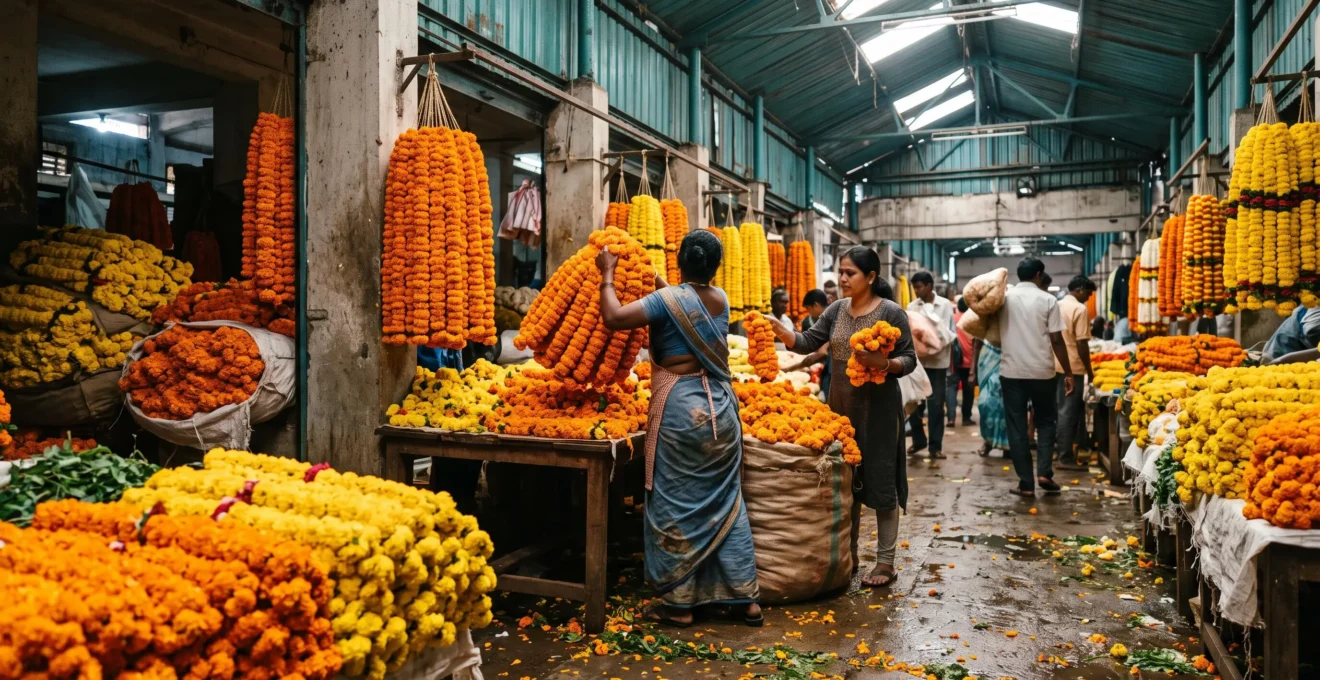
In late October, Mexico’s streets begin to glow orange. Flower sellers stack enormous bundles of marigolds, market floors disappear beneath scattered petals, and doorways become framed by golden blossoms. For travellers arriving from the UK, the spectacle is immediately striking. Yet the flowers are doing something much more significant than decorating the streets for autumn.
Known as cempasúchil, these marigolds are closely associated with Día de Muertos, the Day of the Dead. In many Mexican traditions, their colour and fragrance help guide the spirits of deceased relatives towards homes where families have prepared offerings to welcome them.
The flowers belong to a living practice of remembrance, hospitality and continuing relationships with the dead. Their meaning becomes clearest not only in spectacular public displays, but also in the work of growers, vendors and families preparing for the commemorations.
Understanding that relationship changes how you experience a Mexican flower market, how you plan your visit and, crucially, when you should put your camera away.
Mexican marigolds: what travellers need to know
- Meaning: Cempasúchil petals, bright colour and fragrance are traditionally believed to help returning spirits find their way home.
- Timing: Flower markets and preparations intensify during October, while major commemorations take place around 1–2 November, with regional variations.
- Respect: Public installations welcome visitors, but private altars and cemetery vigils require sensitivity, distance and sometimes explicit permission.
- Why Are Orange Marigolds Considered a Bridge Between the Living and the Dead in Mexico?
- How to See Marigold Harvesting and Altar Building in Mexico Instead of Just the Final Display?
- Which Is More Meaningful: Urban Marigold Installations or Village Altar-Making in Rural Mexico?
- The Marigold Mistake That Turns a Beautiful Tradition Into a Tourist Photo Prop
- When Should You Arrive in Mexico for Peak Marigold Season Without Missing the Best Traditions?
- How to Observe a Commemorative Altar in Mexico Without Crossing Boundaries You Can’t See?
- Which Altar Experience Is Appropriate for Tourists: Public Festival Displays or Private Home Altars?
- Why Touching or Photographing a Mexican Commemorative Altar Can Be More Invasive Than You Think
Why Are Orange Marigolds Considered a Bridge Between the Living and the Dead in Mexico?
Orange marigolds are considered a bridge between the living and the dead because their vivid petals and distinctive fragrance are traditionally believed to guide deceased loved ones back to their families. During Día de Muertos, flower-covered paths and altars represent a welcoming route between the spiritual world and the homes of the living.
This belief gives cempasúchil a practical role within the ritual. Rather than simply symbolising remembrance, the flower helps families express how returning spirits will be received.
According to UNESCO‘s documentation of Mexico’s Indigenous Day of the Dead festivities, families traditionally arrange petals, candles and offerings along pathways connecting cemeteries and homes to facilitate the symbolic return of deceased relatives.
In this understanding, the flowers form a welcoming route. A trail of petals leading towards an entrance is therefore different from a decorative border around a festival stage: it belongs to a relationship between particular people and their deceased relatives.
The symbolism has deep historical layers. The name cempasúchil derives from the Nahuatl cempohualxochitl, commonly interpreted as « twenty flowers ». Mexico’s National Institute of Anthropology and History associates the flower with pre-Hispanic solar symbolism and the ceremonial welcome of returning souls.
The contemporary Day of the Dead also reflects the historical interaction between Indigenous commemorative practices and the Catholic observances of All Saints’ and All Souls’ Days after Spanish colonisation. It would be misleading to treat today’s celebrations as either an unchanged pre-Hispanic ceremony or an exclusively Catholic invention.
Botanically, the most familiar large-headed cempasúchil is Tagetes erecta, a species native to Mexico. However, the cultural category is not limited to one species: Tagetes patula is also associated with the name. Neither a plant’s orange colour nor its scientific classification automatically gives it ceremonial meaning.
That significance comes from the way people use the flowers, the beliefs surrounding them and the relationships they represent.
Cempasúchil may appear in arches over altars, floral carpets, decorated graves, courtyard arrangements and pathways of loose petals. Its meaning can shift with the region, household and ceremony, even when the flower itself looks familiar.
Once you understand that a path of petals may be prepared for someone who has died, the work behind those arrangements becomes as interesting as the flowers themselves.
How to See Marigold Harvesting and Altar Building in Mexico Instead of Just the Final Display?
To experience Mexican marigold traditions beyond finished decorations, follow the flowers from growing areas to markets and then towards public altar preparations. Visit producing regions during October, explore flower markets in the days before Día de Muertos, and attend public commemorations around 1–2 November. Private family preparations should only be observed by invitation.
This sequence reveals something a completed installation cannot: the time, physical work and personal decisions involved in preparing a welcome for the dead.
In flower-growing areas such as Atlixco in Puebla, cultivation begins well before the festival. Mexico’s seasonal flower trade brings together growers, wholesalers, street vendors and families buying blossoms for offerings.
The Puebla government‘s announcement of Atlixco’s 2026 flower season identifies the Santa Rita market as a place to encounter regional production. For 2026, seasonal sales were announced from 25 October to 2 November, featuring cempasúchil, terciopelo and other flower varieties.
Visiting a market lets you observe the movement of flowers from growers towards their ceremonial use without assuming that working farms are open to tourists.
In Mexico City, Mercado de Jamaica provides another type of encounter: a flower market where visitors can see seasonal demand, bundles being prepared for sale and the commercial activity supporting celebrations.
Closer to the commemorations, publicly organised altar-building events and floral carpets in town squares can make the preparation process visible. Within households, relatives may arrange photographs, candles, food, drinks and flowers associated with the people being remembered.
These choices help explain why an ofrenda is more than an attractive composition. Its contents refer to individual lives, tastes and family relationships.
For a practical itinerary, think in stages rather than expecting every activity on one day:
- Earlier in October: Explore flower-producing regions and seasonal cultivation where public or authorised access is available.
- Late October: Visit flower markets and attend publicly advertised preparation activities.
- Around 31 October: Look for community altar construction and the beginning of local commemorations.
- 1–2 November: Attend public displays and appropriate cemetery observances, following local access rules.
The exact order varies. Some communities distinguish the return of children’s spirits from that of adults on different dates. Local programmes are therefore more reliable than a universal timetable.
The next choice is where to experience that journey: amid the large public celebrations of a city or within the quieter rhythms of a smaller community.
Which Is More Meaningful: Urban Marigold Installations or Village Altar-Making in Rural Mexico?
Neither urban marigold installations nor rural altar-making is inherently more meaningful. Public city displays are accessible expressions of shared cultural identity, while village and family practices may reveal closer relationships between remembrance and everyday life. The better experience depends on whether you want organised cultural interpretation, community atmosphere or access that comes through a genuine personal invitation.
Mexico City’s monumental ofrendas and large floral installations offer an immediate visual introduction to Día de Muertos. Their scale helps visitors recognise recurring symbols, compare artistic interpretations and observe how public institutions commemorate the dead.
These installations may be temporary civic artworks, but that does not make them culturally false. Urban families also maintain their own traditions, and a city celebration can express both contemporary creativity and deeply rooted remembrance.
In smaller communities, the commemorations may centre more visibly on households, neighbourhood relationships and cemeteries. The sense of closeness can be powerful, but proximity does not automatically grant visitors a role within the rituals.
The differences are most useful when considered as practical trade-offs.
| Consideration | Urban public installations | Village and community observances |
|---|---|---|
| Visual experience | Large installations, designed displays and public events | Family-scale offerings, local floral arrangements and cemetery traditions |
| Accessibility | Generally straightforward at public venues | Depends on local customs, public access and invitations |
| Planning | Published programmes and established visitor infrastructure | More local research and logistical flexibility |
| Cultural learning | Public interpretation and exposure to varied artistic expressions | Potentially closer observation of community practice, where welcomed |
| Photography | Often permitted in designated public spaces | Requires closer attention to people, mourning and privacy |
A traveller with only two days in Mexico City can gain considerable understanding from a market, a public ofrenda and a neighbourhood celebration. Someone staying longer with local contacts may have opportunities to understand family practices in greater depth.
Yet there is a vital distinction between witnessing a tradition and expecting to participate in it. Public events are organised for audiences; private commemorations are organised primarily for relatives, friends and the deceased.
Calling one « authentic » and the other « commercial » imposes a misleading hierarchy. A giant floral installation can convey genuine cultural meaning, while an intimate ceremony may be inappropriate for an outsider to attend.
The most rewarding setting is one where you can learn without requiring families to reshape their commemorations around your visit.
The Marigold Mistake That Turns a Beautiful Tradition Into a Tourist Photo Prop
The most damaging marigold-related tourist mistake is treating an ofrenda or cemetery vigil as a decorative backdrop rather than an act of remembrance. Posing in front of family altars, rearranging petals, touching offerings or photographing mourners without permission can intrude on a deeply personal occasion, even when the visitor intended only to capture a beautiful scene.
The mistake is understandable. Cempasúchil arrangements are visually spectacular, and visitors accustomed to photographing public artworks may struggle to recognise the difference between a festival installation and a family offering.
Social media also encourages people to turn striking locations into personal portraits. But an altar has an intended recipient, and its objects may have been chosen because they mattered to someone who died.
Standing between the altar and the person attending it, moving flowers to improve a photograph or posing beside a grave can change the meaning of the encounter from remembrance to performance.
The appropriate response is not to stop photographing Mexico’s Day of the Dead altogether. It is to recognise that different places involve different expectations.
- Public installations: Photography is generally suitable where organisers permit it, provided you respect barriers and other visitors.
- Markets: Photograph flowers and commercial activity with consideration for vendors, especially when photographing identifiable people.
- Private altars: Do not approach or photograph simply because the altar can be seen from the street.
- Cemetery vigils: Prioritise the families’ experience; seek permission where photography is allowed and avoid photographing grief as spectacle.
The same contextual judgement applies to elaborate skeletal face paint. It is associated with some public Day of the Dead festivities, but wearing it does not automatically make every ceremony an appropriate setting for theatrical participation.
Mexico City’s official visitor guidance for San Andrés Mixquic specifically recommends asking before taking photographs, maintaining respectful silence during La Alumbrada and avoiding stepping on or sitting on graves.
An alternative to collecting portraits is to engage with the flower itself: learn its name, speak respectfully with vendors when they have time, buy flowers where appropriate and visit exhibitions intended for public learning.
This approach also shapes when to travel, because the busiest and most visually dramatic dates are not necessarily the easiest moments for respectful observation.
When Should You Arrive in Mexico for Peak Marigold Season Without Missing the Best Traditions?
For travellers hoping to experience both marigold preparations and Día de Muertos commemorations, arriving in the final days of October and staying through 2 November is a practical choice. Earlier October visits favour flower fields and markets, while 1–2 November brings major commemorations. The precise schedule varies considerably between Mexican regions and communities.
There is no single national peak that delivers every aspect of the tradition. Flower production, public festivals, family rituals and cemetery observances follow overlapping but distinct calendars.
Mexico City illustrates this range. According to Mexico City‘s official 2026 Day of the Dead programme, the Festival Flores de Cempasúchil on Paseo de la Reforma runs from 18 October to 1 November, while the monumental Zócalo ofrenda is scheduled for 29 October to 2 November.
The programme also lists the city’s parade on 31 October 2026 and a distinctive series of commemorations at San Andrés Mixquic, culminating in La Alumbrada on the evening of 2 November.
These are specific 2026 event dates, not permanent annual guarantees.
| Travel period | Likely experience | Main compromise |
|---|---|---|
| Mid-October | Flower cultivation, early markets and preparations | Many major commemorations have not yet begun |
| Late October | Busy flower markets, public altar preparation and growing festival activity | Regional programmes may still be unfolding |
| 31 October–2 November | Major public displays, commemorations and cemetery observances | Popular destinations can be crowded and private rituals remain private |
| After 2 November | Some continuing exhibitions and regional activities | Many family commemorations and temporary installations have ended |
In many places, 1 November is associated with deceased children and 2 November with adults. Nevertheless, local traditions can differ. In Mixquic’s published programme, children’s souls are welcomed on 31 October, adults on 1 November, and La Alumbrada takes place on 2 November.
Michoacán’s Pátzcuaro lake communities, Oaxaca’s local celebrations and Mexico City’s public events should therefore be researched separately rather than treated as interchangeable versions of one timetable.
Famous destinations may also attract substantial visitor interest around the main dates. Those seeking quieter observation should consider the character of a community and the availability of appropriate public activities, not simply choose somewhere obscure and assume its ceremonies welcome outsiders.
Five steps to plan a meaningful marigold-season visit
- Choose your priority: Write down whether flowers, public altars or commemorative ceremonies are your main interest.
- Select a region: Identify one destination and save its relevant official tourism or community information.
- Check the local calendar: Record confirmed event dates, venues and any visitor-access conditions.
- Include a preparation stage: Add a flower market, publicly accessible growing area or authorised altar-building activity to your itinerary.
- Plan respectful observation: Note where photography is allowed, where permission may be needed and what you will do if an activity is private.
Once your itinerary is settled, learning to recognise the boundaries around commemorative altars will help you navigate the celebrations with greater confidence.
How to Observe a Commemorative Altar in Mexico Without Crossing Boundaries You Can’t See?
Observe a Mexican commemorative altar by first identifying whether it is public, communal or private. Look for thresholds, barriers, family members and signs of active mourning. Keep a respectful distance, avoid touching offerings and assess whether photography is appropriate. An altar being visible from a public street does not mean visitors have permission to approach it.
The essential distinction is between something created for public viewing and something visible because a family has chosen to place it near an entrance, window or courtyard.
An ofrenda is an offering prepared to welcome and remember deceased loved ones. It may contain photographs, candles, food, drinks, flowers and objects associated with those people.
For visitors, these arrangements can appear like elaborate still-life compositions. For the people who prepared them, the contents may represent memories and personal relationships that are not immediately visible to strangers.
Physical surroundings provide the first clues. An altar in a museum exhibition or cordoned public square is usually intended to be viewed. One inside a house, even with its door open, belongs to a different social setting.
Social cues are just as important. A family sitting quietly near a grave, candles being attended during a vigil or mourners speaking softly are all reasons to remain unobtrusive.
The practical rule is simple: **visibility does not equal permission**.
Observe without crossing thresholds. Lower your voice in cemeteries. Do not move photographs, touch candles, take food or disturb a petal path. If you are unsure whether you may photograph an altar, ask an appropriate person rather than assuming permission.
Watching how local participants behave can provide useful guidance, but it is not a substitute for explicit permission when approaching a private space.
There are also grey areas. Restaurants and hotels may create displays intended for guests, while neighbourhood altars can combine public visibility with personal significance. Neither setting should be treated as an unrestricted invitation to handle the objects.
For most visitors, the easiest way to avoid uncertainty is to begin with commemorative displays explicitly intended for the public.
Which Altar Experience Is Appropriate for Tourists: Public Festival Displays or Private Home Altars?
Public festival displays, museum exhibitions and organised community activities are the most appropriate altar experiences for most tourists. They provide cultural context without requiring access to family spaces. Private home altars are different: visiting one should depend on a genuine invitation from the household, not an assumption that an open doorway or a paid experience grants entry.
Public ofrendas can be meaningful learning environments. They introduce visitors to symbols, materials and commemorative themes while allowing people to observe without intruding on a household’s private relationships.
A visit to a publicly accessible cemetery event occupies a middle ground. The cemetery may welcome visitors, yet individual graves and vigils can remain intensely personal.
Private home altars require the greatest sensitivity because they are prepared for particular deceased relatives and may contain objects with deeply personal associations.
If a host voluntarily invites you to see an altar, follow their lead. They may choose to explain its contents, but an invitation to enter is not necessarily permission to photograph or share details publicly.
For practical planning, match the setting to your circumstances:
| Your circumstances | Suitable setting | Important boundary |
|---|---|---|
| Short visit, interested in culture and photography | Public ofrendas, museums and civic installations | Respect venue photography rules |
| Interested in community observances | Publicly accessible neighbourhood activities or cemetery commemorations | Do not intrude on family rituals |
| Have a personal invitation from local hosts | Invited visit to a private household | Let the hosts determine what can be viewed or shared |
| Uncomfortable entering religious or mourning settings | Flower markets, exhibitions and public cultural programmes | No private access is necessary to learn meaningfully |
Commercial experiences promising intimate access to family vigils or private homes deserve scrutiny. A paid visit is not necessarily inappropriate if a community has independently organised and consented to it, but marketing that implies unrestricted access to private grief is a warning sign.
Ask whether the experience is community-led, whether the participants genuinely welcome guests and whether photography and access boundaries are clearly explained.
There is no obligation to seek increasingly private encounters to prove that a journey has been culturally meaningful.
A public ofrenda can provide everything a thoughtful traveller needs to understand the flower’s symbolism. Private access is neither a requirement nor a measure of a successful trip.
What matters before approaching an altar
- Recognise its purpose: An altar may be a personal offering addressed to a deceased loved one, even when displayed in a visually striking setting.
- Distinguish permission from visibility: Public access to a location does not automatically grant permission to approach, touch or photograph every memorial within it.
- Protect the meaning of the ritual: Leave flowers, photographs, candles and food exactly as they have been arranged, and allow families to determine their own boundaries.
Why Touching or Photographing a Mexican Commemorative Altar Can Be More Invasive Than You Think
Touching or photographing a Mexican commemorative altar can feel invasive because the arrangement may be a personal offering to someone who has died, not an exhibition created for strangers. Moving a photograph, disturbing a petal path or documenting a grieving family can interfere with a ritual whose emotional meaning is much deeper than its visual appearance.
The difference is one of perspective. A traveller sees flowers, candles and photographs arranged beautifully together. A family may see an invitation addressed to a parent, grandparent, child or friend whose absence remains profoundly real.
Handling an altar’s contents is therefore closer to interfering with personal correspondence than adjusting an ordinary decoration.
Consider a path of marigold petals laid towards an entrance. Within the tradition, it may symbolise the route by which a deceased relative returns home. Stepping across it carelessly or rearranging its shape for a photograph can disturb something deliberately prepared for that welcome.
Food and drink offerings may recall a loved one’s preferences. Photographs identify the people being honoured. Candles form part of the commemorative arrangement. None of these objects should be treated as souvenirs or movable photographic accessories.
Photography introduces a further complication because recording a scene can expose deeply personal moments to an audience the family never intended.
An unattended altar in a designated public exhibition is generally different from a family altar being actively attended at a cemetery. The former has been prepared for visitors; the latter may be part of an intimate ritual even though it takes place in an accessible location.
When people appear in the frame, the question becomes more sensitive. An expressive image of a candlelit vigil may attract attention online, but the people photographed might not wish their grief to become public content.
If photography seems appropriate, ask permission where possible. A simple question in Spanish can help: ¿Puedo tomar una fotografía? — « May I take a photograph? »
If someone declines, accept the answer without requesting an explanation. Refusal is a boundary, not a personal rejection.
Some of the most meaningful moments are better observed without a camera: a relative placing a flower, a family gathering quietly beside a grave or a market vendor preparing bundles for the season.
These moments help connect the visible beauty of cempasúchil with the relationships that give it significance.
When planning your own Day of the Dead journey, choose one public flower market, one accessible commemorative display and time to observe without photographing everything. The deeper souvenir is an understanding of why those marigold paths were laid in the first place — and whom they are meant to welcome.
Is cempasúchil the same as the marigold grown in British gardens?
Cempasúchil commonly refers to Mexican marigolds including Tagetes erecta and, in some contexts, Tagetes patula. These species are also cultivated as ornamental flowers internationally. However, the ceremonial significance of cempasúchil comes from Mexican cultural traditions, not simply from the plant belonging to the marigold family or having orange petals.
Can tourists buy cempasúchil flowers at Mexican markets?
Yes. Seasonal flower markets sell cempasúchil to the public, and buying from vendors can be a respectful way to appreciate the work involved in the celebrations. The Santa Rita market in Atlixco, Puebla, is one example of a publicly promoted seasonal sales venue. Availability and opening dates should be checked for the relevant year.
Are all Day of the Dead altars religious?
Not every altar has precisely the same religious purpose. Mexican Día de Muertos traditions combine Indigenous heritage, Catholic influences, family remembrance and contemporary cultural expression in different ways. Public artistic installations may emphasise collective identity, while household altars can hold deeply personal spiritual or religious meaning.
Can visitors attend cemetery commemorations on 2 November?
Some communities hold cemetery commemorations that visitors may observe, including the well-known La Alumbrada in San Andrés Mixquic. However, access arrangements, local customs and photography expectations vary. Visitors should confirm current guidance, respect family gatherings and never assume that a publicly accessible cemetery makes every vigil open to close observation.
Does the Day of the Dead finish everywhere on 2 November?
No. Although 1 and 2 November are important commemorative dates, preparations begin earlier and some regional exhibitions or cultural activities continue afterwards. For example, Puebla’s 2026 programme included a Ruta del Mictlán promoted through 8 November. Specific schedules depend on the community, event and year.