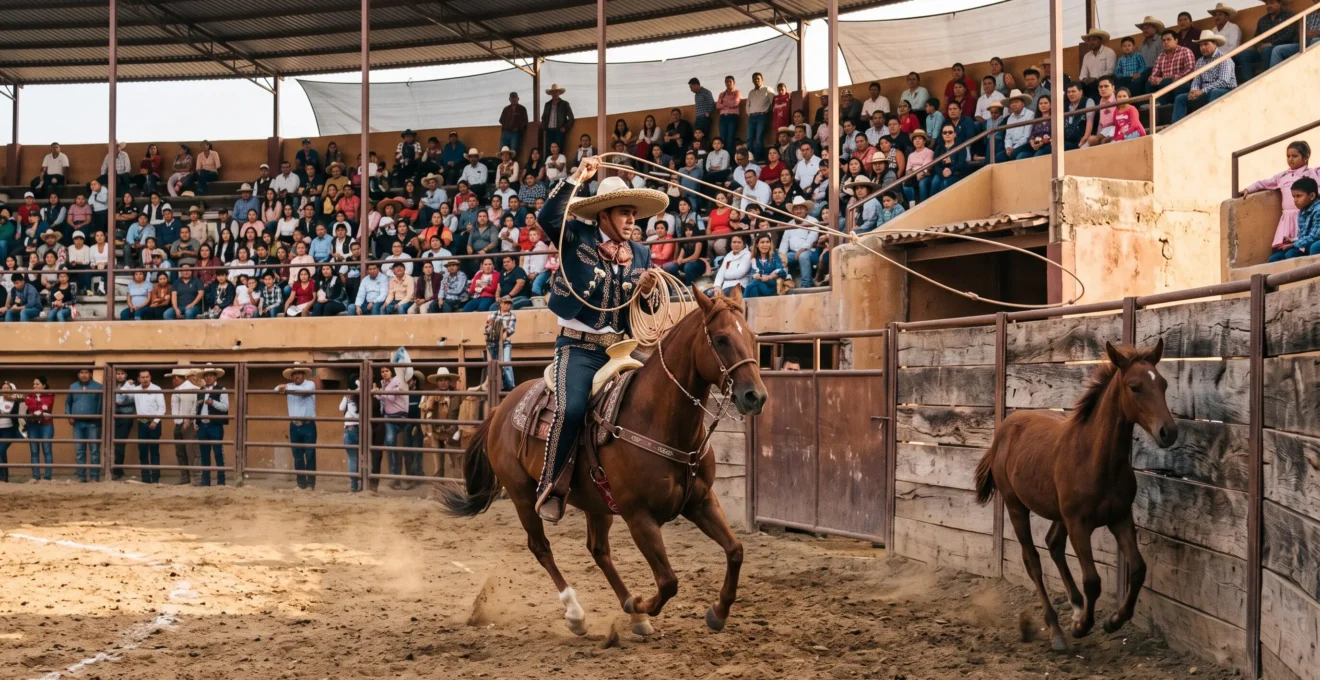
A horse slides to a controlled stop, a rope cuts a circle through the air, and an entire section of spectators begins applauding something you barely noticed. If you arrived expecting an American-style rodeo, a Mexican charreada can be wonderfully confusing.
The difference begins with what the competition represents. Charrería combines horsemanship, livestock-handling techniques, elaborate traditional clothing and a community heritage that predates modern arena sport. Its rules reward specific technical accomplishments, while its cultural significance reaches well beyond the scoreboard.
Not every Mexican event involving horses, cattle and ropes is a charreada, either. A village jaripeo may revolve around bull riding, while a working ranch in northern Mexico reveals the everyday labour behind several of these traditions.
For a British traveller, understanding these distinctions changes the experience. Instead of simply watching animals and riders, you can recognise the skills being demonstrated, understand why certain moments matter and choose an event that suits your interests.
Mexican roping and rodeo: what matters most
- Charrería is both sport and cultural heritage. Its formal team competition follows nine principal disciplines and has a distinct history, clothing and scoring system.
- A charreada is not the same as a jaripeo. The former showcases regulated equestrian disciplines; the latter often centres on bull riding and local festivities.
- Context transforms the experience. Watching horse control, understanding rope technique and recognising regional ranch traditions reveals far more than treating everything as American-style rodeo.
- Why Is Roping Considered a Cultural Heritage Practice in Mexico, Not Just a Sport?
- How to Watch Mexican Roping Manoeuvres Like a Local and Know What Makes One Impressive?
- Which Is Better for First-Timers: A Formal Charreada or an Informal Village Rodeo?
- The Spectator Mistake That Gets You Dirty Looks at a Mexican Charreada
- When Are Charreada Events Most Common in Mexico, and Which Regions Host the Biggest?
- How to Experience Northern Mexican Ranch Culture Without Booking a Gimmicky « Cowboy Day »?
- Which Feels More Real: A Working Ranch Visit or a Local Rodeo in Northern Mexico?
- Why Northern Mexico Feels Like a Different Country, and What Cattle Ranching Has to Do With It
Why Is Roping Considered a Cultural Heritage Practice in Mexico, Not Just a Sport?
Mexican roping is considered cultural heritage because charrería preserves livestock-handling skills, horsemanship, clothing and community traditions developed across generations. UNESCO recognised charrería as Intangible Cultural Heritage of Humanity in 2016. A formal charreada is therefore both a regulated sporting competition and a public expression of Mexico’s historical relationship with horses and cattle.
Its roots reach back to livestock management on Mexican haciendas from the colonial period. People responsible for cattle and horses developed methods of riding, controlling animals and using ropes in demanding working environments. These abilities gradually became traditions demonstrated and transmitted beyond their original agricultural purposes.
The UNESCO charrería heritage inscription identifies livestock-herding communities, family transmission, traditional craftsmanship and organised associations as central elements of the practice. The recognition covers cultural knowledge and community identity, not merely competition results.
2016
The year charrería joined UNESCO’s Representative List of the Intangible Cultural Heritage of Humanity. The inscription recognises a living tradition, rather than certifying the safety or welfare standards of every individual performance.
UNESCO, Charrería, equestrian tradition in Mexico, inscription 01108.
That background explains why traditional charro clothing matters. Embroidered jackets, distinctive trousers, wide-brimmed sombreros, saddles and spurs are not simply theatrical costumes. They belong to an established material culture involving specialist craftsmanship and recognised conventions.
There is also an important distinction between sporting systems. American rodeo developed its own competitive disciplines, commonly presented as separately scored events. A standard team charreada combines several different skills into a structured collective result. Neither tradition is inherently without teamwork or cultural meaning, but their competitive formats differ.
Charrería also involves women. The escaramuza charra, a synchronised equestrian performance by teams of female riders, demonstrates trained coordination and riding skills. Its presence reminds visitors that Mexican equestrian heritage cannot be reduced to men throwing ropes.
Family participation and intergenerational learning remain important, although it would be misleading to assume every team is family-run or that spectators always value elegance above winning.
Once you recognise that both heritage and sporting excellence matter, the next challenge is learning what the riders are actually trying to accomplish.
How to Watch Mexican Roping Manoeuvres Like a Local and Know What Makes One Impressive?
To appreciate a charreada, watch the relationship between the rider, horse, rope and animal rather than looking only for dramatic movement. Judges assess technical execution under detailed rules, including precision, timing and penalties. A clean horse manoeuvre or accurately executed rope catch may be more significant than a spectacular-looking moment that earns fewer points.
A formal team charreada follows nine principal suertes, or competitive disciplines. Understanding their sequence makes the event easier to follow.
- Cala de caballo: A demonstration of trained horse control, including prescribed movements and stopping or turning techniques.
- Piales en la manga del lienzo: A roping discipline involving a mare moving through the competition lane.
- Coleadero: A cattle-handling event in which the competitor attempts a regulated manoeuvre involving a bull’s tail.
- Jineteo de toro: Bull riding, judged according to the applicable charro regulations.
- Terna en el ruedo: A coordinated cattle-roping exercise comprising the lazo de cabeza and pial de ruedo.
- Jineteo de yegua: Riding an unbroken mare under the discipline’s rules.
- Manganas a pie: Roping a mare while the competitor is on foot.
- Manganas a caballo: Roping a mare while mounted.
- Paso de la muerte: A demanding equestrian manoeuvre involving a transfer between horses.
The official competition regulations of the Mexican Charrería Federation establish this structure. The terna includes two distinct roping tasks, so descriptions counting ten component performances are also encountered.
For first-time spectators, the cala de caballo offers an especially accessible introduction. Look for how the horse responds to its rider’s instructions, maintains its balance and executes prescribed movements. This is horse control, not a roping event.
During the manganas, pay attention to the competitor’s rope handling, positioning and whether the attempt is completed according to the rules. These disciplines involve mares rather than the calves associated with American tie-down roping. They should not be described as harmless merely because they are culturally significant: the techniques can raise animal-welfare concerns.
In jineteo, style and technical compliance matter, but so can the duration and conditions of the ride. It is inaccurate to suggest that charro riding is simply about producing a controlled fall instead of remaining mounted.
When an escaramuza team performs, watch the spacing, timing and coordinated movements between riders. Such performances are an important expression of female participation in the tradition, although their scheduling depends on the event format.
You do not need to memorise the regulations before attending. Recognising a few movements and listening to the announcer can turn unfamiliar competitions into a comprehensible sporting experience.
Which Is Better for First-Timers: A Formal Charreada or an Informal Village Rodeo?
A formal charreada is the better introduction if you want to understand Mexico’s recognised equestrian tradition, its rules and its range of disciplines. An informal village jaripeo may suit travellers seeking a lively community celebration centred on bull riding. Both can be culturally meaningful, but they offer different experiences.
The formal charreada takes place in a lienzo charro, a purpose-built competition arena. Expect teams, defined sporting procedures, judges and an event programme. Depending on the competition, several hours may be needed to appreciate the full sequence.
A jaripeo is generally less concerned with presenting the nine charro disciplines. It often takes place during community celebrations or patron-saint festivals, with music, food stalls and a more informal atmosphere. Individual events differ considerably, so the word alone does not guarantee a particular programme or duration.
The distinction becomes clearer when comparing what each experience offers.
| What matters | Formal charreada | Village jaripeo |
|---|---|---|
| Main attraction | Multiple regulated equestrian disciplines | Often bull riding and local festivities |
| Structure | Defined competition rules and judging | Varies by organiser and locality |
| Atmosphere | Sporting and ceremonial | Often festive and informal |
| Time commitment | Potentially several hours | Variable, sometimes shorter |
| Best learning opportunity | Understanding charrería as a complete sport | Observing community celebrations and regional riding customs |
| Visitor planning | Check federation or arena announcements | Ask locally about festivals and event programmes |
Neither format is automatically cheaper, safer or more welcoming to tourists. Admission arrangements, crowd sizes, alcohol consumption and spectator facilities depend on the organiser.
For a formal event, enquire about programmes at local asociaciones de charros, tourism offices or established riding facilities. Jalisco, Michoacán and the State of Mexico are useful regions in which to begin looking, but do not assume that every arena offers public sessions or free admission.
One practical consideration deserves particular attention: animal handling and spectator safety. These should be assessed for the individual event rather than inferred from its traditional or informal status. Look at the arena barriers, available seating and how animals are managed before deciding to stay.
Whichever you choose, understanding the occasion is only half the challenge. Knowing how to behave as a guest makes a significant difference.
The Spectator Mistake That Gets You Dirty Looks at a Mexican Charreada
The most avoidable mistake at a Mexican charreada is treating it as an imitation of American rodeo rather than recognising it as a distinct tradition. Loud comparisons, distracting participants or entering restricted areas can come across as disrespectful. The safest approach is to observe the event’s conventions, follow staff instructions and ask courteous questions.
Imagine watching a competitor prepare a rope while someone beside you announces that American cowboys would do it faster. The comparison overlooks the rules of the discipline being performed. It can also dismiss the expertise of participants whose techniques have developed within a different cultural and sporting context.
Curiosity is welcome in many settings, but a charreada is a competition, not an interactive attraction. Spectators should respect the arena boundary, avoid obstructing judges or riders and follow any announcements concerning seating, movement and photography.
Applause is another useful cultural clue. Instead of assuming the loudest or most dramatic moment deserves the strongest reaction, notice when experienced spectators respond to a completed manoeuvre, a technical achievement or a team result.
There is no verified universal rule requiring visitors to remain seated throughout every suerte or applaud at an exact moment. Local etiquette and formal event instructions take precedence over general travel advice.
Clothing is simpler than many visitors expect. Participants may follow detailed traditional dress conventions, but ordinary spectators do not generally need formal charro clothing. Comfortable, practical attire is appropriate unless an organiser specifies otherwise. Avoid using ceremonial dress as a novelty costume.
Photography from public seating areas may be possible, subject to venue rules. Keep a safe distance from horses, cattle and working personnel, and request permission before photographing individuals at close range.
Animal welfare is a legitimate subject of scrutiny. Some livestock-handling events involve restraint, falls or other potentially harmful procedures. Cultural recognition should not be interpreted as proof that these techniques are harmless. Visitors can respect local communities while making informed decisions about the activities they are comfortable watching.
A little observation and a few well-chosen questions will usually teach you more than arriving with a ready-made judgement about how the event should look.
When Are Charreada Events Most Common in Mexico, and Which Regions Host the Biggest?
Charreada competitions take place in different parts of Mexico throughout the year, while official state, regional and national championships follow the federation’s published schedules. Jalisco, Michoacán, the State of Mexico and Zacatecas are important places to explore the tradition. For major events, confirm the specific championship dates rather than assuming a fixed annual season.
Mexico’s national charro championship provides a particularly clear example of organised competition. The 2026 LXXXII Congreso y Campeonato Nacional Charro was scheduled in San Luis Potosí from October into early November, while Jalisco was selected to host the 2027 edition.
The Mexican Charrería Federation’s official competition website publishes championship information, results, regional competitions and regulatory documentation. This is a useful starting point for checking formal events.
Jalisco, particularly the Guadalajara area, is closely associated with charro imagery and organised charrería. Michoacán, the State of Mexico and Zacatecas are also relevant to the tradition’s regional development and contemporary practice.
However, the historical roots of charrería extend across central and northern Mexico. Calling one city its exclusive birthplace would oversimplify a tradition that emerged through livestock work in several regions.
For travellers interested in community events rather than championships, local fiestas and smaller organised competitions can provide opportunities. Such events are not guaranteed on every weekend, and a patron-saint celebration does not necessarily include a charreada.
Five checks before planning your charreada visit
- Identify the event type. Record whether the advertised programme is a charreada, jaripeo or another equestrian event.
- Confirm the date and venue. Save an organiser announcement showing the event date and exact location.
- Check admission arrangements. Obtain confirmation of ticket availability, entry conditions and any published prices.
- Verify the programme. Note the announced start time, participating teams and whether an escaramuza performance is listed.
- Plan practical access. Keep a written note of transport arrangements, seating information and any venue-specific safety instructions.
Spanish-language notices, local arena announcements and direct enquiries can be more productive than searching only English-language travel platforms. Festival programmes and organisers’ social media pages may help, but details should be cross-checked before travelling.
For British visitors planning a trip around one particular competition, avoid making non-refundable arrangements solely on the basis of an undated event listing.
Travellers who want to understand where these equestrian skills originally acquired their practical value can take the experience further by exploring the working-ranch traditions of northern Mexico.
How to Experience Northern Mexican Ranch Culture Without Booking a Gimmicky « Cowboy Day »?
The best way to explore northern Mexican ranch culture is to seek a legitimate rural experience connected to everyday livestock work, rather than a staged cowboy-themed attraction. In states such as Chihuahua, Coahuila, Sonora, Nuevo León and Durango, ranching forms part of regional history. Genuine access, however, depends on the property, local conditions and the willingness of its owners.
Northern Mexico’s ranching history is linked to large cattle-raising territories, difficult landscapes and agricultural communities that developed practical riding and livestock-management knowledge.
Historical documentation from Mexico’s National Institute of Anthropology and History traces charrería’s origins to the sixteenth century and connects its development to cattle-raising haciendas in northern and central Mexico. What began as practical animal management eventually became a recognised cultural tradition.
The vocabulary of the working ranch is a useful starting point. A vaquero is associated with cattle work, while a charro belongs to a particular Mexican equestrian tradition with its own sporting and ceremonial expressions. These identities overlap historically but should not be treated as interchangeable labels in every context.
When assessing a ranch visit, ask what actually happens on the property. Does it raise livestock? Will someone explain daily operations? Are visits organised around existing work, or does the venue mainly offer costumes and staged photographs?
A legitimate tourism business can still provide valuable cultural interpretation. Commercial organisation does not automatically make an experience inauthentic. Equally, a working ranch does not become more authentic by neglecting guest safety or animal welfare.
Travellers can ask regional tourism offices or established rural hospitality providers about responsible ranch-related experiences. Enquiries around Chihuahua and other northern centres may be a starting point, but individual ranch availability should always be verified. Private working properties are not automatically visitor attractions.
Regional food can add another dimension. Dishes such as machaca, made with dried or shredded meat, and discada, a mixed-meat preparation associated with northern cooking, connect the experience to everyday food traditions rather than a theatrical cowboy menu.
Guest participation in ranch work requires particular caution. Livestock handling is skilled, potentially hazardous work. An authentic host may prefer visitors to observe rather than approach animals or attempt unfamiliar tasks.
The objective is not to prove that you can perform ranch work. It is to understand the people, skills and environments that give these equestrian traditions their meaning.
Which Feels More Real: A Working Ranch Visit or a Local Rodeo in Northern Mexico?
A working ranch visit and a local rodeo reveal different sides of northern Mexican culture. The ranch shows how livestock work fits into daily life, while a jaripeo or regional rodeo reveals how riding traditions become public celebrations. Neither is automatically more authentic. The better experience depends on whether you want practical context or community atmosphere.
A ranch offers a slower perspective. Livestock must be fed, checked, moved and managed according to operational needs. Activities depend on weather, staffing, animal conditions and the agricultural calendar rather than a tourist timetable.
Visitors may discover that much of ranch work involves preparation, observation and routine responsibilities instead of dramatic displays of riding or roping. Those quieter activities are part of what makes the experience informative.
A local rodeo or jaripeo concentrates the social dimension into an organised event. Families gather, spectators respond to performances and the occasion may include music, food and wider festivities.
Its disadvantage is selectivity: the public event highlights particular performances without necessarily explaining the wider agricultural skills from which some traditions developed.
The following comparison can help guide a realistic decision.
| Experience factor | Working ranch visit | Local rodeo or jaripeo |
|---|---|---|
| Primary focus | Daily livestock operations and rural life | Public performance and community gathering |
| Typical pace | Variable and work-dependent | Organised around an event programme |
| Physical demands | Depend on site access and permitted activities | Usually spectator-oriented |
| Main cultural insight | Practical agricultural context | Social and celebratory traditions |
| Main limitation | Limited access and unpredictable activities | Limited exposure to ordinary ranch work |
For travellers with sufficient time, the two experiences can complement each other. A rural stay or guided visit followed by a locally advertised equestrian event offers contrasting perspectives on work and celebration.
Consider a hypothetical itinerary: spend a day learning about the history and organisation of a working cattle property, then attend a publicly accessible regional event later in the trip. The combination offers a context for recognising why skills developed for agricultural purposes are also performed before spectators.
This is a suggested learning approach, not a claim that ranch workers routinely participate in every local rodeo.
Judge the quality of the experience by the information provided, treatment of guests and animals, and clarity about what visitors can safely observe. Being asked to perform hazardous tasks should never be treated as proof of authenticity.
Both experiences become more meaningful when viewed against northern Mexico’s wider regional identity, shaped by landscapes, cattle raising and centuries of cultural exchange.
Key takeaways before exploring northern Mexico
- Recognise the distinction between formal charrería, regional rodeo traditions and everyday vaquero work; they have overlapping histories but different purposes.
- Use local ranching history to understand the connection between Mexican equestrian practices and the development of cowboy traditions north of the border.
- Look beyond riding performances to the food, landscapes, communities and working environments that shape northern Mexican identity.
Why Northern Mexico Feels Like a Different Country, and What Cattle Ranching Has to Do With It
Northern Mexico can feel culturally distinct from central and southern regions because of its landscapes, ranching history, border connections and local traditions. Extensive cattle raising helped shape regional work, food and equestrian practices. Understanding this history also explains why Mexican vaquero culture, formal charrería and American cowboy traditions share connections without being identical.
The north is not a single uniform cultural territory. Chihuahua’s vast inland landscapes, Sonora’s desert environments, Coahuila’s ranching areas and the urban centres of Nuevo León differ in geography and everyday life.
Nevertheless, extensive cattle production and historical movement across northern territories provide important context for the region’s equestrian traditions.
Before modern national boundaries established today’s divisions, livestock work and horse-riding knowledge developed across territories that would later belong to Mexico and the United States. Mexican vaquero practices influenced the development of North American cowboy culture, including aspects of riding equipment, cattle handling and working vocabulary.
Formal charrería followed its own process of cultural and sporting organisation. Its roots reach into both northern and central Mexican livestock traditions, while its contemporary competitive identity should not be confused with every form of northern ranch riding.
For travellers, the differences are visible beyond an arena. Beef dishes such as carne asada, regional preparations involving dried meat, wheat-flour tortillas in many northern food traditions, and local cheese-making can reflect the agricultural and culinary importance of the region.
Music also offers a cultural reference point. Norteño styles, associated with instruments such as the accordion and bajo sexto, are part of northern Mexico’s musical landscape. Corridos and other regional genres may be encountered in social settings, although musical tastes vary considerably between communities and generations.
The familiar visual associations of boots, hats and broad ranching landscapes have genuine historical connections, but they do not describe everyone who lives in northern Mexico. Its cities, industries and contemporary cultural life extend far beyond cattle raising.
That distinction matters when interpreting a charreada. Mexico’s equestrian heritage is not one uninterrupted cowboy performance. It is a collection of related traditions shaped by region, agricultural work, community identity and formal sporting institutions.
Once these differences become clear, the rope ceases to be the entire story. The visitor can recognise a formal charro discipline, appreciate the history of a regional vaquero practice and understand why a village jaripeo creates a different social experience.
Before booking an equestrian event in Mexico, identify which tradition you want to see, confirm the programme with its organiser and leave room to learn from the people who practise it. That preparation will make the experience far more rewarding than simply arriving in search of an American-style rodeo.
Is charrería Mexico’s national sport?
Charrería is widely recognised as Mexico’s national sport and an important element of its cultural identity. It is also a regulated competitive practice. UNESCO inscribed the tradition on its Representative List of the Intangible Cultural Heritage of Humanity in 2016, recognising its community transmission, livestock-handling knowledge and associated craftsmanship.
Do you need to understand Spanish to enjoy a charreada?
No. Watching the horses, ropes and coordinated movements can be rewarding without speaking Spanish. However, knowing terms such as cala de caballo, terna, manganas and escaramuza makes the competition easier to understand. Basic Spanish is particularly helpful when checking local programmes or asking about event rules.
Are charreadas suitable for children?
Families may attend charreadas, but suitability depends on the specific event, seating facilities, noise levels, duration and the children’s comfort around livestock-handling competitions. Some disciplines involve animal restraint or falls. Parents should review the programme, check venue arrangements and make an informed choice before attending.
Can tourists participate in Mexican roping competitions?
Formal competitions are governed by federation rules and are not casual tourist activities. Visitors should not expect to enter the arena or handle animals without appropriate authorisation, experience and supervision. Anyone interested in learning traditional horsemanship should enquire about legitimate riding instruction rather than attempting competitive techniques.
Are charreadas and jaripeos the same as American rodeos?
No. They share historical connections through livestock work and equestrian traditions, but their formats differ. A formal charreada follows Mexican federation disciplines and combines multiple skills in a structured competition. A jaripeo commonly emphasises bull riding within a community event. American rodeo has its own disciplines, judging systems and competitive organisations.