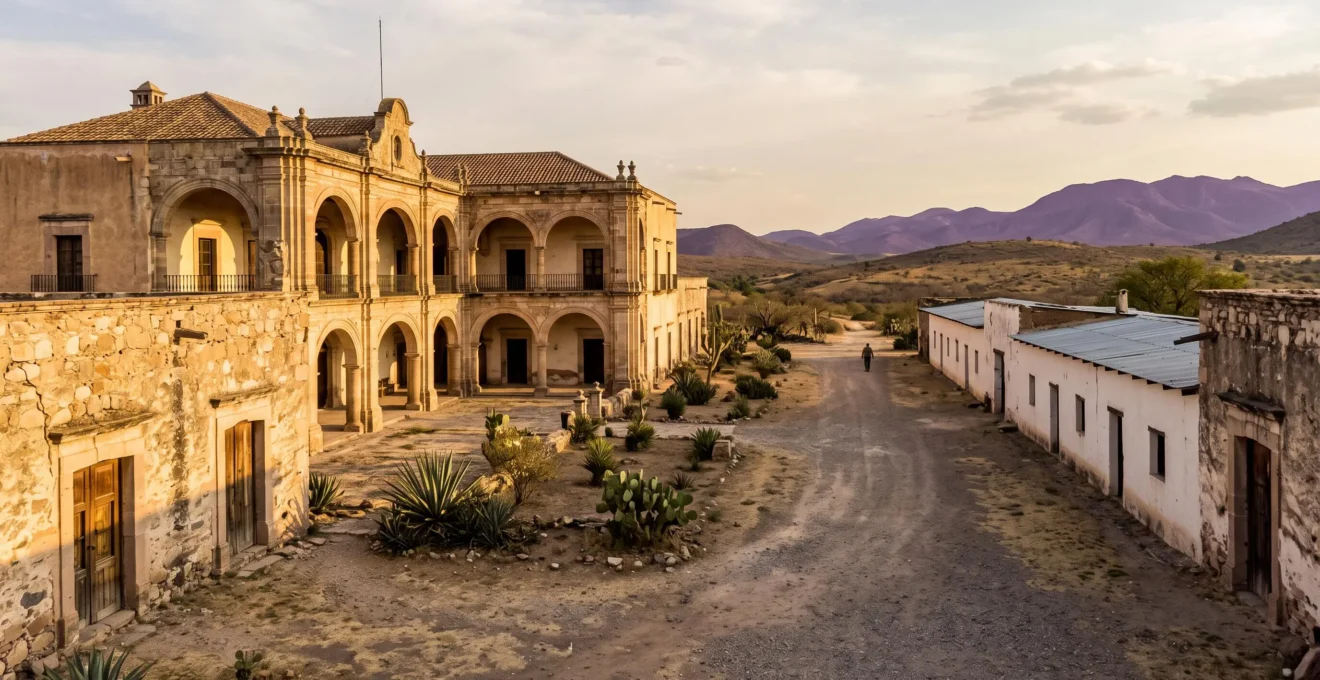
A restored Mexican hacienda can appear almost idyllic. Arched corridors frame peaceful courtyards, thick stone walls shelter elegant rooms, and former agricultural buildings become restaurants or wedding venues. Yet the same estate may once have depended on workers whose freedom, wages and access to land were severely restricted.
Understanding that contrast does not mean dismissing the beauty of historic haciendas. It means recognising that their architecture survives from complex economic systems shaped by colonial landholding, agricultural production, unequal labour relations and, eventually, revolutionary change.
Not every hacienda followed the same history. A henequen plantation in Yucatán, a sugar estate in Morelos and a property associated with mining in Hidalgo could differ substantially in their workforce, organisation and historical circumstances.
For heritage travellers visiting Mexico, the most rewarding approach is to look beyond the restored main house. Buildings, machinery, workers’ accommodation and even absences in the surviving landscape can help reveal whose lives made these estates possible.
Understanding Mexican haciendas at a glance
- Haciendas were productive estates and social systems, not simply luxurious country residences. Their labour histories varied considerably by region and period.
- The relationship between the main house, production buildings and workers’ accommodation often reveals more than decorative architecture alone.
- Museums, community interpretation and careful questions can complement a hotel stay and help distinguish documented history from romanticised presentation.
- Why Were Mexican Haciendas So Large, and What Happened to the People Who Worked Them?
- How to Read a Hacienda’s Layout in Under 20 Minutes to Understand Its Real History
- Which Tells the Fuller Story: A Hacienda Museum or a Hacienda Hotel in Mexico?
- The Mindset Mistake That Makes Travellers Miss the Real Significance of Mexican Haciendas
- When Should You Visit a Historic Hacienda for Comfortable Touring and Golden-Hour Photos?
- Why Do Some Restored Haciendas Feel Like Living History While Others Feel Like Themed Hotels?
- How to « Read » a Mayan Limestone Pyramid Site in 30 Minutes Without a Tour Guide?
- What You’re Actually Looking At When You Visit a Limestone Pyramid in the Yucatán
Why Were Mexican Haciendas So Large, and What Happened to the People Who Worked Them?
Mexican haciendas became large because they combined extensive landholdings with agricultural production, infrastructure and systems for organising labour. Their workers included people employed under different arrangements, some involving severe coercion or restricted freedom. Revolutionary upheaval and twentieth-century agrarian reforms subsequently transformed many estates, although their individual histories and outcomes varied.
A hacienda was more than its impressive residence, or casa grande. Depending on its function, the estate might include agricultural fields, workshops, warehouses, a chapel, water infrastructure, processing machinery and housing for workers. Together, these formed an economic and social landscape in which owners exercised substantial influence over land, production and employment.
The roots of that system reach into colonial Mexico, but distinctions matter. The encomienda was a colonial institution granting certain rights over Indigenous tribute or labour; it was not simply another name for a hacienda. Large landed estates developed through changing arrangements of property ownership, production and labour over subsequent centuries.
Some estates employed wage workers, tenants or seasonal labourers. Others relied on arrangements that restricted workers’ ability to leave, particularly through debt.
The experience of Yucatán’s henequen industry is particularly revealing. Research by historian Piedad Peniche, published in the Mexican National Institute of Anthropology and History’s journal Historias, examines relations between slavery, marriage and labour on henequen-producing estates during the Porfiriato.
The study describes the nohoch cuenta, an accounting mechanism recording advances against workers’ wages. Such indebtedness could bind workers to an estate, while political authorities could intervene to return people who had fled. This history is documented in INAH research on slavery and labour in Yucatán’s henequen haciendas.
However, debt peonage, forced labour and legal slavery are not interchangeable categories. Their legal status, mechanisms and lived consequences must be examined in context. Evidence from henequen estates should not be projected automatically onto every hacienda in Mexico.
The Mexican Revolution, beginning in 1910, challenged the political and social order associated with large rural estates. Agrarian reform developed over subsequent decades, with particularly extensive redistribution during the presidency of Lázaro Cárdenas, from 1934 to 1940.
More than 20 million hectares
Land redistributed during the Cárdenas presidency, benefiting approximately one million peasants, according to Mexico’s federal agricultural ministry. These are historical national figures, not a measure of land taken from haciendas alone.
Redistribution helped reshape rural ownership through arrangements including ejidos, involving forms of collective landholding and community land rights. Agricultural credit, technical assistance and producer organisation also formed part of the reform agenda.
Some haciendas were divided, others changed functions, and others continued operating in modified forms. It would be misleading to attribute every estate’s decline exclusively to the abolition of coercive labour systems.
What visitors now encounter is often the architectural remainder of a system transformed by conflict, economic change and political decisions. Understanding the whole estate begins with recognising that its grand residence was only one component.
How to Read a Hacienda’s Layout in Under 20 Minutes to Understand Its Real History
A short architectural survey can reveal how a hacienda organised residence, production, worship and work. Begin with the main house, then locate the chapel, agricultural buildings, machinery and workers’ accommodation. Differences in position, scale and materials provide historical clues, although their meaning must be tested against documentation rather than assumed from appearance.
The simplest method is to treat the property as a working landscape instead of a collection of attractive buildings. Ask what each space was used for and how people, agricultural products and water moved between them.
An architectural inventory maintained by Mexico’s INAH describes a former hacienda containing a main residence, chapel, courtyards, agricultural facilities and a storage building known as a troje. Importantly, the workers’ houses were located beyond the principal enclosure, to its northwest.
This documented arrangement illustrates why the most revealing part of a hacienda may lie outside the courtyard shown in promotional photographs. The original description is available in INAH’s architectural inventory of a historic hacienda.
Separate entrances, window sizes and differences in construction quality are worth recording. They may indicate differences of function, resources or occupation, but do not independently prove deliberate segregation or coercion. Similarly, a chapel might have fulfilled religious and communal functions without its physical position demonstrating a particular method of social control.
Water systems offer another perspective. Aqueducts, reservoirs and irrigation works may help explain the estate’s productive capacity, especially when examined alongside processing buildings and storage areas.
Dating requires equal caution. Decorative facades associated with the Porfiriato or surviving industrial machinery may indicate late-nineteenth-century alterations. They do not establish the age of the whole estate or prove the working conditions experienced there. Many haciendas accumulated construction phases over long periods.
Your five-step hacienda field checklist
- Identify the main residence. Mark the casa grande on a site map or sketch and record its position relative to the courtyard.
- Locate the workers’ accommodation. Record its position, visible condition and any explanation supplied by the site. If inaccessible, mark it as unverified.
- Find the production infrastructure. Photograph or note machinery, workshops, warehouses or processing spaces, producing a short inventory of surviving functions.
- Trace the shared infrastructure. Identify the chapel and any visible water systems, noting possible connections without assigning unsupported motives.
- Separate observations from interpretations. Write down one documented historical fact, one architectural observation and one unanswered question for subsequent research.
Twenty minutes is enough for an initial survey where access and site size permit; it is not enough to establish a comprehensive architectural history. Restricted areas, missing structures and later renovations can substantially limit interpretation.
Once the physical layout has raised useful questions, the next task is finding an interpretation that can answer them. A carefully curated museum and a beautifully restored hotel may approach the same historical property very differently.
Which Tells the Fuller Story: A Hacienda Museum or a Hacienda Hotel in Mexico?
A well-researched hacienda museum may offer a fuller account of labour, production and daily life, while a hacienda hotel generally prioritises accommodation and the visitor experience. Neither category guarantees historical accuracy. The strongest choice is the property that provides documented interpretation, acknowledges workers and explains what has been preserved, altered or reconstructed.
The distinction often reflects their purpose. Hotels must maintain comfortable rooms, functioning services and attractive public spaces. Historic buildings may require extensive adaptations to meet those needs.
Museums and community-led heritage initiatives can devote more attention to archives, industrial equipment, archaeological evidence and memories of former residents. However, funding, expertise and curatorial decisions also influence what they present.
The most useful comparison is therefore not simply museum versus hotel, but historical evidence versus unexamined presentation.
| What to assess | Hacienda museum | Hacienda hotel |
|---|---|---|
| Primary visitor experience | Historical interpretation and collections | Accommodation, hospitality and atmosphere |
| Workers’ history | May feature research, documents or oral histories | May be included, abbreviated or absent |
| Original industrial spaces | May preserve machinery and explain its function | May adapt industrial spaces for contemporary use |
| Building alterations | Conservation records may explain historical phases | Restoration information may require a specific request |
| Best evidence of historical depth | Named research, credible collections and contextual interpretation | Transparent restoration documentation and meaningful historical explanation |
A hotel can still offer an excellent heritage experience, particularly when the owners have retained original equipment, documented restoration decisions and involved local historians or communities.
Conversely, a museum may focus heavily on architecture or prominent families while devoting little attention to agricultural workers. Institutional status alone is not proof of a complete narrative.
A practical approach is to combine experiences. Stay at a historic hotel if it suits your journey, but consider visiting a nearby museum, former estate or community interpretation project to investigate the wider history.
Ask three specific questions: Who worked on this property? Where did they live? What happened to the estate during and after the Revolution and agrarian reforms?
It is also worth asking which structures are original and when major restoration occurred. An estate advertised as historic may combine surviving fabric, modern reconstruction and architectural features moved from elsewhere. An attractive appearance does not establish authenticity.
The fullest account may emerge from several sources rather than a single visit. The important shift is to approach a hacienda not merely as a place to stay, but as a historical question worth investigating.
The Mindset Mistake That Makes Travellers Miss the Real Significance of Mexican Haciendas
The biggest interpretive mistake is treating Mexican haciendas as picturesque castles or timeless wedding venues. That perspective draws attention towards architecture, gardens and elite domestic life while obscuring the agricultural workforce and systems that sustained the estate. A more useful approach is to read every attractive feature within its wider economic and social context.
The comparison with castles can be tempting. A hacienda’s imposing entrance, enclosed courtyards and grand rooms may convey status and power. But a hacienda was fundamentally connected to production, landholding and labour, even when its owners created impressive domestic surroundings.
Consider two visitors standing in the same courtyard. One photographs the arches and moves directly towards the restored dining room. The other notices an old loading entrance, asks where agricultural processing took place and searches for evidence of workers’ housing.
Both may appreciate the architecture. Only the second has begun to examine how the estate functioned.
This difference matters because restored spaces can encourage a selective historical perspective. The most accessible buildings are often those associated with owners and guests. Production areas or workers’ quarters may survive less completely, lie outside the main visitor route or have disappeared altogether.
Three questions can help replace romantic nostalgia with informed curiosity:
- Who produced the wealth? Identify the estate’s main activity and the people involved in it.
- Who occupied the different spaces? Examine the relationship between residential, religious, agricultural and workers’ buildings.
- Whose account is missing? Consider whether the interpretation includes workers, Indigenous communities and subsequent changes in land ownership.
These questions should prompt investigation, not automatic condemnation. Local labour arrangements differed, and the absence of information on a display panel is not proof that a particular form of exploitation occurred.
The same balanced approach allows travellers to enjoy a restored property without confusing enjoyment with historical endorsement. Staying in an old hacienda hotel need not imply approval of its former social order.
Once that mindset becomes habitual, the timing and pace of a visit become more important. A quieter tour may give you the opportunity to examine parts of the property that a hurried photographic stop misses.
When Should You Visit a Historic Hacienda for Comfortable Touring and Golden-Hour Photos?
Early morning and late afternoon are often comfortable choices for visiting historic haciendas in Mexico’s warmer regions, particularly where much of the tour takes place outdoors. These periods can also offer attractive directional light for photography. However, the best visiting time depends on local climate, seasonal weather, opening hours and whether the estate operates as a museum or hotel.
In warm lowland locations, such as parts of Yucatán and Morelos, exposed courtyards and open agricultural spaces may feel considerably hotter around midday. Seeking shade and allowing time for rest can make a longer architectural visit more manageable.
Thick masonry walls, deep corridors and shaded courtyards can moderate the experience of moving through different spaces. Their practical effect depends on the building’s design, exposure and modern alterations.
For photography, lower-angle sunlight may bring out the texture of weathered plaster, limestone, timber and masonry repairs. It can also make differences between restored and unrestored surfaces easier to notice.
Yet the most useful light is not always the most dramatic. Soft conditions can reveal details in narrow courtyards or machinery rooms without harsh contrast.
Access matters more than golden hour. A museum might close before the preferred photographic period, while a hotel may reserve certain spaces for registered guests or private events. Open ruins can carry additional safety risks and may require official access arrangements.
Before visiting, confirm the site’s timetable, available areas, photography rules and whether a guided historical tour is offered. Do not assume that overnight accommodation automatically provides access to every historic structure.
Quieter periods may make it easier to ask a caretaker or guide about architectural details. Staff availability varies, however, and local employees should not be expected to supply specialist historical information without appropriate resources.
Where the weather is hot, bring drinking water, sun protection and suitable footwear. Uneven paving, exposed surfaces and deteriorated structures may be more important considerations than photographic opportunities.
Good timing helps you examine the buildings carefully. But the value of what you see also depends on how much original evidence the restoration has preserved.
Why Do Some Restored Haciendas Feel Like Living History While Others Feel Like Themed Hotels?
Restored haciendas feel historically convincing when they preserve meaningful evidence of their former use and explain how the buildings changed over time. Others may resemble themed hotels when extensive renovation emphasises decorative atmosphere but removes or conceals historical features. The distinction depends less on elegance than on whether surviving materials, production spaces and documented history remain understandable.
Conservation and renovation are not inherently opposites. An old building may require significant intervention to remain usable, safe and structurally stable. The critical question is whether that work respects and explains its historical character.
Original floor surfaces, construction joints, machinery foundations, agricultural storage spaces and visible repairs may provide evidence of changing functions. Even seemingly awkward alterations can reveal how an estate adapted across generations.
Removing all such traces can leave visitors with a visually consistent but historically simplified environment. A polished courtyard might suggest an unchanging colonial past, although the surrounding buildings were repeatedly modified.
Signs of meaningful heritage interpretation include:
- Clear explanations of which structures and architectural elements are original.
- Documentation of restoration dates and significant alterations.
- Preserved agricultural or industrial equipment accompanied by contextual information.
- Interpretation of workers’ lives as well as owners’ residences.
- Research or oral histories involving people connected with the property, where available.
Conversely, generic antiques, theatrical legends and loosely defined claims of authenticity deserve scrutiny. Antique furniture can create an attractive interior without proving anything about the historic use of a particular room.
Restoration quality should not be judged exclusively by visible age. Responsible conservation may stabilise or replace damaged elements, while leaving dangerous deterioration untouched is not a historical virtue.
The strongest heritage experience often comes from a combination of material preservation and transparent explanation. Visitors should be able to distinguish original fabric from reconstruction and verified history from interpretation.
Learning to recognise these distinctions develops a broader skill: reading a heritage site through its surviving evidence. That approach also proves useful at Mexico’s much older Maya archaeological sites.
How to « Read » a Mayan Limestone Pyramid Site in 30 Minutes Without a Tour Guide?
To interpret a Maya limestone pyramid without a guide, begin by identifying the main structure and its relationship to surrounding buildings. Then examine accessible stairs, entrances, plazas and connecting routes, before consulting official archaeological interpretation. A 30-minute survey can reveal spatial relationships and useful questions, but it cannot establish every building’s ceremonial or political purpose.
The method resembles reading a hacienda because both types of site preserve evidence about how people organised space. Their historical contexts, however, are fundamentally different and should not be conflated.
Maya cities contained buildings associated with political authority, ritual activity, residence and public gatherings. Their spatial arrangements developed over time and differed between settlements.
Begin by examining the principal architectural group. Is the main structure positioned beside a broad plaza? Does a stairway face an open gathering space? Are other buildings arranged around it?
These observations provide clues about accessibility and the relationship between public spaces and monumental architecture. They do not, by themselves, identify exact rituals or social rules.
Next, look for routes connecting buildings, including raised causeways where documented. Notice whether a ball court, water feature or other architectural group appears within the accessible area.
Surrounding landscapes matter too. Cenotes, depressions and other water resources may have influenced settlement patterns and activity, although their significance must be established site by site.
Orientation can be important in Maya architecture, but it is risky to assign astronomical meaning simply because a staircase faces a particular direction. Such interpretations require archaeological evidence and careful analysis.
A practical 30-minute introduction can be divided into three ten-minute stages:
- Orientation: identify the main structure, plaza and paths permitted to visitors.
- Architectural observation: note building scale, access routes, masonry and visible construction differences.
- Historical interpretation: compare observations with official signs or site plans, separating established facts from questions.
Respect barriers and conservation restrictions. Climbing or entering a monument is only appropriate where explicitly authorised.
It is also important to resist interpretations based solely on an imagined mystical atmosphere. Archaeological sites certainly held religious significance, but claims about particular energies or functions need evidence rather than personal impressions.
The next step is understanding the limestone itself. What appears to be an exposed stone monument today may once have presented a very different surface, colour and architectural composition.
Key takeaways before examining Maya limestone monuments
- Visible stone is not necessarily the original finished surface: plaster, reliefs and pigments may once have shaped a building’s appearance.
- Different construction phases can complicate the assumption that a monument represents a single period.
- Observe materials and spatial relationships first, then check site-specific archaeological evidence before interpreting their meaning.
What You’re Actually Looking At When You Visit a Limestone Pyramid in the Yucatán
A limestone pyramid in Yucatán is not simply an exposed pile of ancient stone. Visitors may be seeing masonry, remnants of plaster and decoration, construction from different periods and surfaces affected by centuries of weathering or conservation. Its present appearance therefore offers only partial evidence of how the monument looked and functioned when it was used.
Limestone was a major construction material in the region. Maya builders exploited locally available stone and developed techniques for shaping masonry, producing lime-based materials and applying architectural finishes.
At Ek’ Balam in Yucatán, Mexico’s INAH documents limestone walls constructed with lime-and-sand mortar, carved architectural reliefs and stucco surfaces. The material was obtained from nearby quarrying areas, while lime production required processing limestone.
The site’s architectural interpretation also distinguishes between painted and unpainted surfaces. Some stucco carried mineral-based pigments, while the particular facade described in the source was not painted.
This distinction is important. It would be inaccurate to assume that every Maya pyramid was originally covered in the same bright colours, even though painted architectural finishes are documented at particular sites.
The construction details are explained in INAH’s explanation of limestone and stucco construction at Ek’ Balam.
At archaeological sites, the exposed masonry visitors photograph can represent a different stage in a monument’s history from the finished architectural surfaces experienced by its original users.
Successive construction phases create another interpretive challenge. Maya monumental architecture could be modified, enlarged or rebuilt over earlier structures. Where archaeologists have documented such sequences, a visible building may conceal older architectural remains.
However, a particular pyramid’s construction history must be established through evidence from that site. The presence of limestone or stucco alone cannot demonstrate how many rebuilding phases occurred.
This is where the comparison with haciendas becomes especially valuable. Both environments can appear more historically uniform than they really are.
In a restored hacienda, a carefully renovated facade may conceal different periods of construction and changing patterns of landownership. At a Maya archaeological site, weathered stone and surviving architectural finishes may preserve only fragments of a much longer building history.
The historical periods and societies involved are distinct, but the interpretive discipline is similar: look beyond the visible surface, identify the people and processes behind construction, and distinguish documented evidence from attractive speculation.
On your next heritage visit in Mexico, choose one feature that raises a question rather than merely inviting a photograph. Find out who built it, what purpose it served, how it changed and whose experiences its interpretation includes. That small habit can transform the way an entire historic landscape is understood.
Were all Mexican haciendas built using forced labour?
No universal claim is justified. Labour arrangements differed across regions, industries and historical periods. Some estates relied on coercive systems, including debt arrangements that restricted workers’ freedom, while others operated through different combinations of wage labour, tenancy and seasonal employment. The history of each property requires specific evidence.
Does staying in a restored hacienda mean supporting its former social system?
Not necessarily. A modern hotel operates in a different historical and economic context. Travellers can still ask whether the property acknowledges its labour history, explains restoration choices and includes the experiences of people beyond its former owners. Historical transparency is a useful consideration when choosing accommodation.
What should visitors ask when a hacienda tour mentions only wealthy owners?
Ask what the estate produced, how labour was organised, where workers lived and what changed after the Mexican Revolution and agrarian reforms. If guides cannot answer, look for archival records, official heritage inventories or specialised historical research. An unanswered question should remain open rather than being filled with assumptions.
Can a reconstructed hacienda still be historically valuable?
Yes. Reconstruction can preserve a site’s use and help visitors understand aspects of its past. What matters is transparency about surviving original materials, later additions and the evidence used to guide the work. A reconstruction should not be presented as entirely original if substantial elements have been rebuilt.
How can visitors distinguish documented history from legends at Mexican heritage sites?
Look for named historians, archaeological research, archival references and official heritage documentation. Treat dramatic stories without identifiable evidence as traditions or interpretations rather than verified facts. The same principle applies to hacienda labour history and claims about the original purpose or appearance of Maya monuments.