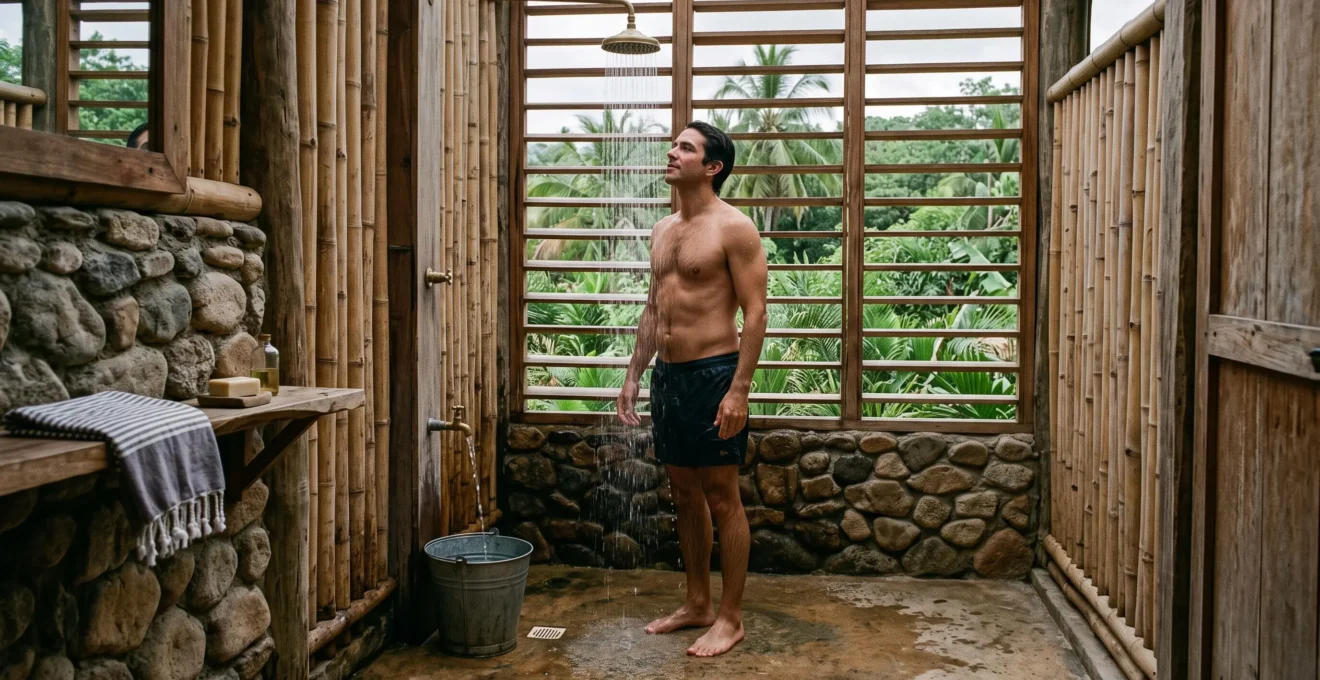
You turn on the shower at a remote Mexican eco-lodge, expecting a refreshing stream after a humid afternoon. Instead, water trickles gently from the shower head. Is something broken, or is this simply part of staying somewhere that collects its own rainwater?
The answer depends on the property’s plumbing, storage arrangements and available water supply. Some remote accommodations rely on rooftop rainwater collection because conventional infrastructure is limited or because they want to reduce reliance on other sources. Others combine harvested rainwater with wells, delivered water or a municipal connection.
A rainwater system can affect shower pressure, but low pressure does not automatically mean the cistern is nearly empty. Gravity, pumps, blocked filters and maintenance all play a role.
Understanding these differences helps UK travellers ask better questions before booking, adapt their routines without sacrificing basic comfort, and recognise when an environmentally responsible accommodation is genuinely well managed.
Rainwater-fed eco-lodges: the essentials
- Shower pressure depends on the water distribution system, not simply the amount of rainwater remaining in storage.
- Shorter showers, fewer unnecessary laundry changes and prompt leak reporting help protect limited reserves.
- Before booking, ask how water is collected, treated, stored and supplied during dry periods.
- Why Do Some Mexican Hotels Rely on Rainwater and What Does That Mean for Your Stay?
- How to Adjust Your Water Habits at a Rainwater-Fed Property Without Feeling Deprived?
- Which Is Genuinely Eco: A Lodge With Real Rainwater Systems or One That Just Says « Green »?
- The Guest Habit That Drains a Rainwater System Dry Before Checkout in Peak Season
- When Should You Book a Rainwater-Dependent Eco-Lodge to Avoid Low-Water Months?
- How to Vet a Jungle Cabin Listing in Mexico Using 6 Questions the Owner Might Not Answer?
- How to Prepare for a Protected Lagoon Visit in Mexico Without Getting Turned Back at Entry?
- How to Visit Mexico’s Protected Lagoons Without Breaking the Rules You Didn’t Know Existed
Why Do Some Mexican Hotels Rely on Rainwater and What Does That Mean for Your Stay?
Some remote Mexican hotels and eco-lodges collect rainwater to supplement or replace conventional water supplies. Roofs channel rainfall into storage tanks, from which gravity or pumps deliver water to bathrooms. Your shower experience depends on how that system is designed, whether sufficient water remains available, and how reliably its equipment operates.
In locations such as parts of the Riviera Maya or the Sierra Norte of Oaxaca, an isolated property may face practical challenges connecting to conventional infrastructure. Rainwater harvesting can provide another source, although the exact reasons for adopting it vary from one accommodation to another.
A typical system channels roof runoff through gutters and downpipes into a cistern. It may include first-flush diversion, filtration, treatment equipment and a pump.
As explained in Oregon State University‘s technical publication on rainwater harvesting, gravity-fed and pumped distribution use different methods to deliver water.
For guests, three configurations are particularly relevant:
| System | How it works | What guests may notice |
|---|---|---|
| Gravity-fed | An elevated tank delivers water using gravity. | Pressure may be modest but relatively steady when the tank maintains an adequate water level. |
| Pump-fed | A pump moves water and may maintain pressure through a pressure tank. | Stronger, more consistent flow is possible, but electrical or mechanical faults can interrupt supply. |
| Hybrid supply | Harvested rainwater is supplemented by another source. | Greater supply resilience is possible, depending on backup capacity, controls and maintenance. |
In a gravity-fed system, the height difference between the water surface and shower head influences pressure. In a properly configured pumped system, pressure may remain stable even as stored water decreases, until a minimum operating level is reached.
Seasonality matters primarily because the tank must contain enough water to meet demand between rainfall events. A lodge can therefore have adequate shower pressure during a dry spell if its storage, pumping and backup arrangements are sufficient.
**Low pressure is not proof of sustainability.** A consistently gentle flow may be intentional, but it may also indicate restricted plumbing, a dirty filter or inadequate equipment. A sudden reduction deserves investigation.
Ask staff whether the shower is designed for low flow or whether something has changed. A responsible property should be able to distinguish normal operating conditions from a problem requiring maintenance.
How to Adjust Your Water Habits at a Rainwater-Fed Property Without Feeling Deprived?
The easiest way to conserve water at a rainwater-fed lodge is to eliminate unnecessary running water rather than abandon normal hygiene. Shorter showers, sensible towel reuse and fewer avoidable laundry requests can reduce demand while preserving comfort. The most useful adjustment is to follow the property’s actual water guidance rather than assume every eco-lodge has identical limitations.
Start by identifying which activities are essential to your stay and which can be organised differently.
A comfortable shower remains important, particularly in a hot climate. However, water running while you search for toiletries, shave or wait unnecessarily can add to consumption without making the experience better.
If hot water takes a long time to reach the bathroom, ask whether the property has a recommended procedure. Some accommodations may offer a way to collect initially cold water for an approved non-drinking use. Avoid storing or reusing water independently where hygiene or plumbing arrangements are unclear.
Laundry is another opportunity. Reusing a towel that remains clean and dries properly may avoid unnecessary washing. You can also ask whether bedding changes are scheduled rather than automatic.
**For families and groups**, shower timing may matter as much as shower duration.
A lodge with a limited hot-water tank or solar water-heating system might struggle when several guests shower consecutively. That does not necessarily mean the rainwater cistern is empty: hot-water capacity and total water supply are separate issues.
Practical adjustments include:
- Space showers apart if staff advise that hot-water recovery takes time.
- Turn off taps while brushing teeth or soaping up.
- Request fresh towels or bedding when needed rather than automatically.
- Report continuously running toilets or dripping taps promptly.
- Ask whether the kitchen or housekeeping team follows a water-saving programme.
At check-in, ask whether rainwater reserves are currently normal, whether any restrictions apply and how water is replenished during prolonged dry weather.
There is also an important safety distinction: water conservation must not compromise safe washing or drinking water. If staff cannot explain whether the supply is suitable for bathing, request clarification rather than treating rainwater as automatically safe.
These changes are most effective when the accommodation provides clear instructions and maintains its own equipment. Guests should contribute sensibly, not compensate for serious shortcomings in basic facilities.
Which Is Genuinely Eco: A Lodge With Real Rainwater Systems or One That Just Says « Green »?
A genuinely responsible lodge should be able to explain where its water comes from, how it is treated, how wastewater is managed and what happens when rainfall is insufficient. Visible rainwater equipment supports the credibility of its claims, but does not prove the whole property is sustainable. Transparency and documented practices matter more than an appealing eco-friendly description.
Terms such as « eco », « green » and « off-grid » may describe very different operating arrangements. Without a specific certification scheme and its criteria, these words alone provide little independent assurance.
Look for concrete evidence.
A property collecting rooftop rainwater may have gutters feeding a storage tank, an accessible maintenance area, filtration equipment and clearly explained water-use arrangements.
However, **a visible filter does not prove that water is safe**.
The CDC guidance on collecting rainwater and protecting health explains that contaminants can enter rainwater through roofing materials, gutters and storage systems. Appropriate testing and treatment depend on the contaminants and intended use.
For travellers, this means asking separately whether the water is suitable for showering, brushing teeth, drinking and food preparation.
Three questions reveal more than a sustainability slogan:
- Where does the shower water come from? A credible answer identifies the source and any backup supply.
- What happens in the dry season? Look for an explanation of storage, consumption management or alternative arrangements.
- How is wastewater handled? The operator should identify how greywater and toilet wastewater are collected, treated or disposed of.
Consider two hypothetical listings.
One explains its rainwater collection arrangements, water treatment, expected shower flow and dry-season contingency. Another calls itself « 100% eco » but cannot describe its water supply.
The first offers more verifiable information, even if it promises fewer luxuries. That does not automatically certify its overall environmental performance.
Likewise, a lodge supplied by water deliveries is not necessarily irresponsible. The environmental implications depend on delivery frequency, transport, local water availability and other operational factors. A rainwater system can also have environmental costs.
The strongest accommodation choice combines an understandable water system, appropriate treatment, transparent limitations and credible wastewater management.
The Guest Habit That Drains a Rainwater System Dry Before Checkout in Peak Season
The biggest avoidable burden on a small rainwater system is treating every water-using activity as unlimited: extended showers, unnecessary towel changes and taps left running. When many guests repeat these habits during a busy dry period, total demand can exceed replenishment. Leaks and inadequate storage can worsen the situation, regardless of how carefully individual guests behave.
A single long shower is not automatically responsible for emptying a cistern. The issue is cumulative consumption.
Imagine a hypothetical lodge hosting several families while rainwater collection has paused during a dry spell. Each cabin uses water for showers, toilet flushing, washing and cleaning. The kitchen and housekeeping areas draw on the same reserve if connected to that supply.
Even modest additional use across multiple rooms can shorten the time before the lodge requires replenishment.
This matters around busy travel periods such as Christmas holidays and Semana Santa, which can coincide with relatively dry conditions in some Mexican regions.
However, occupancy patterns and the precise availability of rainwater are property-specific. There is no reliable basis for assuming all Mexican eco-lodges face the same shortage during these holidays.
One particularly important action is reporting leaks.
A toilet that continually refills or a tap that will not close can waste water without providing any benefit to guests. The actual loss depends on the fault, but leaving it unresolved can be more damaging than making ordinary reductions in shower duration.
Guests can help through simple changes:
- Take a comfortable but reasonably short shower.
- Reuse suitable towels rather than requesting automatic replacements.
- Turn taps off completely after use.
- Report leaking taps, toilets and unexplained water flow immediately.
- Tell reception when shower pressure changes unexpectedly.
A declining supply can affect more than bathing. Depending on the plumbing, the kitchen, toilets and housekeeping operations may share the same reserve.
Staff may be able to identify a pump fault, arrange backup supplies or introduce temporary conservation measures before services are disrupted.
Responsible conservation is a shared responsibility: guests can avoid waste, while operators must provide realistic capacity, functioning equipment and a plan for maintaining essential services.
When Should You Book a Rainwater-Dependent Eco-Lodge to Avoid Low-Water Months?
The best time to book depends on the lodge’s local rainfall pattern, storage capacity and backup supply. Much of Mexico receives substantial rainfall between May and October, but conditions vary by region and year. Rather than assume a particular month guarantees strong shower pressure, ask the accommodation how it manages reserves during your intended dates.
Mexico does not have one uniform rainy season.
According to Conagua‘s communication on Mexico’s rainy season and canícula, rainfall in much of the country is concentrated between May and October. Regional exceptions exist, including areas where winter precipitation is important.
There may also be a temporary reduction in rainfall during part of the wet season, known as the canícula, which varies geographically and from year to year.
For travellers, three considerations matter more than the national calendar:
- Local rainfall: the expected wet and dry periods at the property’s actual location.
- Storage autonomy: whether the cistern can meet demand between significant rainfall events.
- Backup arrangements: what happens when stored rainwater becomes insufficient.
The end of a local dry season can be a period worth investigating because the time since substantial rainfall may have been long. Yet a well-designed lodge can remain adequately supplied, while a poorly sized system may face restrictions even during wetter months.
The dry season can offer attractive conditions for outdoor activities, although wildlife viewing, trail access and comfort vary considerably by destination.
Travelling after seasonal rainfall begins may improve replenishment prospects, but it can also mean muddy access roads, heavier rain and altered outdoor plans. Early rain does not guarantee that storage tanks are already full.
Before booking, ask: « During this particular month, do you normally have enough stored water for all guest facilities, and what is your backup plan? »
An operator who can explain typical constraints without making guarantees provides more useful information than a listing offering a vague promise of unlimited water.
Choose dates based on the entire travel experience, including weather, access and activities. A suitable water-management system may be more important than choosing a supposedly perfect month.
How to Vet a Jungle Cabin Listing in Mexico Using 6 Questions the Owner Might Not Answer?
Before booking a remote Mexican jungle cabin, ask six questions covering its water source, storage, treatment, wastewater, electricity and shortage contingency. The goal is not to demand hotel-style infrastructure, but to establish what the property can reliably provide. Clear, specific answers are more meaningful than scenic photographs or broad assurances about sustainability.
Remote accommodation can be wonderful precisely because it operates differently from a conventional resort. That difference should be described accurately before payment.
The following questions are practical screening tools, not a formal certification process.
| Question | Useful answer | Potential warning sign |
|---|---|---|
| 1. What is the exact source of shower water? | Rainwater, well water, municipal supply or a specified combination. | « Natural water » without clarification. |
| 2. What is the storage capacity and how is it replenished? | Tank capacity or a practical explanation of storage autonomy and replenishment. | No explanation of how shortages are managed. |
| 3. How is water treated and what uses is it safe for? | Named treatment methods and clear distinctions between bathing and drinking. | « It’s filtered, so you can drink it » without supporting information. |
| 4. How are greywater and toilet wastewater managed? | A description of the collection, treatment or disposal arrangement. | No clear response about wastewater. |
| 5. How is electricity supplied? | A clear explanation of grid, solar, battery or generator arrangements. | No information about power reliability or pump dependence. |
| 6. What happens during a water shortage? | Backup supplies, conservation procedures or clear guest arrangements. | An unlimited-water promise with no credible contingency. |
Not every owner will know technical specifications immediately. A small accommodation operator may need to consult maintenance staff. Willingness to obtain an accurate answer can be more revealing than immediate fluency.
Independently review recent guest comments mentioning showers, electricity, hot water and dry-season visits. Request recent photographs where appropriate.
Also examine the cabin’s actual access route. A remote property reached by an unpaved track may face different logistical constraints from a lodge near a well-maintained road, although remoteness alone does not prove a service problem.
Your five-step eco-lodge booking check
- Send the six infrastructure questions and save the owner’s written responses in your booking records.
- Request a recent photograph or description of the water-storage and treatment arrangements; keep the evidence with the listing.
- Read recent reviews for water, electricity and hot-water complaints; make a short record of any recurring issues.
- Confirm the actual location and access route; save the map and arrival instructions.
- Obtain written confirmation of essential amenities and shortage arrangements before committing to a non-refundable booking.
A transparent explanation of occasional limitations is generally more useful than a promise of effortless luxury. Booking with realistic expectations reduces the likelihood of a disappointing stay.
How to Prepare for a Protected Lagoon Visit in Mexico Without Getting Turned Back at Entry?
To avoid access problems at a protected Mexican lagoon, identify the site’s managing authority, confirm current visiting arrangements and check whether a guide, permit or admission payment is required. Rules vary between destinations and may change because of environmental protection, weather or local operating decisions. Prepare an alternative activity rather than assuming online visitor information is always current.
Mexico’s lagoons may fall within federal protected areas, community-managed territories or other conservation arrangements. A site’s Ramsar wetland designation, where applicable, does not by itself tell travellers what admission rules apply.
Begin by checking whether the destination falls under the Comisión Nacional de Áreas Naturales Protegidas (CONANP). Where it does, official protected-area visitor information is a valuable starting point.
For other destinations, consult the relevant local authority or community organisation responsible for access.
Laguna Miramar, within the Montes Azules Biosphere Reserve in Chiapas, provides a useful example. Its official visitor information describes local access arrangements, community agreements and conservation guidance.
These details matter because access to a remote natural attraction may involve more than arriving at a roadside entrance.
Before travelling, follow a three-level check:
- Confirm the lagoon’s official designation and identify its managing organisation.
- Contact the relevant visitor office, community operator or authorised guide to verify current access arrangements.
- Prepare a realistic alternative activity in case entry or access is unavailable.
Ask specifically about opening hours, guides, booking requirements, weather restrictions, entry fees, accepted payment methods and any temporary closures.
Some destinations may use locally organised guiding or cash payments, but these arrangements must be confirmed for the particular site. Neither universal guide requirements nor universal visitor quotas can be inferred from the information available here.
Carry sufficient Mexican pesos where cash payments have been confirmed. Ask for a ticket or receipt when available, and check displayed prices before paying.
For remote visits, confirm whether boat transport or trail access is involved and how return arrangements operate. Weather and daylight can affect a journey even when the destination is officially open.
The goal is to arrive with accurate expectations, respect local management arrangements and avoid placing pressure on communities or conservation staff when access is restricted.
What to remember before visiting a protected lagoon
- Official protected-area guidance is the starting point, but local operators should confirm current conditions.
- Access permission and permission for specific activities, such as swimming or boating, are separate questions.
- Choose water-safe personal-care habits and plan to remove your rubbish instead of assuming visitor facilities are available.
How to Visit Mexico’s Protected Lagoons Without Breaking the Rules You Didn’t Know Existed
The safest approach to visiting Mexico’s protected lagoons is to follow the rules published for the specific site, not general advice about natural attractions. Restrictions may affect swimming, boating, wildlife observation, drones, sunscreen and waste disposal. Understanding local conservation requirements before arrival helps protect fragile habitats while preventing avoidable conflict with guides or protected-area staff.
A lagoon that looks accessible in photographs may contain sensitive nesting areas, protected vegetation or sections where visitor activities are restricted.
Rules are not identical across Mexico. Even nearby destinations can be managed by different authorities or communities.
The CONANP’s official visitor information for Montes Azules and Laguna Miramar illustrates the importance of destination-specific guidance.
For that protected area, CONANP describes requirements to respect local community and ejido agreements, manage waste responsibly and avoid removing plants, animals or archaeological materials.
Its guidance also recommends environmentally friendly sunscreen at Laguna Miramar to reduce water contamination. That recommendation should not be misrepresented as a universal Mexican prohibition on conventional sunscreen.
Common subjects to check before visiting include:
- Swimming and kayaking: whether these activities are permitted and which areas are accessible.
- Wildlife protection: rules for avoiding disturbance to birds, reptiles and other animals.
- Drones and photography: whether particular equipment or activities require permission.
- Food and rubbish: restrictions on what visitors can bring and obligations to remove waste.
- Personal-care products: locally applicable guidance on sunscreen, soap and other products that may enter the water.
Never assume that a product labelled « biodegradable » is harmless to aquatic ecosystems. Where product restrictions exist, follow the managing authority’s specific instructions.
Guests staying near lagoons should also consider their accommodation’s wastewater practices. Untreated wastewater can create environmental risks, but the mere presence of a rainwater-fed lodge does not establish that it is contaminating a protected water body.
These two sides of sustainable travel are connected through responsible water management: collecting water responsibly is useful, while managing what leaves the property is equally important.
Before leaving your lodge, carry the essentials that the destination actually permits: drinking water from a safe source, any required personal supplies, a way to collect rubbish, suitable payment and confirmed access details.
Where boat or trail access is involved, ask the operator about departure and return times. Do not assume facilities such as toilets, bins or shops will be present.
Before your next protected-lagoon excursion, check the destination’s current official rules, confirm access with the responsible operator and prepare only the supplies permitted on site. It is a simple way to support conservation while making the trip more enjoyable.
Is rainwater from an eco-lodge safe for brushing your teeth?
Not automatically. Collected rainwater can contain microorganisms or chemical contaminants, even when it looks clean. Ask whether the water is specifically treated and verified as suitable for drinking and brushing teeth. If this cannot be confirmed, use an appropriate safe-water alternative.
Does low shower pressure mean an eco-lodge is running out of water?
No. Low pressure may result from gravity-fed plumbing, limited elevation, a pump problem, a clogged filter or other restrictions. A falling water level can affect some systems, but properly controlled pumps may maintain pressure until a critical level is reached. Ask staff whether the flow is normal or requires maintenance.
Can a Mexican eco-lodge collect enough rainwater to operate all year?
It is possible in principle, but it depends on local rainfall, collection area, storage capacity, occupancy, water demand and any backup supply. A property cannot demonstrate year-round reliability merely by having a large tank. Ask how it manages prolonged periods without substantial rainfall.
Should you expect hot water in a remote jungle cabin?
Only if the listing explicitly provides it. Hot-water availability depends on the heating system, electricity or fuel supply and stored hot-water capacity. Check whether hot showers are available throughout the day and whether several guests can use them consecutively. Rainwater harvesting alone does not determine hot-water availability.
Are protected lagoons in Mexico always open to overnight eco-lodge guests?
No. Staying nearby does not automatically grant access to a protected area. Visiting arrangements depend on the destination, managing authority, community agreements and current conditions. Confirm entry requirements and permitted activities directly with the relevant authority or local operator before travelling.