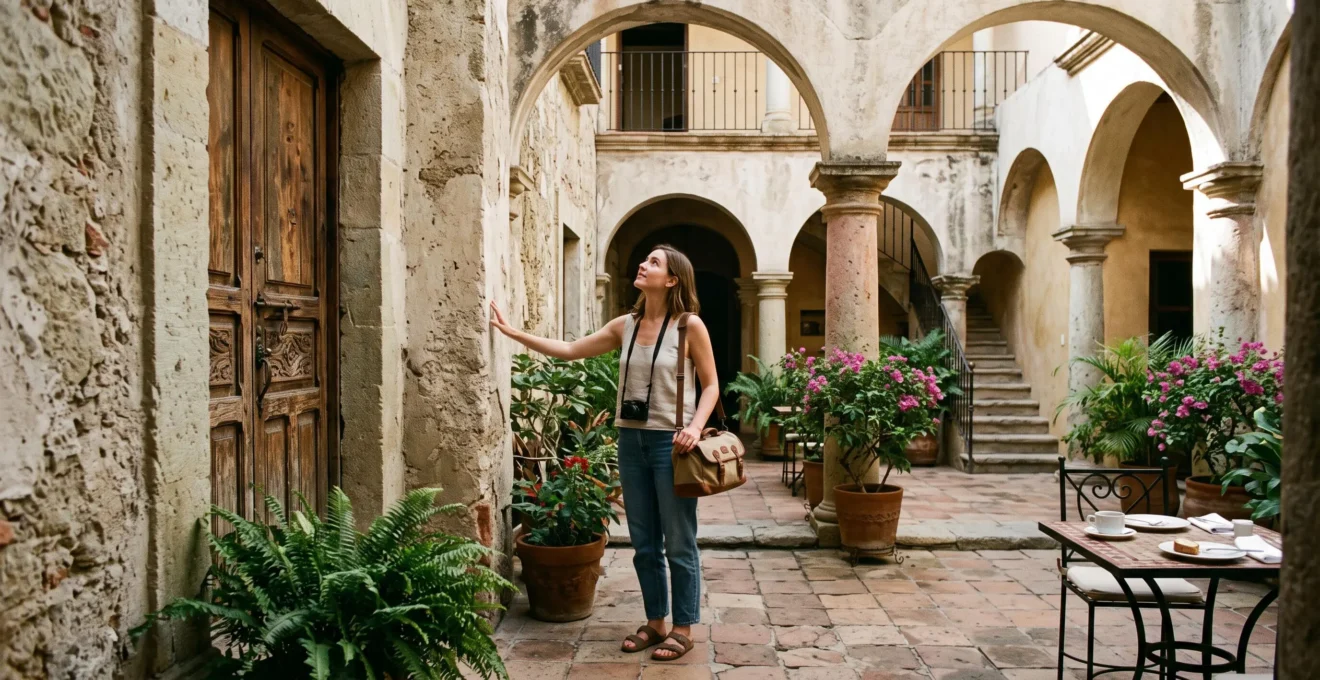
A handsome courtyard, artisan-looking furniture and a beautifully photographed breakfast can make almost any hotel in Mexico appear distinctive. None of these details tells you whether the building has a meaningful history, whether the service feels personal or whether you’ll actually sleep comfortably.
The problem with the word « boutique » is that it describes a style of hospitality without guaranteeing a particular architectural pedigree or guest experience. A converted family residence, a thoughtful contemporary hotel and a freshly built property decorated to resemble an old hacienda can all use the label.
For UK travellers spending a meaningful part of their holiday budget on a short Mexican stay, the distinction matters. The strongest choice is not necessarily the oldest or most photogenic property. It is the hotel whose setting, design, management and everyday operation justify its price.
To find it, look beyond atmospheric photographs. Investigate the actual building, the specific room, repeated patterns in reviews and the location you’ll experience after the photographer has gone home.
Mexican boutique hotels: the essentials
- Verify the building’s history and distinctive features rather than accepting heritage-inspired décor as evidence of authenticity.
- Read reviews for room-specific noise, maintenance and personal service, not merely overall scores.
- For a two-night town visit, favour a walkable location and a confirmed quiet room over impressive photographs or an isolated luxury setting.
- Why Do « Boutique Hotels » in Mexico Range From Extraordinary to Disappointing for the Same Price?
- How to Vet a Mexican Boutique Hotel Listing Using 4 Clues Beyond Star Ratings
- Which Delivers More Atmosphere: A Heritage-Building Boutique or a Modern Design Hotel in Mexico?
- The Boutique Hotel Mistake That Costs Around £150/Night and Delivers Street Noise Instead of Charm
- When Should You Book a Mexican Boutique Hotel to Get Lower Rates and Better Attention?
- How to Vet a Hacienda Stay in Mexico Before Booking Using 5 Review Red Flags
- Which Is Better for a 2-Night Stay: Historic Centre Hotels or Outskirts in a Colonial Mexican Town?
- Which Colonial Town in Mexico Feels Best on Foot When You Only Have 2 Nights?
Why Do « Boutique Hotels » in Mexico Range From Extraordinary to Disappointing for the Same Price?
Mexican boutique hotels can charge similar rates while delivering very different experiences because the label covers both historic conversions and newly built design-led properties. One may offer original architecture and close owner involvement; another may rely on decorative styling. Price reflects positioning and demand, not necessarily authenticity, comfort or hospitality quality.
In Mexico’s colonial towns, many smaller hotels occupy former family residences and historic mansions. Rough Guides‘ overview of accommodation in Mexico describes this conversion tradition alongside other accommodation types, including haciendas.
That history is important because certain qualities cannot be added simply by hiring an interior designer. A courtyard shaped by an old residential layout, a carved doorway and rooms with different proportions create a physical experience that standardised decoration struggles to reproduce.
It helps to distinguish two kinds of character:
- Earned character: architectural features and spatial arrangements resulting from a building’s actual history, such as original masonry, historic joinery or a courtyard whose form predates its hotel conversion.
- Designed character: an atmosphere created through furniture, finishes, lighting, textiles and decorative choices. It may be attractive and culturally thoughtful, but its appearance alone establishes no historical connection.
A newly built property might use mass-produced furnishings, immaculate plaster and carefully arranged ceramics to evoke an old Mexican residence. A genuine historic conversion might show irregular floor levels, distinctive window proportions and a patio that makes architectural rather than merely photographic sense.
Neither category guarantees a better night’s sleep. An old building can be poorly maintained; a new one can be designed with exceptional care.
Pricing adds another complication. A family-run historic guesthouse may compete on location, personal hospitality and a limited number of rooms, while a newer property may command a premium through marketing and visual presentation. The reverse can also occur. These are possible commercial arrangements, not established pricing rules.
Once the difference is clear, the next task is to find evidence that an individual hotel genuinely delivers what its photographs suggest.
How to Vet a Mexican Boutique Hotel Listing Using 4 Clues Beyond Star Ratings
To assess a Mexican boutique hotel beyond its star rating, examine who operates it, what its photographs reveal about the building, how precisely it describes its neighbourhood and what guests repeatedly say about the service. Together, these four clues are more informative than attractive images or a single review score, although none proves authenticity alone.
1. Investigate the people behind the property. Read management responses to recent reviews. Does someone consistently answer specific concerns, explain the hotel’s history or identify improvements? Or are the replies generic and interchangeable?
An owner responding personally can suggest close operational involvement. Nevertheless, a professional manager can provide equally attentive hospitality, and friendly replies do not prove that the owner is regularly present.
2. Study photographs as architectural evidence. Look past the styled bed and breakfast tray. Compare doorway proportions, room shapes, ceiling details, floor finishes and courtyard layouts across multiple photographs.
Historically distinctive buildings often contain irregularities. However, irregular plaster can be deliberately recreated, while original features can be hidden behind renovation. Ask whether the hotel can identify which elements actually predate its conversion.
3. Demand geographical specificity. A useful listing identifies the actual neighbourhood and explains whether restaurants, markets and major sights are comfortably accessible on foot. Phrases such as « minutes from everything » mean little without a map and a recognisable starting point.
Check the hotel’s position independently. A property marketed as being in the historic centre may sit near its edge; this may be an advantage for tranquillity, but it changes the practical experience.
4. Search reviews for operational substance. Repeated references to thoughtful local recommendations, remembered preferences and helpful staff suggest service with personality. Conversely, recurring comments such as « beautiful but impersonal » or « no one available when needed » deserve attention.
Prioritise recent, detailed reviews mentioning the same room categories or service problems. One unusually enthusiastic or disappointed review is weaker evidence than a consistent pattern.
Your five-step boutique hotel verification checklist
- Identify the property’s origin and ask which features are original. Save the written response or building-history page.
- Compare photographs of at least two room categories. Record one architectural detail you want verified.
- Locate the entrance on a map and check the streets around it. Save a map pin showing the exact position.
- Review recent comments about staff, sleep quality and maintenance. Note three recurring observations, distinguishing patterns from isolated complaints.
- Contact the property about your preferred quiet room and any essential requirements. Keep its specific written confirmation with the reservation.
A hotel that answers precise questions convincingly may be a stronger candidate than one with more dramatic photography. The remaining choice is whether historic architecture or contemporary design better suits your stay.
Which Delivers More Atmosphere: A Heritage-Building Boutique or a Modern Design Hotel in Mexico?
A heritage-building boutique hotel usually offers more direct contact with Mexico’s historic architecture, while a well-designed contemporary hotel may provide better-controlled comfort and its own genuine sense of place. Choose heritage when the building itself is a major attraction; choose contemporary design when sleep, practical amenities and architectural interpretation matter more than original fabric.
Mexico’s historic architecture offers real reasons to favour older buildings. UNESCO‘s World Heritage description of Oaxaca’s historic centre identifies substantial walls, low building forms and a preserved colonial street arrangement as distinctive features of the city.
These are characteristics of the wider historic environment, not proof that a particular hotel retains its original walls or layout.
Old buildings can offer intimate courtyards, unusually high ceilings and architectural details shaped by generations of use. But some conversions also have practical compromises: awkward staircases, inconsistent room sizes or installations that require careful maintenance.
Soundproofing, air conditioning and plumbing must be assessed individually. Historic designation alone does not establish that these services are inadequate.
The choice becomes clearer when you compare what you will actually do during the stay.
| Decision factor | Heritage-building boutique | Modern design hotel |
|---|---|---|
| Main attraction | Documented architectural history and original spaces | Contemporary interpretation and purposeful design |
| Room layout | May vary considerably between rooms | Often easier to standardise, depending on design |
| Comfort | Depends on renovation and maintenance quality | Depends on construction and operational standards |
| Best travel style | Slow mornings and time spent enjoying the property | Busy days exploring with a comfortable base |
| Main verification | Original features, restoration and exact room | Local design substance, materials and actual amenities |
Contemporary does not automatically mean culturally empty. A hotel designed by Mexican architects using locally appropriate stone, regional craft traditions and a layout responding to climate can express a more meaningful sense of place than a historic-looking property full of imported decorative clichés.
Equally, a hotel advertised as a restored colonial residence may retain little more than its frontage. Request photographs of the actual rooms, corridors and courtyard, not just the exterior. Ask what was preserved, rebuilt or newly added.
INAH‘s official conservation and restoration FAQs explain the importance of assessing the specific characteristics, history and condition of heritage property when planning conservation work. They do not certify individual hotels, but they reinforce why vague renovation claims are inadequate evidence.
Once the building type suits your preferences, investigate the room itself. An excellent architectural setting can still produce a disappointing night if its location and noise exposure have been overlooked.
The Boutique Hotel Mistake That Costs Around £150/Night and Delivers Street Noise Instead of Charm
The costly mistake is paying extra for a picturesque balcony, prominent street frontage or rooftop view without checking how much noise reaches the bedroom. Around £150 per night is an illustrative boutique-hotel budget, not a verified average Mexican rate. Whatever you spend, room orientation and nearby evening activity can matter more than the view.
A balcony overlooking a colonial street may be the most appealing photograph in a hotel’s gallery. Yet the same location can expose guests to traffic, conversations, church bells, music or late-night activity.
In a short stay, a disturbed first night is particularly frustrating. Guests may discover that the room they selected for its atmosphere is less restful than a plainer room overlooking a quiet interior area.
Consider a hypothetical booking: two travellers select a £150-per-night room because it has a wrought-iron balcony facing a historic square. On arrival, they discover a nearby bar operates late. The room matches the photographs perfectly, but the listing never explained its acoustic exposure.
The problem is not that an old-town balcony is inherently unsuitable. It is that a visual feature was treated as evidence of overall room quality.
Before confirming a reservation, use this verification sequence:
- Search recent reviews for « noise », « quiet », « music », « street » and « sleep ».
- Identify whether positive and negative comments refer to balcony rooms, courtyard rooms or another wing.
- Inspect the immediate surroundings on a map, looking for bars, restaurants, churches and major traffic routes.
- Ask which specific room categories are least exposed to evening activity.
- Request written confirmation of the allocated room or an explanation if room assignment cannot be guaranteed.
Courtyard-facing is not automatically synonymous with quiet. A room above a hotel restaurant or beside a pool can experience more disturbance than one on a relatively calm street.
For properties surrounding an internal patio, ask when breakfast preparation starts, when communal areas close and whether events take place. For street-facing rooms, inquire about nearby nightlife and windows rather than assuming thick masonry solves every acoustic problem.
Protecting a good night’s sleep is often a better use of your accommodation budget than upgrading a room category. Booking timing matters next, especially when the quiet rooms are limited.
When Should You Book a Mexican Boutique Hotel to Get Lower Rates and Better Attention?
For many Mexican colonial destinations, travelling outside major holiday peaks can improve your chances of finding more attractive boutique-hotel rates. Late spring and parts of autumn are worth comparing, but local festivals and weather can change the picture. At very small properties, securing the right room early may be more valuable than chasing a last-minute discount.
Two separate questions affect booking value: how much the room costs, and what experience the hotel’s occupancy and staffing will allow.
Accommodation demand across Mexico varies by destination. The Rough Guides accommodation overview identifies December to April as an important tourism period and highlights Christmas and Easter as potentially more expensive times. Those broad patterns should not be mistaken for an identical pricing calendar in every inland city.
School holidays, cultural festivals and weekends can create local spikes. A midweek booking outside a major event may compare favourably with a holiday weekend, but actual availability and rates need checking for your dates.
Lower occupancy may also give staff more flexibility to assist with questions, room preferences or arrival arrangements. That is a plausible operational advantage, not a guaranteed relationship between hotel occupancy and better service.
Small properties create a particular booking dilemma. At a hotel with fewer than 15 rooms, there may be only one or two rooms in your preferred orientation or category. The value of securing one can outweigh a hypothetical discount later.
Contacting a hotel directly is worthwhile even when the reservation itself is made through a platform. It gives you an opportunity to ask about room placement, dietary arrangements, transfer logistics and the practical details that generic booking forms may not address.
However, direct booking does not automatically produce the lowest rate, better treatment or stronger consumer protection. Compare the final price, payment terms, cancellation conditions and written promises on both channels.
For a UK traveller, also check the currency in which payment will be collected. A rate quoted in Mexican pesos and a converted sterling display may not produce identical final costs once card conversion arrangements are applied.
Timing can improve a booking, but it cannot compensate for choosing the wrong kind of property. This becomes especially relevant when a hotel is advertised as a hacienda.
How to Vet a Hacienda Stay in Mexico Before Booking Using 5 Review Red Flags
Before booking a Mexican hacienda hotel, determine whether it is a restored estate, a historic property with modern additions or a newly built hacienda-style resort. Then examine reviews for annex accommodation, resort-style operations, inconvenient distances, recurring maintenance problems and private events. These five signals help establish what experience you are actually buying.
The term « hacienda » needs scrutiny because a property’s architectural appearance and its historical origin are not necessarily the same.
A genuine estate conversion may preserve former residential or agricultural buildings, gardens and an architectural arrangement reflecting the site’s previous use. A newly built resort may borrow visual elements without sharing that history. A third category may combine an authentic historic core with extensive contemporary accommodation.
None is automatically a poor choice. The problem arises when the marketing encourages expectations that the booked room cannot fulfil.
The five warning signals to investigate are:
- Rooms in a modern annex. Reviews mentioning separate new wings should prompt a question about where your exact room is located. The historic building in photographs may not contain the guest accommodation.
- Predominantly resort-style facilities. Large pool complexes, extensive event spaces and high-capacity dining facilities may indicate a different operating atmosphere from an intimate restored estate. They are not proof of inauthenticity.
- Unexpected distance from town. An illustrative 20–60-minute journey to a historic centre can substantially alter a short itinerary. Verify the real journey for your chosen property rather than relying on a generic description of its location.
- Recurring maintenance or staffing complaints. Repeated reports of unresolved plumbing, inconsistent housekeeping or limited staff availability matter particularly where services and alternatives are not close by.
- Weddings and private events. Banqueting spaces, event galleries and reviews mentioning celebrations justify checking whether a private function is scheduled during your visit.
Look for precise answers. Which building houses your room? Is access to the historic courtyard unrestricted? How many dining areas will be operating? Will other guests or a private event share the principal spaces?
A rural estate with modern rooms and weddings may still be an excellent choice for travellers seeking grounds, a pool and a comfortable retreat. It should simply be evaluated on that basis rather than as an intimate heritage guesthouse.
Once you understand what the hacienda actually offers, location becomes the deciding factor: is the property itself the reason for travelling, or is it the nearby colonial town?
Which Is Better for a 2-Night Stay: Historic Centre Hotels or Outskirts in a Colonial Mexican Town?
For a two-night visit focused on exploring a Mexican colonial town, a hotel in or near the historic centre is generally the more practical choice. It preserves time for morning markets, evening walks and spontaneous meals. An outskirts hotel or hacienda makes more sense when gardens, tranquillity and time spent at the property are the main purpose of the trip.
Location affects a short stay disproportionately. With only two nights, journeys between the accommodation and the town compete with the hours when streets, restaurants and squares are most atmospheric.
A central hotel can turn ordinary movements into enjoyable parts of the holiday. Breakfast is followed by a walk through local streets; an afternoon rest does not require a major transfer; and dinner can begin without coordinating another journey.
Yet « central » is not the same as « comfortable ». Historic streets may have evening activity, uneven cobblestones, restricted vehicle access and buildings where bedrooms are smaller than photographs suggest.
Ask how close a car or taxi can reach the entrance, particularly if arriving with substantial luggage. Consider stairs and room access if mobility matters.
A practical compromise is to search a few streets beyond the busiest central square. This second ring can retain convenient walking access while potentially reducing exposure to the most concentrated street activity. It is a search strategy, not a guaranteed quiet zone.
Outskirts accommodation becomes more persuasive when you expect to remain on site for much of the trip. A spacious garden, a pool and a characterful estate may justify additional travel, especially if your idea of relaxation does not involve frequent sightseeing.
Before committing, compare two realistic daily itineraries. For the central hotel, calculate how much you can experience on foot. For the outskirts property, establish the practical transport arrangements, costs and return options after dinner.
For travellers prioritising walking, there is one more decision that can outweigh the hotel itself: selecting a town whose layout and atmosphere match the available time.
What matters before choosing your colonial town
- A compact historic centre is more valuable for two nights than an impressive list of attractions spread far apart.
- Arrival and departure logistics can determine how much of the town you actually experience.
- Match the town’s distinctive character to your interests, then choose a hotel within comfortable walking distance of those experiences.
Which Colonial Town in Mexico Feels Best on Foot When You Only Have 2 Nights?
Oaxaca is a strong choice for travellers who want markets, food and street life within a historic urban setting; San Miguel de Allende suits those drawn to art, architecture and winding streets. Puebla appeals to visitors interested in monumental buildings and decorative heritage, while Mérida offers a generally flatter central walking environment. Arrival logistics and personal interests should decide.
The best town for a two-night walking stay is not necessarily the most famous one. It is the destination where you can experience the things you care about without lengthy transfers or a demanding daily itinerary.
These four places offer different combinations of urban form, architectural interest and on-foot experiences.
| Destination | Walking character | Particular appeal | Consider before booking |
|---|---|---|---|
| Oaxaca | Historic street grid and a central concentration of activity | Food, markets and cultural life | Choose a base near the areas you want to explore |
| San Miguel de Allende | Atmospheric streets with noticeable slopes in parts | Art, galleries and distinctive architecture | Cobbles and gradients may affect walking comfort |
| Puebla | Grid-based historic streets and substantial urban architecture | Churches, ceramics and architectural grandeur | Check distances between your chosen sights |
| Mérida | Relatively flat central streets within a larger urban area | Squares, historic buildings and regional culture | Heat and distances beyond the core can limit walking |
Puebla‘s architectural identity is especially well documented. UNESCO describes its historic centre as having a Renaissance-influenced grid, significant Baroque architecture and houses decorated with coloured ceramic tiles known as azulejos. That makes architectural exploration a meaningful reason to visit, although it does not establish that Puebla is objectively more walkable than the other towns.
Oaxaca offers a compelling balance for travellers who enjoy discovering a place through food and everyday street life. Its preserved historic layout provides a coherent setting for exploring without constantly travelling between distant attractions.
San Miguel de Allende offers a different experience, with much of its visual appeal encountered along streets and around historic buildings. Visitors who find steep or irregular surfaces tiring should pay particular attention to the precise location of their accommodation.
Mérida can be attractive to travellers who prefer flatter routes, but its warmer conditions can make the time of day an important part of walking plans.
Arrival arrangements can reverse an otherwise obvious preference. A town with excellent accommodation may be inconvenient if reaching it consumes much of the first day. Check real transport connections for your travel dates, including flights, onward buses and the final transfer to your hotel. Where using intercity services such as ADO, verify that the route and timetable actually serve the intended journey.
The most effective selection process begins with your main interest: choose Oaxaca for food-and-market immersion, San Miguel de Allende for an art-focused visit, Puebla for architectural exploration or Mérida for its particular urban and regional atmosphere. Then examine walking routes between the sites that matter to you.
For your next booking, shortlist two or three hotels in the most walkable part of your chosen town. Compare their actual room layouts, recent reviews and written answers about noise and building history. The goal is not to find the most picturesque courtyard in Mexico, but a place whose character remains convincing throughout your stay.
Does the word « boutique » mean a hotel is independently owned?
No. The description does not by itself guarantee independent ownership, a historic building or personal management. Check the hotel’s operator and whether it belongs to a wider portfolio. Ownership may influence its identity, but service quality still needs to be assessed independently.
Can a new Mexican hotel have authentic local character?
Yes. Contemporary architecture can be meaningfully rooted in its location through locally informed design, regional materials, craftsmanship and thoughtful relationships with its surroundings. The important distinction is between genuine design choices and purely decorative imitation, not simply between old and new buildings.
How can you confirm that a hotel room is in the historic part of a property?
Ask the hotel to identify the building and floor containing your reserved room. Request recent photographs of that exact category and confirmation of which features are original. Do not assume that photographs of an impressive heritage courtyard represent every bedroom on the premises.
Is it better to pay for a refundable boutique hotel reservation?
A refundable rate can be valuable when travel arrangements or room preferences remain uncertain. Compare its additional cost against the specific cancellation deadline, penalties and refund conditions. A non-refundable rate may be reasonable when plans are settled, but the cheapest displayed price is not always the lowest-risk choice.
Should UK travellers pay Mexican boutique hotels in pounds or pesos?
Compare the hotel’s Mexican-peso price with any offered sterling conversion, including applicable exchange-rate markups and card charges. Paying in the local currency can avoid an unfavourable merchant conversion, depending on your card terms. Confirm the actual billing currency before authorising payment.