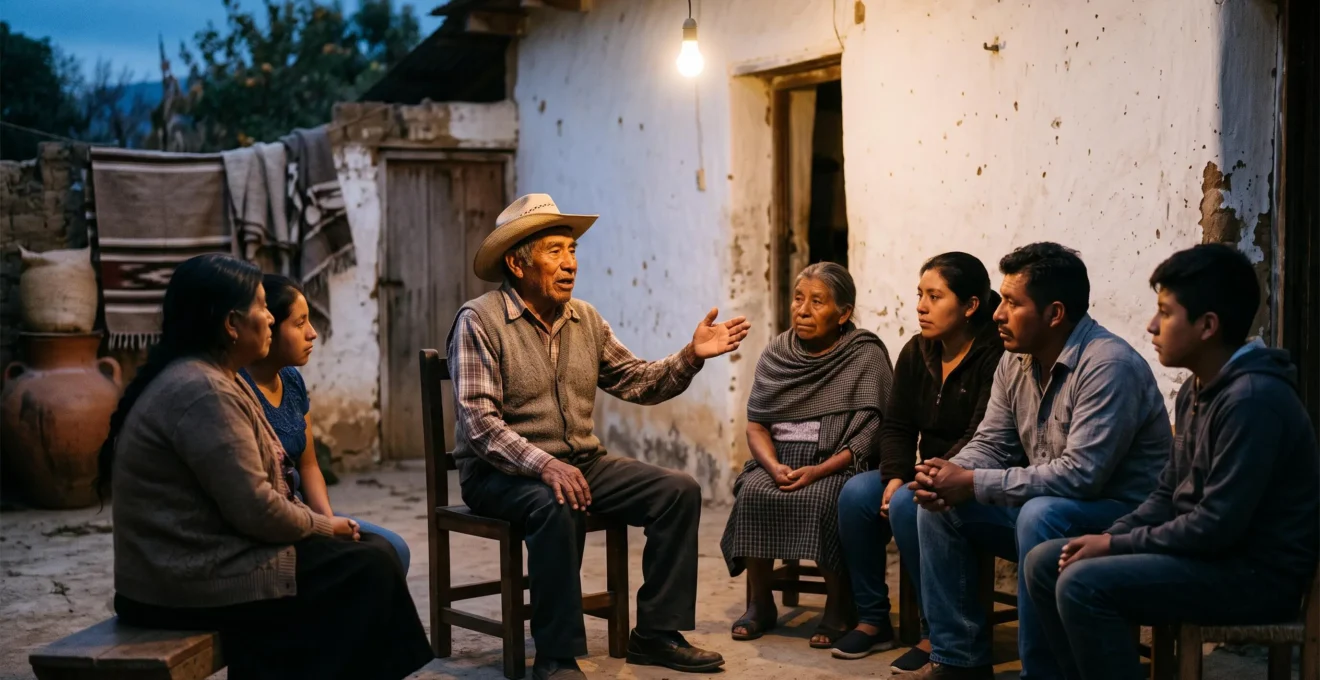
In Mexico, traditional storytelling is not confined to books, museums or performances arranged for tourists. It lives wherever people choose to transmit local histories, legends, memories and ritual knowledge through speech: sometimes on a public stage, sometimes in a cultural centre, and sometimes within gatherings that visitors have no automatic right to attend.
For travellers hoping to hear these traditions, Oaxaca, the Chiapas highlands, the Yucatán Peninsula and Purépecha-speaking areas of Michoacán are useful starting points. Each has its own languages and cultural contexts. None offers a guaranteed storytelling performance simply because an Indigenous community lives nearby.
The practical approach is to research languages and cultural programmes first, contact local organisers, and distinguish public performances from private community occasions. The result may be a bilingual story session, a theatrical presentation of a regional legend or an invitation to listen in a smaller setting.
What matters is not how remote the venue feels. It is whether the people telling the stories have chosen to share them, and whether visitors understand the responsibility that comes with listening.
Where to hear Mexican storytelling: the essentials
- Start with cultural centres, municipal programmes and publicly advertised festivals in regions where Indigenous languages remain in use.
- Choose community-led events and request permission before recording, photographing or sharing a performance.
- Plan around specific festivals or local invitations rather than assuming stories will be performed on demand.
- Why Do Some Mexican Communities Still Rely on Spoken Stories Instead of Written Records?
- How to Find Live Storytelling Events in Mexico Without Stumbling on Them by Accident?
- Which Feels More Authentic: Storytelling at a Festival Stage or in a Small Village Gathering?
- The Recording Mistake That Silences Storytellers and Closes Doors for Future Visitors
- When Is the Best Time of Year to Experience Oral Storytelling Traditions in Southern Mexico?
- How to Watch a Syncretic Ceremony in Mexico Without Being the Tourist Who Ruins the Moment?
- Which Is Better for First-Timers: A Market Day Visit or a Homestay in an Indigenous Community?
- How to Visit Indigenous Villages in Mexico Respectfully Without Turning It Into ‘Human Tourism’?
Why Do Some Mexican Communities Still Rely on Spoken Stories Instead of Written Records?
Oral storytelling continues in Mexican communities because spoken transmission carries more than words. It can preserve collective memory, cultural values, local knowledge and ways of relating to a place. This does not mean communities lack written records or reject literacy. Oral and written forms can coexist, while particular stories retain meaning through performance, language and relationships between teller and audience.
A story heard aloud contains elements that a written summary struggles to reproduce: pauses, changes of voice, gestures, humour and responses from listeners. The meaning may also depend on the location, occasion and people present. A tale about a landscape, for example, can carry a different resonance when heard near the place it describes.
UNESCO‘s overview of oral traditions and expressions explains how spoken traditions transmit knowledge, social values and collective memory. It also recognises that some expressions circulate widely while others are reserved for particular groups.
For travellers, it helps to distinguish three broad situations:
- Community elders may recount histories, family memories or locally significant events in informal settings.
- Ritual specialists may speak within ceremonies whose words and meanings are not intended for unrestricted audiences.
- Public performers may adapt stories for festivals, educational programmes or cultural events where visitors are explicitly welcome.
These are useful distinctions, not fixed categories covering every Mexican community. A storyteller might occupy several roles, and being an elder does not automatically mean someone is willing to narrate for visitors.
Language adds another layer. Zapotec, Mixtec, Nahuatl, Tsotsil, Tseltal, Maya and Purépecha traditions are not interchangeable. A bilingual event can help a traveller hear the original language and follow an explanation in Spanish, although translation cannot preserve every nuance.
Some traditions also have customary restrictions on who may hear or retell particular material. When a recording is unavailable, the absence may reflect decisions about cultural access rather than a failure to document the story.
The next challenge is finding occasions where storytelling is intentionally shared with an audience that includes outsiders.
How to Find Live Storytelling Events in Mexico Without Stumbling on Them by Accident?
To find live Mexican storytelling, search by Indigenous language region and cultural organiser rather than by tourist attraction. Begin with Oaxaca, Chiapas, Yucatán or Michoacán, then check cultural centres, municipal calendars, libraries and festival programmes. Confirm that an event actually includes spoken narration: a celebration featuring traditional dance or music is not necessarily a storytelling session.
The first useful resource is the Instituto Nacional de Lenguas Indígenas language atlas. It identifies Indigenous language groupings and provides a foundation for choosing where to research cultural activities. It is a linguistic reference, not an events directory.
Use the following regions as starting points for further enquiries:
- Oaxaca: investigate Zapotec- and Mixtec-speaking areas, cultural venues in Oaxaca City and regional community programmes.
- Chiapas: look for publicly announced activities connected with Tsotsil- and Tseltal-speaking communities, particularly in the highlands.
- Yucatán: search for Maya-language cultural programming, storytelling workshops and community-led events.
- Michoacán: investigate public cultural activities associated with Purépecha-speaking communities.
Once a destination is selected, use Spanish search terms such as narración oral, cuentacuentos, tradición oral, relatos comunitarios and narradores indígenas, combined with the municipality or language name.
Check the local Casa de la Cultura, municipal culture department, public libraries and book-fair programmes. Larger events such as the Festival Internacional Cervantino may also merit investigation, but a festival’s existence does not confirm that its current programme includes Indigenous oral storytelling.
Ask organisers whether the session involves live narration, which language will be used, whether translation is available, and whether non-community visitors can attend. These questions prevent an uncomfortable arrival at an event intended for a different audience.
Different formats offer different levels of predictability. Public performances are easiest to plan; bilingual workshops may be more conversational; community gatherings often depend on an invitation and may not be advertised.
Local agricultural and religious calendars can affect programming, with some occasions announced relatively close to their dates. For a trip booked months ahead, leave room for confirmation rather than building the entire itinerary around an unverified performance.
Once an event is confirmed, the next question is whether a public stage or a smaller gathering better suits the experience you want.
Which Feels More Authentic: Storytelling at a Festival Stage or in a Small Village Gathering?
Neither a festival stage nor a village gathering is automatically more authentic. The meaningful distinction is who chooses the stories, controls access and determines how the performance is presented. A public festival can be a deliberate expression of community heritage, while a small gathering may be private, sensitive or unsuitable for visitors. Intimacy should never be mistaken for permission.
Picture two contrasting situations. At an organised festival, a performer knows the audience includes outsiders and has prepared a presentation for public listening. At a village gathering, the same kind of story might be part of a family or community occasion that was never intended as a tourist experience.
The second setting may feel less staged, but that does not establish that it offers a more truthful or valuable representation of tradition. A smaller audience can also make an uninvited visitor’s presence more intrusive.
Use this comparison when choosing how to attend:
| Consideration | Public festival performance | Small community gathering |
|---|---|---|
| Access | Generally governed by public admission arrangements | May require invitation or community approval |
| Language | May include Spanish explanations or accessible presentation | May take place entirely in a local language |
| Economic benefit | Depends on organisers, performer agreements and ticket arrangements | Depends on local arrangements; payment does not itself grant access |
| Photography | Subject to event and performer permissions | Requires particular attention to personal and customary restrictions |
| Context needed | Programme notes may help explain the story | Local knowledge or an introduction may be essential |
A festival can also be economically meaningful when the participating community has a genuine voice in how its culture is presented and receives appropriate benefits. Conversely, paying an outside intermediary for access to a private setting does not guarantee that the host community consented.
For a first visit, a clearly public, community-supported event is usually the more reliable starting point. Conversations with organisers may later reveal other opportunities that are genuinely open to visitors, without turning personal relationships into a strategy for gaining access to restricted traditions.
Whatever the setting, the next boundary is easy to overlook: listening to a story does not automatically grant permission to make a copy.
The Recording Mistake That Silences Storytellers and Closes Doors for Future Visitors
The recording mistake is switching on a phone, camera or audio device without first securing appropriate permission. Even in a publicly accessible setting, attendance does not automatically authorise recording or redistribution. Some stories have customary access restrictions, and unwanted documentation can damage trust. The respectful alternative is to clarify the rules before the telling begins and accept restrictions without negotiation.
For an oral storyteller, the audience is part of the performance. A microphone placed unexpectedly nearby, or a phone raised during an intimate account, can change the interaction. Recording may also separate a story from the context in which its teller agreed to share it.
That does not mean recording is inherently harmful. Community-approved recordings can support preservation, language learning and cultural transmission. The central issue is who authorises the recording and controls its subsequent use.
UNESCO’s ethical principles for intangible cultural heritage emphasise informed consent, community participation and respect for customary restrictions. They establish an ethical framework, not a single recording rule for every venue in Mexico.
Before the event, ask the organiser about recording rules. Where appropriate, also seek the storyteller’s consent and any approval required by the community. This must happen before the performance, not halfway through a story.
A useful Spanish question is: ¿Está permitido grabar o tomar fotografías durante la narración? — “Is recording or taking photographs allowed during the storytelling?” If the answer is unclear, keep the device away.
Do not assume that permission to capture a personal memory also covers posting it publicly, uploading a complete performance or using it commercially. Those uses can require separate permissions and may involve additional rights considerations.
Written reflections after a performance, or an authorised publication offered by the storyteller, can preserve a personal connection without creating an unwanted recording. Even notes should avoid reproducing material identified as confidential or restricted.
There are no verified cases in the supplied evidence proving that a particular traveller’s recording silenced storytellers or closed future access. The risk is best understood as a matter of consent, trust and community authority, not as an established universal outcome.
When Is the Best Time of Year to Experience Oral Storytelling Traditions in Southern Mexico?
The best time to experience oral storytelling in southern Mexico depends on the occasion, not simply the season. July’s Guelaguetza period in Oaxaca offers a starting point for public cultural programming, while Day of the Dead and local patron saint festivals create other cultural contexts. None guarantees an accessible storytelling session, so specific programmes and community permissions must be verified before travel.
Three different calendars shape the opportunities travellers encounter: public festival schedules, religious celebrations and local agricultural rhythms. They sometimes overlap, but they do not serve the same purpose.
In Oaxaca, the Guelaguetza is an important public cultural occasion. The documented 2026 edition was scheduled for 20–27 July, with activities at the Guelaguetza Auditorium and elsewhere in Oaxaca City and surrounding municipalities. The programme description included theatrical interpretations of local legends alongside music and dance.
That is a useful cultural lead, but a theatrical presentation of a legend is not necessarily an oral storytelling session. Future festival dates and individual performances require fresh confirmation.
Day of the Dead, observed around the beginning of November, may also bring public cultural activities in Oaxaca and Michoacán. Yet family remembrance and ceremonies are not performances for visitors, and a festival atmosphere should not override the privacy of mourners.
Patron saint celebrations and agricultural occasions may offer different forms of cultural expression, depending on the community. Their relevance to storytelling cannot be assumed from the calendar alone.
Practical conditions matter too. Rainy-season travel in parts of Oaxaca and Chiapas can complicate journeys to rural areas, while major festivals can increase visitor numbers and accommodation demand. A quieter period may provide more conversational opportunities, but fewer publicly scheduled events.
Five steps to plan a storytelling-focused visit
- Choose a language region and write down one municipality or cultural hub as your starting location.
- Identify a cultural centre, library, festival organiser or community tourism contact and save its published contact details.
- Ask whether live narration is scheduled, in which language, and whether visitors are welcome; retain the reply as confirmation.
- Check the event date, access conditions and transport arrangements shortly before travelling; produce a confirmed itinerary rather than relying on an old festival calendar.
- Request the photography and recording rules in advance and keep a written note of the permissions communicated.
For a long-haul trip from the UK, a sensible itinerary combines a confirmed public cultural event with flexible time for additional community-led activities. Avoid making an unannounced village visit the sole reason for an expensive journey.
Once a festival or community event is selected, remember that some spoken traditions appear within ceremonies where the rules of participation are very different.
How to Watch a Syncretic Ceremony in Mexico Without Being the Tourist Who Ruins the Moment?
To observe a syncretic ceremony respectfully, first establish whether visitors are welcome, then follow the instructions of community organisers or participants. Syncretic practices can bring Indigenous beliefs and Catholic elements into a shared ritual context, but the details vary greatly between communities. A procession may be public while another ceremony is restricted. Being able to see a ritual does not mean being invited to participate.
In parts of Mexico, religious celebrations combine practices shaped by different historical traditions. Some Day of the Dead observances and certain Maya community rituals provide examples of these complex cultural relationships. They should not be treated as one uniform national custom.
The label syncretic can be useful, but it should not flatten distinctions between Indigenous peoples or imply that today’s ceremonies are unchanged survivals of the pre-Hispanic past.
Before attending, ask who organises the ceremony, whether its public elements are open to outsiders and whether there are restrictions on clothing, movement, photography or participation. A reputable local guide should be able to explain what they have permission to show, rather than merely promise access to something described as mysterious or ancient.
During the ceremony, a few principles help:
- Stand or sit only where organisers indicate, even if another position offers a better photograph.
- Follow locally communicated expectations for clothing and behaviour.
- Do not touch offerings, religious objects or ceremonial materials without explicit invitation.
- Remain quiet during prayers and restricted moments; ask questions afterwards when appropriate.
- Participate in singing, movement or other activities only when that participation is clearly welcomed.
Arriving midway through a ritual, interrupting an offering or treating worshippers as photographic subjects can turn an otherwise welcome visitor into an intrusion.
The most useful distinction is between public celebration and restricted ritual. Public processions may encourage collective involvement, while other moments are intended only for particular participants. The correct boundary comes from the community, not from a traveller’s interpretation of the atmosphere.
If permission is uncertain, observation from outside the activity, or choosing not to attend, is better than testing limits in person.
For visitors who want more ordinary cultural contact, a market visit or an organised homestay may be easier places to begin than a ceremony.
Which Is Better for First-Timers: A Market Day Visit or a Homestay in an Indigenous Community?
A market day is usually the easier introduction for first-time visitors: it offers a public setting, flexible timing and opportunities to encounter local languages, food and crafts without expecting intimate access. A community-organised homestay allows more time for conversation, but requires greater preparation, mutual understanding and willingness to respect a host family’s privacy. Neither format guarantees storytelling.
A market can provide a vivid sense of daily community life. Languages are spoken in ordinary transactions, local products change hands and conversations happen for reasons unrelated to tourists. That is precisely why visitors should avoid treating stallholders as performers or expecting someone to recount traditional legends on request.
A homestay works differently. Sharing time with hosts may allow conversations about food, family life, language or local history, depending on what they choose to discuss. But paying for accommodation does not purchase access to personal memories, ceremonies or family stories.
Choose based on three practical questions:
- Language: can you communicate comfortably in Spanish, or does the arrangement include agreed interpretation?
- Living conditions: are you comfortable with the facilities, food, transport and routines clearly described by the host?
- Purpose: do you want an introductory cultural encounter or a longer stay built around shared expectations and genuine exchange?
The organiser matters as much as the format. Look for a cooperative, community-operated service or established local host arrangement that clearly identifies who receives payment, what is included, and which activities are actually authorised.
Be cautious of operators selling supposed access to private rituals or promising that an Indigenous family will perform stories for guests. Such promises may misrepresent the hosts’ wishes.
A possible hybrid is to stay through a legitimate community accommodation programme while attending an independently advertised market or public festival nearby. This gives the visit a clear public activity without placing pressure on hosts to entertain.
Whichever format you choose, the final test is not how much local life you managed to see, but whether the people involved retained control over the encounter.
What to keep in mind before visiting a community
- A public cultural event is an invitation to attend; proximity to a village or ceremony is not.
- Direct spending with authorised local providers can support hosts, but payment never replaces cultural consent.
- The strongest travel preparation concerns introductions, language, access rules and expectations—not a list of photographs to collect.
How to Visit Indigenous Villages in Mexico Respectfully Without Turning It Into ‘Human Tourism’?
Visit Indigenous villages as communities where people live, work and make decisions, not as attractions to be consumed. Choose visits organised or approved locally, respect restrictions on photography and ceremonies, and pay fairly for services that residents willingly provide. The boundary between meaningful cultural exchange and “human tourism” lies in consent, community control and the visitor’s expectations.
Mexico’s Indigenous communities are contemporary, diverse societies. Their languages, occupations, beliefs and relationships to tourism differ from place to place. No village exists to deliver an idealised picture of traditional life to outsiders.
A traveller crosses the ethical line when ordinary people become exhibits: photographing faces without permission, entering domestic spaces uninvited, asking to witness private rituals or bargaining over culturally significant objects as if their meaning were irrelevant.
Respectful visiting begins well before arrival. Research whether the community welcomes independent visitors, whether a locally approved guide is appropriate, and whether particular areas or activities are restricted. An introduction from a trusted local contact may help communication, but it does not override anyone’s right to refuse a visit.
Basic Spanish can make interactions easier. Simple phrases such as buenos días, muchas gracias and ¿se puede? are more useful than assuming English will be understood. A greeting in the local Indigenous language can be welcome when learned from a reliable speaker, with attention to pronunciation and context.
The economic arrangements also deserve scrutiny. A trip advertised as community tourism should make clear whether local guides, hosts, artisans or cooperatives actually receive payment. Buying directly from willing local sellers or using transparent community-run services can help direct spending towards the people providing the experience.
Do not confuse a commercial booking with a right to document everything encountered. Even where a tour is authorised, permission to photograph individuals, homes or ceremonial activities may remain separate.
Most importantly, let conversation develop without demanding a performance. Ask whether there is a public storytelling event, a language programme or an authorised cultural workshop. If the answer is no, that answer is part of the experience of visiting responsibly.
For a next step, select one region, identify a community-approved cultural organiser, and enquire about an upcoming public storytelling opportunity. Arrive ready to listen, understand what is being offered and leave what is not yours to take.
Do you need to speak Spanish to attend a Mexican storytelling event?
Not always, but some Spanish is useful for contacting organisers and understanding cultural context. Stories may be told in an Indigenous language, Spanish or a combination of languages. Ask in advance whether translation or bilingual explanation is available. A performance can still be meaningful without full comprehension, provided the visitor accepts that not every element will be explained.
Can children attend traditional storytelling sessions in Mexico?
Children may be welcome at public family-oriented cultural events, libraries and suitable storytelling workshops. However, a storytelling event is not necessarily designed for young listeners. Check the organiser’s guidance on age suitability, duration, language and whether children are permitted to attend.
Are Mexican storytelling traditions always connected to religion?
No. Oral traditions can include historical memories, legends, tales, songs, social knowledge and ritual expressions. Some are connected to religious practices, while others circulate through educational, domestic, artistic or community settings. The meaning and restrictions depend on the particular tradition and the people transmitting it.
Is it appropriate to pay someone to tell a traditional story?
Yes, when the storyteller or authorised organiser willingly offers a paid performance, workshop or other cultural service. Compensation can recognise the storyteller’s time and expertise. It does not entitle a visitor to request restricted material, record the performance or redistribute it without appropriate permission.