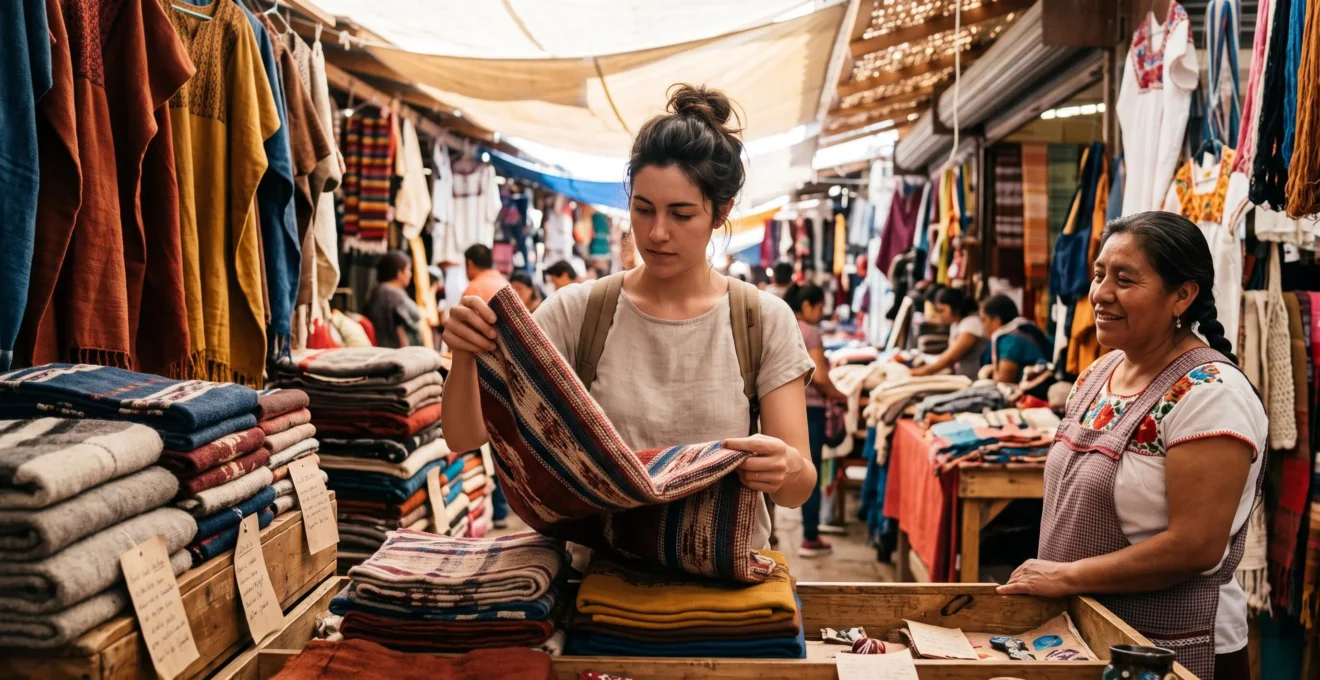
A hand-woven blanket from Oaxaca, an embroidered huipil from Chiapas or a lightweight rebozo can become one of the most meaningful purchases on a Mexico trip. But the qualities that make these textiles appealing in a market—soft fibres, intricate fringes and unusual dye colours—also create questions about packing, cleaning and everyday use back in Britain.
For most UK travellers, a compact, closely woven cotton textile or a carefully chosen rebozo offers the easiest balance between portability, usefulness and visual character. A wool blanket makes sense when luggage space and home use matter more than weight. A huipil can be an excellent wearable purchase when its fit, provenance and cultural context are understood.
The important distinction is not simply handmade versus factory-made. Fibre, weave construction, dye stability, finishing and the seller’s knowledge all influence whether a purchase will survive the journey and remain enjoyable afterwards. A few respectful questions and gentle checks can prevent expensive mistakes without turning an artisan market visit into an interrogation.
Choosing Mexican textiles that travel well
- Prioritise stable weaving, secure fringes and manageable packed volume over colour intensity or apparent thickness.
- Ask about fibre, dye, origin and care before purchasing; natural dyes are not automatically colourfast.
- Learn a garment’s community of origin and intended use, then pack it clean, dry and protected from friction.
- Why Do Some Mexican Hand-Woven Textiles Fade Faster, Even When They Look High Quality?
- How to Check Textile Durability in a Market Without Washing Anything First?
- Which Makes More Sense for UK Travellers: A Woven Blanket or a Wearable Textile Piece?
- The Wearing Mistake That Can Offend People When You Buy Traditional Mexican Textiles
- When Should You Buy Textiles on a Mexico Trip So You’re Not Stuffing Them Into a Bag on the Last Night?
- How to Check if a Mexican Craft Is Truly Handmade in 5 Non-Rude Questions?
- How to Check Mexican Pottery Quality at a Market Stall Without Breaking Anything?
- How to Tell Oaxacan Black Pottery From a Factory Copy in Under 2 Minutes?
Why Do Some Mexican Hand-Woven Textiles Fade Faster, Even When They Look High Quality?
Mexican hand-woven textiles can fade because their dyes react differently to sunlight, moisture, washing and everyday handling. Cochineal, indigo and synthetic colourants do not all behave alike, and workmanship alone cannot guarantee colour stability. A beautifully woven piece may therefore lose colour sooner than a cheaper-looking one without having been poorly made.
Traditional Mexican textile production includes dyeing practices associated with cochineal insects, indigo plants and, in particular regional traditions, purple colourants obtained from marine molluscs. These materials can produce complex shades, but their stability depends on dye preparation, mordants where used, fibres and subsequent exposure.
Modern synthetic dyes are also widely used in Mexican weaving. Some provide excellent light and wash resistance; others can bleed or fade. A vividly coloured textile is not automatically industrial, just as a muted textile is not automatically naturally dyed.
The Canadian Conservation Institute’s textile conservation guidelines explain that visible light and ultraviolet radiation can fade textile colours, while excessive humidity can contribute to dye movement and deterioration. These mechanisms apply to textiles regardless of their country of origin.
Fading and colour transfer are different problems
Fading means colour gradually changes or lightens, often through exposure to light. Colour transfer happens when colourant moves onto another surface through contact, rubbing or moisture. A textile can experience one without necessarily showing the other.
For a UK buyer, transfer is particularly important when considering a richly dyed garment that will be worn over pale clothing or packed against light-coloured fabrics.
With the seller’s permission, a gentle test using a clean, slightly damp white cloth on a discreet area may reveal immediate transfer. It cannot predict years of fading or prove that a textile is completely wash-fast. Avoid testing delicate, historic or unusually valuable work without the maker’s guidance.
Why the return to Britain changes storage conditions
A textile bought in a relatively dry market may later spend time inside a humid suitcase, a poorly ventilated wardrobe or a room exposed to sustained daylight. Those conditions can affect dyes and fibres differently.
In Britain, keep valuable dyed textiles away from direct window sunlight, radiators and persistently damp storage. Allow them to dry thoroughly before long-term storage, without deliberately exposing them to harsh sun.
Some buyers appreciate the softened appearance that naturally develops in an older textile. However, fading does not prove authenticity, and there is no general rule that faded textiles are more collectible.
Once colour behaviour is understood, the next question is whether the weave and finishing can withstand actual handling and travel.
How to Check Textile Durability in a Market Without Washing Anything First?
Inspect a Mexican textile by checking weave consistency, gently examining its flexibility, studying the edges and asking about fibre and care. A brief visual inspection can reveal loose threads, weak attachments or existing damage without washing the item. No simple market test can guarantee that a textile will survive every journey or cleaning method.
Begin by asking whether the piece may be handled. Many textiles are made for everyday use, but highly detailed embroidery and delicate fringes deserve more caution than a robust blanket.
Hold the textile towards available light, without pulling hard. Look for areas of unexpected thinning, broken threads or gaps that differ from the surrounding structure. Small changes in thread tension can be part of handweaving; they are not necessarily defects.
Next, gently move a small section between your fingers. A firm weave should generally hold its structure, while a very open weave may need more protection against snagging. This is an observation rather than a validated durability measurement.
When appropriate, fold an unobtrusive corner loosely and release it. Observe whether the material recovers comfortably or develops a pronounced crease. Avoid repeated pressing: sharp folds can themselves stress fibres.
Inspect the parts most likely to snag
Look particularly closely at fringes, tassels, seams, embroidered sections and decorative attachments. Ask whether fringe threads extend from the woven structure or have been attached afterwards. Either construction can work well, but loose knots and already fraying ends deserve attention.
A thick wool blanket may tolerate being packed alongside soft clothing, although excessive pressure can still distort its shape. An open-weave rebozo or loosely stitched cotton garment is more vulnerable to friction from zips, buckles and other luggage contents.
A musty smell or visible dampness is a reason to ask about storage and whether the textile can be dried safely. It is not proof of mould, but placing a damp purchase immediately into a closed suitcase is unwise.
Your five-step textile inspection checklist
- Identify the material: ask the seller about fibre and dye, and record both answers in your phone.
- Check the woven surface: inspect the front and reverse for broken or unusually loose threads; note any areas needing protection.
- Examine the finishing: check edges, fringe knots and embroidery attachments; identify anything that could catch during packing.
- Ask about colour stability: request care advice and permission for any gentle colour-transfer check; record whether testing was possible.
- Plan the packing: fold the item loosely as appropriate, estimate its packed dimensions and decide where it will fit in your luggage.
A textile that passes basic inspection still needs an appropriate role at home. That is where the choice between a blanket and a wearable piece becomes important.
Which Makes More Sense for UK Travellers: A Woven Blanket or a Wearable Textile Piece?
A woven blanket is often the better purchase for travellers seeking a long-lasting home textile with substantial visual presence. A wearable huipil, rebozo or woven jacket is more practical when luggage space is limited and the garment will genuinely fit into everyday life. The best choice depends on weight, cleaning needs, construction and intended use.
Blankets make an immediate impact on a sofa, chair or bed. Their weight can be reassuring in a British winter, but a large wool piece may occupy considerable luggage space and require specialist cleaning.
Wearable pieces offer a different advantage: a traveller may be able to wear a suitable jacket or shawl during the journey home rather than pack it. However, traditional garment shapes do not always correspond to familiar UK sizing conventions.
A huipil can have a straight, boxy construction. Before purchasing, check shoulder movement, neckline, length and how it falls over the clothing normally worn at home. Do not assume that a garment described as one-size will fit everyone comfortably.
The following comparison helps match the format to the intended purpose.
| Decision factor | Woven blanket | Wearable textile |
|---|---|---|
| Suitcase volume | Often substantial, particularly for wool | Usually smaller, depending on garment |
| Main benefit | Home furnishing and occasional warmth | Personal use and wardrobe integration |
| Packing concern | Bulk, compression and fibre protection | Snags, embroidery and creasing |
| Care concern | Large items may be difficult to clean | Fit, colour transfer and repeated washing |
| Best suited to | Travellers with space and a defined home use | Travellers intending to wear the piece regularly |
The useful middle ground: a rebozo or small household textile
A rebozo offers flexibility because it can function as a shawl or wrap, subject to its construction and cultural context. A smaller table runner or decorative woven panel may provide similar craftsmanship with less luggage bulk.
Neither category guarantees simple maintenance. With unlabelled handmade textiles, request the maker’s instructions rather than assuming ordinary machine washing is safe. Some wool pieces may require specialist cleaning, while selected cotton textiles may tolerate gentle washing when the maker confirms it.
For storage, avoid leaving textiles in direct sunlight. Delicate pieces may be better stored flat or rolled than hung for long periods, particularly when their own weight could distort the weave.
If the chosen purchase is clothing, understanding how it is worn and what it represents matters as much as fabric quality.
The Wearing Mistake That Can Offend People When You Buy Traditional Mexican Textiles
The mistake is treating a community-specific Mexican garment as a generic costume without understanding its origin or meaning. Wearing an artisan-made huipil or rebozo is not automatically disrespectful, but designs, ceremonial uses and traditions vary between Indigenous communities. Asking the maker about the garment’s context is more reliable than assuming that one rule applies throughout Mexico.
Mexican weaving traditions are not a single interchangeable visual style. Motifs, colours, garment forms and embroidery techniques may communicate local identities or reflect particular social practices.
For example, UNESCO’s analysis of Indigenous textile designs discusses the cultural and economic interests associated with traditional motifs, including designs linked to the Mixe community of Santa María Tlahuitoltepec in Oaxaca.
This does not mean that every traditional garment is restricted to members of its originating community. It does mean that individual designs and community perspectives deserve consideration rather than a universal assumption about permission.
How to wear an artisan garment respectfully
Ask who made the textile and what its name means. Learn the community or workshop of origin where that information is available. If the seller is also the maker, ask whether the garment is intended for everyday wear, particular occasions or display.
When trying on a huipil or arranging a rebozo, invite the maker to demonstrate how it is commonly worn. There may be several legitimate ways to use a textile, and not every garment comes with cultural restrictions. Specific questions are more useful than assumptions based on appearance.
Be especially cautious with garments described as ceremonial or sacred. Ask before photographing people, workshops or culturally significant pieces, and respect any restrictions communicated by those involved.
Buying directly does not answer every cultural question
Purchasing from an artisan or a cooperative can make it easier to understand where a piece comes from and who benefits from its sale. It can also provide opportunities to discuss care and traditional use.
However, no single seller can necessarily speak for an entire community. Perspectives on wearing, reproducing and commercialising particular designs may differ, including within the same region.
Second-hand textiles and mass-market imitations require similar care when describing provenance. A garment marketed as Indigenous-inspired is not necessarily made by the community associated with its design.
The clearest distinction is between respectfully using a textile whose origins are understood and presenting an unfamiliar tradition as an exotic costume or claiming cultural authority that the buyer does not possess.
Respectful purchasing also benefits from time: conversations about makers, techniques and meaning are easier when the purchase is not rushed on the final evening.
When Should You Buy Textiles on a Mexico Trip So You’re Not Stuffing Them Into a Bag on the Last Night?
Buying early or midway through a Mexico trip generally gives travellers more time to compare craftsmanship, ask questions and organise safe packing. It also allows a newly purchased textile to be checked for moisture before travelling. The ideal moment is when sufficient luggage space remains and the buyer understands how the item will be transported.
Oaxaca and Chiapas offer opportunities to encounter textile-making communities, workshops, cooperatives and markets. When an itinerary includes these locations, leaving time for visits and conversations can make the purchase more informative.
Direct purchasing is not always possible, and a market intermediary is not automatically unreliable. The useful distinction is whether the seller can provide credible information about the maker, material and origin.
A final-day purchase may still be perfectly sensible. The problem arises when a large textile is bought without checking its dimensions, care requirements or packing needs.
Plan the purchase around the suitcase
For a robust, clean and fully dry textile, prepare a suitable space in the suitcase rather than forcing it into remaining gaps. A protective fabric layer or clean packing sleeve can reduce contact with zips, shoes and potentially staining items.
A delicate embroidered garment may be better laid flat with soft clothing around it. Heavily embellished areas should not sit directly against hard objects. Fragile fringes can be enclosed loosely so they do not catch when luggage is opened.
If the textile has absorbed moisture, allow it to dry in a clean, ventilated environment according to the maker’s care instructions before enclosing it. Avoid direct heat or strong sunlight as a shortcut.
Consider shipping before the last evening
A large blanket or multiple purchases may justify comparing airline baggage charges with an insured shipping service. Obtain a written quotation covering dimensions, destination, tracking, packaging and any applicable import costs. International shipping is not automatically cheaper or safer than carrying the purchase.
Market timing can also affect the experience. A calmer visit may provide more opportunity to speak with the maker than a crowded period, but there is no reliable universal rule that weekday mornings guarantee lower prices.
Allow room in the budget for a fair purchase rather than relying on hurried bargaining. When a textile requires substantial manual labour, the maker’s explanation of the process should inform how its price is considered.
UK travellers also need to consider customs. UK Border Force customs guidance for travellers states that most travellers entering Great Britain can bring goods, gifts and souvenirs worth up to 390£ within the relevant personal allowance without import tax or duty.
When that allowance is exceeded, tax may be due on the full value of goods in the relevant category, rather than only the excess. Personal allowances cannot be pooled, commercial goods follow different rules, and Northern Ireland has separate arrangements. Keep purchase records and check the rules applicable to the journey.
Once the practical timing is settled, evaluating the seller’s description of the craft becomes much easier.
How to Check if a Mexican Craft Is Truly Handmade in 5 Non-Rude Questions?
The most respectful way to investigate whether a Mexican craft is handmade is to ask about its place of origin, maker, materials, production time and care. These questions invite the seller to explain the work without accusing anyone of dishonesty. Answers should be considered alongside physical evidence, because no single question proves authenticity.
Start with curiosity about the object rather than a demand for certification. Handmade can describe different processes, including backstrap weaving, foot-operated loom weaving, hand embroidery, shaping and finishing.
For textiles, subtle changes in weave tension, fibre thickness or colour may be consistent with hand production. However, skilled makers can produce remarkably regular work, while industrial products can imitate irregularities.
Likewise, an item may combine machine-produced cloth with genuine hand embroidery. That is not necessarily deceptive if the production method is represented accurately.
Five questions worth asking the seller
- Where was this made? A named village, community or workshop provides useful provenance to investigate.
- Who made it? Ask whether the seller, a family member, a cooperative or another workshop produced the piece.
- What materials and techniques were used? The answer may distinguish wool from cotton, natural from synthetic dyes, or backstrap from pedal-loom weaving.
- How long does a piece like this take to make? The explanation can reveal preparation, weaving and finishing steps.
- How should it be cared for? Specific instructions can help establish whether the seller understands the materials and intended use.
What production time can and cannot tell you
Asking about time is particularly useful because the seller may explain processes that are invisible in the finished object: spinning, dyeing, preparing the loom, weaving, embroidery or finishing.
A complex backstrap-loom textile may require substantial work, sometimes extending across days or weeks. But production time varies enormously with dimensions, design, technique and available labour. A short production time does not automatically indicate factory manufacture, and a convincing answer is not conclusive proof.
Unusually low prices combined with vague provenance may justify further questions, but neither is sufficient to establish that an item is counterfeit.
Foot-operated looms also deserve a more accurate description than simply handmade or machine-made. They can involve intensive manual work and may be part of longstanding local production traditions. Mechanisation, artisan authorship and cultural authenticity are not always mutually exclusive.
If a seller cannot identify the maker, describe the production method or explain the material, the buyer should simply avoid paying a premium based on unverified claims.
The same curiosity is useful when buying ceramics, although pottery introduces additional concerns about structural integrity and food safety.
How to Check Mexican Pottery Quality at a Market Stall Without Breaking Anything?
Assess Mexican pottery by examining the rim, base, visible surface and intended use before buying. Look for chips, cracks, instability and damaged finishing, and ask the maker whether the piece is decorative or suitable for food contact. Gentle inspection can identify obvious problems, but neither appearance nor a tapping sound guarantees durability or safety.
Begin by placing the pot on a stable surface, with permission. A slight irregularity may be expected in handmade pottery, but a vessel that rocks noticeably may be inconvenient if it needs to hold liquids.
Look closely at the rim, handles and junctions where different parts meet. Visible cracks, chipped edges and loose attachments are more important than perfectly symmetrical decoration.
If the seller permits it, gently inspect the inside with a fingertip, taking care around sharp edges. Do not scrape the glaze or deliberately apply pressure to test strength.
A light tap may produce a different sound depending on the clay body, shape, wall thickness and firing. Although an unexpected dull sound can raise questions, tapping is not a dependable test for hidden cracks, firing quality or food safety.
Match the ceramic body to its purpose
Traditional low-fired earthenware may be porous and unsuitable for holding liquids without appropriate finishing. Glazed pieces can be designed for serving food, but glazing alone does not establish food-contact safety.
Higher-fired stoneware may offer practical advantages for some uses, yet it should not automatically be assumed dishwasher-safe. Thermal resistance, glaze compatibility and care instructions depend on the particular piece.
The most important distinction for a UK kitchen is whether the pottery has credible evidence of suitability for the intended food or drink use.
The FDA’s advice on lead-glazed traditional pottery explains that some traditional pottery, including Mexican ceramics, may release lead from glazes into food. A lead-free claim alone may not be sufficient evidence of safety.
When reliable food-contact information cannot be established, use the item for display rather than cooking, serving or storing food. Washing or boiling cannot remove lead contamination. This is US consumer safety guidance, not a statement of UK ceramic regulations.
Protecting pottery during the flight
Lightweight pottery is easier on baggage limits, but very thin walls and projecting handles can be vulnerable. Thick walls may offer more material around impact points while adding considerable weight; thickness is not a guarantee against breakage.
Use clean, soft clothing as cushioning around a fully dry ceramic piece, particularly near the rim and handles. Ensure hard objects cannot strike it and that the packed item cannot move freely inside the bag.
Hand luggage may reduce exposure to rough baggage handling, but it still requires careful protection and must comply with airline cabin baggage limits. Checked luggage may be necessary for heavier or larger pieces.
These precautions are especially relevant to Oaxaca’s distinctive black pottery, whose finish can attract buyers before they understand how it was produced.
Key takeaways before buying Oaxacan black pottery
- A distinctive black surface is not enough to establish the origin or production technique of a ceramic piece.
- Ask about shaping, polishing and firing rather than treating symmetry or price as definitive evidence.
- Decide whether the purchase is for decoration or food use before choosing how to inspect and pack it.
How to Tell Oaxacan Black Pottery From a Factory Copy in Under 2 Minutes?
To assess Oaxacan black pottery quickly, examine its surface finish, construction and the seller’s explanation of where it was made. Traditional barro negro is associated particularly with San Bartolo Coyotepec, near Oaxaca City. A credible production story and identifiable workshop are stronger evidence of provenance than colour, shine or a single physical test.
Barro negro is recognised for its black appearance, often accompanied by a distinctive polished sheen. Traditional production involves shaping clay, finishing the surface and firing under conditions that influence its final colour.
Some polished pieces are burnished before firing rather than finished with a conventional glossy glaze. Burnishing involves rubbing the surface with a suitable smooth tool or stone to compact and polish it.
However, finish varies between pieces and makers. A matte surface does not automatically indicate a factory copy, and a shiny surface alone does not establish authenticity.
A two-minute examination at the stall
- Look at the surface: observe whether the shine appears integrated into the ceramic surface or resembles an applied coating. Do not scrape or scratch it.
- Examine the shape: check for signs of hand shaping and finishing while recognising that moulds may also be used within artisan production.
- Compare similar pieces: repeated dimensions and decoration may suggest standardised production, but skilled artisans can also make matching sets.
- Ask about burnishing and firing: invite the seller to explain how the finish and black colour are achieved.
- Confirm the origin: ask whether the piece was made in San Bartolo Coyotepec or another named workshop, and whether further provenance information is available.
These observations can guide an informed conversation, but they do not provide laboratory authentication. A resonant tapping sound, often mentioned in discussions of black pottery, is not proof of origin or manufacturing method.
Traditional blackware is not necessarily kitchenware
Not all barro negro pieces are designed for cooking or holding food and drinks. Decorative vessels, sculptural work and functional ceramics may have different manufacturing and firing requirements.
Developments in polished black pottery production are often associated with the Pedro family of San Bartolo Coyotepec in the twentieth century. The evolution of surface finishing and firing practices should not be simplified into a universal rule that a particular shine, sound or firing temperature proves authenticity.
For any black pottery intended for food contact, apply the same food-safety precautions discussed earlier. Black colour, high polish and a maker’s reputation do not independently demonstrate that a vessel is suitable for a UK kitchen.
How to interpret price and provenance
Hand-forming, surface finishing, decorating and firing all require work, and a complex piece may reasonably command a higher price. But there is no dependable souvenir-price threshold that separates genuine artisan pottery from mass-produced objects.
A mould-formed product is not necessarily fraudulent if it is described accurately. The concern arises when its origin, technique or maker is misrepresented.
When possible, request the workshop name, retain a receipt and ask about the production process. Those details can be more meaningful than an unverified certificate or a claim that every piece on the stall is unique.
Choose an object whose maker, intended use and transport needs you understand. Whether the final purchase is a woven textile or an Oaxacan ceramic, informed questions and careful packing are more valuable than a rushed judgement based on appearance.
Can Mexican hand-woven textiles go in checked luggage?
Yes, ordinary textiles can generally travel in checked luggage, subject to airline restrictions. Pack them clean and dry, protect delicate embroidery and fringes, and avoid direct contact with liquids or sharp objects. Particularly fragile or valuable textiles may benefit from being carried in cabin baggage when permitted.
Should a newly purchased Mexican textile be washed before wearing it?
Not automatically. First ask the maker about the fibres, dyes and care method. Washing an unfamiliar hand-woven garment can cause shrinkage, colour transfer or distortion. If cleaning is necessary and the care method is uncertain, seek specialist advice instead of experimenting with a machine-wash cycle.
Can a hand-woven Mexican blanket be stored in a vacuum compression bag?
Vacuum compression may be unsuitable for delicate embroidery, fringes, bulky wool or pieces vulnerable to creasing. A short journey in a protective fabric layer is often a more cautious approach. For long-term storage, prioritise a clean, dry, ventilated environment and avoid sustained pressure on fragile areas.
Do UK travellers have to declare expensive Mexican textiles at customs?
Travellers entering Great Britain must consider the applicable personal allowance for goods and souvenirs. For most travellers, that allowance is £390. Purchases exceeding the allowance must be declared, and import tax or duty may apply to the entire value in the relevant category. Northern Ireland has separate rules, and commercial imports are treated differently.
Is Mexican black pottery safe for serving food?
Some ceramic pieces may be suitable for food use, but traditional black pottery should not be assumed food-safe simply because it is polished, glazed or handmade. Seek reliable evidence of food-contact suitability for the specific item. If that cannot be established, reserve it for decorative use.