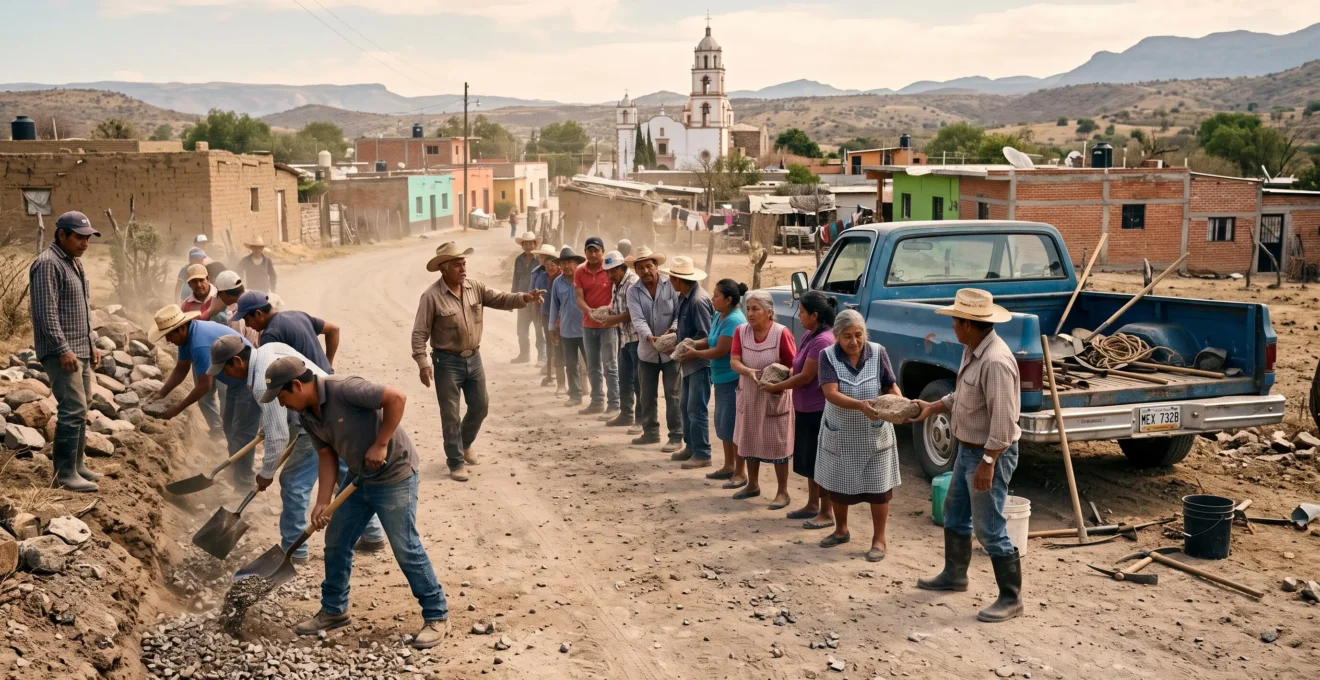
A road closes because neighbours are repairing it together. Shops open late while families prepare for a patron-saint festival. Someone who works in a distant city returns home to fulfil an obligation that appears to have nothing to do with their paid job.
For travellers visiting rural Mexico, these scenes can seem spontaneous, picturesque or puzzling. Yet in some communities, they reflect organised systems of shared responsibility known as tequio, faena and civic-religious cargos. These practices help coordinate local work, distribute responsibilities and sustain collective institutions.
They are neither universal across Mexico nor unchanged remnants of the past. Their rules, importance and relationship to local government differ between communities.
Understanding them changes how visitors interpret everyday life. A closed road may reflect a collective decision rather than poor organisation. Festival preparations may represent civic obligations rather than entertainment. And an invitation to help may carry responsibilities for the person extending it.
Communal labour in Mexico: what travellers need to know
- Tequio and related practices can be part of local governance, not simply informal volunteering.
- Community-managed tourism is generally a clearer starting point than joining work that was never organised for visitors.
- Respect local authority over participation, photography and ceremonies; public visibility does not automatically mean permission.
- Why Do Communal Labour Traditions Still Matter in Rural Mexico Even With Modern Jobs?
- How to Respond if You’re Invited to a Community Work Day in Mexico Without Making It Weird
- Which Is More Respectful: Joining a Community Project Day or Booking a Community-Run Tour?
- The Social Media Mistake That Can Damage Trust in Communities Using Communal Labour
- When Are Communal Work Days Most Likely to Happen, and When Should Travellers Give Space?
- Which Is Better for First-Timers: A Market Day Visit or a Homestay in an Indigenous Community?
- How to Watch a Syncretic Ceremony in Mexico Without Being the Tourist Who Ruins the Moment
- Why Mexican Spiritual Practices Look Catholic on the Surface but Feel Completely Different Up Close
Why Do Communal Labour Traditions Still Matter in Rural Mexico Even With Modern Jobs?
Communal labour continues to matter in parts of rural Mexico because it connects practical work with local governance, membership and shared responsibilities. Having a paid job does not necessarily remove someone’s community obligations. Where tequio remains active, residents may contribute labour to collective projects while also working in agriculture, commerce or employment elsewhere.
Tequio commonly refers to community work undertaken for collective purposes, sometimes as an obligation established through local rules. Faena can describe an organised work session, although the terms and their meanings vary geographically.
The work might involve maintaining paths, preparing communal facilities or improving shared infrastructure. It can supplement public services without replacing the legal responsibilities of municipal or state authorities.
Three forms of participation are especially important to distinguish:
- Communal labour: work assigned or organised for a shared purpose, potentially carrying an obligation for eligible community members.
- Civic-religious cargos: rotating offices that may involve decision-making, ceremonial responsibilities, expenditure and social recognition.
- Voluntary cooperation: work undertaken by choice through a group, association or community initiative without necessarily carrying the same formal obligations.
These categories can overlap. Their meaning depends on the particular community rather than a single nationwide system.
INAH research on community identity and civic-religious duties in Oaxaca documents how tequio, mayordomías and rotating cargos are organised in San Juan Cotzocón, an Ayuuk community. The study describes unpaid responsibilities, community assembly appointments and possible sanctions for non-compliance in that locality.
Documented example: San Juan Cotzocón, Oaxaca
Research by César Aníbal Tránsito Leal describes a community in which civic and religious positions are generally assigned through the assembly and rotate, often after approximately one year.
Those holding cargos may receive no remuneration and can incur personal expenses. Participation in tequio is described as obligatory in the community studied. The research also notes historical changes elsewhere, including an example where communal labour was replaced by paid work.
Financial contributions can sometimes provide an accepted alternative to physical work, but this is not an automatic right. Quotas, exemptions, obligations and sanctions depend on local arrangements. A resident who is absent from a work day may have contributed differently, received permission or fulfilled another duty.
For visitors, this explains why working life and communal responsibilities coexist. A household may prioritise festival preparations or a community meeting even when doing so interrupts ordinary business.
What might look like an inconvenient interruption can be an expression of collective decision-making. That distinction becomes especially relevant when a visitor is invited to participate.
How to Respond if You’re Invited to a Community Work Day in Mexico Without Making It Weird
If someone invites you to a communal work day in Mexico, do not automatically accept or assume you are being offered an activity for tourists. First establish who organised the invitation, whether outside participation is welcome and what contribution is appropriate. Your presence should support the event without creating extra responsibility for your host.
The essential question is not whether you are physically capable of helping. It is whether your participation has been accepted within the community’s arrangements.
An invitation from someone responsible for organising the work may carry different expectations from a casual suggestion by an acquaintance. A family member, cargo holder or local representative might also need to introduce you or explain your presence.
Before agreeing, ask your host privately:
- Is this activity open to visitors, or is it intended for community members?
- Who should approve my participation?
- What work, clothing or equipment would be appropriate?
- Would my presence make extra work for anyone?
If participation is confirmed, follow the person assigning tasks. Do not select the most photogenic activity, give unsolicited instructions or turn the occasion into a demonstration of your enthusiasm.
Work at the group’s pace, respect safety instructions and accept that a light task may be assigned out of courtesy. Being given something simple does not necessarily mean you are unwelcome.
Food and drinks may form part of collective hospitality. Receive an offer courteously, but communicate genuine allergies, dietary requirements or health concerns without criticism or embarrassment.
If you become unsure whether your presence is useful, discreetly ask your host rather than questioning other participants or community authorities without an introduction.
When you cannot work, ask whether a contribution to a communal fund, materials or refreshments would be appropriate. Never presume that money substitutes for labour simply because you can afford it.
Above all, remember that your host may be accountable for introducing an outsider. Stay within the boundaries they establish.
If the invitation remains ambiguous, declining politely may be kinder than accepting enthusiastically. Travellers seeking meaningful participation can instead consider activities deliberately organised for visitors.
Which Is More Respectful: Joining a Community Project Day or Booking a Community-Run Tour?
For most first-time visitors, a genuinely community-run tour is the more respectful starting point. Residents can define the activity, its price, access conditions and cultural boundaries. Joining a communal work day can be appropriate when specifically authorised, but it introduces an outsider into obligations that were not necessarily created for visitors.
The difference is not simply between paying and helping. It concerns who controls the encounter, who receives its benefits and whether local people requested outside participation.
UNESCO‘s announcement of Mexico’s community-based tourism strategy emphasises community management, local decision-making and the importance of communities benefiting from their cultural heritage.
This gives travellers a practical framework for evaluating their options.
| Decision criterion | Communal work day | Community-run tour |
|---|---|---|
| Financial benefit | May involve no payment; visitor participation can also create costs. | Creates an opportunity for locally managed income, depending on the provider’s arrangements. |
| Control over participation | Determined by local authorities, organisers and communal obligations. | Residents or community organisations should define the visitor experience. |
| Purpose | Completing work that the community needs. | Providing an experience intentionally designed for visitors. |
| Potential burden | Extra supervision, safety considerations, refreshments or responsibility for a guest. | Visitor management can be planned and incorporated into the service. |
| Best fit | Established relationships or explicitly authorised participation. | First visits and short stays where appropriate local options exist. |
The enthusiasm behind voluntourism can obscure a basic difficulty: an inexperienced visitor may contribute less than the time required to supervise them. Working for free is not necessarily a benefit when the community has not requested additional workers.
There are exceptions. Some communities deliberately welcome outside participants at reforestation activities, festival preparations or other collective events.
In those cases, check whether the invitation comes through an authorised organiser, community body or cooperative. A publicly announced event with defined participation conditions is different from an informal invitation made without wider agreement.
Community-based tourism also requires scrutiny. A company operating in an Indigenous village is not automatically community-run. Ask who makes decisions, who receives payments and whether the experience has community approval.
For a short first visit, choose a properly organised local experience where possible. Save communal work participation for occasions when a genuine relationship or authorised programme makes your role clear.
The Social Media Mistake That Can Damage Trust in Communities Using Communal Labour
The most damaging social media mistake is posting identifiable images of people carrying out communal labour or religious duties without their informed permission. Even when photography seems harmless, publication can remove the community’s control over how its work and traditions are represented. Consent to take a photograph does not necessarily include consent to share it online.
A visitor might photograph residents repairing a road, caption it as evidence of poverty and present the scene as an unusual cultural discovery. The image may instead depict an organised collective responsibility that the caption completely misrepresents.
Such framing can expose individuals to unwanted attention and create tensions for the host who introduced the photographer. Depending on the circumstances, publicity may affect relationships with local authorities, organisations or other visitors.
These risks should not be attributed uniformly to every community governed through customary institutions. Their seriousness depends on the content, audience, context and local relationships.
The practical distinction is between three separate permissions: taking, publishing and identifying.
- Ask whether photography is permitted before recording anyone at work.
- Seek explicit permission before photographing children or ceremony participants, including permission from an appropriate guardian where relevant.
- Ask separately whether an image may be published, even if the person agreed to the photograph.
- Allow the organiser or host to identify sensitive images that should not be shared.
- Confirm whether naming the village, household or cooperative is wanted.
Public visibility is not equivalent to permission. Standing in a public square may be different from entering the space of a communal work session, household gathering or sacred ceremony.
The words accompanying an image are equally important. Descriptions such as « primitive village life » or « poor locals helping themselves » can erase the decision-making structures behind what was photographed.
When community representatives welcome publicity, accurate credit and locally approved descriptions can help them present their own initiatives. However, tagging individual residents or publishing precise locations should still be their choice.
Sometimes the most respectful record of an experience is a private memory. Learning to recognise when not to use a camera also helps travellers identify occasions when they should give the community space altogether.
When Are Communal Work Days Most Likely to Happen, and When Should Travellers Give Space?
Communal work days in Mexico do not follow one nationwide calendar. Depending on the community, they may be organised before festivals, around agricultural activities, after damaging weather or when shared infrastructure needs attention. Some take place at weekends, but visitors should not assume Sundays or any particular season will always bring a faena.
Patron-saint celebrations can generate considerable preparation, including cleaning public areas, arranging facilities and coordinating communal resources.
Planting and harvesting periods may also influence the availability of labour or the timing of shared activities. After storms or flooding, urgent work can take priority over the usual schedule.
In some places, community authorities announce dates shortly before the work takes place. Other localities may use more regular arrangements.
For travellers, the most useful skill is recognising the signs without treating them as an invitation.
- Groups assembling near a community hall or municipal building.
- Vehicles transporting tools and building materials.
- Temporary restrictions on roads or communal spaces.
- Businesses opening later than expected.
- Neighbours gathering for a coordinated practical task.
These signs do not prove that an activity is a compulsory tequio. They simply suggest something collective may be happening.
Watching briefly from an unobtrusive public position may be acceptable at some work sites. Nevertheless, remain outside the activity, avoid blocking access and follow any instructions to move away.
Give space entirely when a private meeting is discussing responsibilities, when tensions arise over obligations or when a ceremony is not clearly open to outsiders.
A useful travel habit is asking your host, before arrival, whether any community responsibilities or celebrations may affect access during your stay.
A five-step preparation checklist for visiting a community
- Check the local calendar: ask your host about communal work or festivals and record any relevant dates in your itinerary.
- Clarify access: confirm which activities welcome visitors and write down the organiser’s instructions.
- Plan flexible transport: identify an alternative route or journey time in case local services pause.
- Confirm photography rules: establish whether images may be taken and published; record the permissions received.
- Prepare a respectful response: learn how to ask whether you should stay or leave, and keep the relevant phrase accessible on your phone.
Leave flexibility for cancellations or closures. Pressuring a host to abandon an obligation because of your booking misunderstands the importance of the event.
This awareness matters especially when choosing how closely to engage with a community. A brief market visit and a household stay involve very different expectations.
Which Is Better for First-Timers: A Market Day Visit or a Homestay in an Indigenous Community?
For most first-time visitors to an Indigenous community in Mexico, a market day is a more accessible starting point than a homestay. Markets provide a familiar setting for commerce and conversation without requiring entry into private household life. A properly arranged homestay can offer deeper cultural exchange, but it requires more preparation, trust and attention to local rules.
At a market, travellers can buy food or crafts, observe ordinary commercial activity and speak with sellers when they are available and willing.
However, being in a market does not mean everyone wants to be photographed or interviewed. Buying something also does not confer a right to personal stories or cultural explanations.
A homestay changes the relationship. Visitors enter a household where people continue their work, family commitments, religious practices and community responsibilities.
Before booking, assess four practical considerations:
- Communication: can you manage basic exchanges in Spanish, or through an agreed interpreter? Some households primarily speak an Indigenous language.
- Daily routine: are you comfortable with early starts, shared meals and household schedules?
- Facilities: do the accommodation arrangements meet your essential accessibility, privacy and hygiene needs?
- Boundaries: can you respect restrictions on private rooms, family time, prayer and photography?
For example, a traveller comfortable with basic accommodation but unable to communicate essential dietary needs should resolve that issue before committing to an overnight stay.
Community approval also matters. A household advertising accommodation does not automatically establish that overnight tourism is accepted under local rules.
UNESCO’s presentation of community-based tourism experiences in Yucatán highlights initiatives designed with Indigenous rural communities. Its examples include Casa de Barro in Uayma, Meliponario Lool-Ha in Maní and Unajil Ek Balam.
These illustrate the range of organised cultural and nature-related experiences available through community-oriented tourism initiatives. Their presence in a programme does not independently establish current availability, ownership structures or how each payment is distributed.
A sensible progression is to begin with a market or locally managed day experience, then consider a homestay once you have reliable contacts and understand the expectations.
Ask how payment is handled, who manages the arrangement and whether community permission is needed. A fee paid directly to a household, through a cooperative or through a collective arrangement may circulate differently; no model is automatically equitable without further information.
A rewarding encounter does not have to be intimate. Sometimes a respectful conversation during a market purchase provides more genuine exchange than an overnight stay organised without sufficient understanding.
How to Watch a Syncretic Ceremony in Mexico Without Being the Tourist Who Ruins the Moment
To observe a syncretic ceremony respectfully in Mexico, establish whether visitors are welcome, remain outside the active ritual space and follow the instructions of local organisers. A ceremony taking place in a church courtyard or public square may be visible without being open to unrestricted participation or photography. When access is uncertain, observe from a distance or leave.
Syncretic ceremonies can bring together Catholic and Indigenous religious elements, but their precise meanings differ across regions and communities.
A church atrium, public procession or plaza celebration may permit some observation. A ceremony in a home, cave, burial area or sacred landscape may involve more restricted access, even when participants are visible from a path.
Do not assume an altar, healer or burning copal indicates an opportunity to approach for a closer look. These may instead signal that a ritual space has been established.
The most reliable rules concern what visitors should avoid:
- Do not use flash photography or drones without explicit authorisation.
- Never step between participants and an altar, sacred object or ceremonial leader.
- Do not touch offerings, flowers, candles, incense or ritual equipment.
- Avoid interrupting prayers, music or processions with questions.
- Leave immediately and calmly if asked.
- Do not offer money to a ritual leader unless an appropriate local representative confirms that such an offering is customary and welcome.
Payment is particularly sensitive. A ceremony should not be treated as a performance for which an unsolicited tip secures a better view or special access.
Religious etiquette familiar from British churches is not a sufficient guide. The ritual may involve different relationships among ceremonial specialists, community officeholders, sacred places and offerings.
Silence is not always the defining expression of reverence. Music, movement, fireworks or collective meals can carry significance within the particular celebration.
If you realise you have crossed a boundary, stop the intrusive behaviour and withdraw quietly. An elaborate apology during the ceremony may cause further interruption.
When appropriate, ask your host afterwards what you should have done differently. Accept that some aspects of the ceremony may not be explained to outsiders.
Respectful observation begins with recognising that a ritual has its own purpose, independent of your visit. Understanding the relationship between spiritual practices and communal organisation makes that principle clearer.
Key takeaways before interpreting Mexican spiritual traditions
- Identify who has ceremonial authority before deciding how to behave; a priest, mayordomo or ritual specialist may have different responsibilities.
- Look at the purpose and setting of a ritual rather than classifying it solely by its Catholic imagery.
- Recognise that funding and organising celebrations may be part of the same collective responsibilities that sustain everyday communal work.
Why Mexican Spiritual Practices Look Catholic on the Surface but Feel Completely Different Up Close
Some Mexican spiritual traditions combine Catholic imagery with Indigenous understandings of place, ancestry, agricultural cycles and communal responsibility. Their distinctive character comes from historical encounters, adaptations and continuing religious practices. A saint’s image or church building may therefore form part of a ceremony whose meaning cannot be understood through Catholic symbolism alone.
During Spanish colonisation, Catholic institutions spread through territories where Indigenous communities already maintained complex religious traditions.
Over time, relationships developed between saints, local sacred places, ritual calendars and older forms of religious knowledge. These processes varied considerably and involved both colonial pressure and Indigenous agency.
The resulting practices should not be described as a uniform conversion, nor as unchanged pre-Hispanic religion hidden beneath a Catholic disguise.
Many communities understand their traditions through their own evolving religious identities. Some practices are explicitly Catholic; others integrate several traditions, while some remain distinct from Catholic worship.
Travellers can approach an unfamiliar ceremony through three observations.
- Who leads? A Catholic priest, mayordomo, traditional healer, elder or another authorised person may hold responsibility for different aspects of an event.
- What is its purpose? The ceremony may concern healing, remembrance, protection, rainfall, thanksgiving or another locally understood need.
- Where does it take place? A church, family altar, cemetery, mountain or other landscape feature may carry particular religious significance.
These observations provide context, but they do not establish the meaning of a ceremony by themselves. Only appropriate local explanations can clarify what participants understand themselves to be doing.
Offerings of flowers, food, drink or copal may serve ritual purposes rather than decorative ones. Music or fireworks may accompany acts of devotion, not merely entertain spectators.
One important connection is the relationship between religious organisation and communal labour.
In communities with civic-religious cargo systems, mayordomías and other responsibilities may help organise, finance or sustain celebrations. A festival can therefore combine religious observance, collective expenditure, preparation work and shared hospitality.
The Oaxaca research described earlier provides a documented example of the institutional relationship between community obligations and civic-religious offices. It should not be taken as proof that all Mexican ceremonies operate through the same structure.
This distinction changes the interpretation of a patron-saint celebration. The event is not necessarily a tourist attraction with religious elements attached. For participating residents, it may be a significant collective undertaking that links spiritual life with responsibilities recognised by the community.
Visitors who understand this are less likely to mistake shared preparation for disorder, ceremonial expenditure for unnecessary extravagance or restricted access for personal rejection.
Before attending a community celebration, ask a locally authorised host what visitors may observe, whether photography is permitted and how best to respect the occasion. The aim is not to decode every practice, but to recognise that its meaning and boundaries belong to the people maintaining it.
Is tequio compulsory everywhere in Mexico?
No. Tequio exists in particular local contexts, and its rules vary. Some communities assign work through established obligations, while others organise voluntary activities or rely on paid labour. The Oaxaca research discussed above documents both obligatory tequio in one community and historical change elsewhere. Visitors should ask about the specific locality rather than assume a nationwide rule.
Can tourists donate money instead of joining communal work?
Only when an appropriate organiser confirms that a contribution is welcome. Some communities have arrangements involving financial contributions, but these are not universal and may apply specifically to residents. Tourists should not assume that paying grants access to communal activities or substitutes for obligations they do not hold.
How can UK travellers identify genuinely community-managed tourism in Mexico?
Ask who manages the experience, who determines visitor access and how payments are handled. Community management is more meaningful than simply operating in an Indigenous village. Officially documented initiatives and established local cooperatives can provide useful starting points, but the current arrangements of individual providers still need checking.
Do all Indigenous communities in Mexico welcome visitors to festivals?
No. Public celebrations, restricted ceremonies and private gatherings can coexist within the same festival. Permission to attend one part of an event does not imply permission to enter other spaces or photograph participants. Follow the guidance of locally authorised organisers and respect requests to withdraw.
What should you do if a village road closes during your stay?
Ask your accommodation provider or local transport contact whether there is an alternative route or expected reopening time. Avoid interrupting workers or entering a closed work area. Allow flexibility in your plans, especially around celebrations and communal activities, rather than assuming that the closure can be changed for your convenience.