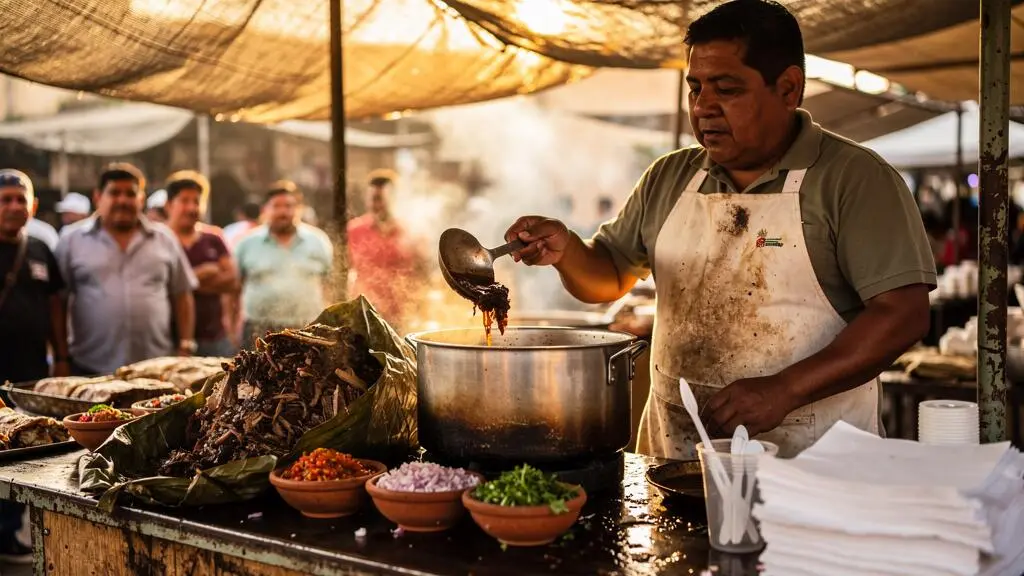
If eating a substantial meal late at night leaves you uncomfortable, Mexico’s traditional pit-oven cooking may suit your schedule better than you expect. In parts of central Mexico, barbacoa is traditionally prepared overnight and served in the morning. Instead of rearranging dinner, you can make slow-cooked meat and its fragrant broth the centrepiece of breakfast or brunch.
The Teotihuacán Valley in the State of Mexico and barbacoa markets in Hidalgo offer particularly relevant starting points. Traditional preparations often involve meat cooked with maguey leaves, producing tender textures and richly flavoured juices. However, not every dish described as barbacoa comes from an underground oven, and neither opening times nor cooking methods are identical across Mexico.
For UK travellers balancing sightseeing, early departures and digestive comfort, the useful approach is to choose the region, confirm the cooking day, arrive during the morning service and order a manageable portion. Understanding the differences between pit cooking, wrapped preparations, consomé and chilli accompaniments will help you enjoy the experience without turning it into a heavy evening meal.
Pit-oven cooking in Mexico: the essentials
- Choose the right region: explore traditional barbacoa around Teotihuacán, Texcoco or Hidalgo, and verify individual vendors rather than assuming every barbacoa restaurant uses an underground pit.
- Plan a morning visit: some traditional cooks prepare meat overnight for weekend service. Ask about opening and sell-out times the previous day.
- Eat for comfort: start with a modest portion of meat and consomé, taste salsa separately and leave a comfortable interval before a long journey.
- Why Are Pit-Oven Dishes Often Sold in the Morning in Mexico Instead of at Dinner?
- How to Find Pit-Oven Barbacoa Before It Sells Out Without Knowing the Area?
- Which Is Better for First-Timers: Pit-Oven Food at a Market or a Weekend Roadside Setup?
- The Timing Mistake That Guarantees You Miss the Best Pit-Oven Food in Mexico
- When Should You Eat Pit-Oven Barbacoa if You Have a 4-Hour Bus Ride Later?
- How to Taste Slow-Simmered Sauces in Mexico Without Overwhelming Your Palate on Day 1?
- How to Ask About Chilli Heat in Mexico in 2 Simple Questions Without Sounding Rude?
- How to Order Roasted-Chilli Dishes in Mexico Without Accidentally Setting Your Mouth on Fire?
Why Are Pit-Oven Dishes Often Sold in the Morning in Mexico Instead of at Dinner?
Traditional pit-oven barbacoa is often served in the morning because its lengthy cooking process begins the previous evening or overnight. In the Teotihuacán Valley, cooks traditionally prepare meat for weekend morning service. This makes breakfast or brunch a natural opportunity to enjoy barbacoa, particularly for travellers who prefer not to eat rich meals late at night.
In this regional tradition, meat is placed in an underground cooking chamber, commonly protected by maguey leaves. The enclosed heat cooks it slowly, while the juices collected beneath the meat can become the accompanying broth, or consomé. According to INAH‘s overview of Teotihuacán Valley cuisine, the documented cooking process lasts approximately eight to twelve hours.
The same institutional account describes a tradition in which barbacoyeros prepare the meat on Friday night for service on Saturday and Sunday mornings. That schedule helps explain why visiting a morning market can provide a more direct introduction to the preparation than searching for a late-night restaurant.
8–12 hours
Traditional underground cooking time documented for barbacoa in the Teotihuacán Valley. This is a regional example, not a standard cooking duration throughout Mexico.
Instituto Nacional de Antropología e Historia (INAH), The Ancient Cuisine of the Teotihuacan Valley.
For travellers, the morning service matters more than a universal opening hour. A vendor might begin serving between 6 and 8 a.m., but that should be treated as a planning window rather than a guaranteed schedule. Some market stalls continue into early afternoon; smaller setups may finish as soon as their prepared meat sells out.
The sensory experience can also change during service. Meat newly brought out from a covered cooking vessel may retain abundant juices, while portions held for longer can have a different temperature or texture depending on how the vendor stores and serves them. However, later service does not automatically mean dry or inferior meat.
It is also worth separating the cooking techniques. Traditional barbacoa may use whole maguey leaves in a pit, whereas mixiotes involve wrapping ingredients in a thin membrane associated with particular agaves and can be steamed without an underground oven. The shared use of wrapping materials does not make the methods interchangeable.
Once you understand when the cooking finishes, the next challenge is identifying which vendors are preparing it on the day you plan to visit.
How to Find Pit-Oven Barbacoa Before It Sells Out Without Knowing the Area?
To find pit-oven barbacoa in an unfamiliar Mexican town, identify the local market day, ask residents who is cooking that morning and confirm the vendor’s service time before travelling. In places such as Hidalgo and the Teotihuacán Valley, local knowledge can be especially useful because smaller family-run setups may have limited or irregular online information.
Begin your search the evening before. Ask your accommodation host, a market trader or a local driver where traditional barbacoa will be served the following morning. A useful question is “¿Dónde hay barbacoa de hoy?” — roughly, “Where can I find today’s barbacoa?”
For greater precision, ask “¿Dónde hacen barbacoa en horno de tierra?” to indicate that you want meat cooked in an underground oven rather than simply a restaurant dish bearing the name barbacoa.
Market schedules are particularly helpful clues. In PROFECO’s December 2021 Revista del Consumidor, a report on traditional barbacoa in Hidalgo mentions the 8 de Julio market in Actopan on Mondays and Thursdays and the market at El Arenal on Saturdays and Sundays.
Those are documented examples, not verified current trading schedules. Check the days locally before arranging transport, especially if your itinerary allows only one morning in the area.
On arrival, look for signs of active preparation: customers gathering around a stall, steam rising from covered containers, or equipment associated with wrapping and serving the meat. Smoke or a visible pit may help identify a cooking location, but neither is reliable proof that the barbacoa on sale was prepared there that morning. Many vendors cook elsewhere and transport the finished food to market.
Before ordering, ask “¿La barbacoa es de hoy?” — “Is the barbacoa from today?” You can also ask whether it was cooked in a pit. A stall selling reheated meat is not automatically unsafe or poor quality, but knowing its preparation and handling gives you a clearer expectation of the meal.
Your five-step barbacoa morning checklist
- Choose a regional starting point. Write down the town and market you intend to visit, such as Actopan or a community in the Teotihuacán Valley.
- Verify the trading day. Ask someone locally and record the confirmed day and opening time.
- Identify a vendor. Obtain a stall name, market entrance or recognisable meeting point from a local contact.
- Confirm the preparation. Ask whether the barbacoa is from today’s cooking and whether an underground oven was used; note the answers.
- Protect your morning schedule. Record your departure time, travel route and a backup breakfast option in case the stall is closed or sold out.
Once you have found a promising vendor, the next decision is whether a conventional market stall or a less predictable roadside setup better matches your travel style.
Which Is Better for First-Timers: Pit-Oven Food at a Market or a Weekend Roadside Setup?
A market stall is generally the easier starting point for travellers trying pit-oven barbacoa for the first time, particularly when they need an early meal before sightseeing. A weekend roadside setup can offer a closer view of local cooking and serving traditions, but availability and facilities may be less predictable. Neither setting guarantees better meat or more traditional preparation.
The main difference is logistical rather than culinary prestige. A market may offer several traders, a place to sit and the option to order consomé separately. A roadside setup might serve directly from the cooking location, but it could operate only on particular mornings or finish when its prepared quantity is gone.
Compare the practical conditions before deciding:
| Consideration | Market stall | Roadside pit setup |
|---|---|---|
| Planning | May have established market days and several nearby food options | May depend on a particular family, day or cooking event |
| Early eating | Convenient when service times are confirmed | May reward an earlier arrival but requires verification |
| Seating and facilities | Seating and tables may be available | Facilities may be basic or absent |
| Cooking experience | Usually focuses on ordering and eating | May allow observation of serving near the cooking area |
| Texture and flavour | Depends on preparation, cut, temperature and handling | Depends on the same factors; pit proximity is no guarantee |
| Backup options | Other traders may be available | Alternatives may require additional travel |
For first-time visitors, a two-morning strategy can make the experience more rewarding. Start with a market breakfast to learn the difference between meat cuts, broth and accompaniments. On another morning, visit a locally recommended cooking setup if you want to see more of the process.
Do not assume that market barbacoa is necessarily softer or that roadside barbacoa is always smokier. Underground cooking relies heavily on retained heat, moisture and wrapping; the resulting flavour depends on the ingredients and technique as much as the setting. Some preparations are intensely savoury without a pronounced smoky taste.
For a practical regional example, PROFECO documented a traditional producer in Hidalgo using a cooking process lasting approximately eight to ten hours. The report illustrates how preparation can be highly involved without establishing that any particular market or roadside setting provides objectively superior meat.
If your priority is digestive comfort, a market where you can sit, order a small serving and eat at your own pace may be more useful than a standing meal beside a busy road. If your priority is witnessing the cooking tradition, a confirmed pit-side visit may justify the additional planning.
Whichever setting you select, choosing the wrong time of day can undermine an otherwise carefully organised visit.
The Timing Mistake That Guarantees You Miss the Best Pit-Oven Food in Mexico
The most consequential timing mistake is treating traditional pit-oven barbacoa like an ordinary dinner dish and postponing your search until midday or evening. In communities where cooks prepare it overnight for morning service, arriving late can mean fewer available cuts or no remaining food. This is a recurring planning risk, although no single sell-out time applies everywhere.
Travellers often arrange a morning excursion, visit several attractions and assume they can stop for barbacoa afterwards. That approach may work at a restaurant serving throughout the day, but it is less reliable for a vendor whose entire supply comes from one overnight cooking session.
The mistake has consequences beyond availability. If a traditional stall is closed, the remaining choice might be a restaurant serving a differently prepared version. That meal could still be enjoyable, but it would not necessarily represent the underground cooking technique you originally intended to experience.
A useful way to avoid the problem is to schedule the barbacoa before the day’s major excursion. For example, a hypothetical itinerary near Teotihuacán could begin with a locally confirmed morning barbacoa breakfast, followed by archaeological sightseeing after the meal. The precise order would depend on transport and the vendor’s verified operating hours.
Example: building a day around traditional barbacoa
Imagine a traveller staying near the Teotihuacán Valley who wants to visit archaeological sites and taste underground-cooked barbacoa. Instead of putting lunch at a barbacoa stall between sightseeing activities, the traveller confirms a weekend vendor the previous evening and makes that breakfast the first planned stop.
If the vendor is open and serving as expected, the meal takes place before the main excursion. If not, the traveller uses a previously identified alternative rather than spending the afternoon searching for food that may already have sold out. This is a hypothetical planning example, not a documented vendor itinerary.
For visitors who cannot eat late, the logic is particularly straightforward. There is no need to find an artificially early dinner service or force a substantial meal into the evening. Traditional morning barbacoa can serve as the day’s principal food experience, leaving room for a lighter supper.
It is important not to confuse freshness with food safety. Mexico’s food hygiene rules address safe handling, holding and reheating, but the use of a particular cooking time does not establish that every later-serving restaurant offers inferior food.
The same timing approach is especially useful when a lengthy bus journey is scheduled later in the day, although portion size and digestive comfort then become equally important.
When Should You Eat Pit-Oven Barbacoa if You Have a 4-Hour Bus Ride Later?
If you have a four-hour bus journey after eating barbacoa, plan your meal in the morning and leave as much comfortable time as your itinerary allows before departure. A modest portion of meat and consomé may be easier to manage than a large, fatty meal immediately before boarding. The ideal interval depends on your usual digestion and travel tolerance.
Traditional barbacoa can be rich, particularly when ordering fatty cuts, several tortillas and heavily dressed accompaniments. Some travellers find that combination uncomfortable before sitting still for several hours, especially on winding roads or when they are prone to motion sickness.
If possible, make barbacoa a breakfast or mid-morning meal rather than a last-minute stop at the bus terminal. For a bus departing soon afterwards, consider a smaller portion or a modest bowl of consomé, provided it suits your appetite and dietary needs. Broth itself can also be rich, so it should not automatically be treated as a fat-free alternative.
Use your own reaction to rich food as the deciding factor. There is no established universal rule that barbacoa must be eaten exactly two hours before travel. Travellers with digestive conditions or particular medical dietary restrictions should follow their individual medical advice rather than relying on an itinerary-based digestion rule.
Eating on site is preferable for another reason: temperature and texture. Hot consomé and freshly served meat are easier to appreciate at a table than from a container on a moving bus. Transporting the meal also introduces food-handling considerations.
Mexico’s NOM-251-SSA1-2009 food hygiene standard specifies that prepared food being reheated must reach at least 74°C, while prepared hot foods ready for service must be maintained above 60°C under the relevant provisions. These regulatory requirements concern food safety, not a guarantee of flavour or freshness. The standard’s original publication dates to 2009, so its current consolidated status should be checked before drawing definitive legal conclusions.
For travellers, the practical implication is to avoid carrying a warm meat dish unrefrigerated for hours. If you need food for the journey, choose something that can be transported and stored appropriately, and ask the vendor how any packed food should be handled.
A simple hypothetical schedule illustrates the principle: enjoy a manageable barbacoa breakfast, take a relaxed walk or complete a nearby activity, then depart for your bus without rushing straight from a large meal. The exact timing can be adjusted to your transport arrangements.
The result can be an enjoyable regional food experience without a heavy evening dinner. To appreciate the dish fully, however, it also helps to approach the broth, sauces and condiments in a deliberate order.
How to Taste Slow-Simmered Sauces in Mexico Without Overwhelming Your Palate on Day 1?
Start by tasting barbacoa and its consomé without added salsa, then introduce condiments individually in small amounts. This allows you to recognise the meat’s natural richness, cooking juices and any maguey-related aromas before stronger chilli flavours dominate. On your first day in Mexico, a gradual tasting approach also makes it easier to discover your preferred heat level.
Traditional barbacoa is particularly well suited to this method because the broth is integral to the cooking experience. As the meat cooks, its juices can collect beneath it, producing a deeply flavoured consomé. That flavour deserves attention before you add lime, onion, coriander or chilli salsa.
Begin with a spoonful of plain broth. Notice whether it tastes meaty, earthy, lightly herbal or fatty. Then try a small portion of meat without sauce and observe how it differs from the liquid. These characteristics are tasting possibilities, not guaranteed features of every regional preparation.
Next, try a small amount of one salsa on a separate bite. If you enjoy it, add more gradually. Keep different salsas apart initially so that a particularly hot or acidic condiment does not mask the others.
Richness and chilli heat are different sensations. A long-cooked sauce may be intensely savoury because of its ingredients and preparation without being especially spicy. Conversely, a simple fresh salsa can be extremely hot if it contains potent chillies.
For visitors exploring Mexican cooking over several days, variety is more useful than attempting to taste every preparation at once. Begin with relatively simple barbacoa accompaniments. Later, explore sauces such as mole or regional recados, whose ingredient combinations and culinary contexts can be quite different.
These sauces should not all be treated as interchangeable barbacoa condiments. A mole may form the foundation of a separate dish, while a recado can function as a seasoning paste or preparation component, particularly in regional cooking such as that of the Yucatán Peninsula.
That geographical distinction matters for expectations. Central Mexican pit-cooked barbacoa and Yucatán-style cochinita pibil both belong to Mexico’s rich traditions of slow cooking, but they differ in seasoning, meat, preparation and serving customs. Do not assume that visiting a barbacoa market in Hidalgo will provide the same dish as seeking cochinita pibil in Yucatán.
Once you can distinguish the base flavours, a few straightforward Spanish questions will help you choose condiments without accidentally ordering more chilli heat than you want.
How to Ask About Chilli Heat in Mexico in 2 Simple Questions Without Sounding Rude?
Ask “¿Es picante?” to find out whether a dish is spicy, then “¿La salsa es de chile seco o fresco?” to learn whether its sauce uses dried or fresh chilli. Both questions are polite and practical at Mexican food stalls. However, dried versus fresh chilli does not reliably indicate heat intensity, so ask which salsa is milder when necessary.
The first question, “¿Es picante?”, means “Is it spicy?” It is useful when a vendor offers a prepared dish whose chilli content is not obvious. If you need a gentler option, follow up naturally with “¿Cuál pica menos?” — “Which one is less hot?”
The second question, “¿La salsa es de chile seco o fresco?”, means “Is the salsa made with dried or fresh chilli?” The response can tell you something about its preparation and possible flavour profile. Dried chillies may contribute roasted, fruity or earthy notes; fresh chillies may taste brighter or more vegetal.
Neither category guarantees mildness. A sauce made with dried chile de árbol may be very hot, while another dried-chilli preparation may be gentle. Fresh serrano or habanero sauces can also be intensely spicy. Ingredient variety, quantity and preparation matter more than whether the chilli was dried.
Asking about chilli heat is a normal part of ordering food, not a criticism of Mexican cooking. The politest approach is to show curiosity and describe your preference rather than judging the dish. “Prefiero poco picante, por favor” — “I prefer a little heat, please” — makes your needs clear.
If your Spanish is limited, point to the available sauces and ask the vendor which is milder. A gesture can help identify the containers you mean, but it cannot establish how hot they are. Watching what other customers choose is useful for understanding how dishes are assembled, not for reliably determining which salsa is mild.
At a busy morning barbacoa stall, prepare your question before reaching the counter. Vendors may be serving several customers at once, so a short request is easier to understand than a complicated explanation.
Once the chilli ingredients are clear, the final distinction is understanding that roasting changes flavour but does not necessarily reduce heat.
Key takeaways before ordering roasted-chilli dishes
- Roasting is a preparation technique: a smoky or charred flavour does not indicate whether a chilli is mild or very hot.
- Ingredient identification beats guesswork: ask which chilli is used instead of relying on sauce colour or appearance.
- Keep control of the first serving: request salsa separately so the natural flavour of the meat and broth remains easy to appreciate.
How to Order Roasted-Chilli Dishes in Mexico Without Accidentally Setting Your Mouth on Fire?
To order roasted-chilli dishes without unexpected heat, ask which chilli variety is used and request the salsa separately. The Spanish terms asado and tatemado describe roasting or charring, not how spicy a preparation will be. For a first pit-oven barbacoa breakfast, plain meat, consomé and a small serving of mild salsa offer a manageable introduction.
Roasting can transform the aroma and flavour of a chilli by adding toasted, smoky or slightly bitter notes. It does not establish a consistent heat level. Two roasted salsas with similar colours can taste very different depending on the chillies, seeds, other ingredients and quantities involved.
If you recognise the chilli names, use them as a starting point. Poblano and Anaheim chillies are commonly relatively mild, while serrano and chile de árbol are generally hotter. Natural variation still exists within each variety, and a dish’s final heat depends on the recipe.
When the ingredients are unfamiliar, ask “¿Qué chile lleva?” — “Which chilli does it contain?” You can then follow with “¿Tienen una salsa más suave?” — “Do you have a milder salsa?”
For a straightforward morning order, request barbacoa, a serving of consomé and salsa on the side. Taste the meat first, then touch a small amount of salsa to a separate bite. If the heat is comfortable, add more. There is no need to cover the entire dish immediately.
If a bite is unexpectedly hot, stop adding salsa and allow the sensation to subside. Dairy products can help relieve capsaicin-related burning for some people, although water may provide limited relief. Milk or yoghurt can be useful when available. Crema or fresh cheese may also help, but do not assume that every barbacoa stall stocks dairy products; they are not universal accompaniments.
For travellers who prefer light evening meals, this approach has another benefit: it allows you to appreciate the slow-cooked meat without relying on large amounts of sauce or extra food to manage overwhelming chilli heat.
Keep regional identity in mind when choosing your next experience. In Hidalgo and the State of Mexico, seek vendors preparing traditional pit-cooked barbacoa. If your itinerary takes you to Yucatán, investigate cochinita pibil separately and ask about the preparation method used by the specific cook. The names, seasonings and techniques should not be treated as identical simply because they involve slow cooking.
For your next morning in Mexico, choose a region, verify a traditional vendor and its cooking day, then arrive ready to order a modest portion with condiments separately. That simple plan gives you time to enjoy the food, explore its texture and flavour, and continue your travels without depending on a heavy late-night meal.
Is Mexican barbacoa always cooked in an underground pit?
No. Traditional regional preparations, including those documented in the Teotihuacán Valley, use underground ovens and maguey leaves. However, barbacoa is also a broader culinary term, and cooking methods vary between regions and businesses. Ask the vendor whether the meat was cooked in an horno de tierra if the underground technique is important to your visit.
Can you try traditional barbacoa on a weekday?
Yes, depending on the town and vendor. Although weekend morning service is an established tradition in parts of central Mexico, a PROFECO report from December 2021 also identified Monday and Thursday barbacoa market days in Actopan, Hidalgo. These historical market details should be verified locally before travelling.
What should you order if you dislike fatty meat?
Ask which cuts are leaner and request a small portion before ordering more. You can say “¿Tiene carne con poca grasa?” — “Do you have meat with little fat?” Consomé can also contain rendered fat, so do not assume the broth will necessarily be a lighter option. Availability varies by vendor.
Are barbacoa, mixiotes and cochinita pibil the same dish?
No. Traditional barbacoa in central Mexico can involve meat cooked underground with maguey leaves. Mixiotes are wrapped preparations that may be steamed without using a pit. Cochinita pibil is a Yucatán-associated pork dish traditionally linked to underground cooking and distinctive regional seasoning. Similarities in slow cooking do not make their ingredients, wrapping materials or methods interchangeable.
How can you tell whether barbacoa is safe to eat at a morning stall?
Look for hygienic handling, clean utensils, protection from contamination and appropriate temperature control. Ask whether the meat was prepared that day, but remember that same-day cooking alone does not prove safe handling. Mexican food hygiene standards establish requirements for holding and reheating prepared foods; a vendor’s appearance or the presence of a traditional cooking pit cannot replace those safeguards.