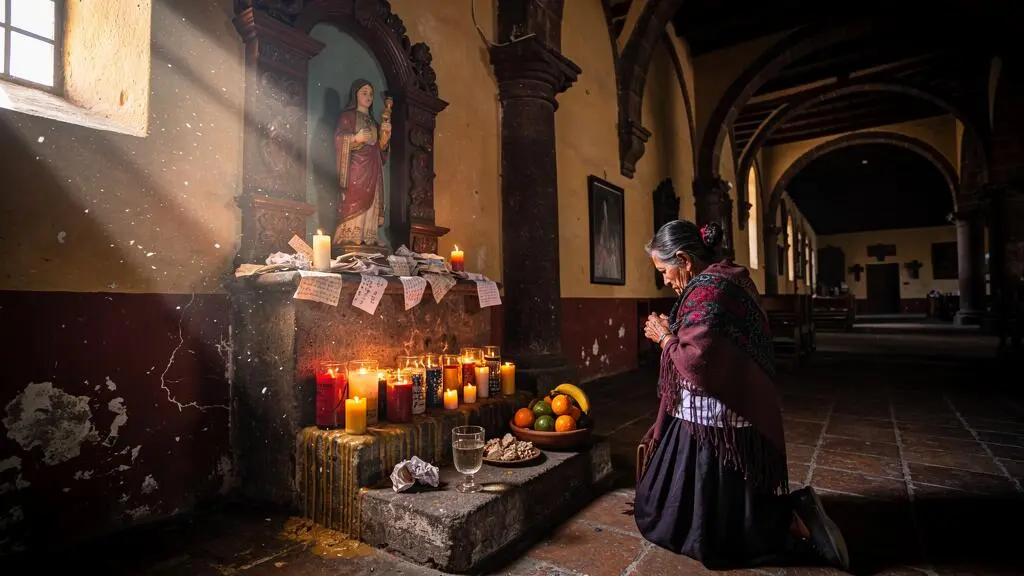
A Catholic saint watches over an altar crowded with candles. Beside it, someone places food, flowers or a handwritten request. The setting is recognisably Christian, yet the gestures may belong to devotional traditions that cannot be explained through Catholic doctrine alone.
In parts of Mexico, Indigenous cosmologies, Catholic imagery, local histories and relationships between living communities and their ancestors intersect in religious practice. Anthropologists often discuss these encounters through the concept of religious syncretism. But the term does not mean that two belief systems simply merged into one, or that every unusual offering conceals an ancient deity.
For travellers, the distinction matters. A church might be a public architectural landmark, an active parish and a place of deeply personal ceremonial obligations at the same time. Understanding which role takes precedence helps visitors recognise what they are seeing without treating another community’s spiritual life as a performance.
The most rewarding approach begins with a simple principle: religious practices belong to the people who maintain them, not to the visitors who happen to encounter them.
Understanding Mexican spiritual traditions at a glance
- Mexican religious practices can connect Catholic devotion with Indigenous histories and cosmologies, but their meanings vary considerably between communities.
- Permission, discretion and attention to local boundaries matter more than obtaining photographs or participating in every ritual.
- Community-connected guides, public cultural events and live storytelling can provide meaningful context without demanding access to private ceremonies.
- Why Do Some Mexican Churches Have Offerings That Look Nothing Like Catholic Tradition?
- How to Watch a Syncretic Ceremony in Mexico Without Being the Tourist Who Ruins the Moment?
- Which Gives Better Insight: Visiting a Syncretic Church Alone or With a Local Cultural Guide?
- The Reaction That Makes Locals Stop Welcoming Travellers Into Spiritual Spaces
- When Are Syncretic Ceremonies Most Likely to Happen, and When Should You Stay Away?
- How to Respond if You’re Invited to a Community Work Day in Mexico Without Making It Weird?
- How to Find Live Storytelling Events in Mexico Without Stumbling on Them by Accident?
- Where Can You Actually Hear Traditional Mexican Storytelling Instead of Just Reading About It?
Why Do Some Mexican Churches Have Offerings That Look Nothing Like Catholic Tradition?
Some Mexican churches contain offerings unfamiliar to visitors because Catholic worship has developed alongside Indigenous religious understandings, local devotional customs and community obligations. Candles, flowers, food or other objects may express petitions, gratitude or relationships with ancestors. Their presence does not automatically establish a pre-Hispanic origin: meaning depends on the particular community, recipient and ritual context.
After the Spanish conquest, Christian institutions expanded across societies with existing religious landscapes. Catholic saints, sacred images and feast days became part of Indigenous communities’ religious lives, sometimes acquiring meanings shaped by earlier cosmologies and local responsibilities. The resulting practices were neither uniform nor necessarily accepted on equal terms. Conversion, adaptation, resistance and reinterpretation all formed part of the historical encounter.
The Virgin of Guadalupe provides a revealing example. Her association with the Tepeyac landscape and discussions surrounding Tonantzin have encouraged interpretations of Catholic imagery through Nahua religious frameworks. Yet saying that Guadalupe simply replaced Tonantzin would overstate what historical and iconographic evidence establishes. The 2025 academic study of Nahua interpretations of the Guadalupe image explores possible Indigenous meanings while acknowledging the conjectural and inconclusive aspects of that interpretation.
Contemporary practices also demonstrate why history alone cannot explain a living altar. The same object may carry different meanings in different places. A candle might accompany a Catholic prayer, a community obligation or a personalised request. Its colour is not a reliable universal code.
When observing a devotional space, the following distinctions are more useful than assuming every unusual object belongs to a single tradition:
- Food and drink: Fruit, meals, mezcal or pulque may function as offerings, hospitality or elements of a locally specific devotional relationship. Not every church uses them, and their presence alone identifies no particular belief system.
- Candles and incense: Candles occur in ordinary Catholic devotion as well as Indigenous and locally developed practices. Copal can have particular ritual significance, but its use requires contextual interpretation.
- Cigarettes and other personal objects: These may appear in particular devotional settings. Their significance cannot be established from appearance alone.
- Written petitions: Requests and messages of thanks have long-standing Catholic parallels, including ex-votos. A written petition is not inherently evidence of Indigenous ritual.
- Offerings left in place: Duration and arrangement may reflect local custom, personal devotion or practical management of a sacred space. They are not sufficient to establish ritual purpose.
Mexico’s Indigenous Day of the Dead celebrations offer a better-documented example of intersecting religious histories. INAH‘s documentation of Indigenous Day of the Dead celebrations describes food offerings, candles, flowers, family altars and decorated graves, alongside the historical contributions of Indigenous and European beliefs.
The spatial distinction matters: an offering in a cemetery, a family home, a churchyard and a church interior may fall under different rules. Visitors should not assume that a practice documented in one setting is permitted in another.
What ethnography reveals about living religious traditions
Anthropologist Ivy Alana Rieger studied religious festival practices in San Juan Mixtepec, Oaxaca, in 2013 and El Espíritu, Hidalgo, in 2018. Her research examined how Catholic saints, Indigenous cosmologies, ritual objects and community identities intersect in particular social settings.
Published in 2023, the research supports understanding these practices as lived religion rather than a uniform category of supposedly diluted Catholicism. Its conclusions arise from two communities, not a representative survey of Mexico.
That evidence helps explain why a church may simultaneously be a Catholic institution, a locally significant Indigenous devotional space and a destination promoted to visitors. Before approaching an altar, ask which activity is happening and whose needs take priority.
Recognising multiple religious layers is a starting point, not permission to investigate them. The next challenge is learning how to behave when devotion is happening in front of you.
How to Watch a Syncretic Ceremony in Mexico Without Being the Tourist Who Ruins the Moment?
Observe a Mexican religious ceremony only when visitors are welcome, remain outside the active ritual area and follow the host’s instructions. Keep cameras and phones lowered unless explicit permission is given. An invitation to watch is not permission to participate, record or question practitioners. When uncertain, prioritise silence, distance and an unobtrusive departure.
Religious ceremonies are not interchangeable tourist experiences. A public procession may accommodate spectators, whereas a healing ritual, family remembrance or community obligation may be restricted to participants. The physical absence of a barrier does not establish that observation is welcome.
At an accessible ceremony, stand where other non-participants have been directed to gather. Avoid blocking entrances, paths, offerings or people’s view of an altar. If seating exists, do not occupy places apparently reserved for elders, ritual specialists or family members. When unsure, ask an organiser before the ceremony begins.
Photography is one of the most important boundaries. Flash can interrupt concentration, close-up recording can expose intimate devotional moments, and online distribution introduces consequences beyond the immediate visit. Permission to enter a space does not imply permission to photograph its occupants or publish images afterwards.
Distinguish between three situations: being allowed to witness, receiving a personal invitation to participate, and assuming participation is available. The first does not imply the second. A limpia, or cleansing ritual, should not be approached as an activity to sample simply because another person is receiving one.
If invited to participate, ask what will happen before agreeing. Someone offering a shared drink or an unfamiliar ritual gesture may be extending hospitality, but accepting should remain a genuine choice. A discreet « Muchas gracias, prefiero observar » — thank you, I would rather observe — is generally preferable to joining reluctantly or making a public demonstration of refusal.
Money requires similar care. Some publicly offered services have an established fee; other settings involve voluntary contributions, candles or materials; some are not commercial at all. Rather than placing money on an altar or offering payment directly to a practitioner without context, ask an organiser privately what, if anything, visitors are expected to contribute.
A five-step preparation checklist for respectful ceremony visits
- Confirm that the particular ceremony welcomes outside observers; record the organiser’s answer or a reliable contact.
- Ask where visitors may stand and which areas are restricted; identify the permitted observation area before arriving.
- Clarify photography and recording rules; leave with an explicit yes or no rather than an assumption.
- Check whether any contribution or materials are expected; note the amount or arrangement only if the organiser specifies one.
- Prepare a polite way to decline participation and a quiet exit plan; know whom to approach if a problem arises.
Should you cross a boundary, stop immediately. Lower the camera, move back or put down the object you were handling. A brief « Disculpe, no sabía. No volverá a pasar » — I’m sorry, I didn’t realise; it won’t happen again — is more constructive than prolonged explanations. If recording was the problem, ask whether the material should be deleted.
Respect is demonstrated less by knowing every ritual detail than by responding appropriately when someone establishes a boundary. In situations where those boundaries are difficult to interpret, a trustworthy guide can make a substantial difference.
Which Gives Better Insight: Visiting a Syncretic Church Alone or With a Local Cultural Guide?
A solo visit is usually better for quiet observation of public church interiors, museums and accessible historical sites. A community-connected guide becomes more valuable when ceremonies are underway or local expectations are unfamiliar. Neither approach guarantees spiritual insight: the better choice is the one that provides context without putting pressure on practitioners or entering restricted spaces.
Visiting alone allows a traveller to move slowly, read available interpretation and notice how a site functions outside its busiest hours. It also encourages independent reflection. Its main limitation is interpretive: an outsider may see objects or gestures without understanding the social relationships surrounding them.
A knowledgeable local guide can identify which spaces are devotional rather than architectural attractions, distinguish a public event from a private gathering and explain how visitors should behave before a misunderstanding occurs. That knowledge may be particularly valuable where information is communicated informally rather than through signs.
Choosing between the two approaches becomes easier when the practical trade-offs are explicit.
| Decision factor | Visiting alone | Visiting with a guide |
|---|---|---|
| Public church or museum | Suitable when visitor access and information are clear | Useful for additional historical interpretation |
| Active ceremony | Only if observers are explicitly welcome | Preferable when the guide has established permission |
| Understanding local customs | Limited to independently verifiable information | Can provide contextual explanations and clarify boundaries |
| Quiet contemplation | Often easier without an organised itinerary | Depends on tour size and format |
| Community accountability | Requires independent care and preparation | Depends on the guide’s relationships and conduct |
| Restricted knowledge | Not automatically accessible | Still not automatically accessible |
A good guide does not promise unrestricted access. Instead, they explain what participants are comfortable sharing, how interpretations differ and why certain questions cannot be answered. Their value is partly in recognising when no further explanation should be requested.
Before booking, ask whether the guide works with local organisers, how community members benefit from visits, whether ritual observation is genuinely authorised, and what happens if a ceremony becomes private. Clear answers matter more than promises of secret knowledge or extraordinary spiritual transformations.
Be cautious of itineraries that advertise encounters with supposedly untouched ancient rituals, guarantee a healer’s availability or treat religious practitioners as performers. Marketing language alone cannot establish the guide’s reliability, but exaggerated claims warrant scrutiny.
Community accountability does not require every guide to belong to the community being visited. A guide working transparently with local hosts may be more appropriate than someone claiming insider status without permission or accountability.
Even an excellent guide cannot translate every dimension of religious experience. Some understanding is reserved for participants, transmitted through long-term relationships or simply not intended for tourists.
Whether accompanied or alone, the same responsibility remains: avoid turning hospitality into an entitlement. The consequences of ignoring that responsibility extend beyond one uncomfortable encounter.
The Reaction That Makes Locals Stop Welcoming Travellers Into Spiritual Spaces
The reaction most likely to damage trust is treating someone’s religious practice as entertainment: raising a camera without consent, laughing at unfamiliar gestures, demanding explanations of supposed magic or acting offended when access is refused. Such behaviour places the visitor’s curiosity above the community’s control over its own sacred space.
Spectacle-seeking can be less obvious than overt disrespect. A traveller might photograph an intimate prayer because it looks beautiful, publish the precise location of a small ritual gathering or describe a practitioner online as a mysterious shaman without understanding their role. Positive intentions do not remove the effects of unwanted exposure.
Consider the difference between asking, privately and beforehand, whether a ceremony welcomes observers and approaching a participant mid-ritual to request a demonstration. Both actions may arise from curiosity, but only the first recognises that religious activity has its own purpose independent of tourists.
Digital behaviour matters as much as behaviour on site. Even a photograph taken with permission may create difficulties if posted with identifiable faces, sensitive locations or misleading explanations. Particular care is appropriate when children, elders or participants in personal healing or mourning are involved.
Repeated unwanted attention can give communities reasons to introduce restrictions. Locked doors, photography bans, controlled entry or private ceremonies are possible responses to intrusive visits, although no single cause should be assumed for any particular restriction.
The important consequence is that access depends on ongoing relationships and decisions made by the people responsible for the space. One visitor cannot guarantee the conditions future visitors will encounter.
Before entering or sharing content, ask yourself three questions:
- Am I trying to understand what is happening, or primarily trying to collect a memorable image?
- Would I behave the same way if this were a funeral, family ceremony or religious service within my own community?
- Have the people concerned actually agreed to my presence, questioning or recording?
These questions are not a substitute for local instructions. They are a way to recognise the moment when curiosity risks becoming intrusion.
If someone says photography is prohibited, put the camera away without negotiation. If an organiser asks visitors to leave, depart without demanding justification. If a host offers a brief explanation, receive it without pushing for information they have not volunteered.
A welcome into a sacred space is not automatically a paid service, even where nearby tourism businesses charge for tours. Purchasing a guide’s time or paying admission to a building does not confer permission to interrupt worship.
Timing provides another opportunity to demonstrate that restraint. Choosing when to visit — and when not to — can prevent conflict before it occurs.
When Are Syncretic Ceremonies Most Likely to Happen, and When Should You Stay Away?
Many Mexican celebrations involving Catholic and Indigenous traditions take place around patron saint feast days, Holy Week and the Day of the Dead period in late October and early November. However, there is no single national calendar of syncretic ceremonies. Check local schedules and access rules, because public festivities may contain devotional moments that are not open to outsiders.
Day of the Dead is an especially visible example. Celebrations commonly centre on 1 and 2 November, with preparations and regional observances extending into surrounding dates. Altars, candles, flowers and visits to graves can express relationships with deceased relatives, but timing and observance differ between communities.
Holy Week, or Semana Santa, likewise varies by locality. Processions and public observances may combine established Catholic forms with regional traditions, but the presence of local customs does not mean that every event has an identifiable pre-Hispanic component.
Patron saint fiestas require even more specific preparation. Their dates depend on the saint or local devotional calendar associated with a town, and celebrations may follow arrangements established by community authorities. Some include public music, processions, food and festivities alongside religious acts with narrower participation.
Seasonal or agricultural observances may also intersect with religious calendars. Yet it would be misleading to claim that all such ceremonies derive from solstice rituals or that one astronomical date predicts when a community will celebrate.
There are two different reasons to avoid a ceremony. One is practical: the gathering is already crowded, and an additional visitor would obstruct participants or increase pressure on the site. The other is a question of consent: the ritual is private, regardless of how quiet or unobtrusive the visitor believes they would be.
A publicly advertised festival is not necessarily a completely public ritual. Tourism promotion may describe a procession or celebration while leaving family gatherings, preparatory activities and restricted sacred spaces outside the advertised visitor programme.
Before travelling, contact the parish, local cultural centre or an organiser who can clarify which activities welcome visitors. Ask about permitted observation areas, photographs and whether particular times are reserved for participants.
A smaller community event can sometimes provide a less crowded environment than a major celebration, but smaller does not automatically mean more accessible. Never choose an unpublicised ceremony solely because it appears more private or supposedly more authentic.
When attending, make space for people performing religious obligations rather than competing for the best view. If crowding prevents respectful observation, an alternative public activity may be the better experience.
For some travellers, a genuine invitation arrives through a different kind of activity altogether: the everyday community work that makes celebrations possible.
How to Respond if You’re Invited to a Community Work Day in Mexico Without Making It Weird?
If a community member invites you to help prepare a celebration, accept only when you can contribute reliably and are clear about what the invitation involves. Follow the organisers’ instructions, participate without filming and avoid treating the work as an attraction. Ask privately whether you should bring materials, food or another contribution.
Many Mexican communities organise collective responsibilities through traditions of communal labour. One important example is tequio, which can involve work on roads, churches and shared infrastructure. Related terms such as faena, gozona and mano vuelta describe practices that should not be assumed to be identical.
UNAM‘s explanation of tequio and Indigenous communal work documents the variety of these arrangements, including differences between community obligations and reciprocal assistance among families.
Not every invitation to help prepare a fiesta is formally a tequio. The invitation may instead involve family hospitality, voluntary help or a responsibility organised through a particular local institution. A traveller should not impose an anthropological label on work whose local meaning has not been explained.
Imagine, hypothetically, that a host invites a visitor to help clean a churchyard before a patron saint celebration. The appropriate response is not to arrive with a camera crew or propose a more efficient cleaning system. It is to ask what needs doing, arrive at the agreed time and complete the assigned task.
Reliability matters more than enthusiasm. A modest contribution completed carefully is preferable to promising an entire day and disappearing after an hour. If your schedule limits participation, say so before accepting.
Shared food and drinks can be part of the social experience. Accepting a small portion may be an appreciative gesture when appropriate, but dietary, religious and health boundaries remain legitimate. A courteous explanation is better than pretending to consume something or making an elaborate public refusal.
Contributions can be sensitive. Bringing supplies requested by an organiser may be useful; unexpectedly handing someone money can change the character of an interaction. Ask a trusted contact privately: « ¿Hay algo que deba llevar o aportar? » — Is there anything I should bring or contribute?
Do not assume that an invitation to work grants permission to attend every subsequent ceremony. Helping with preparations and taking part in religious observance may be separate responsibilities, subject to different expectations.
Leave photography aside unless hosts explicitly invite it. Tasks, meals and shared conversations should not become content production merely because they appear unfamiliar to an outsider.
Participation is one way to understand community life, but it is not the only one. Public storytelling offers a different kind of encounter, often with fewer concerns about entering religious spaces.
How to Find Live Storytelling Events in Mexico Without Stumbling on Them by Accident?
To find live Mexican storytelling, search Spanish-language programmes published by cultural centres, libraries, museums, arts festivals and municipal cultural offices. Terms such as cuentacuentos, narración oral and encuentro de narradores orales are often more useful than English-language tourism searches. Confirm dates, language and public access directly with organisers.
Storytelling takes several forms. Professional narrators may perform adapted folktales for public audiences. Community members may recount local histories during festivities or gatherings. Religious narratives may be transmitted within ceremonial settings that are not open to general audiences.
These settings are not interchangeable. A public storytelling performance is designed for listeners, whereas a family or community narrative may depend on existing relationships. A ceremonial account may have rules governing who can hear it, retell it or record it.
The search strategy should therefore match the kind of encounter you want. For a public performance, look for cultural programming. For community oral traditions, begin with organisations that maintain relationships with local narrators rather than attempting to locate private gatherings.
Useful Spanish-language searches include:
- « cuentacuentos Oaxaca agenda » for scheduled storytelling activities in Oaxaca.
- « narración oral Puebla eventos » for oral narrative programmes in Puebla.
- « encuentro de narradores orales Ciudad de México » for storytellers’ gatherings in Mexico City.
- « leyendas tradicionales casa de cultura » for cultural-centre programmes involving traditional legends.
- « festival de narración oral » for publicly organised storytelling festivals.
These are search phrases, not claims that specific events are currently scheduled. Always confirm that an announcement is recent and that the activity is taking place at the stated venue.
Ask cultural-centre staff, librarians, local hosts and arts organisers about upcoming programmes. Posters and community announcements can supplement online calendars, especially for smaller activities. Hotel recommendations may help with major performances but should not be treated as a complete inventory of local cultural life.
Once you find a promising event, establish whether it is an artistic performance, a public cultural presentation or a community occasion where visitor attendance needs specific approval. Ask what language the narrator will use and whether interpretation is provided.
Traditional narratives can offer insight into how communities remember saints, ancestors, sacred places and extraordinary events. But an intriguing legend should not automatically be interpreted as evidence that a Catholic saint was historically an Indigenous deity.
Stories are continually retold and reinterpreted. Their cultural importance does not depend on proving that every narrative preserves an unchanged pre-conquest belief.
Listening also carries obligations. Even at a public event, recordings and subsequent publication should follow the narrator’s rules. An oral account offered to an audience is not necessarily permission to circulate the recording independently.
Finding an event is only the beginning. The final choice is identifying a setting where listening is genuinely welcome and the cultural context remains visible.
What to keep in mind before choosing a storytelling experience
- Public storytelling programmes are generally the most straightforward entry point for travellers seeking cultural context without entering private religious life.
- The language, narrator’s role and type of gathering determine how much a listener can realistically understand.
- A story’s significance comes from the community and context in which it is told, not from its ability to satisfy expectations about ancient or mystical Mexico.
Where Can You Actually Hear Traditional Mexican Storytelling Instead of Just Reading About It?
Traditional Mexican storytelling can be heard through public programmes at cultural centres, libraries, museums and oral-narrative festivals, particularly in cultural hubs such as Mexico City, Oaxaca and Puebla. Community gatherings offer other possibilities, but are not automatically open to tourists. Choose an event that welcomes listeners and confirm its language, format and recording rules beforehand.
The most useful distinction is between artistic storytelling, communal storytelling and ceremonial narration. Each has different expectations concerning audiences, interpretation and participation.
| Storytelling setting | What travellers may encounter | Access considerations |
|---|---|---|
| Cultural centres and casas de cultura | Scheduled storytelling sessions, performances and local history programmes | Check public calendars, language and admission conditions |
| Museums and cultural institutions | Interpretive programmes, oral heritage activities and performances linked to exhibitions | Confirm specific event dates and whether translation is available |
| Literary and oral-narrative festivals | Professional narrators and publicly advertised artistic performances | Usually audience-oriented, subject to each event’s rules |
| Public plazas during cultural events | Announced performances or informal storytelling gatherings | Distinguish organised public presentations from private conversations |
| Community fiestas | Locally transmitted stories, histories and legends | Attend only activities where outsiders are welcome |
| Ceremonial settings | Narratives connected with ritual responsibilities or sacred knowledge | Potentially restricted; access is not a tourist entitlement |
In Mexico City, established cultural infrastructure offers useful starting points for searching. The programming of the Secretaría de Cultura, public libraries and local cultural centres can point towards scheduled oral-narrative activities. These institutions should be treated as discovery channels rather than guarantees of a particular event.
In Oaxaca, regional cultural centres and community cultural organisations can help identify storytelling connected with local heritage. The state’s linguistic diversity also makes it important to ask whether an event is conducted in Spanish or an Indigenous language.
Puebla similarly offers museums, libraries and municipal cultural programming as starting points. Rather than assuming that a storyteller will appear in a particular plaza, search for a named programme and confirm the venue before attending.
Language preparation changes the experience. A narrative told in Nahuatl, Mixtec, Zapotec or another Indigenous language may carry expressive features that cannot be reduced to a simple Spanish or English summary. If translation is available, it can improve comprehension, but it does not eliminate the cultural context surrounding the original telling.
For an event in Spanish, basic listening preparation can be useful. Learn terms such as leyenda (legend), relato (account or narrative), antepasados (ancestors) and costumbre (custom). Their precise meanings still depend on how the speaker uses them.
Where a bilingual companion or authorised interpreter is available, agree beforehand on how interpretation will work. Continuous whispering throughout a performance can distract others; a short explanation before or afterwards may be more appropriate.
Not every traditional story is explicitly syncretic. Some concern local history, moral dilemmas, social relationships, animals or places without a direct connection to Catholic imagery. Others may reveal how particular communities understand saints, miracles, ancestors and sacred landscapes.
The 2023 ethnographic research on Indigenous religious festivals provides a useful broader perspective: religious identities and practices are sustained through contemporary community relationships, not simply preserved as fragments of a distant past. Oral narratives can form part of those relationships, although a particular story requires its own contextual evidence.
For travellers uncomfortable with entering active ceremonies, a genuinely public storytelling performance offers a valuable alternative. It creates a setting in which the narrator has chosen to address an audience and listeners can engage without presuming a place in devotional practice.
That accessibility should not be confused with unrestricted use of the material. Ask before recording, respect any limits on retelling, and avoid presenting one narrator’s version as the authoritative belief of an entire community.
Start with one publicly announced storytelling event, confirm the language and access rules, and attend prepared to listen rather than document. A story freely offered to an audience can provide a meaningful introduction to living Mexican traditions without turning a ceremony, or its participants, into something to be consumed.
Is every unusual offering in a Mexican Catholic church an Indigenous ritual?
No. Catholic devotional traditions themselves include candles, petitions, ex-votos and offerings. Other objects may reflect local customs or Indigenous religious understandings, but their origins cannot reliably be determined from appearance alone. Ask an appropriate local contact for context rather than applying a universal interpretation.
Is it respectful to describe Mexican religious practices as syncretic?
Syncretism is an established analytical concept, but it has limitations. It can suggest that two previously separate traditions simply combined, overlooking unequal historical power relationships and the continuing agency of living communities. Terms such as lived religion may be more useful for understanding specific contemporary practices. Local self-descriptions should take precedence where available.
Can visitors photograph Day of the Dead altars and cemetery celebrations?
Permission depends on the location, organisers and people involved. Public decoration does not automatically permit photographing mourners, personal offerings or family activities. Ask before taking close-ups or recording participants, follow posted rules and avoid interrupting devotional acts for a photograph.
Do travellers need to participate in a cleansing ritual to understand it?
No. Understanding a ritual does not require undergoing it. An authorised explanation, respectful observation where permitted or a discussion with a knowledgeable cultural interpreter may provide context. Participation should depend on a genuine invitation, informed willingness and the rules of the particular setting.
Can traditional Mexican stories be enjoyed without understanding Spanish or an Indigenous language?
Listeners may appreciate gesture, rhythm and performance without understanding every word, but much of a story’s meaning depends on language and context. Look for translated programmes, bilingual narrators or authorised interpretation. Listening respectfully remains important even when comprehension is incomplete.