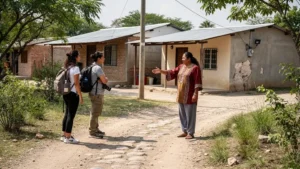
Visiting an Indigenous village in Mexico respectfully starts with recognising a distinction that many travel itineraries overlook: being allowed to enter a place does not mean being entitled to observe, photograph or participate in everything happening there. Communities have their own rules, responsibilities, languages, religious practices and decision-making structures. A visitor’s curiosity, even when well intentioned, does not override those boundaries.
For UK travellers seeking meaningful cultural experiences, the most reliable approach is to arrange visits through community-authorised contacts, clarify what the experience includes and follow local guidance without treating everyday life as a performance. This applies whether visiting a market, staying with a host family, attending a cultural event or learning about communal work. Respect also means accepting that certain activities, conversations and spaces may remain inaccessible to visitors. A good visit is not measured by how much of another person’s life can be witnessed, but by whether the encounter takes place on terms that residents have chosen.
The essentials of respectful Indigenous village visits in Mexico
- Permission to enter, join a tour or pay a guide does not automatically include permission to photograph people, religious spaces or private activities.
- Choose experiences demonstrably managed or authorised by the community, and establish who controls the arrangements and receives the income.
- Follow local instructions, ask before initiating interactions and accept restrictions, refusals or changes of plan without argument.
- Why Are Photos Restricted in Some Indigenous Mexican Villages Even If You Pay a Tour Fee?
- How to Choose a Community-Led Visit in Mexico Without Accidentally Funding the Wrong Operator?
- Which Is Better for First-Timers: A Market Day Visit or a Homestay in an Indigenous Community?
- The Behaviour That Gets You Quietly Frozen Out in an Indigenous Village Within 10 Minutes
- When Is the Least Disruptive Time to Visit an Indigenous Village in Mexico Without Being in the Way?
- Which Is More Respectful: Joining a Community Project Day or Booking a Community-Run Tour?
- How to Greet People Respectfully in Regions Where Spanish Isn’t the First Language?
- Why Communities in Mexico Still Use Communal Labour Systems and What Travellers Misread
Why Are Photos Restricted in Some Indigenous Mexican Villages Even If You Pay a Tour Fee?
Photography restrictions exist because paying for access is not the same as obtaining consent to document people or cultural practices. A tour fee may cover transport, a guide, a meal or the use of community facilities, but it does not automatically grant permission to photograph residents, enter religious buildings with a camera or publish images of ceremonies. These decisions remain subject to the rules established by the relevant people or community authorities.
Photography can affect more than an individual’s privacy. Images of sacred objects, religious ceremonies and community gatherings can circulate far beyond their original context, sometimes without the knowledge or approval of the people represented. A photograph that seems harmless to a visitor may expose private practices, misrepresent cultural knowledge or turn a meaningful religious activity into online travel content.
San Juan Chamula, in Chiapas, illustrates why local context matters. The Secretaría de Cultura‘s historical study of San Juan Chamula documents a prohibition on photography inside the town’s church. The study, dated 1984, describes the church as a setting for community ceremonies, individual prayer and collective religious practices. It is useful historical evidence, but it cannot establish the precise rules currently in force. Visitors should therefore confirm present-day restrictions with authorised local representatives rather than assume that the historical account is a current visitor regulation.
Different spaces can have different conditions. A landscape visible from a public road is not equivalent to a private home, a market stall, a religious interior or a ceremonial gathering. Permission to photograph one setting does not extend to another.
A useful consent protocol separates four questions:
- Who is being photographed? Ask the individual directly or follow the designated representative’s instructions for group activities.
- What is being photographed? A portrait, craft demonstration, religious interior and ceremonial activity may have different restrictions.
- How will the image be used? Explain whether it is for private memories, social media, a blog or commercial publication.
- Can the person refuse? Treat a refusal, hesitation or absence of a clear answer as a reason not to take the photograph.
Children require particular care. Do not approach them independently to request portraits. Follow the applicable rules and obtain permission from the responsible adult as well as any relevant community guidance. Likewise, consent to take an image and consent to publish it are separate decisions. Someone may agree to a photograph for private use without agreeing to its appearance on a public account.
If a photograph is taken against the rules, the visitor may be asked to delete it or stop documenting the experience. Access to a guided activity may also be affected. Discreet photography, telephoto lenses and filming from a distance do not solve the problem: they can make an intrusive action less visible, not more acceptable.
The most respectful photograph is sometimes the one that is never taken. When permission is unclear, putting the camera away protects both the people being visited and the possibility of a more trusting encounter.
How to Choose a Community-Led Visit in Mexico Without Accidentally Funding the Wrong Operator?
A community-led visit is one in which residents have meaningful control over how the experience is organised, managed and represented. A tour taking place in an Indigenous village is not necessarily community-led simply because it employs a local guide or includes traditional crafts. The essential question is whether the community itself has authority over the experience and benefits from it. That distinction is central to UNESCO‘s description of community-based tourism in Mexico.
UNESCO’s article on Mexico’s community-based tourism strategy describes tourism managed by communities themselves, rather than simply tourism taking place in their territory. The initiative also identifies community decision-making over cultural heritage and the importance of communities remaining primary beneficiaries.
This provides a practical starting point, but institutional recognition or inclusion in a discovery guide should not be mistaken for an independent financial audit of every operator. UNESCO reported that more than community-based tourism initiatives received support and accompaniment in Mexico 140 in 2024. Its 2025 article also described a National Guide of Community-Based Tourism Experiences intended to promote more than 100 organisations, cooperatives and community groups. The latter figure was a programme objective, not a verified final count of certified operators.
For a traveller, the distinction between a genuine community enterprise and an externally controlled commercial excursion can be explored through four questions:
- Who owns or manages the experience? Look for an identifiable cooperative, community enterprise, local organisation or designated community representative.
- Who employs the guides? Establish whether guides work for the community organisation, an external agency or an independent intermediary.
- Who sets the rules and prices? Residents should have meaningful authority over visitor conditions, activities and access.
- Who receives the revenue? Ask which organisation or household is paid and what the booking price actually includes.
A local-looking website, Indigenous-language branding or an itinerary featuring traditional activities does not independently demonstrate community ownership. Equally, an external travel agency is not automatically exploitative. It may legitimately facilitate transport, communication and reservations if the community has authorised the arrangement and the financial relationship is transparent.
Look for consistency between the information advertised and what the community contact confirms. A trustworthy arrangement should be able to explain the experience, identify the responsible organisation, clarify inclusions and communicate the relevant visitor rules. This does not mean demanding confidential accounts or asking individual residents to disclose internal financial arrangements. It means seeking reasonable evidence of accountability before paying.
A five-step verification checklist before booking
- Identify the named local organisation or cooperative responsible for the experience. Deliverable: its official name and contact details.
- Ask who manages the booking and who is authorised to receive payment. Deliverable: a written explanation of the booking arrangement.
- Confirm who provides the guiding service and whether guides are employed or designated locally. Deliverable: the guide’s role and organisational affiliation.
- Request a clear breakdown of what the price includes, including transport, food, activities and accommodation where relevant. Deliverable: an itemised itinerary or booking description.
- Confirm that the organisation or designated representative authorises the proposed visit and communicates its restrictions. Deliverable: direct confirmation of the experience and visitor conditions.
These checks are particularly important when booking through an intermediary. A reservation platform may handle the transaction while the community retains control over the actual visit. What matters is that the relationship is authorised, understandable and consistent with the experience being sold.
Choosing a community-led experience does not guarantee that every interaction will be uncomplicated or that every resident will welcome visitors. It does, however, establish a more accountable starting point: the people whose community is being visited should have a meaningful say in the conditions of that visit.
Which Is Better for First-Timers: A Market Day Visit or a Homestay in an Indigenous Community?
For a first-time visitor unfamiliar with local customs, a community-authorised market visit is often the more manageable introduction. It generally involves a shorter, more structured encounter and allows visitors to interact with vendors without entering a household’s private environment. A homestay can offer a deeper exchange, but it requires an explicit invitation, advance coordination and greater sensitivity to domestic routines. Neither option is inherently more authentic or respectful.
The most useful comparison is not the amount of cultural access each experience provides, but the degree of privacy involved and the expectations placed on hosts and visitors.
| Criterion | Market day visit | Homestay |
|---|---|---|
| Duration | Usually shorter and easier to organise around a guided visit. | Involves an overnight or longer arrangement, depending on the offer. |
| Privacy | Interactions generally take place in designated public or commercial spaces. | Visitors enter a household environment and share aspects of domestic life. |
| Coordination | Requires confirmation of visiting conditions and suitable market times. | Requires agreement about accommodation, meals, facilities and household expectations. |
| Communication | Basic exchanges may be sufficient for a short interaction. | More sustained communication may be needed to manage everyday arrangements. |
| Economic benefit | Spending may be distributed among several independent vendors. | Income may be concentrated within the host household. |
| Best suited to | Visitors seeking an organised first introduction. | Visitors with an explicit invitation and flexibility around household routines. |
A market can offer an opportunity to buy locally produced goods, ask questions when vendors are available and learn about regional food or craft traditions. However, it should not be treated as an open-air museum. Vendors are working, negotiating prices and serving customers. A person selling textiles is not automatically available for a lengthy interview or portrait session.
A homestay involves a different relationship. Hosts are offering accommodation and hospitality, not promising unlimited cultural explanations or constant entertainment. Clarify meals, shared bathrooms, sleeping arrangements, household photography and any expectations concerning religious practices before confirming the booking.
It is also important to distinguish direct household income from wider collective benefit. A homestay may provide a meaningful payment to one family without necessarily supporting a community-wide project. A market visit may spread spending among several traders, but it does not automatically create broader economic benefits either. Ask how the experience is organised instead of assuming that one format is universally fairer.
Visitors should also establish whether the host family is comfortable discussing daily life. Personal questions about income, family relationships, religion or community difficulties should never be treated as part of the accommodation package.
For someone unsure about local expectations, a short guided market visit can be a sensible first step. A homestay becomes appropriate when the invitation is explicit and both hosts and visitors understand what the arrangement involves.
The Behaviour That Gets You Quietly Frozen Out in an Indigenous Village Within 10 Minutes
There is no verified universal ten-minute threshold for losing a community’s trust, but several behaviours can undermine an encounter almost immediately. Photographing people without permission, entering private spaces, approaching children independently or interrupting religious activities communicates that a visitor’s curiosity matters more than local boundaries. These actions can close opportunities for interaction before a meaningful conversation has even started.
The distinction between physical access and social welcome is particularly important. A visitor may be authorised to follow a designated route, attend a guided demonstration or buy something at a market. That does not create an invitation to enter homes, join private conversations or observe people at work from close range.
An observation-first approach reduces the risk of misunderstanding. On arrival, pause and identify the designated meeting point. Listen to the guide’s instructions before moving around, and observe how other visitors are expected to behave. If the guide indicates that an area is restricted, do not test the boundary or assume that it is merely a suggestion.
Some less obvious behaviours can also create discomfort:
- Treating people as attractions: staring, following individuals or repeatedly requesting portraits turns ordinary interactions into an unwanted performance.
- Interrupting conversations: entering a discussion because it sounds interesting ignores the possibility that it is private or sensitive.
- Demanding explanations: asking residents to justify political disagreements, religious choices or local restrictions places an unreasonable burden on them.
- Comparing lifestyles: describing people as unusually traditional, untouched or primitive imposes stereotypes rather than recognising contemporary individual lives.
- Publicly challenging restrictions: complaining about photography rules or visitor limits suggests that payment should override local authority.
- Pressuring artisans: aggressively bargaining after agreeing to a community-organised experience can undermine an exchange that is already structured around local pricing.
Good intentions do not automatically make an action respectful. A visitor may believe that asking personal questions demonstrates interest, but the person being questioned has no obligation to explain their identity or circumstances. Similarly, a traveller who wants to support local artisans should not assume that purchasing an item creates a right to photograph the maker.
When an interaction feels uncertain, slow down rather than trying to fill the silence. Introduce yourself briefly, let the guide establish the context and allow residents to decide whether they wish to engage. A conversation that never happens is preferable to one imposed on someone who is busy or uncomfortable.
It is also worth remembering that residents do not necessarily share a single opinion about tourism. One person may welcome visitors while another prefers privacy. A guide’s authorisation for a particular activity should not be interpreted as collective consent for every encounter along the route.
The strongest impression a visitor can make is often a quiet one: listening, following instructions, respecting personal space and accepting that not every aspect of community life is available for observation.
When Is the Least Disruptive Time to Visit an Indigenous Village in Mexico Without Being in the Way?
The least disruptive time to visit an Indigenous village in Mexico is the time the relevant community has agreed is suitable for visitors. A weekday, early morning or quieter tourist season is not automatically respectful. Agricultural work, market activity, religious celebrations, household responsibilities and communal meetings all influence local availability. The appropriate visiting window must therefore be confirmed locally rather than selected according to a generic travel calendar.
Three situations require different approaches:
- Scheduled tourism activities: A community-organised tour has a defined time, meeting point and visitor framework. This is generally the easiest arrangement for coordinating a visit without interrupting unrelated activities.
- Ordinary working days: Residents may be occupied with farming, trade, household responsibilities or community work. The fact that fewer tourists are present does not mean visitors are welcome to observe these activities.
- Culturally or socially sensitive occasions: Religious celebrations, ceremonies and community meetings may involve restrictions on access, photography or movement. Attendance should only take place when explicitly authorised.
A festival is not automatically an appropriate occasion for independent tourism. Even when an event takes place in a public area, an increase in visitors can affect transportation, shared facilities, photography conditions and the ability of residents to carry out their own activities.
There is also a difference between attending a community-approved event and arriving unexpectedly because a celebration appears on an online itinerary. The former can involve designated routes, guidance and visitor limits. The latter may create pressure on people who have not agreed to accommodate outsiders.
Before travelling, contact the organisation or representative responsible for the proposed experience. Confirm the date, meeting point, expected duration, any restrictions and whether the activity is still taking place. Repeat the confirmation shortly before departure if the arrangement depends on local schedules, weather, road access or community decisions.
Flexibility is part of respectful planning. Allow time to postpone a visit rather than expecting a host or guide to rearrange community responsibilities around a fixed holiday schedule. If an activity is cancelled or access is restricted, accept the decision without asking residents to justify it.
Travellers should also avoid treating agricultural or communal work as an alternative attraction when a scheduled tour is unavailable. The absence of a formal tourism activity does not create permission to watch people working.
A flexible schedule allows visitors to adapt to local decisions. It also recognises an important principle: a community’s time belongs to its residents, not to the expectations of a visitor’s holiday.
Key considerations before choosing how to participate
- A community-run tour is designed to organise an exchange with visitors; a project day may serve an entirely different local purpose.
- Volunteering is appropriate only when participation has been explicitly requested and the task has a clear local purpose.
- Understanding language preferences and communal responsibilities helps visitors recognise that local rules are expressions of community authority, not obstacles to tourism.
Which Is More Respectful: Joining a Community Project Day or Booking a Community-Run Tour?
For travellers whose main goal is cultural learning, a community-run tour is generally the more straightforward and appropriate choice. It is organised around a defined visitor experience, with arrangements that can clarify the guide’s role, activities and expected behaviour. Joining a community project day is different: it involves participation in work intended primarily to meet local needs and should only happen when an accountable organisation has explicitly invited visitors to contribute.
The distinction matters because a project that benefits residents does not automatically need outside volunteers. A traveller may arrive with enthusiasm and a desire to help, but that enthusiasm is not evidence that the community needs additional labour, skills or supervision.
Before accepting an invitation to participate in a project, consider four questions:
- Has participation been requested? Is there an identifiable community organisation or authorised local contact inviting visitors to join?
- Are the skills appropriate? Can visitors genuinely perform the proposed task safely and effectively?
- Could visitors replace paid local work? Is the project unintentionally substituting unpaid foreign labour for jobs that residents could perform?
- Is supervision available? Has the organisation explained who coordinates the activity, supplies equipment and accepts responsibility for safety?
These questions are particularly relevant to short-term voluntourism. Projects designed primarily to create attractive visitor experiences can duplicate existing work, divert time toward supervising visitors or prioritise activities that are easy to market rather than those identified by residents as necessary.
There may also be practical risks when visitors attempt work outside their expertise. Construction, infrastructure maintenance, environmental restoration and community services can require local knowledge, technical qualifications and ongoing responsibility. A short visit does not provide enough context to assume that an outside participant can safely improve the situation.
Financial support or purchasing locally produced goods may be more useful than volunteering. If a community organisation has identified funding, materials or a specific resource need, supporting that request can be more appropriate than arriving with an unsolicited offer of labour.
A community-run tour and a project day should therefore be evaluated according to different objectives. The first is a tourism service with defined visitor expectations. The second is a form of participation that must be justified by an identified local need and an explicit invitation.
Do not interpret a community’s willingness to explain a project as permission to join it. Asking about an activity is not the same as receiving authorisation to participate, and watching residents work does not create an entitlement to take photographs or offer unsolicited assistance.
When the objective is cultural understanding, a well-organised community-run visit offers a clearer framework. Project participation should remain exceptional, locally requested and carefully coordinated.
How to Greet People Respectfully in Regions Where Spanish Isn’t the First Language?
The most respectful greeting in an Indigenous community in Mexico begins with attention to individual language preferences rather than an assumption that everyone speaks Spanish as a first language. A polite Spanish greeting may be appropriate in many situations, but visitors should be prepared for someone to prefer an Indigenous language or another form of communication. Asking courteously which language is preferred is generally more respectful than attempting an unfamiliar expression without understanding its meaning.
Mexico has considerable Indigenous linguistic diversity. The Instituto Nacional de Lenguas Indígenas (INALI) identifies linguistic groupings including Bats’i k’op Tsotsil, Bats’il k’op Tseltal, Tu’un Savi (Mixteco) and Zapoteco. These examples are not interchangeable labels for a single language or culture, and their presence in the national linguistic classification does not establish the preferred language of every individual or household.
A simple interaction can begin with a greeting such as:
- “Buenos días.” A polite Spanish greeting when Spanish is appropriate.
- “Buenas tardes.” A courteous greeting later in the day.
- “¿Prefiere hablar en español?” A question that checks whether Spanish is comfortable for the other person.
- “¿Hay alguien que pueda ayudarnos con la traducción?” A practical request when communication requires assistance.
These expressions are examples of Spanish interaction, not universal scripts. Some people may prefer to communicate through a guide or interpreter, while others may not wish to have a conversation at all.
Learning a greeting in a local language can be a thoughtful gesture, provided it is done carefully. Check pronunciation and meaning with someone who is willing to help. Avoid presenting unfamiliar words as a performance, asking people to repeat expressions for entertainment or expecting residents to translate private conversations.
Respectful communication extends beyond the first greeting. Introduce yourself briefly, allow time for responses, address older people politely and avoid interrupting. If a guide is interpreting, let them establish the exchange rather than speaking over them or treating the person being translated for as an object of explanation.
Language is also relevant to consent. If a visitor cannot explain the intended use of a photograph or understand the restrictions attached to an activity, they should not assume that a nod or an ambiguous response constitutes permission. A guide or interpreter can help clarify the exchange, but should not manufacture consent on someone else’s behalf.
Likewise, a person who does not speak Spanish fluently should never be treated as less informed, less capable or less interested in communication. Language preference is not a measure of education, hospitality or willingness to engage.
A greeting is an invitation to establish a courteous interaction, not a demand for one. Sometimes the most appropriate response is simply to smile, acknowledge the person and allow them to continue with their day.
Why Communities in Mexico Still Use Communal Labour Systems and What Travellers Misread
Communal labour systems in Mexico are forms of collective organisation through which residents contribute work or resources to shared community needs. In parts of Oaxaca, the term tequio describes cooperation that can include maintaining roads, repairing infrastructure and improving shared surroundings. It should not be confused with an ordinary tourist volunteering activity: its organisation, responsibilities and meaning are determined by local community arrangements, not by the expectations of visitors.
The government of Oaxaca describes tequio as collective cooperation involving work and material contributions to construct, improve, repair and preserve community surroundings. Its Tequios Bienestar programme also illustrates how collective work can involve local authorities, neighbourhood support and community participation. However, this particular government programme should not be treated as a universal administrative model for every community’s traditional practices.
Communal labour can be connected to collective responsibility and local governance. Residents may participate in maintaining shared infrastructure or supporting projects that benefit a wider community. The arrangements can reflect local histories, rules and understandings of responsibility rather than an activity organised primarily for recreation or tourism.
Travellers may encounter different terms, including tequio and faena, alongside other locally named forms of collective work. These expressions should not automatically be treated as interchangeable. Their meanings, participation rules and possible alternatives can vary between places. It would therefore be inaccurate to assume that every Indigenous community in Mexico follows the same system or applies identical obligations.
Several misunderstandings can arise when visitors encounter communal work:
- Interpreting it as evidence of poverty: collective maintenance can reflect a system of local cooperation and responsibility, not simply an absence of public services.
- Assuming identical participation: responsibilities and arrangements may differ according to local rules and circumstances.
- Treating it as a cultural attraction: residents carrying out shared work are not automatically providing an activity for tourists to observe.
- Assuming payment grants access: purchasing a tour or making a donation does not create permission to join communal work.
- Offering unsolicited assistance: visitors may lack the necessary skills, context, equipment or authorisation to participate safely and usefully.
Communal governance is also relevant to tourism. Local decision-making structures, including community assemblies or other designated authorities where applicable, may influence whether tourism activities are accepted, which spaces are accessible, how visitor numbers are managed and what rules apply to photography. The precise arrangements differ between communities, and outsiders should not assume that one model applies everywhere.
Respecting communal labour therefore involves recognising the distinction between a resident’s responsibilities and a visitor’s opportunities. A community project may be taking place in a visible public area, but its visibility does not make it an invitation to participate, interview workers or record the activity.
Visitors can still support local priorities through arrangements that residents have chosen to make available. This might involve booking an authorised community-led experience, purchasing locally produced goods or supporting a project through an established organisation. The important point is that the community determines what form of participation is useful and appropriate.
Ultimately, visiting an Indigenous village respectfully means recognising that it is a living community with its own authority, responsibilities and priorities. The most meaningful cultural exchange begins when travellers accept that not everything is available for observation, explanation or participation. Before booking, ask who has authorised the visit, what residents have agreed to share and which boundaries must remain intact. That approach creates room for genuine learning without turning other people’s everyday lives into a tourist attraction.
Can tourists visit Indigenous villages in Mexico without a guide?
Sometimes, but access depends on the individual community and its visitor arrangements. Some places welcome independent visitors in designated public areas, while others organise visits through authorised guides or community organisations. Before travelling, establish whether independent access is accepted, which areas are open to visitors and whether specific permissions or fees apply. Never assume that entering a village gives permission to visit private homes, attend ceremonies or photograph residents.
Is it disrespectful to buy traditional crafts directly from Indigenous artisans?
No. Purchasing locally made crafts can be a respectful way to support artisans, provided the transaction is voluntary and conducted on fair, clearly understood terms. Ask about products when the seller is available, avoid aggressive bargaining and do not assume that buying an item includes permission to photograph its maker, workshop or production process. If the purchase is part of a community-organised visit, follow the agreed arrangements.
Should visitors bring gifts for Indigenous families in Mexico?
Not necessarily. Unrequested gifts can create awkward expectations or introduce items that hosts do not need. If staying with a family, ask the booking contact whether a small contribution or particular household item would be appropriate. Follow the host’s preference rather than assuming that gifts are expected. Paying the agreed accommodation or experience fee fairly and on time is often a more straightforward way to respect the arrangement.
Can visitors attend Indigenous religious ceremonies in Mexico?
Only when attendance is explicitly permitted by the relevant community or authorised organisers. A ceremony taking place in a publicly accessible location is not automatically open to tourists. Photography, filming, movement and participation may be restricted separately. Confirm the conditions in advance and accept that some ceremonies are private or unsuitable for visitors, even when a guided tour is available nearby.
What should travellers do if they accidentally break a local rule?
Stop the activity immediately, listen to the person explaining the restriction and apologise briefly without becoming defensive. If asked to delete a photograph or leave a restricted area, follow the instruction. Avoid arguing that a tour fee, good intention or lack of prior knowledge should exempt you from the rule. If the misunderstanding has affected the visit, let the guide or authorised representative explain whether the experience can continue.