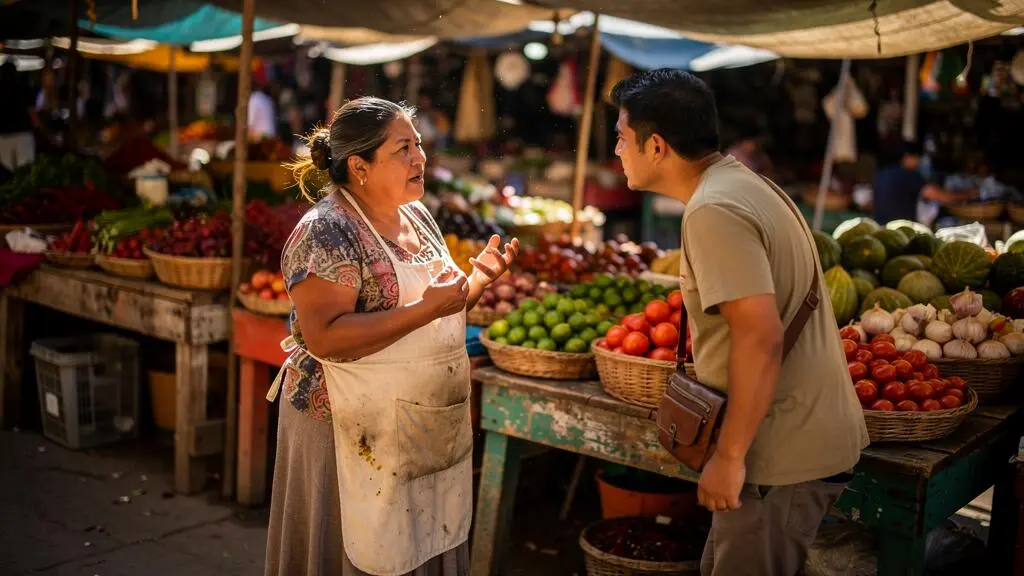
Your Spanish lessons prepared you to order lunch, ask directions and negotiate a price. Then you arrive at a market in Oaxaca, hear a vendor move between two unfamiliar-sounding languages, and suddenly your carefully rehearsed phrases seem inadequate. Did you misunderstand something? Should you speak more slowly? Or is the conversation happening in a language other than Spanish?
Mexico is not a monolingual country with a handful of regional accents. Its linguistic landscape includes Indigenous languages with their own histories, structures and local varieties. According to Mexico’s National Institute of Statistics and Geography (INEGI), an estimated 7.4 million people aged three and over spoke an Indigenous language in 2023.
For British travellers with basic Spanish, the challenge is not necessarily poor grammar. It is recognising when Spanish is only one language in the conversation. That matters in five particularly useful regional contexts: Oaxaca, Chiapas, Puebla, the Yucatán Peninsula and communities across central Mexico where Nahuatl or other Indigenous languages are spoken.
These are not five uniform linguistic zones. Languages, attitudes and everyday communication practices vary between communities, sometimes between neighbouring towns. The practical solution is to listen before assuming, adapt your Spanish without becoming patronising, and learn a little about the specific place you are visiting.
What to remember before speaking Spanish in Mexico
- Indigenous languages are distinct languages, not simply regional Spanish accents. Their presence can change how everyday conversations unfold.
- Start with polite, clear Spanish and observe the response. A locally appropriate greeting can be welcome, but it is not compulsory.
- For village stays, community events and storytelling, checking the local language and participation arrangements matters more than memorising a long phrasebook.
- Why Do People in Some Mexican Markets Switch Between 2 Languages Mid-Sentence?
- How to Greet People Respectfully in Regions Where Spanish Isn’t the First Language?
- Which Is Less Awkward: Attempting an Indigenous Greeting or Using Slower Spanish With Respect?
- The Language Mistake That Makes Locals Go Quiet Around Tourists in Rural Mexico
- When Should You Prepare Extra Language Notes Before Visiting Indigenous-Language Regions?
- Which Is Better for First-Timers: A Market Day Visit or a Homestay in an Indigenous Community?
- How to Find Live Storytelling Events in Mexico Without Stumbling on Them by Accident?
- Where Can You Actually Hear Traditional Mexican Storytelling Instead of Just Reading About It?
Why Do People in Some Mexican Markets Switch Between 2 Languages Mid-Sentence?
People in multilingual Mexican markets may switch between Spanish and an Indigenous language because different customers, relatives or colleagues use different languages. This practice, known as code-switching, can reflect familiarity, conversational context or the intended audience. A visitor should not automatically interpret it as secrecy, exclusion or a reaction to their Spanish.
Imagine a hypothetical encounter at a market in Oaxaca. A vendor answers your question in Spanish, then turns towards a relative and speaks in a local variety of Zapotec. The relative responds in the same language before the vendor returns to Spanish to complete your purchase.
Nothing about that sequence necessarily indicates a problem. The speakers may simply be communicating in the language they normally use together. In other circumstances, changing languages can help a speaker address someone more comfortably or manage a conversation involving several participants.
Research provides a useful foundation for understanding this complexity. Sophia Schnuchel‘s research on Indigenous bilingualism in León examined language use among 67 Indigenous participants from six groups in Guanajuato. The study documented language alternation and different patterns of Indigenous-language and Spanish use across social settings, including commercial contexts.
It did not establish a universal explanation for why market vendors switch languages. The lesson is that language choice is shaped by relationships and circumstances, not merely by whether a speaker knows Spanish.
68 linguistic groupings, 364 variants
Mexico’s official linguistic classification distinguishes 11 language families, 68 linguistic groupings and 364 Indigenous-language variants. INALI recognises the registered variants as national Indigenous languages. These categories should not be confused with regional Spanish accents.
Instituto Nacional de Lenguas Indígenas (INALI), Atlas of Indigenous Languages of Mexico.
This diversity helps explain why assumptions such as « Oaxaca speaks Zapotec » or « Chiapas speaks one local language » are misleading. Oaxaca includes communities associated with Zapotec, Mixtec and other languages. In Chiapas, Tsotsil and Tseltal are among the languages travellers may encounter. Even a familiar language name can cover substantially different local variants.
What should you do when a conversation changes language?
- Continue listening rather than interrupting the exchange.
- Wait until the speaker addresses you again before repeating your question.
- If clarification is needed, ask calmly in Spanish: « Perdón, ¿me lo puede repetir? » — « Sorry, could you repeat that? »
- Avoid assuming that every remark spoken in another language concerns you.
The most important distinction is between being unable to follow a conversation and being deliberately excluded from one. They are not the same thing.
Once you recognise that Spanish may share the conversation with another language, the next question becomes how to begin an interaction without making the speaker uncomfortable.
How to Greet People Respectfully in Regions Where Spanish Isn’t the First Language?
The safest approach is to greet someone politely in Spanish, allow time for a response and adjust to the individual’s communication style. Where you have verified a greeting in the specific local Indigenous language, using it naturally may show consideration. The priority is respectful interaction, not demonstrating linguistic knowledge.
In parts of Oaxaca, Chiapas, Puebla, Yucatán and central Mexico, an Indigenous language may be someone’s first or preferred language. Spanish can still function as a shared language between visitors and residents, although proficiency differs between individuals.
A simple « Buenos días » followed by a pause is often a practical beginning. It avoids assuming that someone speaks a particular Indigenous language merely because of where they live, how they dress or how old they appear.
Greeting etiquette also involves more than vocabulary. Depending on the community and individual, conversation may place different emphasis on pauses, introductions, forms of address and eye contact. These practices should be learned locally rather than presented as universal Indigenous customs.
For instance, using « usted » rather than « tú » with an unfamiliar adult is a sensible polite starting point in many Spanish-speaking settings. But it is not proof of an Indigenous-specific rule. Likewise, acknowledging an elder respectfully may be appropriate without assuming that every community follows the same greeting hierarchy.
For travellers keen to learn a local expression, the INALI’s Indigenous-language courtesy phrase guides provide a particularly useful starting point. The institution has published courtesy phrases in 30 Indigenous languages, with written materials and audio resources available for some entries.
These materials include expressions associated with greetings, thanks, welcomes and farewells. However, a phrase from one Mixtec or Zapotec variant should not be assumed appropriate across every community using the same broader language name.
Ask a local host, guide or language speaker which expression applies in the town you are visiting. Practise its pronunciation privately, then use it only when the moment feels natural.
There is an important difference between greeting someone and performing a greeting for an audience. Reciting unfamiliar words to entertain companions can make the speaker’s language feel like a novelty. A quiet, sincere greeting in a normal exchange avoids that problem.
Even so, travellers often face a practical dilemma: is a slightly imperfect Indigenous greeting preferable to reliable, polite Spanish?
Which Is Less Awkward: Attempting an Indigenous Greeting or Using Slower Spanish With Respect?
Polite, clearly spoken Spanish is usually the safer default when meeting someone for the first time. Attempting an Indigenous greeting becomes more appropriate when you know the language and local variant, have practised the pronunciation, and have reason to believe the person welcomes its use. Neither choice is automatically more respectful in every situation.
Consider three questions before trying a phrase you have recently learned. Did you hear it used locally? Do you know how to pronounce it? Is the interaction personal enough for the attempt to feel conversational rather than performative?
The following comparison can help you choose.
| Situation | Indigenous-language greeting | Polite Spanish |
|---|---|---|
| First encounter with a stranger | Use only if locally verified and appropriate. | Best starting point when Spanish is understood. |
| Meeting a host who has taught you a phrase | A natural opportunity to practise. | Useful for continuing the conversation. |
| Uncertain pronunciation or language variant | Ask for guidance before attempting. | Preferable until the phrase is confirmed. |
| Busy transaction or time-sensitive request | May be unnecessary. | Prioritise clarity and practical communication. |
| Someone replies in their preferred language | Follow their lead if you can communicate. | Use if it helps both participants understand. |
One useful strategy is to remove the pressure of choosing in advance. Begin with a Spanish greeting, listen to the response, and introduce a local phrase only after establishing that it belongs in the exchange.
- Start simply: « Buenos días. Disculpe… » establishes a polite tone without presuming language preferences.
- Observe: Notice whether the person answers comfortably, requests clarification or introduces another language.
- Adapt: If they teach you a greeting, repeat it carefully and ask whether your pronunciation is correct.
The question « ¿Lo pronuncié bien? » — « Did I pronounce it correctly? » — can turn an uncertain attempt into a request for guidance. Of course, the person may not have the time or interest to teach you, and that choice deserves respect too.
Using and acknowledging Indigenous languages in everyday settings can contribute to their visibility. But it would be overstating the evidence to claim that a tourist’s individual greeting directly prevents language loss or changes community language transmission.
The point is more modest: showing interest without placing extra demands on a speaker is better than treating the language as invisible.
The same attentiveness matters once a conversation has begun, particularly when the person opposite you becomes quiet or stops responding.
The Language Mistake That Makes Locals Go Quiet Around Tourists in Rural Mexico
One potentially uncomfortable mistake is responding to a communication difficulty by speaking louder, faster or in an exaggeratedly simplified way. Someone whose first language is not Spanish may understand more than they can comfortably express, or may simply prefer another language. Silence can have several meanings, so the practical response is to reduce pressure rather than assume ignorance or hostility.
Imagine a hypothetical traveller asking for directions in a rural village. Their initial Spanish question receives a brief reply. They repeat it more loudly, add several complicated explanations and eventually begin speaking as though addressing a child.
The person answering may disengage. That could reflect a language barrier, discomfort, uncertainty about the question or something unrelated to the traveller. It is impossible to infer a single motive from silence alone.
Yet the traveller can still make the situation easier.
The problem is not that textbook Spanish is inherently offensive. It is that a polished, rapid sequence of questions can be difficult to process when speakers have different levels of fluency, different language preferences or limited familiarity with one another.
Watch for changes in the interaction rather than trying to diagnose the other person’s feelings. Shorter answers, hesitation, a request to involve somebody else or a long pause may suggest that your current approach is not working.
Try this recovery sequence:
- Stop speaking and allow a natural pause.
- Lower your volume to an ordinary conversational level.
- Use one short question instead of several linked questions.
- If suitable, offer a simple choice that can be answered without a lengthy explanation.
- Thank the person for their time, whether or not the exchange succeeds.
Useful phrases include « Perdón, voy a hablar más despacio » (« Sorry, I’ll speak more slowly ») and « ¿Prefiere que pregunte a otra persona? » (« Would you prefer that I ask someone else? »). Use these only when the other person appears to understand Spanish.
A slower pace should not become a theatrical one. Clear adult-to-adult communication means using ordinary grammar, manageable sentences and enough time for a reply.
Equally, if the person does not wish to continue, accepting that boundary is more respectful than insisting on an answer.
Some misunderstandings can be resolved immediately. Others are easier to prevent by preparing for the specific linguistic conditions of your destination.
When Should You Prepare Extra Language Notes Before Visiting Indigenous-Language Regions?
Prepare extra language notes when your trip involves prolonged contact, limited connectivity or situations where misunderstandings could have practical consequences. Multi-day village stays, homestays, community gatherings and travel with someone needing assistance justify more preparation than a brief market visit. The aim is not fluency: it is knowing which languages are relevant, what to say and where to obtain help.
Start with geography rather than a generic list of « Mexican Indigenous phrases ». The language associated with one town may not be the language used in the next. A guide covering one variety of Nahuatl, Mixtec or Zapotec cannot automatically serve every community using the broader name.
For Oaxaca, first identify your destination town and the specific language or variant associated with your hosts. In Chiapas, distinguish between local language communities rather than assuming that one phrase list applies throughout the state. In Puebla and central Mexico, likewise verify the relevant community language. In Yucatán, Yucatec Maya may be relevant, but individual language preferences still vary.
There are also practical reasons to prepare beyond greetings. Digital translation services may offer uneven support for particular Indigenous languages and variants, and rural connectivity can be limited. A downloaded Spanish dictionary does not guarantee an appropriate translation into the local language.
For a short visit, three verified courtesy expressions — greeting, thanks and a polite farewell or excuse — may be more useful than a long, poorly rehearsed list. For an extended stay, add information about travel arrangements, essential services and bilingual assistance.
Your five-step language preparation checklist
- Identify your destination community and verify the locally relevant language or variant. Write down the town name and confirmed language identification.
- Ask a host or knowledgeable local contact to confirm three useful courtesy expressions. Create a small phrase card with pronunciation notes.
- Prepare essential Spanish questions for transport, accommodation and assistance. Save one offline page containing those questions.
- Confirm where bilingual help or interpretation may be available, especially for important appointments or emergencies. Record a verified contact or service location.
- Print or save the notes offline and check that you can retrieve them without mobile data. Keep an accessible paper copy if connectivity is uncertain.
For health-related communication, do not assume that a phrasebook or automated translation is sufficiently reliable for medical decisions. Identify appropriate professional or bilingual assistance in advance where possible.
Advance preparation also protects the people you visit from being unexpectedly asked to act as translators, guides or emergency contacts.
How extensively you need those notes depends partly on the experience you choose. A casual market visit and an overnight community stay place very different demands on your communication skills.
Which Is Better for First-Timers: A Market Day Visit or a Homestay in an Indigenous Community?
A market-day visit is generally the easier introduction for travellers who want short, flexible encounters and opportunities to practise polite Spanish. A homestay offers more sustained contact, but it requires greater comfort with communication gaps and clearer arrangements with hosts. For many first-time visitors, beginning with a market and considering a homestay later is a sensible progression.
The difference is not simply the amount of cultural exposure. It is the level of responsibility involved in each interaction.
At a market, you might exchange greetings, ask a price, purchase food and leave. The exchange has a relatively clear purpose. You can practise patience without expecting the vendor to provide language lessons or cultural explanations.
A homestay involves repeated interaction around meals, schedules, household arrangements and personal space. Misunderstandings can therefore be more consequential. The experience may be rewarding, but it should be organised with the host’s expectations and preferences in mind.
Before booking, ask whether the experience is genuinely community-organised, what language the host normally uses with guests and what support is available if communication becomes difficult.
| Consideration | Market-day visit | Community homestay |
|---|---|---|
| Conversation length | Usually brief and task-focused. | Repeated interactions over a longer period. |
| Language practice | Greetings and simple transactions. | Everyday routines and more varied exchanges. |
| Communication pressure | Generally easier to end an exchange politely. | Requires ongoing adaptation and mutual understanding. |
| Preparation | Basic vocabulary and local etiquette. | Host language, arrangements, expectations and assistance. |
| Best suited to | Travellers seeking an initial introduction. | Travellers comfortable with uncertainty and longer stays. |
One easily overlooked question is who will communicate with you during the stay. Some households may include relatives with different levels of Spanish proficiency. Never presume that an older host speaks less Spanish, or that a younger family member is automatically willing to translate.
Instead, confirm directly with the organiser how communication will work and whether interpretation has been agreed upon.
A practical sequence is to explore a public market respectfully, learn which languages are used in the area, then choose a homestay through an appropriately organised community-based tourism initiative if that experience interests you.
Neither format should turn residents into unpaid cultural educators. Purchase goods fairly, respect household privacy and recognise that participation is voluntary.
A well-arranged homestay may also introduce you to community cultural activities, including oral storytelling, although access should never be presumed.
How to Find Live Storytelling Events in Mexico Without Stumbling on Them by Accident?
To find live storytelling in Mexico, start with local cultural institutions, community museums, language organisations and trusted hosts rather than relying exclusively on broad online searches. Ask specifically about oral narration or storytelling events, the language used and whether visitors are welcome. Many gatherings depend on local calendars or community arrangements, so confirm details before travelling.
Searching only for « traditional Mexican storytelling show » may favour commercially promoted experiences. Meanwhile, a locally organised storytelling gathering might be publicised through a cultural centre, community noticeboard, local radio or direct communication between residents.
That does not make smaller events automatically more authentic or culturally valuable. It simply means their publicity channels may differ from those aimed at tourists.
Useful places to make enquiries include state cultural institutions in Oaxaca, Chiapas, Puebla and Yucatán, as well as community museums, language-focused cultural initiatives and appropriate local tourism contacts.
In Oaxaca, institutions such as the Centro Cultural San Pablo or the state’s cultural authorities can be useful starting points for enquiries about language and cultural programming. Their mention is not a claim that a particular storytelling event is currently scheduled.
A host who already participates in local cultural life may be able to explain which events are public, which require an invitation and which are not intended for visitors.
Before making plans, ask the organiser four straightforward questions:
- Is the event open to visitors, or is participation restricted to the community?
- Will narration be in Spanish, an Indigenous language or more than one language?
- Will any translation or explanation be provided?
- Are photography, recording and audience participation permitted?
Useful Spanish enquiries include « ¿Habrá algún evento de narración oral abierto al público? » (« Will there be a storytelling event open to the public? ») and « ¿En qué idioma se contará? » (« What language will it be told in? »).
Be cautious about treating community celebrations as ready-made tourist entertainment. Some ceremonies and gatherings are private, religious or restricted to invited participants. A local contact’s reassurance does not automatically override the organisers’ rules.
Where permission is uncertain, seek confirmation from the event organiser rather than arriving unannounced.
Once you know how to enquire, the final step is understanding which types of places and occasions are most likely to offer an appropriate opportunity to listen.
Key takeaways before attending a storytelling event
- Choose an event for which public access and the language of narration have been confirmed, not simply one advertised as traditional.
- Decide whether you want to follow a story in Spanish or listen attentively to an Indigenous-language performance you may not fully understand.
- Check dates, recording rules and participation expectations directly with organisers before building travel plans around the gathering.
Where Can You Actually Hear Traditional Mexican Storytelling Instead of Just Reading About It?
Traditional oral storytelling in Mexico can be encountered through public community festivals, cultural centres, language revitalisation activities and certain locally organised gatherings. Oaxaca, Chiapas, Puebla and Yucatán offer relevant regional contexts, but no venue or calendar guarantees a live session. The most reliable approach is to identify an appropriate event, confirm that visitors are welcome and check its language and date.
Unlike a book, an oral story involves the relationship between a narrator, an audience and a particular moment. Speech rhythm, repetition, pauses and responses from listeners can all contribute to the experience.
That does not imply every Indigenous storytelling tradition follows the same pattern. Narrative forms differ between languages, communities, individual storytellers and occasions.
The settings below are useful places to investigate rather than verified listings of upcoming performances.
| Regional context | Potential setting | What to verify |
|---|---|---|
| Oaxaca | Community cultural centres, language events and public festivals. | Local language variant, public access and event scheduling. |
| Chiapas | Community museums, cultural programmes and public celebrations. | Language of narration and whether interpretation is available. |
| Puebla | Local cultural initiatives and Indigenous-language activities. | Whether oral narration is part of the actual programme. |
| Yucatán | Maya-language cultural programming and community festivals. | Public participation arrangements and narration language. |
| Central Mexican Indigenous-language communities | Language-focused cultural gatherings and locally organised public events. | Exact venue, date and visitor permissions. |
Community celebrations associated with agricultural cycles, patron-saint festivities or language-related cultural activities may sometimes include oral narration. However, the existence of a festival does not establish that storytelling will take place, and not every cultural activity is open to tourists.
Timing is therefore as important as location. A cultural centre with no scheduled performance cannot provide the same experience as a confirmed public event, however relevant its wider programme may be.
When listening to a story in an unfamiliar language, allow the narrator’s pacing and the audience’s responses to guide your behaviour. Do not expect a sentence-by-sentence Spanish translation unless one has been announced.
If a bilingual retelling is offered, it may help you notice how stories move between languages. But a Spanish retelling is not necessarily a word-for-word equivalent of the original narration.
Respect recording restrictions, avoid interrupting to request explanations and ask questions only when the organiser has made time for them. If the gathering is not open to visitors, choose another public event instead.
There is a meaningful connection between this experience and a market conversation. In both settings, language communicates relationships and cultural context as well as information. Understanding every word is not the only way to listen respectfully.
Choose one region on your itinerary, identify a local cultural contact and ask about a confirmed public storytelling event. Even if nothing suitable is scheduled, that enquiry is a useful starting point for encountering Mexico’s linguistic diversity on its own terms.
Can you travel through Mexico knowing only basic Spanish?
Yes, basic Spanish can be useful for many common travel interactions, particularly in destinations accustomed to visitors. However, it does not guarantee communication in every community. For extended rural stays or important appointments, confirm local language needs and available assistance before travelling.
Are Indigenous Mexican languages just dialects of Spanish?
No. Languages such as Nahuatl, Yucatec Maya, Zapotec and Mixtec are Indigenous languages with distinct linguistic histories and structures. They are not regional forms of Spanish. Each broad language designation may also encompass several locally recognised varieties, as reflected in INALI’s classification.
Should you ask someone which Indigenous language they speak?
It can be appropriate when the question is relevant and the person seems comfortable conversing, but avoid guessing their language from appearance or location alone. A respectful, optional question is preferable to treating someone as a representative of an entire linguistic community.
Can smartphone translation apps handle Mixtec, Zapotec or other Indigenous languages?
Support varies by application, language and variant, and automated translations may not match the speech used in a specific community. Check the precise language support before departure, test offline functionality and do not rely on automatic translation for medical or other high-stakes conversations.
Is it respectful to record an Indigenous-language greeting or story?
Ask permission from the speaker or event organiser before recording. Permission to attend, listen or participate does not necessarily include permission to capture or share someone else’s words. Respect a refusal and check whether any cultural restrictions apply.