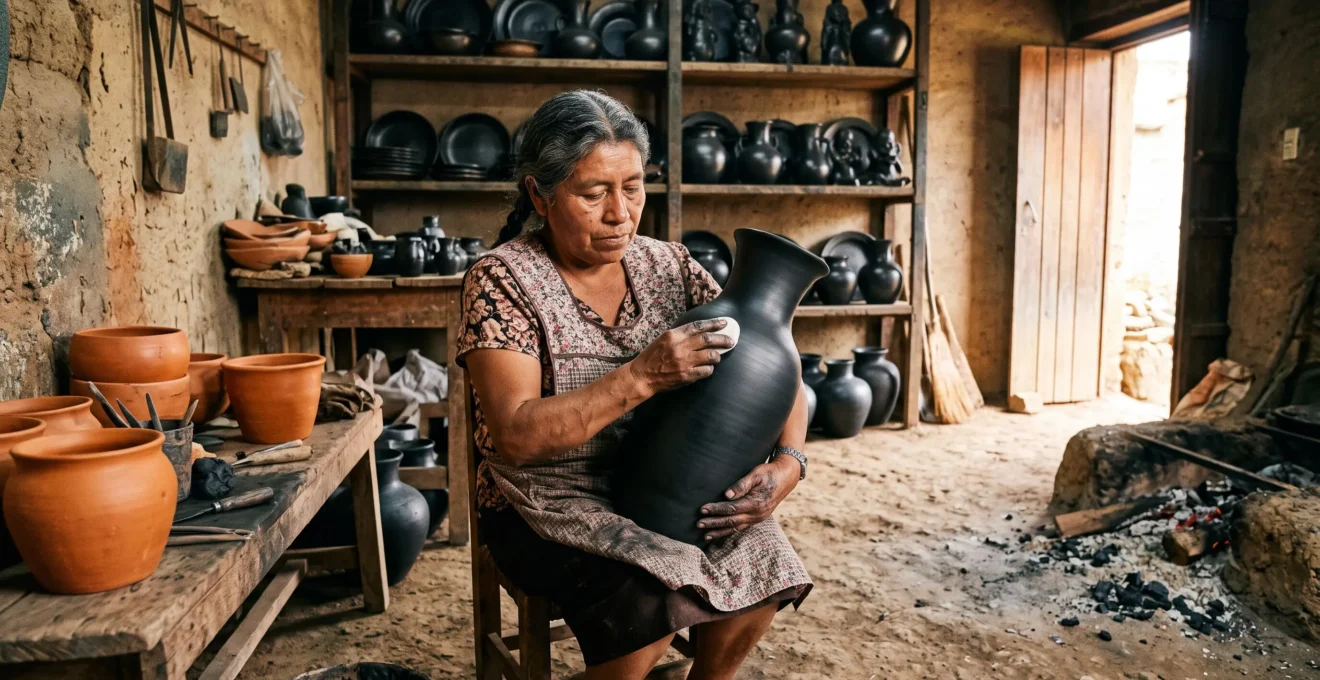
A black ceramic vase catches the light at an Oaxaca market. The seller calls it handmade barro negro, but the next stall displays an almost identical piece. One costs noticeably more. Which deserves a place in your suitcase?
The quickest useful check combines three observations: examine how the black finish interacts with the clay, look for evidence of forming and finishing, and ask where and by whom the piece was made. None is a foolproof authentication test. Together, however, they reveal more than a label or price tag.
Authentic barro negro from San Bartolo Coyotepec owes its characteristic colour to a traditional firing process, not simply to black surface paint. Its finish may be silky, matte or highly polished. A glossy piece is therefore not automatically a factory copy.
For UK travellers, recognising craftsmanship is only half the decision. A worthwhile purchase should also suit its intended use, survive the journey home and come with a convincing account of its origin.
Authentic Oaxacan pottery: the essentials
- Look beyond shine. Traditional black colour develops during firing; polishing can give genuine pieces a reflective surface.
- Check craftsmanship and provenance together. Examine the base, rim and decoration, then ask about the maker and production process.
- Protect the purchase. Keep fragile ceramics apart, cushion vulnerable areas and account for UK customs allowances.
- Why Does Oaxacan Black Pottery Look and Feel So Different From Copies and Other Mexican Styles?
- How to Check Oaxacan Pottery Quality at a Market Stall Without Breaking Anything
- Which Gives Better Value for Ceramics: Buying at the Village Workshop or a City Craft Market?
- The Packing Mistakes That Crack Handmade Pottery Before You Even Leave Mexico
- When Should You Visit a Pottery Village to See Firing in Action Instead of Just a Shop?
- How to Check if a Mexican Craft Is Truly Handmade in 5 Non-Rude Questions
- How to Check Textile Durability in a Market Without Washing Anything First
- Which Mexican Hand-Woven Textiles Are Practical to Bring Back in a UK Suitcase Without Damage?
Why Does Oaxacan Black Pottery Look and Feel So Different From Copies and Other Mexican Styles?
Oaxacan black pottery looks distinctive because its dark colour develops during firing, while polishing and carving create different textures on the same clay surface. A factory-made imitation may resemble it visually but use different materials or finishes. The most useful distinction is not how shiny a piece looks, but whether its appearance and production story fit the regional tradition.
Barro negro is closely associated with San Bartolo Coyotepec, a village in Oaxaca’s Central Valleys. Contrary to a common assumption, artisans do not begin with naturally jet-black clay. The regional raw material is described as grey clay, which becomes black during oxygen-restricted firing.
According to Mexico’s cultural heritage entry on San Bartolo Coyotepec black pottery, traditional production involves forming, drying, smoothing, burnishing and sometimes carving or incising the clay.
Burnishing compresses and smooths the unfired surface through repeated rubbing with a hard tool, traditionally including a stone. It can produce a polished appearance without requiring a clear glossy coating.
Gloss is not proof of imitation. The development of highly polished black pottery is particularly associated with Doña Rosa Real Mateo in the twentieth century, although earlier precedents existed. Genuine traditional work can therefore reflect considerable light.
Consider these visual and tactile differences while examining ceramics in Oaxaca.
| Feature | Traditional barro negro | Other styles or potential imitations |
|---|---|---|
| Colour | Black develops during oxygen-restricted firing. | Some black-looking products may use applied colour; other regional traditions use different clays or finishes. |
| Surface | Can be matte, silky or burnished to a sheen. | Applied paint, varnish or glaze may create a different surface appearance. |
| Decoration | May include individually worked carving, incisions and pierced patterns. | Moulded or repeated decoration may look highly uniform, although mould use alone does not prove factory production. |
| Regional comparison | Associated with San Bartolo Coyotepec. | Santa María Atzompa is particularly associated with green-glazed ceramics. |
| Best evidence | Coherent making process and identifiable workshop provenance. | Appearance without a convincing production history provides weaker attribution. |
Two apparently identical vases can offer another clue. Compare the depth of carved details, the spacing of openings and the contours around repeated motifs. Small differences may indicate individual finishing. Perfect repetition can suggest standardised production, but both handmade mould-assisted work and industrial manufacturing can produce similar shapes.
A gentle tap may reveal differences in an object’s condition, thickness or structure, but there is no established universal bell-tone test for authentic barro negro. Similarly, an odour resembling varnish is not conclusive evidence of a counterfeit.
The strongest judgment combines material knowledge with the seller’s explanation. Once a piece looks plausible, its physical condition deserves a separate examination.
How to Check Oaxacan Pottery Quality at a Market Stall Without Breaking Anything
Check a ceramic piece by asking permission to handle it, supporting its base, examining its outline, and inspecting its rim, underside and vulnerable joints. Look for cracks rather than demanding perfect symmetry. A light tap can sometimes reveal a structural concern, but it cannot establish authenticity and should never be attempted without the seller’s agreement.
A useful market inspection takes roughly a minute if the stall is quiet and the vendor agrees. Begin with the simplest question: ¿Puedo tomarla para sentir el peso? — May I hold it to feel the weight?
Hold the object securely with both hands, keeping it above the vendor’s table. An object that feels light for its dimensions is not automatically genuine; wall thickness, shape and construction all affect weight.
- First 15 seconds: Observe the overall shape at eye level. Look for unexpected distortion, unstable positioning or a noticeably uneven rim.
- Next 15 seconds: Inspect the lip, base and any handle attachments for hairline cracks or chipped edges.
- Next 15 seconds: Ask permission to view the underside. Notice finishing marks, surface treatment, any signature and possible mould seams.
- Final 15 seconds: Ask about the maker and intended use. If the vendor agrees, a very gentle tap may provide an additional condition clue, but never treat its sound as proof of origin.
Distinguish an intentional handmade variation from damage. A slightly uneven decorative opening may reflect the making process. A crack travelling from the rim, through the base or around a handle joint can compromise the object during normal handling.
Fine surface crazing is associated with some glazed ceramics. It should not automatically be interpreted as a crack through the underlying body. In contrast, an apparent fracture passing through the ceramic deserves caution, particularly on anything intended to hold liquid.
On traditional unglazed barro negro, inspecting the clay itself is more relevant than searching for glaze crazing.
The underside is especially worth examining because it reveals areas that decorative presentation may conceal. Hand-finished bases can display subtle variations, while some mould-produced pieces show seam lines or highly regular surfaces. These are manufacturing clues, not individually decisive authentication markers.
A felt pad covering the entire base is a reason to ask about the finish, not to accuse the seller. Do not remove anything attached to a piece without permission.
Your five-point pottery buying check
- Confirm handling permission. Obtain the seller’s agreement before lifting the piece; record whether inspection was possible.
- Inspect vulnerable areas. Identify any crack, chip or unstable joint; note the exact location.
- Compare the finish. Examine the colour and polish under available light; record whether any coating appears visible without scraping it.
- Check the production story. Ask who made the piece and where; note the workshop or maker’s name if supplied.
- Confirm the purchase conditions. Ask whether the item is decorative or functional, and how it will be packed; leave with a clear use recommendation and packing plan.
A seller may prefer not to let visitors handle fragile pieces, especially intricate or expensive work. That response does not establish dishonesty. Ask for a demonstration or request that the vendor turn the object instead.
Quality is easier to assess once the object is in hand. Value, however, depends just as much on where it was made, how confidently it can be attributed and what the buying experience contributes.
Which Gives Better Value for Ceramics: Buying at the Village Workshop or a City Craft Market?
A village workshop usually offers the strongest opportunity to understand who made a ceramic piece and how it was produced. An Oaxaca city craft market offers greater convenience and the chance to compare multiple sellers. Neither is automatically cheaper: value depends on the object, the journey required and how much importance the buyer places on direct artisan contact.
San Bartolo Coyotepec is a natural destination for black pottery, while Santa María Atzompa provides a contrasting ceramics tradition. Both appear on Oaxaca’s official Ruta Mágica de las Artesanías itinerary, which promotes visits to craft-producing communities.
At a workshop, visitors may be able to learn directly about clay preparation, finishing and the roles of individual family members. At a city market, different objects and styles can often be compared without committing to a separate village excursion.
| Buying factor | Village workshop | Oaxaca city craft market |
|---|---|---|
| Price | Direct purchasing may avoid some retail intermediaries, but lower prices are not guaranteed. | Prices vary by seller, quality and attribution; convenient comparisons are possible. |
| Provenance | Potential to meet the maker or production family. | Depends on whether the stallholder knows and identifies the maker. |
| Selection | Often concentrated on the workshop’s own techniques and designs. | Potential access to several regional craft traditions in one location. |
| Travel effort | Requires additional transport and coordination. | Convenient for travellers already exploring the city. |
| Learning experience | Potential access to production explanations and demonstrations. | Opportunities to compare objects and ask questions across stalls. |
| Best suited to | Buyers prioritising provenance and artisan contact. | Buyers prioritising convenience, variety and browsing. |
For a small decorative bowl, a separate village journey may cost more in transport than any purchase-price saving. For a traveller interested in pottery techniques, however, meeting the maker can justify the visit regardless of the final purchase.
Documented provenance can also make a piece more personally meaningful. A maker’s name, written attribution or permitted photograph helps preserve its story. That documentation does not guarantee future resale value or financial appreciation.
Negotiation calls for sensitivity. A market stall may invite discussion about price, while a workshop may follow its own pricing practices. Neither setting has a universal bargaining rule.
Instead of assuming a discount is expected, ask politely whether the displayed amount is the final price. Respect the answer, especially when buying directly from the people who made the object.
Once a purchase has a credible origin and feels worth its price, the next challenge is less romantic but equally important: making sure it reaches Britain intact.
The Packing Mistakes That Crack Handmade Pottery Before You Even Leave Mexico
The most avoidable packing mistake is allowing two ceramic objects to touch inside the same wrapped bundle. Hard surfaces transmit impacts, while rims, handles and delicate openings are particularly vulnerable. Wrap each piece independently, prevent movement inside the case and use cushioning suited to its shape rather than relying on clothing alone.
A narrow-necked barro negro vase may feel surprisingly light, but lightness does not make thin ceramic walls resistant to impacts. The danger is concentrated force, especially where one object rests directly against another.
Professional collections-care guidance provides useful principles for travellers. National Museums Scotland‘s object-packing guidance emphasises protection against vibration, surface abrasion and environmental changes, together with adequate support and stability.
Begin by examining the piece for existing damage. Then create a protective barrier around the ceramic surface using suitable clean, soft material. Bubble wrap can provide temporary impact protection, although sensitive finishes should not come into direct contact with its bubbles.
Use sufficient cushioning to stop the object shifting within its package. Support protruding elements without applying pressure that could snap a handle or crush a thin rim.
A simple approach for a reasonably sturdy decorative vessel is to fill large hollow spaces loosely with soft, clean cushioning, protect the exterior and place the wrapped object where surrounding luggage will not compress it. Upright positioning may suit some shapes, but it is not a universal requirement. Stability and support matter more than a fixed orientation.
Avoid packing ceramics directly against a rigid suitcase shell. Prevent neighbouring objects, including shoes and electronic accessories, from striking them.
Where several pieces must share one suitcase, each should have its own protected space. Nesting is only sensible when surfaces, rims and bases are thoroughly separated and the arrangement cannot shift.
For especially fragile work, compare three options:
- Cabin baggage: potentially offers more control over handling, provided the object meets the airline’s current dimensions and security requirements.
- Checked baggage: requires particularly robust packaging against pressure, movement and repeated handling.
- Professional shipment: may suit unusually large or valuable ceramics, but packaging standards, insurance terms and costs need confirmation.
A workshop or specialist shipper may be able to provide protective boxing. Ask what materials are used, whether fragile areas are immobilised and what happens if damage is discovered after delivery.
Once home, unpack carefully and inspect the rim, base and other vulnerable areas before displaying the object. There is no scientifically established universal 48-hour inspection rule; early inspection is simply sensible for documenting possible transit damage.
If a display-only piece has a small chip, seek conservation advice before attempting cosmetic repair. A repair that looks acceptable on a shelf may be unsuitable for food contact or water use.
Buying a beautiful vase is easier than repairing one. Seeing how the pottery is made can also improve the initial choice, particularly when a village visit includes more than a retail display.
When Should You Visit a Pottery Village to See Firing in Action Instead of Just a Shop?
Visit a pottery village when the workshop can confirm an upcoming firing and your schedule allows for changes. Traditional firing is a production activity rather than a guaranteed daily tourist performance. Ask the family when the next quema is planned, and distinguish an actual working firing from a demonstration of shaping or polishing.
Watching barro negro production connects the object’s appearance to its physical transformation. The clay begins with a colour very different from the finished black ceramic, and the firing atmosphere plays a decisive part in the result.
That distinction matters because a visitor who understands the process is less likely to assume that every reflective black object has been coated with varnish.
Some workshops may demonstrate burnishing, carving or forming during normal visiting hours. These activities can be valuable even without a firing. They reveal tools, handling techniques and how much manual finishing contributes to the completed piece.
A working firing, however, requires additional preparation. Pottery must be produced and dried before it can be fired; the firing schedule depends on the workshop’s actual activity.
There is no reliable basis for assuming that weekends, tourist high season or a particular hour will guarantee a firing demonstration.
Before travelling, contact the workshop directly where possible. Ask whether production will be taking place, whether visitors are welcome, and whether the activity involves a working firing or a separate demonstration.
San Bartolo Coyotepec and Santa María Atzompa can be considered together when planning a craft-focused excursion from Oaxaca city. They offer contrasting traditions, but actual journey times and workshop access should be checked rather than assumed.
Festival preparations, market days and family commitments may affect availability. A knowledgeable local guide can help coordinate introductions, although a guide does not guarantee access to a firing.
Respect safety boundaries around kilns, pits, hot vessels and smoke. A working workshop is not an exhibition designed around unrestricted visitor movement.
Even without seeing the flames, meeting a maker can transform a purchase. The next skill is knowing how to ask about that maker’s work without turning a friendly conversation into an interrogation.
How to Check if a Mexican Craft Is Truly Handmade in 5 Non-Rude Questions
Ask five open, respectful questions about the maker, materials, firing method, production time and family workshop. Specific answers can strengthen confidence in provenance, especially when they fit the object’s visible characteristics. However, no verbal response proves authenticity by itself, and genuine handmade crafts may involve moulds or other tools alongside substantial manual work.
Start with curiosity rather than suspicion. A visitor who asks how a ceramic object was produced is inviting an explanation; a visitor who immediately challenges its authenticity may make the conversation uncomfortable.
These Spanish questions are designed to sound natural in a market or workshop.
- ¿Quién hizo esta pieza? — Who made this piece? The answer may identify an individual artisan, workshop or family member.
- ¿De dónde viene el barro? — Where does the clay come from? This opens a conversation about regional materials without assuming every piece uses exactly the same clay.
- ¿Cómo la quemaron? — How was it fired? Listen for an explanation of the firing process and how the piece acquires its colour.
- ¿Cuánto tiempo lleva hacer una pieza así? — How long does it take to make a piece like this? A useful response may distinguish forming, drying, decorating and firing.
- ¿Su familia también hace otros estilos? — Does your family make other styles too? This can reveal workshop specialisation and the division of labour.
A brief smile and Qué bonita pieza — What a beautiful piece — can make the opening feel conversational. Ask the questions that fit the encounter rather than delivering all five as a fixed examination.
Handmade is not a single production method. Some legitimate artisan objects involve mould assistance, shared workshop equipment or different family members completing different stages.
The meaningful question is how and by whom the object was produced, not whether every movement was performed without any tool.
Someone directly involved in production may describe the sequence of steps, the materials and the characteristics of individual pieces. A retailer may also know these details thoroughly. Conversely, a genuine maker may be shy, busy or uncomfortable explaining the process to visitors.
Neither eloquence nor hesitation is an authentication certificate.
Look for consistency between the explanation and observable details. If a vendor describes a hand-carved design, compare the decoration closely. If a piece is attributed to a particular workshop, ask whether its name can be written on a receipt or provided separately.
Photographs can preserve memories of the encounter, but always request permission before photographing the artisan or workplace.
A good answer adds context to the object rather than replacing visual inspection. The same principle applies to Oaxaca’s woven textiles, where appearance alone says surprisingly little about durability.
How to Check Textile Durability in a Market Without Washing Anything First
Assess a textile by examining the weave, seams, fringe attachments and fabric recovery after gentle handling. Check both sides of the material and ask about fibres and dyes. These observations help reveal structural weaknesses, but no dry market inspection can reliably predict every washing outcome, particularly colour bleeding, shrinkage or long-term abrasion.
Begin by asking whether you can unfold the textile. Support it rather than pulling sharply at an edge or tassel.
Hold a small section gently between your fingers and observe how it drapes. If the seller agrees, apply minimal tension along the weave and release it. A fabric that remains visibly distorted may need closer inspection, although stretch behaviour also depends on its intended construction.
Turn the textile over. Look for loose threads, unfinished seams, irregular joins or areas where decorative elements have not been securely attached.
Colour appearing on both sides may be consistent with yarn-dyed weaving. A pale reverse may indicate surface printing, but reverse-side colour alone does not predict colourfastness. Some excellent textiles are intentionally printed or decorated on one side.
Nor does a natural fibre guarantee superior lifespan. Cotton, wool and synthetic blends can all perform differently according to yarn quality, weave structure, finishing and care.
A useful market comparison separates the main points of inspection.
| Inspection | What to observe | What it cannot prove |
|---|---|---|
| Gentle tension | Visible distortion, loose yarns or poor recovery. | Overall lifespan or resistance to every type of wear. |
| Reverse side | Construction, knots, joins and method of decoration. | Guaranteed dye stability during washing. |
| Fringe attachments | Loose ends or weak joins between fringe and woven body. | How the textile will behave after repeated laundering. |
| Seams | Stitch consistency and secure attachment. | Long-term resistance to abrasion. |
| Weave against light | Density, openness and irregularities. | Quality based on density alone; some fine textiles are intentionally open. |
A damp-finger rubbing test may seem harmless, but it introduces moisture to a product the seller still owns. Do not perform it without explicit permission. Even when permitted, it is only a limited indication of possible colour transfer, not a substitute for a proper colourfastness test.
Match the inspection to the intended use. A decorative wall hanging may rarely need cleaning and experience little abrasion. A table runner used every day, by contrast, faces repeated contact and possibly frequent laundering.
A rebozo intended for regular wear needs comfortable edges and adequate structural strength where it will be handled. A display textile may be selected primarily for the character of its weave and design.
Once a textile passes the inspection and suits its intended use, portability becomes the final consideration. The best souvenir is not necessarily the largest or most intricate one.
Key takeaways before choosing a textile souvenir
- Decide whether the textile will be worn, displayed or washed frequently before judging its construction.
- Consider packed dimensions and weight alongside craftsmanship, especially when travelling with ceramics.
- Preserve care instructions and purchase receipts; packing convenience does not remove customs or maintenance responsibilities.
Which Mexican Hand-Woven Textiles Are Practical to Bring Back in a UK Suitcase Without Damage?
Scarves, rebozos, cushion covers and small woven table linens are generally the easiest Mexican textiles to transport because they can fit into limited luggage space. Larger rugs and heavy wool pieces need more room and protection. Choose according to fibre, construction and intended use, then pack clean, dry textiles without excessive pressure or damaging creases.
A carefully chosen textile can complement a ceramic purchase without creating another difficult packing problem. The key is to match the object’s shape and material to the luggage available.
For many travellers, a small textile offers a practical introduction to Mexican weaving techniques without requiring specialist shipping.
| Textile | Travel suitability | Packing consideration |
|---|---|---|
| Scarves | Excellent for compact packing. | Avoid snagging delicate threads on zips or accessories. |
| Rebozos | Very good when fabric weight and size are manageable. | Protect fringes and avoid sharp, persistent creases. |
| Cushion covers | Very good, particularly without inserts. | Keep decorative stitching away from abrasive objects. |
| Napkins and small table linens | Excellent for flat or loosely rolled packing. | Keep clean and separate from potentially colour-transferring fabrics. |
| Heavy wool rugs | Less convenient for limited luggage capacity. | Consider volume, weight and whether rolling is feasible. |
Roll or fold according to the textile, rather than assuming one method is always safer. Gentle rolling may help avoid pronounced folds in some fabrics. Others can be folded loosely without harm. Avoid compressing stiff, fragile or heavily decorated areas.
Clean, dry tissue paper can help separate dyed surfaces during short-term travel. Acid-free materials are preferable when preserving particularly valued textiles, while breathable packaging is useful where moisture may be an issue.
Do not seal damp natural-fibre textiles in plastic. Trapped moisture creates an avoidable storage and transport problem.
A scarf or rebozo can provide an additional soft layer around an already protected ceramic object. However, fabric should not replace adequate shock-absorbing packaging or allow two hard pieces to contact one another.
The same textile should not be placed directly against abrasive ceramic surfaces if the weave or decoration is delicate.
For UK-bound purchases, customs planning matters alongside suitcase space. Under UK Border Force customs guidance for souvenirs and personal goods, most travellers arriving in England, Scotland or Wales can bring qualifying other goods, including gifts and souvenirs, worth up to 390 £ without paying UK duty or tax.
The general allowance is £270 for passengers travelling by private plane or boat for pleasure. Where the applicable allowance is exceeded, tax or duty may be payable on the full relevant value rather than only the amount above the threshold. Personal allowances cannot be combined between travellers.
These are general customs allowances, not special exemptions for handmade Mexican goods. Northern Ireland has different arrangements, and restricted-goods rules may apply independently of value. Keep receipts and confirm the rules relevant to your arrival.
At home, inspect the textile and check the maker’s care advice before laundering. Natural dyes are not automatically colourfast. If washing is suitable, begin cautiously, using an appropriate cool-water method and keeping the item separate from other laundry until its colour behaviour is understood.
Do not automatically machine-wash wool, delicate embroidery or pieces whose maker recommends specialist cleaning.
The most satisfying purchase is one whose maker, purpose and care requirements you understand. Before paying, record its provenance, decide where it will live at home and make a realistic plan for transporting it safely.
Can genuine Oaxacan black pottery have a shiny finish?
Yes. Traditional barro negro can be burnished to a polished sheen without a glossy glaze. The historical development of polished black pottery is associated particularly with Doña Rosa Real Mateo, although earlier precedents existed. Shine alone cannot distinguish authentic craftsmanship from an imitation.
Is every piece of black pottery from Oaxaca suitable for food or water?
No. Traditional barro negro includes decorative and historically functional forms, but individual pieces differ. Do not assume a vase, cup or bowl is food-safe, watertight or suitable for hot liquids. Ask the maker about its intended use and whether the materials and finish are appropriate for food contact. If safety cannot be established, use it for decoration.
Does a perfectly symmetrical ceramic vase mean it was factory-made?
No. Skilled artisans can produce highly regular shapes, and genuine workshop production may use moulds or other aids. Symmetry is a useful observation, not proof of industrial manufacture. Look at finishing details and seek credible information about the maker and process.
Should valuable pottery be carried onto the plane or checked in?
Cabin baggage may allow more control over handling for a suitably sized fragile object, but airline dimensions, weight limits and security conditions must be checked. Checked ceramics require protective packaging that prevents movement and absorbs impacts. Particularly fragile or oversized objects may justify specialist shipment.
Do handmade Mexican souvenirs qualify for a special UK customs exemption?
There is no general exemption simply because a souvenir is handmade or purchased directly from an artisan. For most travellers entering Great Britain, qualifying purchases fall within the ordinary allowance for other goods, subject to applicable conditions and declaration requirements. Northern Ireland operates under different customs arrangements.