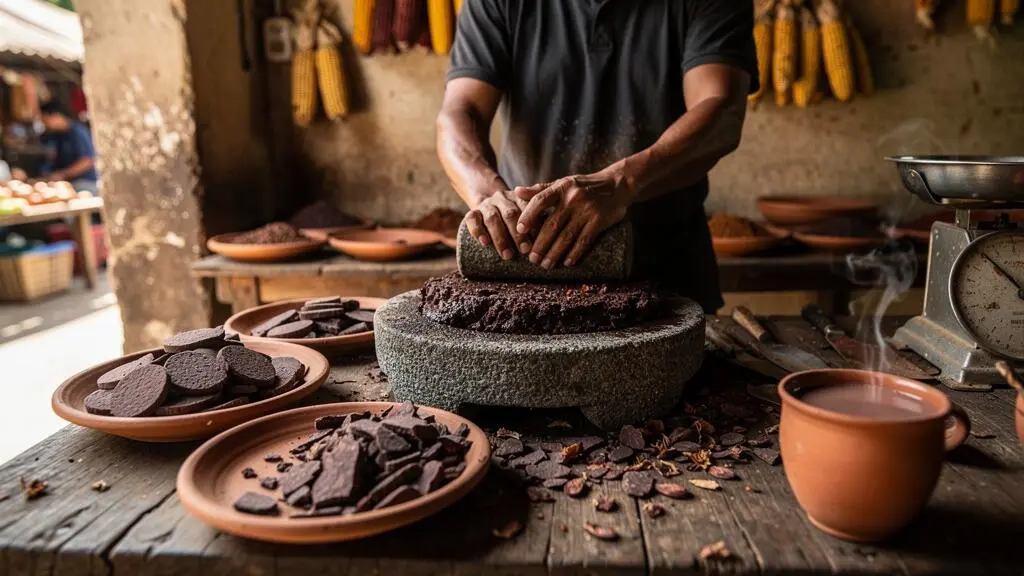
The first sip of traditional Mexican chocolate can surprise a British traveller. Instead of the smooth, creamy sweetness associated with a mug of UK hot cocoa, the drink might taste earthy, slightly bitter, grainy or distinctly of toasted maize. It may arrive in water rather than milk, with cinnamon, a foamy surface or a texture closer to a thin porridge.
That difference is not necessarily a preparation mistake. Mexico has several regional cacao traditions, each with its own ingredients, grinding methods and expectations of sweetness. Chocolate de agua, champurrado, tejate and pozol are not interchangeable names for the same drink.
The useful question is therefore not simply where to find the best hot chocolate in Mexico. It is which cacao preparation you actually want, how to recognise its ingredients and whether the seller can adjust the sweetness before serving. Understanding those distinctions also helps when buying cacao tablets, choosing a café and exploring Mexico’s wider food culture.
Mexican Cacao: What to Know Before Ordering
- Expect regional differences. Traditional cacao drinks may contain water, maize, spices and stone-ground cacao rather than the milk-based cocoa familiar in Britain.
- Ask about sugar before ordering. A finished drink may already contain piloncillo or another sweetener, making a less-sweet version impossible without preparing a new batch.
- Choose by preparation, not appearance. Markets, molinos and specialist cafés can all offer worthwhile cacao experiences, but their recipes and levels of customisation differ.
- Why Does Mexican Cacao Taste Spiced and Grainier Than UK Hot?
- How to Order a Cacao Drink in Mexico With Less Sugar Without Getting Blank Stares?
- Which Is More Authentic: Market-Ground Cacao Drinks or Café Hot Chocolate in Tourist Zones?
- The Cacao Buying Mistake That Leaves You Paying 3x for Mostly Sugar
- When Should You Go for Fresh-Ground Cacao in Mexico to Avoid Finding Every Stall Closed?
- How to Find the Coffee and Cacao That Mexico Exports Without Leaving the Country?
- How to Spot Fresh Nixtamal Tortillas in Mexico Using 5 Sensory Clues?
- Why the Coffee You Drink in Mexico Might Not Be the Best They Grow, and Where the Good Stuff Goes
Why Does Mexican Cacao Taste Spiced and Grainier Than UK Hot?
Traditional Mexican cacao drinks often taste grainier and more complex than UK hot cocoa because they can use ground cacao rather than finely processed cocoa powder, sometimes combined with maize, water and aromatic ingredients. The flavour depends on the regional recipe: chocolate de agua, tejate and champurrado have different textures, sweetness levels and preparation methods.
The distinction begins with processing. Cocoa powder is generally produced by pressing some cocoa butter from cacao liquor and grinding the remaining cocoa solids into a fine powder. Many familiar British hot chocolate products also contain sugar and ingredients designed to disperse readily in milk.
Traditional Mexican drinking chocolate can instead begin with roasted cacao ground into a paste. In some preparations, a stone metate is used to grind the ingredients. The resulting mixture may retain cocoa butter and particles that remain perceptible when the chocolate is dispersed in liquid.
However, stone grinding does not automatically produce a gritty drink, and modern Mexican chocolate is not exclusively made with metates. Grinding fineness, added ingredients and preparation technique all affect the result.
The historical diversity is documented in the CDI‘s study of cacao and Indigenous Mexican food traditions, published in 2015. Its descriptions of Indigenous preparations reveal how strongly cacao recipes depend on local ingredients and culinary practices.
In Oaxaca‘s Central Valleys, for example, tejate combines maize, fermented cacao, mamey seeds and cacao flowers. The ingredients traditionally undergo roasting and grinding before the drink is prepared. In parts of Tabasco and Chiapas, pozol combines cacao with cooked maize, with the resulting mixture diluted in water.
Other preparations have their own identities. Champurrado is a maize-thickened chocolate atole, while chocolate de agua refers to drinking chocolate prepared with water. Bupu, documented in the Isthmus of Tehuantepec, combines cacao with piloncillo, cinnamon and floral ingredients, and is served with a maize-based atole.
These recipes should not be collapsed into a single formula of cacao, maize, cinnamon and chilli. In particular, achiote and other flavourings belong to specific traditions rather than every Mexican chocolate drink.
A simple flavour guide helps explain what you are tasting:
| Sensory clue | Possible explanation | What it tells you |
|---|---|---|
| Earthy or roasted flavour | Cacao variety, fermentation and roasting | Potentially characteristic of the ingredients, not proof of origin |
| Noticeable particles | Grinding texture or added maize | Compatible with traditional preparation, but not proof of quality |
| Thick, substantial body | Maize-based preparation such as champurrado | The drink may be intentionally more substantial than hot cocoa |
| Cinnamon or floral aroma | Recipe-specific aromatic ingredients | A clue to preparation style, not a universal authenticity test |
| Uniformly sweet, creamy texture | Milk, added sugar or a finely processed mix | A different style of chocolate, not automatically an inferior one |
Graininess alone does not establish authenticity. Fresh stone-ground chocolate can be smooth, while poorly processed chocolate can also feel gritty. Similarly, traditional cacao drinks may be intentionally sweet.
Once you recognise the preparation styles, ordering becomes easier: instead of asking for a generic hot chocolate, you can request the particular drink and sweetness level you prefer.
How to Order a Cacao Drink in Mexico With Less Sugar Without Getting Blank Stares?
To order less-sweet cacao in Mexico, ask for chocolate de agua or another named cacao preparation, then check whether sugar has already been added. The phrases sin azúcar and con poca azúcar are useful, but they cannot change a recipe that was sweetened before you arrived. Ask before purchasing rather than assuming every drink is made individually.
The most important distinction is between ordering a finished drink and commissioning a mixture that has not yet been prepared.
At a street stall, champurrado may have been cooked as a batch, with sugar or piloncillo already incorporated. The vendor cannot simply remove that sweetness. Asking for a sugar-free portion may therefore produce confusion even when your Spanish is perfectly understandable.
A market molino that prepares chocolate paste to order can offer more flexibility, provided it is actually grinding and mixing a new batch. You may be able to specify the amount of sugar added to the cacao before it becomes a tablet or paste.
Useful expressions include:
- ¿Tiene chocolate de agua? — Do you have chocolate prepared with water?
- ¿Ya tiene azúcar? — Does it already contain sugar?
- ¿Lo puede preparar sin azúcar? — Can you prepare it without sugar?
- Con poca azúcar, por favor. — With a little sugar, please.
- ¿Puede hacerlo con más agua? — Can you make it with more water?
Chocolate de agua does not automatically mean unsweetened. It identifies the liquid base, not the sugar content. Similarly, aguado can describe something diluted or watery, but it is less precise as an order than explicitly requesting additional water.
For a practical venue-based approach, compare what can be changed before ordering:
| Venue | Typical preparation | Best request |
|---|---|---|
| Street stall | Drink may be made in advance | Ask whether sugar is already included |
| Market molino | Cacao may be ground and mixed to order | Request less sugar before grinding begins |
| Traditional market drinks counter | Recipe may be prepared in batches | Ask which drinks are naturally less sweet |
| Specialist café | Individual service may allow adjustments | Ask about cacao paste, water and added sweeteners |
At a molino, establish whether the purchase is a ready-to-drink chocolate or a tablet intended for later preparation. These products may look similar at the counter but serve different purposes.
If your chocolate arrives sweeter than expected, adding hot water may reduce the perceived sweetness per sip, provided the drink can be diluted without spoiling its intended consistency. Adding milk changes the flavour and texture more substantially.
Pairing sweet cacao with a savoury tamal is another practical option, although the pairing should not be treated as a universal rule across Mexican regions.
A Five-Step Cacao Ordering Checklist
- Identify the preparation. Ask whether the seller offers chocolate de agua, champurrado, tejate or another named drink; note the name before ordering.
- Check the sugar. Ask “¿Ya tiene azúcar?” and establish whether sweetness is already fixed.
- Request an adjustment. If preparation is flexible, ask for “sin azúcar” or “con poca azúcar” and confirm that the vendor agrees.
- Confirm the liquid base. Ask whether the drink uses water or milk; record the answer rather than assuming from its appearance.
- Evaluate your first serving. Note its sweetness, texture and cacao intensity so you can repeat or refine the order at the next stall.
The purpose is not to force every traditional vendor to alter a long-established recipe. It is to find a preparation that suits your palate while respecting the way the drink is actually made.
Which Is More Authentic: Market-Ground Cacao Drinks or Café Hot Chocolate in Tourist Zones?
A market-ground cacao drink is not automatically more authentic than chocolate served in a tourist-area café. Authenticity depends on the ingredients, preparation and relationship to a living regional tradition, not simply the setting or price. A market may offer an established local recipe, while a specialist café may use traceable Mexican cacao and prepare it carefully.
Markets have an advantage for travellers interested in everyday food practices. In places where cacao drinking remains part of local routines, the ingredients, vessels and service methods may be visible rather than explained through branding.
At a molino, it may be possible to see cacao roasting, grinding or tablet production, depending on the business and its working schedule. This provides direct evidence of how the product is made.
However, visible preparation does not guarantee that the cacao was locally grown, that every ingredient is traditional or that the recipe has remained unchanged across generations.
A café serving tourists may instead prepare chocolate with milk, refined sugar and a commercial powder because that is what its customers expect. That is a legitimate beverage, but it may not be the regional cacao experience you were seeking.
The opposite is also possible. A specialist chocolate café in Oaxaca or Mexico City may identify its producer, describe the cacao’s origin and explain whether it uses beans, paste or prepared chocolate. Some offer more transparent sourcing than a market vendor who purchases an unidentified ingredient mix.
Compare the two settings through questions you can actually answer:
| Criterion | Traditional market or molino | Specialist café |
|---|---|---|
| Visible ingredients | Grinding and mixing may be observable | Ingredients may be described on the menu |
| Texture | Depends on regional recipe and grinding | May be deliberately refined or smooth |
| Water or milk | Traditional water-based preparations may be available | Often offers a choice, depending on the café |
| Sweetness control | Limited for drinks prepared in batches | Potentially greater for individual preparations |
| Origin information | May be provided directly by the seller | May be documented through producer details |
| Price | Reflects local ingredients, labour and selling context | May include service, rent and specialist sourcing |
A useful authenticity test is to ask what the establishment is actually selling. Is it a regional drink prepared for regular customers? A chocolate drink made from named Mexican cacao? Or an international-style hot chocolate with decorative references to Mexican culture?
Watching local customers can help you understand how a stall fits into everyday life. It is not a reliable test of ingredient quality, however, and a vendor’s personal drinking habits cannot authenticate a product.
For a specialty café, investigate provenance claims. “Mexican cacao” identifies a country, while a named producer, cooperative or growing region offers a more specific claim that can be investigated. Even detailed sourcing information is not a substitute for tasting the finished drink.
The practical trade-off is between observing traditional service and controlling your own cup. A market can be preferable for the former; an attentive specialist café may be better for the latter.
Once you have found a chocolate you enjoy drinking, the next challenge is buying some to take away without confusing a sweetened drinking tablet with a higher-cacao product.
The Cacao Buying Mistake That Leaves You Paying 3x for Mostly Sugar
The expensive cacao-buying mistake is paying a premium for attractive packaging without checking what the product contains or how it is intended to be used. Tourist-shop chocolate tablets may contain substantial amounts of sugar, while market molinos can sell simpler drinking-chocolate mixtures. A threefold price difference is possible as an illustration, not an established market-wide ratio.
Two different products are frequently presented under the broad label of Mexican chocolate. The first is chocolate de mesa, typically prepared as a drinking chocolate by combining a tablet or portion of paste with hot water or milk. The second is eating chocolate, which may be marketed by cacao percentage, producer or growing origin.
They are not interchangeable purchases. A sweetened tablet can be appropriate for a traditional family drinking-chocolate recipe, even if it tastes excessively sweet when eaten directly. A high-percentage single-origin eating bar may be delicious on its own but behave differently when prepared as a drink.
Check the ingredients before judging the price. Where a conventional ingredient list is provided, ingredients are generally listed by descending weight. If sugar comes before cacao, sugar is present in a larger proportion than cacao by weight.
That observation is more informative than claims such as “traditional”, “artisanal” or “premium”, none of which independently establishes cacao content.
Look for cacao ingredients, sugar, flavourings and any added vegetable fats. A product containing additional fats is not necessarily fraudulent, but you should understand what you are paying for.
For packaged chocolate stating a cacao percentage, check what that percentage refers to. Cocoa solids and cocoa butter may both contribute to declared cacao content. Packaging claims and ingredient lists still need to be interpreted in the context of the product’s intended use.
A rough tablet is not automatically less processed, better or richer in cacao than a smooth one. Texture can provide a clue about preparation, but the ingredient list and the seller’s explanation are more useful for evaluating composition.
To assess the premium, compare products by weight and intended use rather than the number of tablets in a packet. For example, in a purely hypothetical comparison, a 100 g market tablet priced at MXN 50 and a 100 g souvenir version priced at MXN 150 would produce the advertised threefold difference. Those figures illustrate the calculation only; they are not verified market prices.
Even that comparison would not establish which product is better value. The more expensive version could contain more cacao, use different beans or include additional production costs. Alternatively, much of the premium might reflect its packaging and retail setting.
Ask the seller whether the tablet is intended for water or milk, how much is normally used per serving and whether it contains sugar. These questions are especially useful when buying loose chocolate without a conventional label.
A reasonable first purchase is a small quantity from a market molino where the preparation can be observed. Try it at your accommodation according to the seller’s instructions, then decide whether to buy more.
A carefully chosen tablet also gives you an alternative when fresh-ground cacao is unavailable, which is particularly useful in markets with variable trading days and working hours.
When Should You Go for Fresh-Ground Cacao in Mexico to Avoid Finding Every Stall Closed?
Early morning is a sensible starting point for finding active cacao preparation at a traditional market, but there is no nationwide opening time for fresh-ground chocolate in Mexico. Market schedules vary by town, vendor and season. Check the specific molino’s working hours, establish the local market day and confirm whether cacao is actually being ground during your visit.
A permanent market, a weekly market and a family-operated grinding workshop can all follow different schedules. Some vendors begin preparing ingredients before customers arrive; others grind only when they receive orders or have enough demand.
Consequently, arriving when the market opens does not guarantee you will see a metate in use. In some places, a molino may operate mainly with mechanical grinding equipment rather than traditional hand grinding.
For travellers staying in Oaxaca, it is worth investigating cacao sellers in markets serving established local communities, particularly where chocolate tablets and traditional drinks are part of the regular food trade.
Regional location matters. Documented cacao-drinking traditions are particularly associated with areas of Oaxaca, Chiapas and Tabasco, alongside specific traditions elsewhere in Mexico. Seeking a particular preparation outside its region can be difficult even when markets are open.
The CDI’s ethnographic documentation, for example, describes tejate being sold in markets in parts of Oaxaca, while pozol and other maize-cacao preparations appear in different regional contexts.
Before making a dedicated journey, use a simple timing strategy:
- Identify the town and the specific market or molino you want to visit.
- Check its usual market days and ask whether cacao grinding takes place daily or only on certain days.
- Confirm whether grinding is performed on site, and at approximately what time.
- Arrive during the confirmed working period, allowing time for shopping and tasting.
- Keep an alternative source of locally prepared chocolate tablets in mind.
The Day of the Dead period and Christmas celebrations require particular attention, but they do not create a uniform national market schedule. Some markets become exceptionally busy during celebrations, while individual businesses close or change their hours.
Ask a vendor or accommodation host about the specific dates relevant to your destination. A current local answer is more useful than a general claim that all traditional stalls close on holidays.
If you arrive to find the grinding equipment idle, ask whether the shop has tablets produced by its own molino. Permanent market businesses may carry prepared stock, although not every tablet sold in a market necessarily comes from that seller’s workshop.
Buying a locally produced tablet can preserve the connection to the preparation process. It does not provide the same experience as watching the grind, but it allows you to taste the finished product under controlled conditions.
For travellers interested in the ingredients as much as the preparation, the next question is where Mexico’s higher-value cacao and coffee can actually be found within the country.
How to Find the Coffee and Cacao That Mexico Exports Without Leaving the Country?
To find Mexican coffee or cacao comparable to products sold internationally, look for identifiable producers, growing regions and traceable lots rather than packaging labelled “export quality”. Specialist roasters, chocolate makers, cooperatives and origin-region producers can provide useful leads. However, export status does not prove superior flavour, and Mexico’s coffee and cacao trade patterns are significantly different.
Mexico sells coffee internationally as green, unroasted beans. The presence of an export market means some producers supply overseas buyers, including international roasting businesses. It does not mean all the country’s best coffee leaves Mexico or that domestic customers receive only inferior beans.
75,024,400 kg
Mexico’s reported exports of unroasted, non-decaffeinated coffee in 2024, according to trade data for HS 090111. The figure describes export volume, not speciality grade or cup quality.
The United States was the largest destination in those figures, receiving approximately 48.1 million kilograms. Germany was another documented destination. This establishes where substantial quantities of Mexican coffee travelled, but it cannot tell us how those lots scored in a cupping session.
Cacao requires a different interpretation. According to the Mexican government’s trade statistics for 2024, imports of whole or broken raw or roasted cocoa beans substantially exceeded exports in monetary value.
US$1.54 million exported versus US$296 million imported
Mexico’s 2024 trade values for cocoa beans under HS 1801. The figures exclude finished chocolate products and do not distinguish fine-flavour cacao from commodity grades.
These figures do not support the simple claim that most exceptional Mexican cacao is exported before domestic buyers can access it. They show that Mexico participates in a complex cacao trade, including substantial imports of beans from other countries.
That matters when shopping for chocolate described as Mexican. A product manufactured in Mexico is not necessarily made exclusively from Mexican-grown cacao. If origin is important, ask where its beans were cultivated rather than relying on the location of the chocolate maker.
For coffee, regions worth investigating include Chiapas and Veracruz, including areas associated with Coatepec. For cacao, Chiapas and Tabasco are useful starting points for exploring producer relationships and regional preparations.
A traceable product should ideally identify its farm, cooperative or producer group. For coffee, additional details such as harvest, processing method and variety can help establish how much information is available about the lot.
For cacao, look for information about bean origin, fermentation, roasting and the proportion of cacao ingredients in the finished product.
Direct purchases from producers or cooperatives can reduce the distance between customer and origin, but they do not guarantee access to identical export lots or lower prices. Contracts, inventory and distribution arrangements vary.
When planning a finca or cooperative visit, confirm that visitors are accepted and whether tasting or purchasing is available. An agricultural region is not automatically an organised tourist experience.
Mexico’s food traditions offer another way to develop this attention to process. Fresh maize tortillas, for instance, provide sensory evidence of preparation that marketing terms alone cannot supply.
How to Spot Fresh Nixtamal Tortillas in Mexico Using 5 Sensory Clues?
Fresh nixtamal tortillas can often be recognised through their maize aroma, flavour, moisture, appearance and flexibility. A warm tortilla made from freshly prepared masa may smell distinctly of cooked maize, taste more developed than a bland packaged product and bend without immediately breaking. No single sensory clue proves the production method, however, and good tortillas can also use prepared nixtamalised flour.
Nixtamalisation involves treating maize with an alkaline solution, traditionally using lime, before washing and grinding it into masa. The process changes the grain’s structure and influences the flavour and behaviour of the resulting dough.
It is relevant to cacao because maize also contributes to traditional beverages such as champurrado, tejate and pozol, although the precise maize preparation differs between recipes.
Learning to identify fresh tortillas therefore develops the same useful habit as tasting cacao: pay attention to ingredients and preparation instead of assuming the finished product’s appearance tells the whole story.
Use five observations when you encounter freshly made tortillas:
- Smell. Look for a recognisable cooked-maize or toasted-maize aroma. Its intensity depends on the maize, preparation and freshness; a faint smell does not automatically indicate industrial production.
- Taste. Notice the underlying maize flavour and any mild mineral or slightly tangy character. Excessively sharp sourness is not a universal sign of authentic nixtamal.
- Texture. A recently cooked tortilla may feel moist, pliable and tender. Texture changes as tortillas cool, so compare them at similar serving temperatures.
- Appearance. Hand-pressed tortillas may have irregular outlines, and some puff on the comal as steam separates their layers. Machine-formed tortillas can also be fresh and made from nixtamal.
- Feel when folded or torn. A warm tortilla should generally have enough cohesion for normal handling. Flexibility and resilience are practical observations, not definitive laboratory tests.
A Mexican sensory evaluation published in 2011 provides relevant evidence. In the samples examined, freshly prepared tortillas showed a characteristic nixtamal aroma, slight astringency and an absence of the lumpiness identified in the packaged samples.
The research used a small trained sensory panel and particular tortilla samples. It does not validate every proposed street-level clue or establish universal standards for all Mexican tortillas.
What a Mexican Sensory Comparison Actually Found
Researchers compared freshly prepared and packaged maize tortillas using trained sensory evaluation alongside measurements of characteristics such as pH and moisture.
Fresh samples displayed distinctive nixtamal-related sensory properties, while the packaged samples examined showed differences including acetic-acid aroma and lumpier texture. The study also included a fresh tortilla preparation combining 70% fresh masa and 30% nixtamalised maize flour. These results concern the tested products, not every tortilla sold in Mexico.
The methodology and findings are available in the Mexican sensory study of freshly made and packaged tortillas.
That mixed-masa example is particularly important. Fresh nixtamal and prepared nixtamalised flour are not mutually exclusive in real kitchens. Some excellent cooks use carefully selected flour, combine methods or preserve masa for later service.
The presence of a neighbourhood molino can also tell you something about local food production. Molinos de nixtamal provide grinding services and contribute to the infrastructure that allows households and food businesses to prepare fresh masa.
Nevertheless, you cannot determine a restaurant’s purchasing arrangements from a tortilla’s smell alone. Nor should every taquería be expected to process its own maize.
For the most informative comparison, taste a freshly cooked tortilla at a working tortillería or food stall, then compare it with another example served at a similar temperature. Note the differences without treating either preparation method as an automatic quality guarantee.
The broader lesson applies equally to cacao and coffee: the information worth seeking concerns what was produced, how it was processed and whether the resulting flavour justifies the claims made about it.
Key Takeaways Before Choosing Mexican Coffee or Cacao
- Origin is more informative than prestige. A named growing region or producer gives you something concrete to investigate; “export quality” alone does not.
- Processing shapes the final experience. Grinding, fermentation, roasting and preparation can change flavour as much as the ingredient’s geographical origin.
- Quality must be evaluated at the point of consumption. International trade figures explain where products go, but tasting and traceable product details help determine what is worth buying.
Why the Coffee You Drink in Mexico Might Not Be the Best They Grow, and Where the Good Stuff Goes
The coffee served in a typical Mexican café may not represent the full quality range of coffee grown in Mexico. Some green coffee is sold to international buyers, while domestic speciality roasters also source distinctive regional lots. Export statistics confirm substantial overseas trade, but they do not prove that the highest-scoring beans always leave the country.
The distinction begins with the coffee supply chain. Green coffee is processed and prepared for sale before being roasted. Depending on the producer’s relationships, the beans may move through local buyers, cooperatives, exporters or specialist importers.
International roasters can purchase Mexican coffee and develop their own roasting profiles for customers abroad. Domestic roasters can also buy from producers and present the resulting coffee within Mexico.
A cup sold without origin details is therefore difficult to connect to a particular farm or growing region. It might use a commercial blend, regional coffee or beans selected for a particular price and flavour profile. Its quality cannot be established by the absence of an origin label alone.
Nor should robusta automatically be treated as low quality. Coffee species, growing conditions, harvesting, processing and roasting all influence the finished cup. Some blends prioritise body, consistency or affordability rather than the flavour characteristics promoted by speciality roasters.
For travellers seeking more distinctive Mexican coffee, the most useful starting point is a roastery or café that explains where its beans came from.
Mexican speciality coffee may be associated with Chiapas, Veracruz and Oaxaca, including the recognised coffee-growing areas around Coatepec and Pluma Hidalgo. The region is a starting point for inquiry, not a guarantee of quality.
Ask about the following details:
- Roast date: a useful indicator when assessing the age of roasted coffee, although freshness and flavour depend on storage and brewing as well.
- Producer or cooperative: identifies the people or organisation associated with the beans.
- Growing origin: a farm, community or region provides more detail than a generic country designation.
- Variety and altitude: useful information for understanding cultivation conditions, but neither independently guarantees cup quality.
- Harvest and processing: helps explain the coffee’s development before roasting.
Large urban coffee markets such as Mexico City, Guadalajara and Monterrey may offer opportunities to explore domestic speciality roasters. However, no particular city guarantees access to a specific harvest or exported lot.
It is equally important to distinguish a coffee’s reported quality score from its actual availability. Export trade records identify product categories, values, quantities and destinations; they do not disclose sensory scores for individual coffee lots.
That is why the 2024 green-coffee export figures should not be interpreted as proof that overseas customers receive Mexico’s finest coffee while domestic drinkers receive an inferior remainder.
The cacao comparison is instructive. A coffee bag may give detailed farm and harvest information, while a drinking-chocolate tablet may reveal more about its recipe than its growing origin. Both can be worthwhile, but they answer different questions about the product.
For a traveller interested in taste rather than prestige, requesting a named-origin coffee and a cacao drink prepared from identifiable ingredients offers a more meaningful comparison than purchasing the most expensive products available.
On your next visit to a market or café, choose one drink whose ingredients the seller can explain, taste it carefully and record what you enjoy. That single informed purchase will teach you more about Mexican cacao and coffee than an unsupported “authentic” label.
Is Mexican hot chocolate always made with cinnamon?
No. Cinnamon appears in several Mexican chocolate preparations, but recipes vary between regions, communities and households. Some drinks emphasise cacao and maize, while others incorporate spices, flowers, seeds or additional flavourings. Ask which ingredients are used instead of expecting every traditional drink to taste of cinnamon.
Can you drink traditional Mexican cacao without milk?
Yes. Chocolate de agua is prepared with water, and several regional cacao drinks use water as their liquid base. However, water-based does not necessarily mean dairy-free if a seller adds other ingredients, and it does not mean the drink contains no sugar. Confirm the complete recipe if you have dietary restrictions.
Is cacao from a Mexican market necessarily grown in Mexico?
No. Mexico grows cacao but also imports substantial quantities of cocoa beans. A tablet manufactured or sold in Mexico may contain imported beans. To establish agricultural origin, look for producer-level information or ask the seller where the cacao was cultivated.
Can Mexican chocolate tablets be taken home to the UK?
Chocolate tablets are often suitable for transport as packaged food, but applicable import rules depend on the ingredients, product type and destination. Check current UK government requirements before travelling, particularly for products containing dairy or other restricted ingredients. Choose securely packaged tablets, review the ingredient list and protect them from heat during the journey.
Does a higher cacao percentage mean a better chocolate drink?
Not necessarily. Cacao percentage indicates composition, not overall sensory quality. Bean selection, fermentation, roasting, grinding, sugar and the liquid used for preparation all affect flavour. A higher-percentage product may suit someone seeking a more intense cacao taste, while a traditional sweetened drinking chocolate may be better suited to a particular regional recipe.