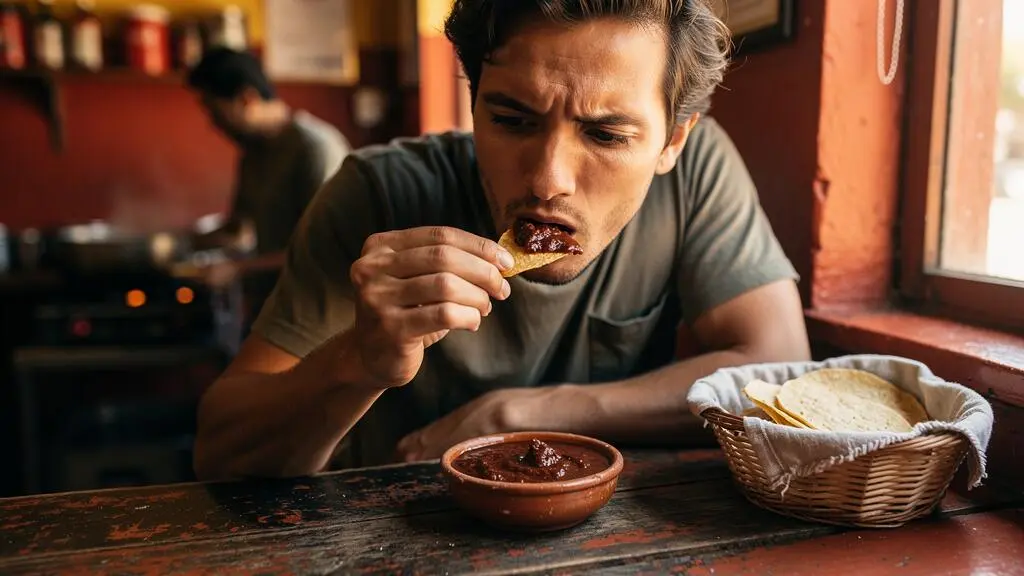
The first spoonful tastes smoky, almost sweet. The second is delicious. By the third, your lips are tingling and you are wondering whether that innocent-looking red salsa was a terrible decision.
Roasted chillies are central to many memorable meals in Mexico, but their flavour does not reliably reveal their heat. A dark sauce might be built around relatively gentle ancho chillies, while another contains fiery chile de árbol. Roasting, drying, smoking and grinding all influence flavour, but none provides a dependable shortcut to measuring pungency.
For UK travellers accustomed to choosing between mild, medium and hot, the most useful adjustment is simple: ask about the specific salsa or dish, taste cautiously and control how much you add. You can enjoy the roasted chilli character without challenging yourself to endure the hottest preparation available.
The reward is more than avoiding an uncomfortable meal. You begin recognising what makes Mexican chillies distinctive, from a charred salsa at a market counter to the fresh maize tortilla that carries it.
Roasted chilli in Mexico: the essentials
- Smokiness, darkness and sweetness do not reliably predict chilli heat. Taste a small amount and allow the sensation to develop before adding more.
- Ask “¿Pica mucho?” and request “la salsa aparte” when you want to control the amount yourself.
- Start with manageable preparations, explore stronger salsas gradually and pay attention to the tortillas accompanying them.
- Why Do Roasted Chilli Salsas Taste Smokier but Sometimes Feel Hotter After 3 Bites?
- How to Ask About Chilli Heat in Mexico in 2 Simple Questions Without Sounding Rude?
- Which Is Easier for Spice Beginners: Roasted Chilli Salsa or Roasted Chilli Marinade?
- The Ordering Mistake That Catches UK Travellers Out With Roasted Chillies Every Time
- When Should You Try the Spiciest Roasted-Chilli Dishes Without Ruining a Long Bus Day?
- How to Tell if a Salsa Was Really Made in a Stone Mortar Using 3 Quick Clues?
- How to Spot Fresh Nixtamal Tortillas in Mexico Using 5 Sensory Clues?
- Why Tortillas Taste Completely Different in Mexico When They’re Made From Nixtamalised Maize
Why Do Roasted Chilli Salsas Taste Smokier but Sometimes Feel Hotter After 3 Bites?
Roasted chilli salsas can seem gentle initially because their charred, sweet and savoury flavours draw attention away from the burning sensation. Capsaicin irritation may also build after the first taste rather than reaching its maximum immediately. Three bites are not a scientific threshold: the practical lesson is to wait before deciding how much salsa you can comfortably handle.
Roasting over a comal, cooking directly over a flame or charring ingredients in a pan can give tomatoes, onions and chillies toasted or smoky notes. The flavour depends on the ingredients and technique. Smoking a chilli, as with chipotle, is also different from simply roasting it.
Capsaicin activates heat-sensitive sensory receptors, producing a burning sensation without requiring the food to be physically hot. In preliminary sensory testing reported in the Chemical Senses study on oral capsaicin perception, perceived intensity reached its maximum after swallowing rather than at initial contact. That observation supports cautious tasting, although the experiment did not investigate roasted Mexican salsa or establish a fixed three-bite delay.
Three useful salsa descriptions can help you ask better questions:
- Salsa de molcajete: Salsa prepared using a traditional stone mortar. Its chilli varieties and proportions determine the heat; the grinding method does not.
- Salsa tatemada: Salsa featuring charred or roasted ingredients. Its toasted character may be pronounced, but pungency remains recipe-dependent.
- Salsa de chile de árbol: A salsa built around árbol chillies, which can produce substantial heat. Ask about the preparation rather than assuming every version has identical strength.
Try a practical three-bite check. Put a small dab of salsa on the edge of a tortilla or chip, take one modest bite, then pause before taking another. If the sensation remains comfortable, try a little more. The third bite is a decision point, not an obligation or a scientifically established measurement.
A chip carrying a large coating of salsa can deliver more capsaicin simply because it contains more salsa. There is no need to assume the chip itself makes the preparation inherently hotter.
Even at the same taquería, a different batch may taste different. Ingredient proportions, chilli selection and preparation can change, so yesterday’s experience is useful background rather than a guarantee.
Once you understand why flavour and heat can be misleading, the next useful skill is knowing exactly what to ask the person serving your food.
How to Ask About Chilli Heat in Mexico in 2 Simple Questions Without Sounding Rude?
Two useful questions are “¿Pica mucho?” — “Is it very spicy?” — and “¿Es picante o sólo sabroso?” — “Is it spicy or just flavourful?” Both can be polite ways of discussing a dish when asked with genuine curiosity. The most reliable follow-up is to describe your personal tolerance and request salsa separately.
In Mexico, picar is commonly used when talking about food that produces a chilli-burning sensation. You do not need elaborate Spanish to communicate your concern.
| Spanish | Approximate pronunciation | What you are asking |
|---|---|---|
| ¿Pica mucho? | PEE-kah MOO-choh | Is it very spicy? |
| ¿Es picante o sólo sabroso? | Ess pee-KAHN-teh oh SOH-loh sah-BROH-soh | Is it spicy or simply full of flavour? |
These pronunciations are approximate guides for English speakers, not exact representations of every regional accent.
The distinction between picante and sabroso is conversational rather than absolute. Food can be both delicious and hot, so do not interpret the question as requiring the cook to choose one quality over the other.
Heat descriptions are also subjective. Someone accustomed to eating powerful salsas might describe one as mild, while the same preparation feels intense to a visitor. This is a difference in personal calibration, not necessarily an attempt to mislead.
If the answer is unclear, try: “¿Para alguien que no come mucho picante?” This asks whether the food would suit someone who does not eat much spicy food.
Visual details can suggest what to investigate, but they cannot provide a reliable heat measurement. Visible seeds do not prove a salsa is especially hot; dark colour may come from roasting or dried chillies. Watching other diners can show how a condiment is used, but not whether it will suit your tolerance.
At a market stall or fonda, ask before committing to a topping or sauce. If you want a tiny sample, “¿Puedo probar un poquito?” means “May I try a little?” Whether tasting is possible depends on the vendor and the dish.
For served meals, “La salsa aparte, por favor” — “The salsa on the side, please” — is especially useful. It lets you enjoy the cook’s preparation without requiring the kitchen to remove every trace of chilli.
Your five-step chilli-ordering check
- Identify the salsa or dish you want. Your result: one specific preparation to ask about rather than a vague request for something mild.
- Ask “¿Pica mucho?” Your result: an initial description of the heat from the person serving it.
- Explain your tolerance with “¿Para alguien que no come mucho picante?” Your result: an answer framed around someone who rarely eats spicy food.
- Request “La salsa aparte, por favor” where practical. Your result: a dish whose additional salsa you can control.
- Taste a small amount and wait before adding more. Your result: a personal heat assessment based on the actual serving.
Asking is usually a more respectful approach than making assumptions about the cook’s food. The next decision is whether to choose a sauce you control or a chilli preparation already incorporated into the dish.
Which Is Easier for Spice Beginners: Roasted Chilli Salsa or Roasted Chilli Marinade?
For beginners who want control, roasted chilli salsa served separately is usually easier to manage than a marinade. You decide how much salsa to add, whereas a marinade has already flavoured the food. However, a moderately seasoned marinade can be a comfortable main-course choice, while an intensely hot salsa should be approached in very small amounts.
The important distinction is controllable heat versus heat already built into the dish. A bowl of salsa on the table gives you options. A piece of chicken cooked in a chilli marinade offers fewer adjustments once it reaches your plate.
| Consideration | Roasted chilli salsa | Roasted chilli marinade |
|---|---|---|
| Control after serving | Usually high when served separately | Limited once incorporated |
| Heat predictability | Can be sampled before adding more | Best discussed before ordering |
| Flavour | Often concentrated in each spoonful | Integrated into the cooked ingredients |
| Beginner approach | Add a little at a time | Ask about chillies and preparation first |
Chilli identity matters as much as format. Ancho, guajillo and pasilla can contribute fruitiness, colour, depth and other flavours to sauces and marinades. They are not interchangeable, and their presence does not make a dish automatically mild.
As described in UNAM‘s article on Mexican chilli flavour and pungency, dried ancho develops sweet notes, while smoked chipotle has a distinctive smoky character. The article also emphasises differences among Mexican chilli varieties. Neither sweetness nor smokiness provides a dependable measurement of heat.
Consider a hypothetical order: a traveller chooses chicken prepared with a guajillo-based sauce after confirming that the kitchen considers it relatively gentle. A separate bowl of chile de árbol salsa accompanies the meal. The traveller can enjoy the chilli-flavoured chicken first and add small amounts of salsa only if comfortable.
That is a practical ordering strategy, not a guarantee that every guajillo preparation is mild.
Names such as adobado, al pastor and en chipotle are worth asking about. They indicate particular preparations or flavour profiles, not fixed spice ratings. Al pastor, for example, is not inherently a very hot dish, and chipotle can appear in preparations ranging from gentle to fiery.
Cochinita-style preparations also vary by recipe and region; the name alone should not be treated as a heat guarantee.
For a cautious first meal, choose a main whose seasoning you have discussed with the cook, then use separately served salsa to explore stronger flavours. This avoids a common mistake: treating every chilli-based preparation as though it belongs on one universal heat scale.
The Ordering Mistake That Catches UK Travellers Out With Roasted Chillies Every Time
The mistake is assuming that “mild”, “medium” and “hot” mean the same thing in Mexico as they do in a familiar UK restaurant. Mexican dishes and table salsas do not follow one nationwide heat scale. Rather than ordering by an imagined rating, ask which chilli is used and whether the hottest component can be served separately.
A UK traveller might be comfortable asking for a medium curry because they recognise that particular restaurant’s scale. At an unfamiliar Mexican taquería, there may be no equivalent rating at all. Some dishes arrive with little chilli heat; others rely on condiments chosen by the diner.
Neither British restaurants nor Mexican establishments use a universally standardised scale. The comparison is useful because familiar menu habits can create expectations that do not transfer reliably to another cooking tradition.
The second part of the mistake is confusing chilli flavour with capsaicin intensity. Asking for absolutely no chilli may eliminate the ingredient responsible for a dish’s defining colour, aroma and depth.
A more precise request is “Con poca salsa picante, por favor” — “With only a little hot salsa, please” — or simply “La salsa aparte, por favor.” When chilli is already central to the sauce or marinade, ask whether that adjustment is possible rather than assuming it is.
If your first taste turns out hotter than expected, stop adding salsa and allow the sensation to settle. Small bites of other food may make the experience more manageable, although they do not necessarily neutralise capsaicin.
Mexican crema or queso fresco may be pleasant accompaniments when available. Dairy proteins have been studied for their effects on capsaicin burning, but findings from controlled experiments should not be treated as proof that every dairy product provides equal relief.
89 participants
A 2022 human sensory experiment examined capsaicin burning and dairy-protein solutions. In the tested rinse conditions, only the 5% micellar casein rinse was significantly more effective than water. These findings do not establish equivalent effects for Mexican crema or queso fresco.
The Journal of Food Science study on dairy proteins and capsaicin
Water is useful for hydration but may provide limited relief from chilli burning. It is inaccurate to claim that drinking water invariably spreads capsaicin around the mouth. A tortilla or another relatively neutral food can help you return to a comfortable eating rhythm, without guaranteeing that the burning will disappear.
Sweet agua fresca may be refreshing, although sweetness alone is not a proven way to neutralise capsaicin. If you are still uncomfortable, there is no reason to force yourself to finish a particularly hot condiment.
Choosing your own heat level is a useful skill. Choosing the right moment to experiment with stronger preparations can be just as important when travelling.
When Should You Try the Spiciest Roasted-Chilli Dishes Without Ruining a Long Bus Day?
Save your boldest roasted-chilli experiments for a relaxed meal when you have access to water, a bathroom and time to recover from discomfort. An evening near your accommodation may be more convenient than breakfast immediately before a long bus or boat journey. This is a practical travel precaution, not a rule that spicy food inevitably causes digestive problems.
A long travel day reduces your flexibility. You may be sitting for hours, dealing with motion sickness, eating unfamiliar food or spending time in hot weather. If a meal causes discomfort, those circumstances make it harder to manage.
Capsaicin can create a burning sensation in the mouth and, for some people, gastrointestinal discomfort. Sensitivity varies considerably. Someone who regularly enjoys hot food at home may tolerate a particular salsa without difficulty, while another traveller may prefer to avoid it before travelling.
Hydration remains important, particularly in hot conditions, but drinking water does not reliably prevent capsaicin-related discomfort. There is also no dependable reason to assume that the same salsa becomes chemically hotter simply because you are travelling.
A sensible way to explore new dishes is to increase the challenge gradually:
- At your first taquería in a destination, begin with a preparation that the cook describes as relatively gentle.
- Taste any unfamiliar salsa in small quantities and observe how you respond.
- Use that experience to make better decisions at later meals, remembering that chilli varieties and recipes differ.
- Try a stronger local speciality when the rest of your schedule allows you to enjoy it without rushing.
For example, if you have an early coach departure, breakfast might be the occasion for a familiar dish rather than the hottest salsa offered by the stall. A relaxed dinner after arrival provides more freedom to experiment.
It is also important to distinguish ordinary chilli burning from possible illness. Mouth burning soon after tasting chilli is consistent with capsaicin exposure, but stomach pain, vomiting or diarrhoea cannot automatically be attributed to spice.
Foodborne illness can have several causes and may begin hours or days after exposure. Symptoms alone do not always identify the responsible food. Persistent or severe symptoms, dehydration, bloody diarrhoea or significant illness warrant medical attention rather than reassurance that the reaction is merely chilli-related.
Similarly, do not dismiss breathing difficulties or signs of an allergic reaction as normal spice discomfort.
The aim is not to avoid memorable food. It is to enjoy that food when your itinerary gives you the freedom to appreciate it, rather than turning a bus journey into an unwanted endurance test.
How to Tell if a Salsa Was Really Made in a Stone Mortar Using 3 Quick Clues?
Look for three clues: an uneven, crushed texture; a working molcajete or visible grinding process; and the aroma and temperature of recently prepared ingredients. The strongest evidence is seeing the salsa made. Texture and serving temperature are helpful observations, but neither can conclusively distinguish stone-ground salsa from a blender preparation.
A molcajete is a traditional Mexican stone mortar, generally used with a pestle called a tejolote. Its rough grinding surface crushes ingredients rather than processing them with rotating blades.
Clue one: irregular texture. A freshly ground salsa may contain differently sized fragments of roasted chilli skin, tomato, onion and seeds. Some ingredients remain visibly distinct, creating a coarse texture that changes from spoonful to spoonful.
However, a blender can also produce a coarse salsa if used briefly. Conversely, a cook can grind ingredients carefully until the texture is relatively fine. Texture is evidence of preparation style, not proof of the exact equipment.
Clue two: the mortar and the cook’s technique. A visible molcajete near the preparation area, particularly one actively being used, is more persuasive than a rustic serving bowl alone. You might see a cook pressing and rotating the pestle against roasted ingredients or hear the scraping and grinding.
Some restaurants use molcajetes as serving vessels even when the food was prepared differently. If the preparation matters to you, politely ask, “¿Está hecha en molcajete?” — “Is it made in a molcajete?”
Clue three: aroma and serving behaviour. Freshly crushed roasted ingredients may have pronounced aromas, especially when they have recently left the comal. The salsa can also be warm if the ingredients were ground shortly after roasting.
Neither warmth nor a layered flavour proves stone grinding. A blended salsa made from freshly roasted ingredients can share those qualities, while a genuine molcajete salsa may be served cold.
Grinding can create a distinctive mouthfeel because ingredients are crushed and combined in a particular way. Nevertheless, it would be an exaggeration to claim that every molcajete salsa is more complex, less acidic or superior to every blended version. Ingredient quality, roasting and seasoning also shape the result.
For the traveller, watching the process is part of the pleasure. It shows how the cook works with ingredients and provides an opportunity to ask which chillies are involved.
Just remember that stone-ground does not mean mild. A molcajete can contain very hot chillies, and the equipment does not reduce their capsaicin content in any predictable way.
Once you have found a salsa worth tasting, pay attention to what carries it. A freshly prepared maize tortilla can transform the overall eating experience, even though it does not magically remove chilli heat.
How to Spot Fresh Nixtamal Tortillas in Mexico Using 5 Sensory Clues?
To assess a freshly prepared nixtamal tortilla, examine its appearance, aroma, flexibility, sound and flavour. A warm tortilla with an appealing maize aroma and soft, pliable texture is a promising sign. However, these sensory clues cannot definitively prove that it was made from freshly cooked whole-maize nixtamal rather than properly prepared nixtamalised maize flour.
Nixtamal is maize that has undergone alkaline cooking and steeping. It can be ground into dough called masa, which is then shaped and cooked into tortillas.
The following five checks offer a practical tasting framework.
- Look at the surface. Some handmade tortillas have slightly irregular edges and visible maize flecks. These can be attractive signs of handmade preparation, but smooth, uniformly shaped tortillas may also be freshly made from nixtamalised dough.
- Smell the maize. A fresh tortilla may have a warm, distinctive cooked-maize aroma, sometimes accompanied by subtle mineral notes. Aroma varies with maize variety, processing and cooking technique.
- Feel the flexibility. A properly cooked, freshly served tortilla is often soft and pliable enough to fold around a filling. Dry stiffness can indicate cooling, moisture loss or reheating problems rather than a particular maize-processing method.
- Listen when folding. A fresh, flexible tortilla should usually fold without breaking or producing the brittle crackle associated with a dried-out tortilla. Thickness and cooking conditions also influence this behaviour.
- Taste without salsa first. Notice the maize character before adding strong condiments. Sweet, earthy, toasted or other nuances may emerge, depending on the grain and preparation.
These are sensory observations, not a scientifically validated authentication test. No single clue can reliably establish how the maize was processed.
For a better chance of discovering freshly prepared tortillas, look for a busy neighbourhood tortillería or somewhere pressing and cooking tortillas in view of customers. A queue can suggest demand and turnover, although it does not establish freshness or production method by itself.
Menu descriptions such as tortillas hechas a mano indicate handmade preparation, while de maíz nativo refers to native maize. Neither phrase automatically guarantees a particular level of flavour, freshness or on-site nixtamalisation.
Likewise, commercially produced masa harina is generally made from nixtamalised maize. Using it does not mean the resulting tortillas are non-nixtamal or necessarily poor quality.
Timing matters because tortillas can lose moisture and flexibility after cooking. A freshly served tortilla often offers a more appealing texture than one left exposed for an extended period. There is no universal requirement to visit in the morning: follow the cooking schedule of the place you choose.
Learning to appreciate a tortilla on its own reveals why it deserves as much attention as the roasted chilli salsa beside it.
What to remember before your next meal
- Ask how tortillas are made rather than relying entirely on their shape, colour or menu description.
- Taste a freshly cooked tortilla before adding salsa so you can recognise its own maize character.
- Think of tortilla and salsa as two separate flavour components that interact in each bite.
Why Tortillas Taste Completely Different in Mexico When They’re Made From Nixtamalised Maize
Nixtamalisation changes maize through alkaline cooking and steeping, affecting its texture, nutritional properties and behaviour when ground into dough. These changes contribute to the distinctive character of traditional maize tortillas. The flavour also depends on maize variety, freshness and cooking technique, so nixtamalisation alone does not explain every difference between tortillas eaten in Mexico and those available abroad.
The process begins with whole maize cooked in water containing an alkaline ingredient, traditionally calcium hydroxide, commonly called cal, or in some historical practices an ash-based alkali.
After cooking, the maize is left to steep. The cooking liquid is removed, the grain is washed and the resulting nixtamal is ground into masa. The dough can then be shaped and cooked on a hot surface such as a comal.
The FAO technical chapter on maize lime-cooking describes traditional Mexican processing as well as industrial approaches. In one documented traditional method, maize is cooked in a lime solution, steeped overnight, washed and ground. This is an example of the process, not a universal recipe followed by every tortillería.
Alkaline processing modifies the grain, including its outer layers and the way its components behave during grinding and cooking. It can improve the availability of niacin and influence calcium content, depending on the conditions used.
The resulting tortilla is not merely a convenient wrapper. It may contribute its own aroma, sweetness, earthiness and toasted notes to the meal.
When combined with roasted chilli salsa, those flavours create a more complex sensory experience. The maize can contrast with the salsa’s acidity, charred notes and capsaicin burn, while the tortilla provides a substantial base for the condiment.
That interaction does not establish that nixtamal tortillas chemically neutralise capsaicin. A tortilla may make a meal feel more balanced without reliably reducing the amount of capsaicin present.
Industrial production introduces further differences, but it is important not to confuse production scale with whether maize has been nixtamalised. Many industrial maize flours used for tortillas are themselves produced from nixtamalised maize.
Consequently, the meaningful comparison is not simply traditional nixtamal versus industrial flour. Freshly ground whole-maize masa, reconstituted masa harina, different grain varieties and different cooking methods can all produce distinct results.
Regional maize diversity adds another dimension. Different maize varieties can vary in colour, composition and sensory characteristics. Preparation traditions also vary, so there is no single tortilla flavour that represents every region of Mexico.
To experience these differences, start with a tortilla made from freshly prepared masa when available. Taste it plain, then add a small amount of roasted salsa. Notice how the maize and chilli contribute separately before judging the overall heat.
At your next taquería, ask about the salsa, request a manageable amount and try the tortilla before covering it with condiments. You do not need to conquer the hottest chilli on the counter to enjoy the depth of Mexican cooking.
Does roasting a chilli make it less spicy?
Not necessarily. Roasting changes flavour, aroma, moisture and texture, but the final heat depends on the chilli variety, preparation and quantity consumed. A roasted chilli may taste sweeter or smokier without becoming reliably mild. Do not use charring alone as a heat indicator.
Can you order Mexican food without chilli while still enjoying traditional flavours?
Yes, although your options depend on the dish. Some preparations contain little or no hot chilli, while others depend on chilli for their defining flavour. Ask which ingredients are essential and whether spicy salsa can be served separately. Removing chilli from a prepared marinade or sauce may not be practical.
Does a green salsa contain less heat than a red salsa?
No reliable colour rule exists. Green and red salsas can contain different chilli varieties and proportions, with heat ranging from relatively gentle to intense. Ingredients, preparation and the amount consumed matter more than colour. Ask about the specific salsa and taste cautiously.
Is it rude to leave a spicy salsa uneaten in Mexico?
Not inherently. Expectations differ across settings and individuals, and a separately served condiment is generally something diners can add according to preference. A polite question before ordering and a respectful response to the cook are more useful than forcing yourself to eat food that causes discomfort.
Are handmade maize tortillas always better than machine-made tortillas?
No. Handmade tortillas can offer distinctive textures and reflect valuable local traditions, but quality depends on maize, masa preparation, cooking and freshness. Machine-made tortillas can also be produced from nixtamalised maize and served freshly cooked. Taste the tortilla itself rather than judging it only by the method used to shape it.