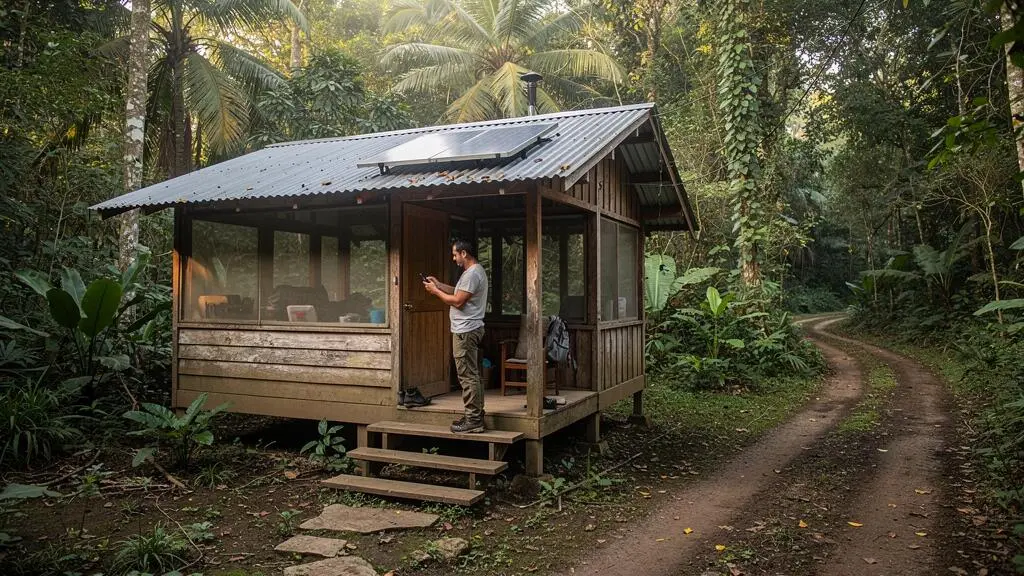
A jungle cabin in Mexico can feel wonderfully removed from everyday life without leaving you completely unreachable. The difficulty is knowing whether a property’s advertised remoteness means peaceful surroundings, unreliable mobile reception, difficult road access or the absence of practical assistance.
A cabin becomes too remote when its communication and access arrangements cannot meet your essential needs. For someone who only wants to send an occasional message, reliable lodge Wi-Fi might be sufficient. For a traveller expecting urgent family calls, managing a health condition or needing dependable transport, the same accommodation could be unsuitable.
Before booking, establish three things: how you can contact someone, how someone can reach you, and what happens if the property’s electricity, water or access route fails. These questions matter more than the distance shown on a map.
For UK travellers considering their first off-grid experience, the safest compromise is often a modest, staffed jungle lodge with a clearly explained communication system and an achievable route back to an inhabited area.
Jungle cabin remoteness: the essentials
- Verify phone reception at the cabin itself. Mobile coverage maps, satellite Wi-Fi and a host’s general assurances do not establish that ordinary cellular calls will work.
- Assess the consequences of isolation. Staff availability, road conditions, medical transport and backup communications matter more than how remote a property looks.
- Protect minimum comfort. Screened sleeping areas, drinkable water, adequate ventilation and dependable essential utilities should be confirmed before payment.
- Why Does « Off-Grid » Mean 3 Very Different Things Depending on Where You Book in Mexico?
- How to Vet a Jungle Cabin Listing in Mexico Using 6 Questions the Owner Might Not Answer?
- Which Is Better for a First Off-Grid Stay: A Connected Eco-Lodge or a Fully Isolated Cabin?
- The Jungle Cabin Mistake That Turns Night 1 Into a Sleepless Insect Battle
- When Is the Best Season for a Jungle Cabin Stay in Mexico Without Drowning in Humidity?
- How to Choose Between Jungle, Mangrove, and Cloud Forest When Your Body Handles Heat Badly?
- How to Adjust Your Water Habits at a Rainwater-Fed Property Without Feeling Deprived?
- Why Your Shower Pressure Drops at Eco-Lodges in Mexico and What Rainwater Harvesting Has to Do With It
Why Does « Off-Grid » Mean 3 Very Different Things Depending on Where You Book in Mexico?
In Mexico, « off-grid » can describe a self-sufficient cabin with dependable internet, a staffed jungle property without usable mobile reception, or a genuinely isolated retreat with limited infrastructure. These are very different travel experiences. The label alone tells you almost nothing about whether you can make a phone call or obtain assistance.
The first type is utility-independent but connected. Electricity may come from solar panels and batteries, water from stored rainwater, and internet from a satellite connection. Guests can enjoy a secluded setting while retaining access to online communication, subject to equipment performance and power availability.
The second type is a cabin supported by an established lodge. Mobile reception might disappear around the sleeping accommodation, but staff may have working communications, transport arrangements and a defined emergency procedure. The guest is digitally disconnected without necessarily being physically isolated.
The third type is a fully isolated cabin where guests manage much of their own arrival, communication and daily routine. It may offer greater privacy, but an equipment failure or unexpected illness can become more complicated when assistance is not nearby.
Judge these properties through four separate factors:
- Cellular reception: Can your phone connect to a mobile network at the actual accommodation?
- Internet availability: Is Wi-Fi provided, and does it depend on independent electricity or satellite equipment?
- Road accessibility: Can an appropriate vehicle reach the property in normal and adverse conditions?
- Proximity to assistance: Are there people nearby who can arrange transport or help in an emergency?
A cabin deep among trees but beside a maintained road may be more accessible than one nearer a town across a difficult track. Similarly, working satellite Wi-Fi does not establish that a UK visitor’s mobile can connect directly to a Mexican cellular network.
Match communication to your actual needs. Occasional messaging can work through reliable Wi-Fi. Scheduled voice conversations require a service capable of carrying calls. Continuous internet access demands a more dependable connection, suitable power backup and clear expectations about outages.
Mexico’s mountainous terrain, vegetation and uneven rural network coverage make property-specific verification essential. The Telcel mobile network coverage maps distinguish different mobile technologies and identify areas where coverage is not guaranteed.
The former Mexican telecommunications regulator’s archived IFT interactive 4G mobile coverage map offers another perspective using crowdsourced mobile measurements from 1 November 2024 to 31 January 2025. Its coverage estimates depend on where users travelled and collected measurements, so missing data does not establish that a location has no service.
Neither resource proves reception inside a particular bedroom, and neither confirms the quality of ordinary voice calls at the property.
The meaningful question is not how far into the jungle you can travel, but how much independence you want without losing the ability to obtain help. That distinction becomes particularly important when evaluating a listing’s promises.
How to Vet a Jungle Cabin Listing in Mexico Using 6 Questions the Owner Might Not Answer?
A jungle cabin listing should be evaluated through six specific questions covering mobile reception, call locations, communication backup, road access, emergency assistance and essential utilities. Ask for answers relating to the exact accommodation, not the surrounding village or reception building. Unanswered safety-critical questions are a booking warning, not a minor inconvenience.
Descriptions such as « Wi-Fi available », « easy access » and « remote but comfortable » are too broad to establish whether the property meets your requirements.
Send the owner these six questions before paying:
- Which mobile operators work at the cabin? Ask whether a recent guest or staff member has tested cellular reception inside the sleeping area, identifying the operator and network.
- Where exactly can an ordinary phone call be completed? Determine whether calls work in the bedroom, on the terrace, at a shared lodge building or only farther along an access road.
- What independent communication backup exists? Ask whether staff have another working telephone, satellite communication equipment or an alternative arrangement if the primary network fails.
- How is the final approach managed? Confirm the road surface, vehicle requirements, navigation instructions, nighttime arrival arrangements and possible changes after heavy rain.
- What happens when a guest needs medical or transport assistance? Identify the person responsible for responding, how help is requested, and how transport to medical care would be arranged.
- What are the operating limits of the essential services? Ask about electricity hours, battery reserves, water availability, drinking-water provision, fans and internet interruptions.
For cellular claims, request a recent screenshot showing the phone’s network connection at the accommodation and ask which operator was used. A screenshot is supporting evidence rather than a guarantee. Confirmation that an ordinary voice call was actually completed is more useful than signal bars alone.
A Wi-Fi speed test proves something different: that an internet connection performed at a particular moment. It cannot demonstrate that your own SIM will receive cellular service. UK travellers should also check international roaming provisions, handset compatibility and whether their mobile plan supports the intended calling method in Mexico.
Arrival arrangements deserve equal attention. Offline navigation, an agreed meeting point and a suitable vehicle can prevent a straightforward journey from becoming an uncertain one after sunset.
Imagine a hypothetical property advertised as being a short drive from a nearby town. The journey estimate might be accurate in dry conditions, yet the final approach could involve an unmarked road that becomes difficult after rainfall. Without arrival instructions and reliable assistance, the advertised travel time provides little reassurance.
Watch for contradictory listing descriptions, restrictions revealed only after payment or an owner who refuses to clarify whether calls work. Keep essential responses in writing and examine cancellation terms if accessibility or connectivity is non-negotiable.
Five checks to complete before paying a deposit
- Request the property’s precise map pin and compare it with the listed address. Save the confirmed location.
- Ask for recent evidence of mobile service at the sleeping accommodation. Save the operator name, screenshot and voice-call confirmation.
- Obtain written arrival instructions identifying the meeting point, road conditions, suitable vehicle and latest supported arrival time. Save them for offline use.
- Request the emergency contact procedure, nearest practical medical assistance arrangements and alternative communications. Record the relevant contact details.
- Confirm drinking water, overnight power, ventilation, insect protection and cancellation conditions. Keep the owner’s written replies alongside the booking confirmation.
A trustworthy host does not need to promise uninterrupted service. Clear limitations, specific alternatives and realistic access instructions are more useful than confidence without evidence. Once those details are established, the next decision is how much responsibility you want to assume yourself.
Which Is Better for a First Off-Grid Stay: A Connected Eco-Lodge or a Fully Isolated Cabin?
For most first-time off-grid travellers who still need dependable communication, a connected, staffed eco-lodge is the more manageable choice. It can offer quiet surroundings and genuine immersion in Mexico’s jungle environments while providing practical assistance when something goes wrong. A fully isolated cabin suits travellers who understand the limitations and have appropriate contingency arrangements.
Privacy and operational independence are not the same thing. A private cabin can be wonderfully peaceful but may require guests to solve problems that lodge staff would normally handle.
Compare the options against the same practical criteria before treating greater isolation as a better experience.
| Decision factor | Connected eco-lodge | Fully isolated cabin |
|---|---|---|
| Phone access | May offer Wi-Fi or staff communications; personal cellular service still requires verification | Depends on the location and equipment supplied |
| On-site assistance | Staff may coordinate repairs, transport and emergencies | Support may be remote, delayed or unavailable |
| Transport flexibility | May include scheduled pickups or organised transfers | May require independent transport planning |
| Privacy | Shared facilities or nearby guests may reduce seclusion | Potentially greater privacy and fewer interruptions |
| Daily routines | Some operational issues handled by staff | Greater responsibility for electricity, water and access |
| Emergency response | Can benefit from an established support procedure | Requires a verified external assistance plan |
The important distinction is between having communication equipment and having someone available to act. A cabin might have excellent satellite internet yet no nearby person capable of arranging a vehicle. Another property might have limited guest reception but a staffed building with dependable communications and access to transport.
Neither arrangement automatically guarantees prompt emergency response. The relevant question is what actually happens after a request for help.
Before choosing, evaluate three personal constraints:
- Reachability: Must you answer calls promptly, or can you check messages at agreed times?
- Self-reliance: Are you comfortable handling power interruptions, unexpected route problems or unfamiliar equipment?
- Remote-stay experience: Have you previously spent nights somewhere without immediate services or reliable phone reception?
A first off-grid trip is also an opportunity to test your tolerance for unfamiliar sounds, darkness, limited dining choices and occasional disconnection. These factors may feel unimportant when viewing attractive daytime photographs but become significant after several hours in an isolated setting.
One practical strategy is to begin with a shorter stay at a staffed lodge that has confirmed connectivity and clear transport arrangements. You can experience the setting, discover your genuine comfort limits and decide whether a longer, more isolated trip would be enjoyable.
Remoteness should be a chosen feature, not an unpleasant discovery. Even at a well-supported lodge, however, the quality of your first night will depend on something more immediate than internet access: the sleeping environment.
The Jungle Cabin Mistake That Turns Night 1 Into a Sleepless Insect Battle
The common mistake is choosing an attractive open-air jungle cabin without checking whether its sleeping area is properly protected from insects. Large openings, inadequate window screens, gaps around doors and poorly fitted mosquito nets can make the first night uncomfortable. A beautiful canopy bed or airy architectural design does not demonstrate effective overnight protection.
An open-air terrace can be enjoyable in the evening. An unprotected sleeping area is a different matter, particularly when insects can enter through ventilation openings or gaps that are not obvious in listing photographs.
Inspect the sleeping space before booking. Look closely at window and door screens, whether the bedroom can be separated from outdoor areas, and how a mosquito net fits around the bed. A net should provide practical coverage rather than function as decoration.
Recent reviews may reveal issues that professional photographs conceal. Comments about mosquitoes indoors, gaps in screens, ineffective fans or guests sleeping with doors closed despite the heat deserve attention.
On arrival, examine the room before sunset. Check that screens close properly, arrange the bed net if one is provided and make sure essential belongings are within reach. Closing exterior doors promptly can also reduce opportunities for insects to enter.
Where a net is necessary, secure it correctly and check for holes or gaps. Avoid assuming that a fan alone provides sufficient protection, although airflow can improve sleeping comfort.
There is also a health distinction between nuisance insects and mosquitoes capable of transmitting disease. The CDC recommendations for preventing mosquito bites while travelling advise travellers to choose accommodation with screened doors and windows or air conditioning where possible, use mosquito nets when appropriate, wear protective clothing and apply suitable repellents according to their instructions.
These measures reduce exposure rather than eliminate it. Local mosquito-borne disease risks vary, so travellers should seek destination-specific health advice before departure.
Comfort and protection should work together. A screened room that becomes excessively hot when closed may be difficult to sleep in, particularly if the fan stops when the property’s electricity is interrupted.
A comfortable first night requires more than avoiding insects. Temperature, ventilation and seasonal humidity also influence whether an apparently idyllic jungle setting remains pleasant after dark.
When Is the Best Season for a Jungle Cabin Stay in Mexico Without Drowning in Humidity?
The best season for a jungle cabin in Mexico depends on the destination, local rainfall patterns and the property’s overnight ventilation. Drier months may offer easier road access and fewer rain-related disruptions, but they do not guarantee comfortable humidity or cooler sleeping conditions. There is no single ideal month for every jungle region.
Rainfall and humidity are related but not interchangeable. A destination can experience fewer rainy days while retaining substantial atmospheric moisture. Similarly, a cabin that feels pleasant during a breezy afternoon may become uncomfortable at night if heat accumulates indoors.
For a traveller sensitive to humidity, four conditions deserve separate attention:
- Monthly rainfall: How frequently and heavily precipitation normally occurs.
- Relative humidity: How moist the air typically feels under the prevailing temperature conditions.
- Nighttime temperature: Whether sleeping conditions provide meaningful relief from daytime heat.
- Ventilation: Whether the room can maintain airflow while keeping insects outside.
Rain also changes the practical meaning of remoteness. Unpaved roads may deteriorate, low-lying routes can become harder to pass, and stream crossings may become unpredictable after heavy rainfall. Severe weather can also interrupt electricity, internet access and transport arrangements.
A property that is straightforward to reach in dry conditions may therefore require more conservative planning during wetter periods.
Before committing to travel dates, compare destination-specific monthly climate records with the host’s recent experience of road conditions. Closer to departure, review short-range forecasts and official weather warnings, then confirm the property’s arrangements for delayed arrival, relocation or cancellation when conditions make access unsafe.
For storm-exposed destinations, tropical cyclone activity is another consideration. Mexico’s hurricane season generally extends from May through November, as noted in the CDC Yellow Book chapter on travel health in Mexico. This does not mean that every location experiences dangerous weather throughout that period. Actual exposure depends on the region and developing weather systems.
The driest-looking option is not always the most appealing jungle experience, either. Seasonal moisture can affect vegetation, wildlife activity and the operation of accommodation that relies on harvested rainwater. The effects differ considerably between ecosystems and properties.
Choosing a drier period may improve access reliability, but it should not replace questions about cooling, water reserves and the availability of backup electricity.
Ultimately, the best travel window is one in which the cabin’s climate and infrastructure remain compatible with your comfort limits. Those limits may point towards a different kind of forest environment altogether.
How to Choose Between Jungle, Mangrove, and Cloud Forest When Your Body Handles Heat Badly?
Travellers who struggle with heat should choose between lowland jungle, mangrove and cloud forest accommodation primarily by expected nighttime temperature, humidity and airflow. Higher-elevation cloud forests may provide cooler conditions, while coastal breezes can make some lower-elevation properties more comfortable. No ecosystem guarantees a pleasant sleeping environment without suitable cabin design and ventilation.
The location matters, but the sleeping room matters just as much. Shade, building materials, screened windows and electricity availability can change how an overnight stay feels.
These three environments present different potential advantages and drawbacks.
| Environment | Potential comfort advantages | Factors to investigate |
|---|---|---|
| Tropical lowland jungle | Dense shade and forest surroundings | Warm nights, moisture, limited airflow and insects |
| Coastal mangrove | Possible coastal airflow and proximity to aquatic landscapes | Humidity, insect exposure, sun exposure and access conditions |
| Higher-elevation cloud forest | Potentially cooler days and nights | Dampness, road access, elevation-related comfort and connectivity |
A lowland jungle cabin may remain warm after sunset, particularly if the building retains heat or cannot be ventilated without admitting insects. A coastal property may benefit from breezes, but airflow varies according to weather, surrounding vegetation and construction.
Cloud forest cabins can offer a more temperate alternative because of their elevation. Yet cooler conditions do not automatically mean dry interiors, simpler access or dependable phone reception. Some higher-elevation properties involve winding roads or more demanding journeys, and elevation can affect individual travellers differently.
Prioritise overnight sleeping conditions over daytime scenery. Ask hosts for typical nighttime temperatures during the intended travel period and for details of the actual sleeping room.
Confirm whether windows are screened, whether fans can operate throughout the night and whether any advertised cooling equipment depends on limited solar power or generator hours.
For example, a hypothetical traveller who sleeps badly in warm, humid rooms might prefer a moderately accessible cloud forest lodge with demonstrated phone reception over a striking lowland cabin that provides only a decorative mosquito net and intermittent fan power.
Another traveller who tolerates warmth but values coastal scenery might accept a mangrove setting after confirming effective ventilation, insect protection and transport access.
Medical considerations also matter. Anyone whose health is significantly affected by heat or elevation should obtain appropriate advice before selecting a demanding location. The coolest-looking cabin is not necessarily the easiest place to reach if assistance is needed.
Choose the environment that meets two conditions simultaneously: comfortable sleep and dependable access to communication or assistance. Landscape appeal and wildlife interests should follow those essentials.
Once the climate and location are suitable, the next expectation to establish is how the property’s resources operate. Water availability is especially important in accommodation designed to function independently of public utilities.
How to Adjust Your Water Habits at a Rainwater-Fed Property Without Feeling Deprived?
At a rainwater-fed jungle property, comfortable water conservation starts with understanding the actual storage system and maintaining a few deliberate habits. Shorter showers, sensible towel reuse and coordinated laundry can reduce unnecessary demand. Drinking enough safe water, washing your hands and maintaining basic hygiene should never be sacrificed to meet an arbitrary conservation target.
Rainwater-fed accommodation can operate with very different levels of water security. Some properties have substantial storage, while others depend more closely on recent rainfall, backup deliveries or carefully managed consumption.
Ask the host which activities place the greatest demand on stored water. Showering, laundry and cleaning may be managed differently depending on tank capacity, replenishment arrangements and how many guests are staying.
A practical approach separates essential from flexible water uses:
- Essential: Safe drinking water, handwashing, food-related hygiene and necessary personal cleanliness.
- Adjustable: Prolonged showers, unnecessary towel changes and repeated personal laundry.
- Host-managed: Cleaning schedules, larger laundry loads and any restrictions linked to the property’s water-storage system.
Do not assume a universal daily water allowance. Ask what the property recommends under its current operating conditions, particularly after unusually dry weather.
Water quantity and water safety also need to be treated separately. Harvested rainwater is not automatically suitable for drinking, brushing teeth or food preparation. Its safety depends on collection, storage, treatment and potential contamination.
Ask which taps provide water confirmed as potable, whether drinking water is supplied separately and what alternative is available if the usual supply fails. Clear appearance alone is not proof that water is safe to consume.
For travellers to Mexico, the CDC’s destination-specific health guidance recommends precautions regarding food and drinking water. Property-level assurances should therefore be assessed carefully rather than assuming that collected or filtered rainwater is drinking-quality.
Small changes can make conservation manageable. Shower efficiently without skipping necessary washing, reuse a towel when hygienically appropriate, coordinate laundry with staff and report dripping taps or leaking pipes promptly.
These habits help protect stored supplies without turning an off-grid holiday into an exercise in unnecessary deprivation. Guests should not attempt improvised sanitation arrangements simply because a property promotes sustainability.
A suitable eco-lodge should explain its water limitations transparently and maintain safe essential services. If the water is available but the shower becomes weak, however, the underlying problem may be pressure or electricity rather than the amount stored.
Key takeaways before assessing water pressure
- Confirm whether shower water comes from an elevated tank, a powered pump or a system combining both.
- Ask what remains operational when the property’s electricity fails, particularly if water and communications share the same power supply.
- Distinguish occasional comfort fluctuations from repeated failures that affect essential hygiene or make an isolated property impractical.
Why Your Shower Pressure Drops at Eco-Lodges in Mexico and What Rainwater Harvesting Has to Do With It
Shower pressure at a rainwater-fed eco-lodge can fall because of limited gravity pressure, pump problems, pipe resistance, simultaneous water use or an interruption to electricity. Rainwater harvesting does not inherently cause weak showers. The important distinction is whether the system lacks sufficient delivery pressure, available water or the power needed to distribute it.
A typical rainwater collection arrangement starts with roof gutters and downpipes directing rainfall into storage. Water may then pass through filtration or treatment equipment, depending on the property’s design and its intended use.
From storage, water reaches showers and taps through gravity, pumps or a combination of distribution methods.
In a gravity-fed system, the height difference between the water level and the outlet contributes to pressure. Greater elevation can provide more pressure, although pipe dimensions, friction and fittings affect the final result.
A pumped system can deliver stronger pressure, but its performance depends on the equipment, settings, electrical supply and the demand placed on it.
Consequently, a full water tank can still produce a weak shower. A low tank elevation or underperforming pump may limit pressure even when water reserves are adequate.
The reverse is also possible: a shower may initially deliver satisfactory pressure while the property’s remaining stored water is limited. Water pressure alone does not indicate the volume available.
The connection between electricity and water delivery is particularly important at remote properties. If a pump depends on solar batteries or generator power, an electrical interruption may also interrupt water distribution.
Some systems have elevated storage, pressure vessels or backup power that can maintain supply for a period. Others may lose pressure more quickly. The equipment and operating arrangements determine what happens.
Because electricity can support pumps, internet routers and communications equipment, a single infrastructure failure may affect several services. That possibility matters more in a cabin where contacting staff or arranging transport is already difficult.
If the shower becomes weak or stops working, use a simple observation-based approach:
- Check whether the problem affects only the shower or also another accessible tap.
- Notice whether it occurs while other guests may be using water.
- Check whether lights, fans or other powered services have stopped at the same time.
- Tell the host what you observed and ask whether the interruption is expected or requires maintenance.
Do not open electrical equipment, adjust unfamiliar pumps or attempt repairs to pressurised water systems.
A brief reduction in pressure may be an acceptable inconvenience for someone seeking a simple eco-lodge experience. Repeated loss of washing water, poor hygiene facilities or unresolved pump failures are different matters, particularly when the property is difficult to leave.
Before booking, establish not only whether a shower is available but whether the host can explain what happens when its supporting infrastructure fails.
Before confirming a remote jungle cabin in Mexico, ask the host to describe one realistic scenario: the electricity stops, phone reception disappears and someone needs assistance. If the response identifies a functioning communication alternative, practical support and a workable access route, you have a much stronger basis for deciding whether the property’s remoteness suits you.
Will a UK mobile phone automatically work in a Mexican jungle cabin?
No. Your handset must be compatible with the available Mexican network, your mobile provider must support the relevant roaming service, and the property must have usable reception. Check roaming conditions before departure and ask the host which network has recently worked at the actual cabin. A working Wi-Fi connection does not guarantee cellular service.
Can I call emergency services in Mexico without a mobile signal?
Mexico’s emergency telephone number is 911, but a mobile telephone generally needs access to a compatible functioning cellular network to place a conventional emergency call. Do not assume that a phone with no service can connect. Confirm the property’s independent emergency communications, staff assistance and transport procedures before staying somewhere isolated.
Does having satellite Wi-Fi make a remote jungle cabin safe?
No. Satellite internet can provide an important communication option, but it depends on functioning equipment, electrical power and an available connection. It does not guarantee cellular voice service, medical assistance or road access. A safe contingency plan also identifies who can respond to a request and how assistance can physically reach the property.
What should I do if I have a medical condition and want an off-grid stay?
Discuss the trip with an appropriate healthcare professional and consider how quickly you might need medical attention. Confirm medication storage requirements, travel insurance conditions, emergency communications, realistic transport arrangements and access to suitable healthcare. A staffed, accessible property may be preferable to a fully isolated cabin when dependable assistance is important.
Should I download offline maps before travelling to a jungle cabin?
Yes. Download maps covering the final approach while you still have a dependable internet connection, and retain the host’s written directions and confirmed meeting point. Offline maps can help with orientation, but they may not accurately represent private tracks, damaged roads or temporary access restrictions. Follow the host’s verified arrival instructions and avoid unfamiliar routes after dark.