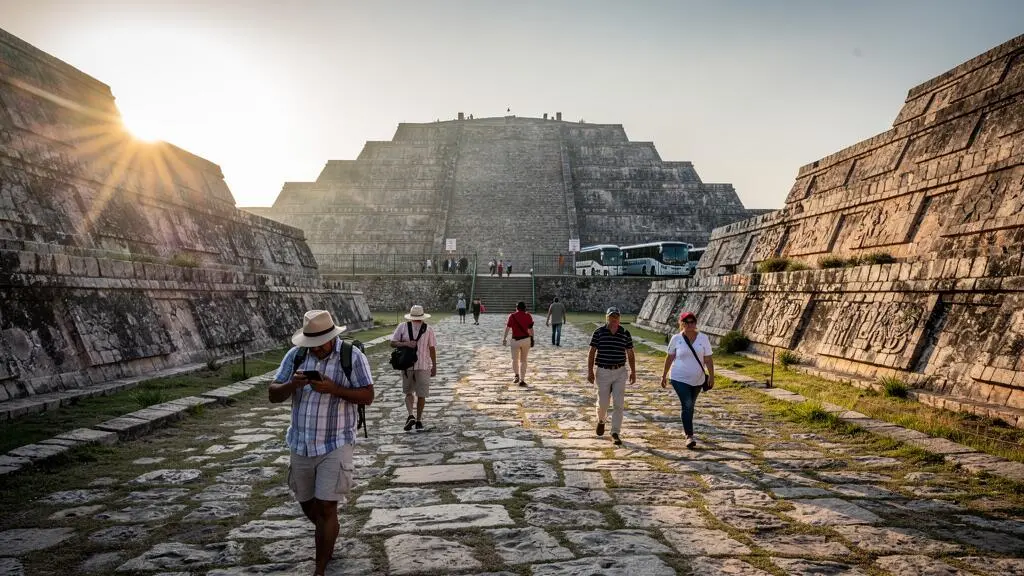
A Mexican landmark can be genuinely extraordinary and still be a poor use of a limited holiday. For UK travellers with seven days in the country, the real question is not whether Chichén Itzá, Teotihuacán or Tulum deserves its reputation. It is whether the experience justifies the journey, physical effort, admission costs and time spent among other visitors.
The difference between a rewarding archaeological visit and an exhausting afternoon often comes down to three things: when you arrive, how far you travel and what you actually want to see. A famous pyramid at the busiest point of the day may offer less satisfaction than a smaller archaeological complex that takes less time to reach. Equally, a remote ruin is not automatically worth the detour simply because it looks quieter in photographs.
The practical shortlist is straightforward: prioritise one flagship archaeological site, choose additional stops according to your geographical route, and avoid treating every famous name as an essential excursion. The following comparisons consider the realities behind the photographs, including admission conditions, access restrictions and the difference between a spectacular landscape and a worthwhile day out.
The Mexican Landmark Shortlist: What Matters Most
- Choose Chichén Itzá or Teotihuacán for monumental architecture, but plan around opening times, transport and visitor flows rather than relying on reputation.
- For a short Yucatán itinerary, compare Tulum’s coastal setting with smaller archaeological complexes according to atmosphere, accessibility and travel effort.
- For Copper Canyon, consider the Chepe Express instead of organising an entire viewpoint day around winding mountain roads.
- Why Famous Mexican Landmarks Feel Underwhelming at Midday — Even With a Ticket in Hand
- How to Rank Mexican Landmarks by Effort vs Pay-Off When You Only Have 7 Days
- High-Altitude Ruin or Coastal Icon: Which Should You Prioritise on a Short Trip?
- The Rookie Error That Gets You Turned Away From a Mexican Landmark After a 2-Hour Journey
- When Is the Best Time to Visit Mexico’s Big Landmarks to Avoid Hour-Long Queues?
- Big Famous Pyramid Site or Smaller Jungle-Covered Complex: Which Is Better for You?
- How to Plan a Canyon Viewpoint Day With Fewer Hairpin Bends and Better Breaks
- What You’re Actually Looking At When You Visit a Limestone Pyramid in the Yucatán
Why Famous Mexican Landmarks Feel Underwhelming at Midday — Even With a Ticket in Hand
Famous Mexican landmarks often feel less impressive at midday because intense overhead sunlight, accumulated heat and concentrated tour-group arrivals change the experience inside the archaeological zone. Buying a ticket in advance may reduce time spent at a ticket counter, but it cannot create shade, improve photographic light or reduce the number of people around a monument.
Consider Teotihuacán and Chichén Itzá. Both feature expansive archaeological spaces where visitors spend substantial time outdoors. At midday, vertical sunlight reduces the shadows that reveal the texture of stonework. Carvings can appear flatter in photographs, while open plazas offer little protection from the heat.
The experience also changes as organised excursions arrive. Visitors travelling from Mexico City or Cancún may reach the same attraction in concentrated groups rather than spreading their visits evenly throughout the day. INAH‘s Chichén Itzá profile identifies preferential attention for agencies between 11:00 and 14:00. This is a useful operational indicator when planning around organised visits, although it does not establish exact visitor numbers or queue lengths.
This is where the idea of a pay-off window becomes useful. The same site can deliver a substantially different experience depending on whether you arrive early, during the main excursion wave or later in the afternoon. The first hour after opening is often attractive for softer light and a quieter initial visit. A later slot may also work where admission conditions allow it and enough time remains to explore.
Advance booking and visit timing are separate decisions. Online tickets can help with purchasing admission, but security checks, entrance procedures and visitor concentration remain independent factors. INAH lists Teotihuacán as open daily from 08:00 to 17:00, with last admission at 16:30. That schedule does not guarantee an empty entrance at opening or a quiet archaeological zone.
11:00–14:00
The preferential agency-attention period identified on INAH’s Chichén Itzá profile. It is an operational planning signal, not a measured crowd forecast or guaranteed queue period.
INAH, Chichén Itzá official visitor information.
Arriving at the busiest point of the day can also create a misleading impression. Visitors rush through monuments because of the heat or crowd density, then conclude that the site itself was overrated. Before rejecting a major landmark, distinguish a disappointing time slot from a disappointing destination.
The practical lesson is simple: choose the visiting window before choosing the ticket. That decision provides a stronger foundation for comparing landmarks according to the time and energy they actually require.
How to Rank Mexican Landmarks by Effort vs Pay-Off When You Only Have 7 Days
For a seven-day Mexican holiday, rank landmarks by the total time and physical effort required to reach and explore them, not by their position on a generic must-see list. A site that takes several hours of transfers may deserve priority if its archaeological or landscape value is exceptional, but the same journey can become a poor decision when it competes with more accessible alternatives.
A useful comparison has two sides: the effort required and the experience delivered. The first should account for transport time, physical demands and exposure to queues. The second should consider architectural uniqueness, landscape, photographic opportunities and the amount of time needed to appreciate the site properly.
Use the following working scorecard. Scores are planning judgements rather than published measurements, so adjust them to your actual itinerary.
| Criterion | What to assess | Planning question |
|---|---|---|
| Travel effort | Transfers, journey duration and transport reliability | How much of the day disappears getting there? |
| Physical effort | Walking distance, stairs, altitude and terrain | Can everyone in the travelling party manage the visit? |
| Crowd exposure | Tour-group arrivals, entrance procedures and seasonal demand | Will visitor density undermine the experience? |
| Uniqueness | Distinctive architecture, archaeological features and landscape | What can only be experienced at this particular site? |
| Viewing quality | Available viewpoints, light and opportunities to explore | Can the main features be appreciated without rushing? |
Two categories help make the ranking more realistic. Destination landmarks deserve a meaningful place in the itinerary. Chichén Itzá and Copper Canyon can fall into this category when the trip is designed around the Yucatán or northern Mexico. En-route landmarks are additional stops that make sense because the traveller is already passing nearby, such as a smaller archaeological complex or colonial town.
Mixing these categories creates unnecessary travel. A seven-day itinerary should not repeatedly change geographical direction to collect famous names.
Hypothetical UK traveller: comparing two detours
Imagine a traveller based in the Yucatán with two possible excursions. Option A requires a four-hour bus journey each way to reach a landmark. Option B involves a shorter transfer to a smaller archaeological complex already close to the planned route.
Option A might still deliver the stronger experience because of its architectural importance. However, the additional transport time reduces the opportunity to explore other places. The correct decision depends on the traveller’s priorities, not on the number of stars awarded to either destination in a travel guide.
The calculation must also change when transport changes. A direct internal flight may make a destination practical, while a four-hour bus journey followed by a long road transfer may make the same excursion unattractive. Neither transport option should be assumed to be faster or cheaper without checking the actual itinerary.
There is another trap: the sunk-cost effect. After spending five hours reaching a site, visitors may feel compelled to justify the journey by staying longer, even when the experience is not matching expectations. Previous travel effort is not a reason to sacrifice the rest of the holiday.
Build a Seven-Day Landmark Shortlist
- Write down your accommodation base and planned overnight stops; keep a dated itinerary showing where each day begins and ends.
- Record the journey duration for every proposed landmark; save a transport route or timetable for each excursion.
- Assess physical effort, including walking, stairs, terrain and altitude; produce a short accessibility note for everyone travelling.
- Check admission arrangements and likely crowd exposure; keep the official visitor-information page and a proposed visiting window.
- Rank the landmarks by personal pay-off against total effort; save a final shortlist showing which destinations justify a dedicated day and which are optional stops.
Once the shortlist is realistic, the next decision is geographical. The contrast between high-altitude archaeological landscapes and coastal ruins is particularly important when the holiday begins after a long flight from the UK.
High-Altitude Ruin or Coastal Icon: Which Should You Prioritise on a Short Trip?
Choose a high-altitude archaeological site when your itinerary is already based around Mexico City or another inland destination; prioritise a coastal landmark when you are staying in Cancún or the Yucatán. Neither type is inherently better. The decision depends on geography, physical comfort, available time and whether you prefer monumental open-air architecture or ruins set against a coastal landscape.
Teotihuacán offers a very different experience from Tulum. The former is a vast archaeological zone near Mexico City, with monumental structures and expansive avenues. The latter occupies a distinctive coastal setting in Quintana Roo, where archaeological remains are associated with the Caribbean landscape.
The physical conditions matter. Mexico City and the surrounding central plateau sit at elevations above 2,000 metres, so travellers arriving directly from the UK may notice that strenuous walking feels different from a visit at sea level. This is particularly relevant during the first days of a holiday, when jet lag and disrupted sleep can already affect energy levels.
Coastal visits create another set of challenges. Heat, humidity, direct sunlight and limited shade can make a relatively short walk uncomfortable. A coastal setting may look relaxing in photographs, but it does not automatically mean an easier archaeological excursion.
| Decision factor | High-altitude or inland ruin | Coastal archaeological site |
|---|---|---|
| Typical geographical fit | Mexico City-based itineraries | Cancún and Yucatán-based itineraries |
| Physical consideration | Elevation and extensive walking | Heat, humidity and sun exposure |
| Travel planning | Inland transfers and possible day excursions | Coastal roads and regional transfers |
| Visual reward | Monumental architecture and broad archaeological landscapes | Ruins framed by coastal scenery |
| Best suited to | Travellers interested in scale and architectural context | Travellers combining heritage with a coastal holiday |
The transport equation usually settles the argument. A traveller flying into Cancún and staying in the Riviera Maya has little reason to organise an additional inland journey simply because an archaeological site elsewhere appears higher in a ranking. Likewise, someone spending most of the holiday in Mexico City gains little from adding a coastal excursion that requires another major transfer.
Trying to combine both types within seven days can work, but only when the flight and accommodation arrangements support it. A short domestic flight may make the combination practical; additional airport transfers, luggage changes and missed connections can quickly consume the available time.
For travellers with limited mobility, young children or a low tolerance for intense heat, the quality of paths, shade and facilities deserves as much attention as the headline monument. The existence of accessibility facilities at a site does not establish that every archaeological path is suitable for wheelchair users.
A geographically sensible choice is also easier to verify before departure. That matters particularly when the proposed landmark is smaller, less frequently visited or reached after a long transfer.
The Rookie Error That Gets You Turned Away From a Mexican Landmark After a 2-Hour Journey
The most avoidable mistake is assuming that an archaeological site will be accessible simply because a travel blog or map listing says it is open. Opening days, last admission, temporary restrictions, payment arrangements and visitor rules can change. For a remote landmark, checking the official status shortly before travelling is essential because an unsuccessful visit may cost far more than the entrance fee.
Large attractions tend to have more established visitor information. Smaller archaeological complexes are where travellers should be especially careful about relying on old third-party descriptions. A page published months or years earlier may no longer reflect the actual arrangements at the entrance.
There are several details worth checking:
- Opening days: establish whether the site operates on the intended day, rather than assuming that every attraction opens daily.
- Last admission: distinguish the closing time from the latest time visitors may enter.
- Payment: check the accepted payment methods and whether separate institutional charges apply.
- Capacity: look for restrictions affecting sensitive or protected archaeological areas.
- Visitor rules: verify restrictions on food, pets, drones, photography or other activities relevant to your visit.
- Temporary closures: check whether maintenance, weather or conservation work has affected access.
INAH’s official listings are a logical starting point for federal archaeological sites. Its Teotihuacán visitor information, for example, lists daily opening from 08:00 to 17:00, with last admission at 16:30. The same listing identifies visitor facilities and restrictions, including prohibitions on bringing food and pets into the archaeological zone.
Chichén Itzá illustrates why checking the actual destination page matters. Its INAH profile lists different admission components for foreign visitors: an INAH charge and a separate CULTUR tourist-facility charge. A single advertised entry price may therefore fail to represent the complete amount payable.
There is also an important source-verification issue: the supplied Chichén Itzá information contains conflicting closing and last-admission times across two INAH pages. That inconsistency should not be resolved by guessing. Travellers should confirm the current schedule directly with the site before departure.
The same caution applies to Tulum. Its official listing identifies separate charges associated with INAH, GAFSACOMM and CONANP. These amounts should not be treated as interchangeable tickets or automatically added together without confirming which charges apply to the particular admission arrangement.
Checking official information within 48 hours of a planned visit is a sensible personal precaution, not a claim that every institution guarantees updates within that period. For remote attractions, also confirm return transport and the availability of a driver or transfer after the visit.
Five Checks Before Leaving for a Remote Landmark
- Open the official archaeological-site listing; save the destination page and its contact details.
- Confirm the intended visiting date against published opening days; record the verified day of operation.
- Check opening and last-admission times; save a screenshot showing both.
- Identify all published admission charges and payment conditions; prepare a written cost breakdown without assuming separate fees are interchangeable.
- Check visitor restrictions, temporary access notices and return transport; save a final departure checklist with a confirmed return arrangement.
The final access check should also include timing. A site can be open, tickets can be available and transport can be arranged, yet the experience may still be undermined by an unnecessarily long wait.
When Is the Best Time to Visit Mexico’s Big Landmarks to Avoid Hour-Long Queues?
The best time to visit a major Mexican landmark depends on the combination of season, day of the week and time of arrival. There is no reliable universal rule that guarantees a queue-free visit at opening. A 60-minute wait is a possible planning scenario, not a standard waiting time that can be applied to Chichén Itzá, Teotihuacán or Tulum throughout the year.
Three timing layers help make the decision more accurate.
Time of day: the first hour after opening can offer softer light and a head start on organised groups. However, the same recommendation appears in countless itineraries, so early entry should not be confused with guaranteed solitude. Late afternoon may provide a useful alternative, provided the site’s last-admission time leaves enough room for a proper visit.
Day of the week: weekdays may be preferable to weekends when domestic leisure travel increases visitor numbers. Nevertheless, a weekday can still be busy during school holidays, major events or periods of concentrated tour activity. A calendar comparison is more useful than assuming that Tuesday is always quiet.
Season: December through Easter is generally a popular period for international travel to Mexico. The green season can offer a different atmosphere and potentially fewer visitors at some destinations, but rain, cloud and reduced visibility can undermine outdoor sightseeing.
These layers can contradict one another. A weekday morning during a holiday period may be busier than a later weekend visit outside peak travel dates. A quieter rainy-season afternoon may also provide a less impressive landscape than a clear morning in a busier period.
The queue itself has different stages, and each requires a different response.
| Where the delay happens | What causes it | Practical response |
|---|---|---|
| Ticket counter | Visitors purchasing admission on arrival | Check official online ticket availability before travelling. |
| Security and entrance | Mandatory visitor checks and admission procedures | Allow extra time; advance booking does not guarantee priority. |
| Road approach | Concentrated excursion traffic and access congestion | Consider staying closer to the site or adjusting departure time. |
INAH’s published visitor information provides useful operational boundaries, but not crowd forecasts. Teotihuacán is listed as open from 08:00 to 17:00, with last admission at 16:30. Tulum is listed from 08:00 to 17:00, with last admission at 15:30. These are site-specific published schedules, not guarantees that the same arrival strategy will work at both destinations.
For Chichén Itzá, the agency-attention period between 11:00 and 14:00 provides another reason to investigate the timing of organised visits. It should be treated as a planning clue rather than evidence that every visitor arriving during those hours will encounter a particular queue.
Before booking a day trip, compare recent visitor reports with the official opening schedule. Reports should be date-specific where possible: a review from a busy holiday weekend is a weak predictor of conditions during a different month.
Timing reduces avoidable frustration, but it does not answer a more fundamental question: whether a large, famous archaeological complex is actually the kind of experience you want.
Key Decisions Before Choosing Your Next Landmark
- A flagship archaeological site makes sense when its architectural scale or historical importance justifies a dedicated day.
- A smaller complex can provide a more atmospheric visit, but lower visitor numbers do not remove transport, heat or access uncertainty.
- The most satisfying short itinerary usually combines one major landmark with carefully selected additional stops rather than collecting famous sites indiscriminately.
Big Famous Pyramid Site or Smaller Jungle-Covered Complex: Which Is Better for You?
A famous pyramid complex is the stronger choice if you want monumental architecture, established facilities and a clear sense of visiting one of Mexico’s defining archaeological destinations. A smaller jungle-covered complex is more suitable if atmosphere, vegetation, wildlife and a less structured visit matter more than scale. Neither is objectively better: the right choice depends on what you expect to experience.
At a flagship destination such as Chichén Itzá, the appeal is immediately recognisable. The scale of El Castillo, the Great Ball Court and the ceremonial architecture provides a concentrated introduction to the archaeological landscape of the northern Yucatán. Established visitor facilities and published access information also make planning more straightforward.
Smaller complexes offer a different experience. Structures partially surrounded by vegetation can feel more integrated into the surrounding landscape. Instead of moving between monumental buildings and large open plazas, visitors may encounter smaller architectural remains, dense greenery and a more fragmented archaeological setting.
That atmosphere comes with trade-offs. Less famous sites may require more complicated transfers, provide fewer facilities or have less predictable access arrangements. A quieter experience is not necessarily a more comfortable one.
Use the following questions to decide which type of visit matches your priorities:
- Heat tolerance: are you comfortable spending several hours walking outdoors in tropical conditions?
- Architectural interest: do you prefer restored monumental buildings or partially excavated structures?
- Photography: are you looking for recognisable panoramic views or more intimate details framed by vegetation?
- Travelling party: will children, older visitors or people with limited mobility be comfortable with the terrain?
- Transport tolerance: how much of the day are you prepared to spend travelling for a quieter experience?
Costs also require a more careful comparison than the simple assumption that smaller means cheaper. A famous archaeological site may have higher admission costs and require an earlier departure. A smaller complex may have a lower entry charge but demand a private transfer, a longer road journey or additional logistical preparation.
The INAH Chichén Itzá profile illustrates why headline prices need context. It lists a foreign-visitor INAH admission charge of MXN 105 and a separate CULTUR charge of MXN 548. These are published components, not a guarantee of the current total payable. The visitor should confirm the applicable charges before travelling.
For most short holidays, the hybrid approach is the strongest compromise. Anchor the itinerary with one major archaeological destination, then add one or two smaller complexes that fit the same geographical route. This offers a contrast between monumental architecture and less developed archaeological landscapes without requiring a complete change of region.
That combination also helps prevent landmark fatigue. Visiting several enormous archaeological zones in quick succession can make their similarities more noticeable than their differences. A smaller site, a different landscape or a change of activity can make the overall holiday feel more varied.
Once a site has been selected, understanding its architecture adds another layer of value. This is particularly true in the Yucatán, where the appearance of a limestone pyramid can conceal several distinct periods of construction.
How to Plan a Canyon Viewpoint Day With Fewer Hairpin Bends and Better Breaks
A Copper Canyon viewpoint day is best planned around a small geographical cluster of lookouts rather than an attempt to visit every famous mirador. Distances between viewpoints can be substantial, road conditions vary and repeated winding journeys can turn an otherwise spectacular excursion into a tiring day. For travellers sensitive to motion sickness, the route and transport method matter almost as much as the final view.
Barrancas del Cobre is a large canyon landscape in northern Mexico, not a single viewpoint that can be covered with a short transfer. The distance between places and the nature of the roads mean that a long sightseeing day needs a realistic sequence of stops.
Start by identifying the area where you are staying. Divisadero is a useful reference point for organising visits around the canyon viewpoints. Instead of creating a long loop that attempts to tick off every named attraction, choose a manageable cluster and allow enough time to enjoy each stop.
The best sequence alternates travel with proper breaks. A dramatic lookout can be followed by a settled lunch stop or a longer pause in a town along the route. This avoids the temptation to treat every scenic point as a five-minute photo opportunity.
Lighting also deserves consideration. A viewpoint exposed to direct midday sunlight may deliver a less rewarding photograph than the same landscape under softer morning or late-afternoon light. However, a longer detour purely to reach a viewpoint at a particular time may not be worthwhile if it creates unnecessary road fatigue.
Motion sickness is another practical consideration. Travellers who experience discomfort on winding roads should consider:
- Choosing a seat with a clear forward view, where available.
- Planning regular breaks instead of completing several long road legs consecutively.
- Avoiding unnecessarily ambitious routes with repeated changes of direction.
- Allowing time for food, hydration and recovery between major viewpoints.
- Considering the railway as an alternative to completing the entire journey by road.
The Chepe Express provides a rail-based alternative for part of the Copper Canyon journey. It is particularly relevant for travellers who want to reach Divisadero without relying exclusively on winding mountain roads.
However, rail travel does not remove every transfer. The train connects particular stations, and visitors may still need road transport to reach viewpoints or accommodation away from the railway. The choice therefore depends on departure location, travel dates and the amount of time available.
The operator’s published 2026 timetable lists Los Mochis-to-Creel departures at 07:00, with arrival in Creel at 17:40, and includes Divisadero at 16:15. The reverse service lists departure from Creel at 08:00, arrival in Los Mochis at 16:40 and Divisadero at 09:55.
There is an important seasonal qualification. The operator states that during May, June, August and September, services run only from Thursday to Sunday. These are 2026 published arrangements and must not be assumed to apply in later years. The timetable also warns that local time in Sinaloa is one hour behind Chihuahua.
The official Chepe Express 2026 train timetable should therefore be checked against the intended departure date before accommodation and onward transfers are arranged.
Finally, consider visibility. Rain, mist and changing weather can obscure the canyon even when visitor numbers are relatively low. A quieter season is not automatically the best season for panoramic photography. The most useful itinerary balances the likelihood of clear views with manageable transport and enough time to enjoy the landscape.
The most rewarding canyon itinerary is not necessarily the one with the most stops. A smaller number of well-chosen viewpoints, adequate breaks and a suitable transport method usually make more sense than an exhausting attempt to see everything in one day.
What You’re Actually Looking At When You Visit a Limestone Pyramid in the Yucatán
A limestone pyramid in the Yucatán is rarely just a single block of ancient stone. Many Maya structures developed through successive construction phases, with later buildings erected over earlier ones. Their original surfaces could include stucco and painted decoration, so the weathered limestone visible today does not necessarily represent the complete appearance of the monument when it was in use.
This changes how a visit should be approached. Instead of looking only at the overall silhouette of a pyramid, pay attention to the relationship between its levels, decorative features and surrounding structures.
Chichén Itzá provides a particularly useful example. INAH describes El Castillo as a stepped pyramid with nine superimposed architectural tiers, built above an earlier temple. What appears to visitors as a single monumental structure therefore reflects successive building phases.
Several architectural features help visitors understand what they are seeing:
- Stepped levels: the visible terraces and tiers reveal the structure’s architectural organisation and can indicate successive building phases.
- Serpent motifs: serpent-head representations appear in the architectural descriptions of El Castillo and other structures at Chichén Itzá.
- Ball courts: the Great Ball Court provides an important example of the site’s ceremonial and sporting architecture.
- Sacbé causeways: these constructed Maya routes connected different parts of an archaeological complex. At Chichén Itzá, a sacbé links the main plaza with the Sacred Cenote.
- Position within the landscape: the relationship between a building, nearby ceremonial spaces and surrounding natural features can help explain why a site developed in a particular location.
Not every limestone pyramid offers the same viewing experience. The degree of restoration and excavation makes a substantial difference.
| Site condition | What visitors encounter | Best suited to |
|---|---|---|
| Heavily restored monumental complex | Clearly defined architecture and recognisable structures | First-time visitors and travellers interested in large-scale monuments |
| Partially excavated complex | A mixture of exposed buildings, architectural remains and vegetation | Visitors interested in archaeological interpretation |
| Less-restored jungle-covered remains | More fragmented structures and a stronger sense of the surrounding environment | Travellers prioritising atmosphere and a less polished setting |
There is also an important conservation consideration. Climbing restrictions or complete prohibitions apply to many major structures, including prominent monuments where access to the summit was once a familiar part of the visitor experience. Travellers should not assume that an older guidebook’s description of climbing arrangements remains valid.
This means the experience increasingly centres on walking around the structures, appreciating their proportions and examining architectural details from permitted viewpoints. For some visitors, that is more rewarding than climbing a pyramid simply to obtain a panoramic photograph.
INAH’s archaeological interpretation of Chichén Itzá provides a useful reference for understanding the site’s architectural features and historical construction phases. It is also a reminder that the Yucatán’s archaeological heritage should not be reduced to the appearance of a single famous pyramid.
The best archaeological visit is an informed one. A traveller who recognises a serpent motif, understands the significance of successive building phases and notices the relationship between the structures will often get more from a permitted ground-level visit than someone who simply arrives to photograph a pyramid and leave. Before finalising a Yucatán itinerary, compare the official site information with the travel time and physical demands of each proposed stop, then choose the landmarks that genuinely fit the holiday.
Is Chichén Itzá worth a three-hour detour?
Chichén Itzá can justify a substantial detour for travellers interested in Maya architecture, monumental structures and archaeological history. El Castillo, the Great Ball Court and the Sacred Cenote provide a distinctive experience. However, the value depends on your starting point, transport arrangements, admission costs and visiting time. It is easier to justify when the site fits naturally into a Yucatán itinerary than when reaching it requires sacrificing several other days.
Is Teotihuacán easier to visit independently from Mexico City?
Teotihuacán is accessible from Mexico City using the official approach roads identified by INAH, and independent visits are possible. However, the practical choice between public transport, a private transfer and an organised excursion depends on your accommodation, departure time and comfort with arranging local transport. The archaeological zone is extensive, so allow sufficient time for walking and exposure to the elements.
Can visitors still climb the pyramids at major Mexican archaeological sites?
Do not assume that climbing is permitted. Access restrictions vary by monument and can change for conservation or visitor-safety reasons. At major archaeological sites, visitors should expect that some prominent structures may only be viewed from designated areas around their bases. Check the current rules before visiting rather than relying on photographs or older travel guides showing people on the summit.
Is Tulum worth visiting if Chichén Itzá is already on the itinerary?
Tulum can still be worthwhile because its coastal setting creates a different experience from Chichén Itzá’s monumental inland architecture. The two destinations are not interchangeable. Tulum is particularly relevant to travellers already staying along the Caribbean coast, while Chichén Itzá is a stronger choice for those prioritising large-scale archaeological architecture. Compare the total admission charges and available visiting time before deciding whether both fit the same holiday.
Is the Chepe Express a practical alternative to driving through Copper Canyon?
Yes, for travellers whose itinerary matches the railway’s route and operating dates. The Chepe Express provides scheduled access to stations including Divisadero, reducing the need to complete the entire journey by road. However, additional transfers may still be required to reach individual viewpoints or accommodation. Check the operator’s timetable for the actual travel year and direction before arranging onward transport.