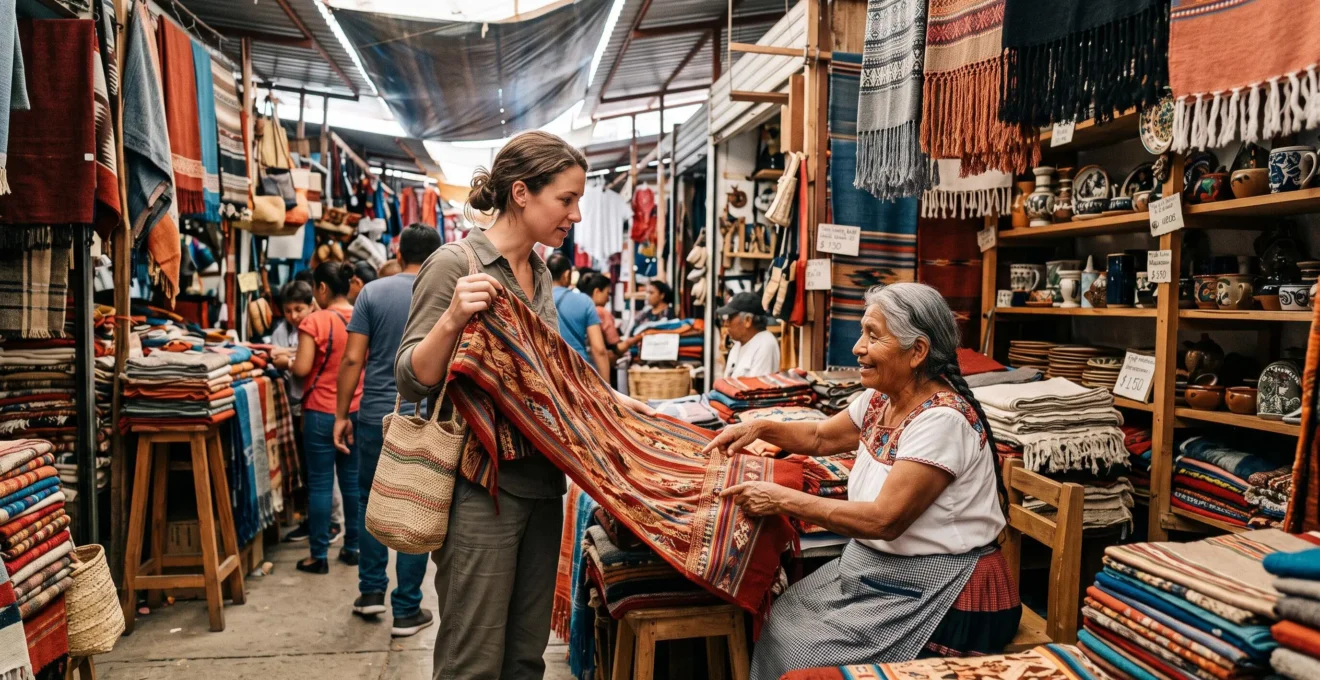
Two embroidered blouses hang beside each other in a Mexican market. Their patterns look similar, yet one costs considerably more than the other. Is the expensive one genuinely handmade? Is the cheaper one a bargain, or a factory-produced imitation? And how can a traveller find out without insulting the person selling it?
Buying Mexican crafts ethically means understanding who made an object, how it was produced, what its price represents and whether its cultural significance makes it appropriate to purchase. A high price is not proof of fair payment, just as machine-assisted production does not automatically make something inauthentic.
For UK travellers, the most useful approach combines respectful questions, careful material inspection and realistic expectations about market prices. It also means considering what happens after the purchase: whether a ceramic bowl is safe for food, whether a textile can survive everyday use and whether a souvenir can legally and safely travel home.
Ethical Mexican craft shopping: the essentials
- Trace the maker, not just the label. Ask where an object was made, who produced it and which techniques were involved. Handmade and machine-assisted craftsmanship are not necessarily opposites.
- Assess prices in context. Compare labour, materials and selling channels before deciding whether something is fairly priced. Neither the cheapest nor the most expensive option is automatically ethical.
- Respect the object beyond the transaction. Check cultural meaning, intended use, material safety and transport requirements before buying.
- Why Do “Similar” Mexican Crafts Cost 3x More in One Market Than Another?
- How to Check if a Mexican Craft Is Truly Handmade in 5 Non-Rude Questions
- Which Is the Better Place to Buy Crafts: Artisan Co-ops or Tourist Boutiques?
- The Souvenir Mistake That Can Be Disrespectful Even If You “Paid Good Money”
- When Should You Shop for Crafts in Mexico to Actually Meet Makers Instead of Middlemen?
- How to Check Textile Durability in a Market Without Washing Anything First?
- How to Check Mexican Pottery Quality at a Market Stall Without Breaking Anything?
- Which Mexican Hand-Woven Textiles Are Practical to Bring Back in a UK Suitcase Without Damage?
Why Do “Similar” Mexican Crafts Cost 3x More in One Market Than Another?
Two similar-looking Mexican crafts can carry very different prices because the work behind them is different, the materials cost more, or the seller operates through a more expensive distribution channel. A threefold price difference is not, by itself, evidence of exploitation or authenticity. The useful comparison is between production methods, maker compensation and retail costs.
Start by separating three components of a craft’s price: the maker’s labour, the origin and quality of materials, and the number of intermediaries involved in selling it.
A woven or embroidered design may look similar from a distance whether its details were produced by hand, with machinery or through a combination of techniques. Yet the time invested can differ dramatically. Material choices, including fibre quality and preparation, create further differences that are not immediately visible.
2 days versus 3–6 months
In an example reported by UNESCO from Yucatán, an artisan described machine embroidery taking up to two days, while a garment using the traditional hand-worked Maya Xok Bi Chuy cross-stitch technique could take three to six months. These are examples of different production methods, not average times for Mexican embroidery.
Location complicates the comparison. A boutique in Mexico City’s Polanco neighbourhood or a tourist-oriented shopping area in Oaxaca may have higher retail overheads than a regional market. However, this does not establish a fixed rent premium or tell you how much of the retail price reaches the maker.
Use a practical comparison rather than a universal price threshold:
- Choose genuinely comparable objects, noting their dimensions, fibres, decoration and intended use.
- Ask where each item was produced and whether the seller knows the maker.
- Ask whether the embroidery, weaving or decoration was entirely hand-worked or assisted by machinery.
- Compare the quoted price with an equivalent item at a documented artisan collective or regional market.
- Consider differences in materials, labour and retail services before deciding what represents good value.
An exceptionally cheap piece deserves the same scrutiny as an unusually expensive one. Mass-produced goods imitating Otomí embroidery or Talavera-style ceramics can be presented alongside artisan work. But there is no defensible universal minimum price that identifies a genuine handmade object.
A useful question is: “Could you tell me who made this and what goes into producing it?” The answer provides more information than an opening demand for a discount.
Price is a starting point, not an ethical certificate. The next step is finding out whether the object’s claimed origin and production method can be explained credibly.
How to Check if a Mexican Craft Is Truly Handmade in 5 Non-Rude Questions
To check whether a Mexican craft is handmade, ask who made it, where it was produced, how long it takes, how the technique was learned and whether individual pieces naturally vary. These questions invite the seller to explain the craft rather than defend it against accusations. Combine the answers with physical inspection, while recognising that machine assistance can still be part of genuine artisan production.
Provenance is more informative than a simple “handmade” label. A family member or cooperative representative may provide an excellent explanation even if the maker is not present. Equally, an artisan may use a loom, sewing machine or mould without concealing that part of the process.
These five questions work particularly well when the stall is quiet enough for a conversation.
Five respectful questions to ask before buying
- “Who made this piece?” Ask for the maker’s name, family workshop or collective, where they are comfortable sharing it. The useful result is an identifiable maker or production group rather than an anonymous claim of authenticity.
- “Where was it made?” Ask for the town, village or region. The useful result is a specific origin you can note, rather than merely “Mexico”.
- “How long does one usually take to make?” Ask which stages require handwork and whether tools or machines help. The useful result is a description of the production process and approximate labour involved.
- “How did the maker learn this technique?” Invite a story about family teaching, training or personal experience. The useful result is a credible explanation of how the skill is practised, without demanding personal information.
- “Are small differences between pieces normal?” Ask which details vary by maker or batch. The useful result is an observable feature you can compare with another piece, with the seller’s permission.
Simple Spanish can help without turning the exchange into an interrogation. “¿Quién hizo esta pieza?” asks who made it. “¿En qué comunidad se elaboró?” asks about its place of production. If using a translation app, introduce the question politely and allow the seller time to answer.
When the seller is a maker’s relative, ask how the family organises production and sales rather than insisting on meeting the person who stitched or shaped the object.
Physical evidence can add context. Look for subtle differences in thread tension, motif placement, painted lines and finishing details. Examine the reverse of embroidery where possible. On ceramics, check whether decoration and surface marks are consistent with the described production technique.
These details are clues, not laboratory tests. Carefully repeated patterns may reflect extraordinary skill or loom-based production; irregularities may also appear in inexpensive factory goods. A mould-formed, hand-painted ceramic object and a loom-assisted weaving occupy legitimate positions between entirely manual production and industrial replication.
The meaningful question is therefore not whether every step was performed without equipment, but whether the seller’s description accurately represents the work and whether that work meets your expectations.
A seller who cannot personally name the maker is not automatically dishonest. Look for consistency, willingness to explain and transparency about what is known. Where the answers remain limited, choosing a different selling channel may help.
Which Is the Better Place to Buy Crafts: Artisan Co-ops or Tourist Boutiques?
Artisan cooperatives can offer closer relationships with makers, but they are not automatically more ethical than reputable tourist boutiques. A boutique that identifies producers and agrees transparent purchasing terms may support artisans who cannot sell directly. Regional markets and curated fairs offer further alternatives. The strongest choice is the seller who can explain provenance and payment arrangements clearly.
The selling channel matters because retail price and artisan income are different things. A direct sale may avoid some intermediary costs, while an organised retailer may provide transport, marketing, storage and access to customers.
Rather than assuming that one type of shop is always superior, compare the practical trade-offs.
| Buying channel | Maker’s share and provenance | Convenience and price |
|---|---|---|
| Artisan cooperative | May offer direct member sales or shared distribution. Ask how participating makers are paid and whether sales involve commissions. | Can require a specific visit or opening time. Prices reflect the collective’s actual costs and policies, not necessarily a discount. |
| Tourist boutique | Varies widely. Stronger evidence includes named workshops, documented sourcing and clearly explained purchasing or consignment arrangements. | Often convenient in major destinations. Prices may include higher retail overheads and curation services. |
| Regional market | May include makers, relatives and resellers side by side. Provenance depends on the individual stall. | Useful for comparisons and local variety, especially on market days. Prices vary by seller and product. |
| Curated artisan fair | May provide access to multiple producers, but participation criteria and intermediary involvement need checking. | Convenient when dates coincide with a trip. Prices and availability depend on the event. |
A genuine cooperative is more than a shop decorated with the words “artesanía” or “co-op”. Ask whether craftspeople are members, who makes sales decisions and how participating producers receive their payments. Some collectives divide responsibilities between making, administration and retail, so the person serving customers need not be a maker.
Do not expect every cooperative to be cheaper than a city boutique. Maintaining a shared workshop, managing stock and staffing a premises all involve costs. Limited inventory or restricted opening hours may also reflect the group’s production capacity.
A reputable boutique deserves consideration when its purchasing arrangements genuinely benefit makers. For example, a hypothetical weaving workshop that lacks staff to operate a tourist stall might prefer agreed wholesale orders or a transparent consignment relationship. Such arrangements can be useful even though an intermediary is involved.
For a short holiday, a realistic strategy is to research one or two artisan collectives around destinations such as Oaxaca, Chiapas or Puebla, then reserve shopping time around their confirmed opening arrangements. A well-documented boutique can serve as a fallback when a workshop visit is impractical.
Ask the same basic question in either setting: “How is the maker paid when this piece sells?” Not every seller can disclose a precise percentage, but a specific explanation of the relationship is more useful than a vague fair-trade claim.
Even excellent sourcing arrangements do not settle every ethical question. The meaning of the object, and how a buyer intends to use it, matter too.
The Souvenir Mistake That Can Be Disrespectful Even If You “Paid Good Money”
The mistake is assuming that paying for a culturally significant craft gives the buyer unrestricted rights over its meaning, display or reproduction. A textile or ritual object may belong to a tradition with specific community significance. An ethical purchase therefore requires understanding what the item represents, whether it was intended for outside buyers and what forms of use are appropriate.
There is an important distinction between buying a piece that an artisan deliberately makes for the souvenir market and acquiring an object whose meaning depends on ceremonial practice or community identity.
Commercial embroidery, decorative ceramics and alebrijes are commonly offered as craft products. Nevertheless, no broad category guarantees that every design or object carries the same cultural meaning. A motif on a garment may have a particular association that is not apparent to a visitor.
Before buying something described as traditional or ceremonial, ask: “Is this made for everyday use, decoration or a particular occasion?” Follow with: “Is there anything I should know about using or displaying it respectfully?”
Buying an object does not automatically confer the right to copy its traditional design for commercial use. Mexico’s federal law protecting Indigenous and Afro-Mexican cultural heritage recognises collective rights over protected cultural expressions and addresses unauthorised appropriation, reproduction and commercial exploitation.
Those protections depend on the relevant community rights and the conduct involved. They should not be interpreted as a blanket prohibition on tourists purchasing or displaying Mexican crafts.
Respect also matters during the transaction. Aggressive bargaining can undervalue work that took substantial time and expertise, particularly where a maker has already calculated a considered price. Equally, offering an arbitrary premium is not a reliable substitute for understanding the stated price or the seller’s normal payment arrangements.
A better approach is to establish whether bargaining is customary at that particular stall. Accept fixed prices at collectives and studios unless invited to negotiate. Where negotiation is normal, make a courteous offer based on a realistic budget and accept a refusal without pressure.
Photography creates another boundary. Ask permission before photographing a maker, a workshop or an individual’s stall. Buying something does not entitle a visitor to record the seller or their working environment, and some activities may be private or culturally sensitive.
The aim is appreciation without treating people as attractions. Learn the maker’s preferred description of the craft, use it accurately when explaining your souvenir at home, and avoid presenting a community tradition as an anonymous decorative trend.
Understanding an object’s story often becomes easier when buyers spend time in craft-producing communities rather than limiting their visit to retail displays.
When Should You Shop for Crafts in Mexico to Actually Meet Makers Instead of Middlemen?
The best opportunities to meet Mexican craftspeople are during confirmed workshop visiting hours, producer-led artisan fairs and established regional market days. These settings can bring buyers closer to production, although makers may still delegate sales to relatives or collective representatives. Planning around a specific event or workshop is more reliable than assuming that tourist markets always have artisans present.
Timing operates on three levels: the annual craft calendar, the weekly market schedule and the daily rhythm of workshops.
Artisan fairs and celebrations connected to local festivals can create opportunities to encounter producers directly. However, a festival’s existence does not guarantee that participating stalls are maker-operated. Before adjusting your itinerary, confirm the current year’s dates, craft specialisms and exhibitor arrangements through an organiser or an official regional tourism source.
Mexico’s craft-producing regions offer different possibilities. Around Oaxaca, travellers interested in weaving or pottery can research family workshops and organised visits. In Chiapas, textile collectives may provide access to weaving traditions and community-run retail. In Puebla, pottery-focused visits can help buyers understand differences between decorative and functional ceramic production.
These are research starting points rather than guarantees of access. Workshop availability, participation and opening times should be confirmed before travelling.
Weekly markets deserve similar care. A local market serving surrounding communities may operate on a particular day, while shops aimed at visitors may trade throughout the week. Confirming the designated market day can change both the available stock and the people a visitor encounters.
A workshop visit is particularly valuable because it can reveal how equipment, materials and skills come together. Watching a weaver operate a loom, or hearing a potter describe forming and firing, provides context that a shelf label cannot.
Find workshops through recognised craft collectives, official state tourism information or organisations with established relationships with producers. Contact the workshop where possible rather than arriving unannounced at a family workplace.
During a visit, respect working hours, request permission before observing or photographing production, and never assume a demonstration will be available without an arrangement. Ask whether purchases can be made directly and whether there are any conditions attached to visiting.
Meeting the individual maker is not the only meaningful outcome. A family member who knows the production process, or a collective representative who can explain which member produced an item, may offer sufficiently credible provenance.
Once provenance is clear, the next decision is practical: will the object withstand how you intend to use it? For textiles, that question begins with a few careful checks at the stall.
How to Check Textile Durability in a Market Without Washing Anything First?
Check a Mexican textile’s durability by examining the weave against light, inspecting edges and seams, feeling the surface and asking about fibres, dyes and care instructions. With permission, a gentle colour-transfer check may provide additional information. None of these tests guarantees wash performance, but together they help distinguish a practical everyday textile from a delicate piece better suited to display.
Start with intended use. A woven wall hanging does not need the same abrasion resistance or washing tolerance as a table runner, cushion cover or frequently worn rebozo.
Use a short, non-destructive inspection:
- Hold the textile towards light. Look for gaps, unusually loose areas or changes in weave density. Some open weaves are intentional, so judge consistency against the design rather than treating all visible light as a defect.
- Inspect the edges. Check fringes, hems and seams for loose threads or sections that appear likely to unravel. Hand-finished and machine-serged edges can both be durable when properly executed.
- Feel the fabric gently. Look for shedding, obvious surface weakness or loose fibres. Ask before rubbing or stretching a delicate item.
- Check possible dye transfer. If the seller agrees, a very gentle rub with a clean, light-coloured cloth may reveal surface colour transfer. This is only a limited observation, not a wash-fastness test.
- Notice any strong odour. Ask about finishing, storage or dyeing if a smell is unusual. Odour alone cannot identify a particular dye or establish toxicity.
Fibre composition helps determine what to expect. Cotton may suit lighter, frequently handled pieces, depending on construction. Wool can provide warmth and resilience in rugs or shawls but may require careful cleaning and protection against insects. Acrylic blends vary in feel, abrasion behaviour and care requirements.
Do not assume natural fibres automatically last longer than synthetic ones. Yarn quality, weave structure, finishing and intended use are all important.
Dye labels deserve equal scrutiny. Natural dyes, including cochineal-based reds, are part of important textile traditions, while synthetic dyes, including aniline-derived colourants, are also used in craft production. Neither “naturally dyed” nor “synthetically dyed” establishes colour-fastness. Fibre preparation, dye formulation and processing all affect the result.
Some authentic traditionally dyed pieces may release colour during initial washing. This is a reason to request specific care advice, not proof that a textile is poorly made. Ask whether the dye has been set, whether washing is recommended and whether professional cleaning is preferable.
For an object intended for display, fragile embroidery or a delicate finish may be entirely appropriate. For an item expected to survive frequent household washing, prioritise stable construction and clear cleaning instructions over decorative complexity.
A beautiful textile that is unsuitable for regular washing can still be a worthwhile purchase when its purpose is understood. Ceramic objects require a different inspection because visible quality and safe use can be separate issues.
How to Check Mexican Pottery Quality at a Market Stall Without Breaking Anything?
Inspect Mexican pottery by examining its rim, base, glaze and vulnerable attachments, then asking how it was made and whether it is intended for food or decoration. Visible cracks and weak handles can affect usability, but appearance cannot establish firing quality or lead safety. A decorative bowl should never be assumed food-safe simply because it looks well finished.
Begin with the surfaces most likely to reveal damage. Check the rim under good light for chips or fine cracks. Inspect the foot and base for visible fractures, instability or rough areas that might scratch furniture.
Look across glazed surfaces at an angle. Pits, bubbles and irregularities may be intentional features of a particular finish, but pronounced defects deserve discussion if the piece is meant to contain liquids or be cleaned frequently.
Where appropriate, examine the underside for a maker’s mark, workshop identification or other provenance information. Such markings can support a seller’s explanation, but their presence or absence does not independently establish origin.
Some buyers use a gentle tap to listen for differences in sound. However, a ringing or dull note depends on factors including ceramic form, thickness and material. Sound alone cannot reliably prove correct firing, absence of hidden cracks or food safety. Avoid tapping at all unless the seller permits it, and do not use enough force to risk damage.
Different pottery traditions also have different intended uses. Some barro negro pieces are made primarily for display, while other black-clay products have different functional characteristics. The same need for product-specific judgement applies to barro rojo, painted ceramics and higher-fired wares.
Ask whether a vessel is designed for water, food, cooking or purely decorative use. Do not infer suitability solely from the colour of the clay, whether the surface is glazed or the name of the pottery tradition.
The most serious safety question concerns lead in some traditional glazes. The US Food and Drug Administration has documented cases of pottery from Mexican manufacturers described as lead-free that nevertheless released lead. Contamination can also occur through production equipment or kilns.
The FDA advice on lead-glazed traditional pottery explains why lead-containing glazes may contaminate food or drink and why washing or boiling cannot remove lead from contaminated ceramics. Its findings concern reported products and do not establish that all Mexican pottery is unsafe.
For functional tableware, ask for credible, product-specific evidence that the item is suitable for food contact. A seller’s verbal assurance, a traditional appearance, or an attractive glaze is not equivalent to verified safety. If the evidence is unclear, use the piece for display rather than preparing, serving or storing food and drink.
Finally, think about the journey home. Check handles, spouts, lids and thin necks for visible damage or weak connections. Ask whether fragile pieces can be packed individually with adequate cushioning. Consider the object’s weight before committing suitcase space to it.
A piece can be beautifully made yet unsuitable for the kitchen or difficult to transport safely. The same distinction between craftsmanship and practicality applies to woven souvenirs, especially when luggage space is limited.
Key takeaways before packing your purchases
- Choose a textile according to its intended use and its flexibility, weight and finishing, not simply its decorative appeal.
- Keep a record of what you bought and what you paid; UK customs allowances apply to the relevant total value of goods, not a separate allowance for each souvenir.
- Plan packing materials before purchasing bulky rugs or fragile combinations of pottery and textiles.
Which Mexican Hand-Woven Textiles Are Practical to Bring Back in a UK Suitcase Without Damage?
Lightweight cotton weavings and flexible rebozos are generally the easiest Mexican textiles to carry in a UK-bound suitcase. Wool rugs can also travel well if weight and space allow, while framed, stiffened or heavily embellished pieces need more protection. Choose according to flexibility, packed volume, resistance to creasing and the item’s actual care requirements.
Suitcase practicality is not an indicator of artistic value. A delicate textile may be an exceptional purchase but require specialised transport, while a modest cotton weaving may be suitable for regular use and easy packing.
Compare common textile types before deciding how much luggage space to reserve.
| Textile | Travel practicality | Main precaution |
|---|---|---|
| Lightweight cotton weaving | Generally easy to pack and relatively light | Protect decorative threads, fringes and delicate embroidery from snagging. |
| Flexible rebozo | Usually highly packable when the weave and finish permit rolling | Keep fringes tidy and avoid pressure that could distort the weave. |
| Wool rug, including Zapotec-style weaving | Often rollable but potentially bulky and heavy | Allow sufficient space and avoid sustained compression or exposure to moisture. |
| Framed, stiffened or heavily embellished embroidery | More difficult to pack without damage | Protect against bending, crushing and pressure on decorative surfaces. |
Rolling can reduce sharp fold lines in many flexible textiles, but it is not universally suitable. If a piece has a stiff finish, fragile stitching or structural decoration, ask the maker about its preferred handling and storage.
For a rollable textile, start with clean, dry hands and a clean packing surface. Arrange fringes without pulling them, support the fabric evenly and roll loosely rather than forcing it into a tight cylinder. Wrap it in clean cotton or suitable acid-free conservation material when additional protection is needed.
Avoid sealing potentially damp natural fibres inside plastic. For a journey where moisture protection is necessary, use an appropriate temporary outer barrier without trapping moisture against the textile, then unpack promptly on arrival.
Heavy ceramics should not rest directly on folded or rolled fabrics. Cushion rigid objects separately and position luggage so that pottery cannot crush embroidery, damage fringes or transfer dirt onto fibres.
UK entry rules also matter. UK Border Force guidance updated on 1 October 2026 gives most travellers entering Great Britain a general £390 allowance for other goods, including souvenirs. This is a category-wide allowance, not an individual textile allowance or a guaranteed exemption for every craft material.
Under the UK Border Force customs guidance for travellers, exceeding the relevant allowance may mean duty and tax are payable on the total value in that category, not just the excess. Different arrangements apply to Northern Ireland and certain travel circumstances. Individual passengers cannot combine their personal allowances.
Finished, commercially processed textiles are generally different from raw or untreated materials, but the guidance does not establish a universal clearance rule for every type of wool, fibre or plant-derived component. Check current restrictions before carrying unusual untreated materials, and declare goods when required or when their admissibility is uncertain.
Keep purchase records for customs questions and confirm the airline’s baggage weight and size conditions independently.
The textile also needs care once it reaches Britain. Unpack wool promptly, inspect it for signs of insects or dampness and allow it to air in suitable conditions. Store it in a clean, dry place with appropriate moth precautions. Avoid leaving valuable wool textiles in humid cupboards or long-term plastic packaging without considering moisture risks.
Before leaving the shop, ask for the maker’s recommended care instructions and keep them with the purchase record. That simple exchange helps preserve both the object and the knowledge behind it, turning a meaningful holiday purchase into something you can use, display and explain respectfully at home.
Can an artisan use a sewing machine and still sell genuinely handmade crafts?
Yes, depending on how the object is produced and how its workmanship is described. Mexican artisan textile production can combine traditional expertise with looms or sewing machines. UNESCO’s work with Yucatán artisans documents the role of both mechanical equipment and hand techniques. Ask which stages are performed by hand rather than assuming all machine assistance makes an object inauthentic.
Should you ask for a receipt when buying Mexican crafts?
Keeping a purchase record is sensible, especially for valuable objects or multiple souvenirs. A receipt can help document what you paid for customs purposes, while a maker’s name, location or product description can preserve provenance. A receipt alone does not establish authenticity or prove that the maker received fair compensation.
Does a Mexican craft need a maker’s signature to be authentic?
No. A signature or workshop mark can help identify an object, but not all handmade pieces are signed. Some are produced within families or collectives, and production traditions differ. Consider the seller’s explanation, the materials and technique, and any available workshop information together rather than treating a signature as a universal authentication requirement.
Can you commission a Mexican artisan to adapt a traditional design?
Commissioning directly can be a way to agree on materials, dimensions, labour and price with the maker. However, traditional designs may involve collective cultural rights that extend beyond an individual transaction. Ask whether the requested adaptation is appropriate and whether additional community permissions apply, particularly if you intend to reproduce or commercialise the design.
What should you do if a craft seller cannot explain where an item was made?
Do not assume dishonesty. The seller may be a reseller with limited production information. Ask whether they can identify a workshop, producer or region, and compare the item with documented alternatives if provenance matters to your purchase. If the origin remains uncertain, avoid claiming the item was made by a particular community or entirely by hand.