Three days in Mexico’s natural landscapes can deliver memorable birdwatching, tropical forest walks and encounters with wildlife found in very different habitats. But choosing the most biodiverse reserve on a map is not necessarily the best way to spend such a short trip.
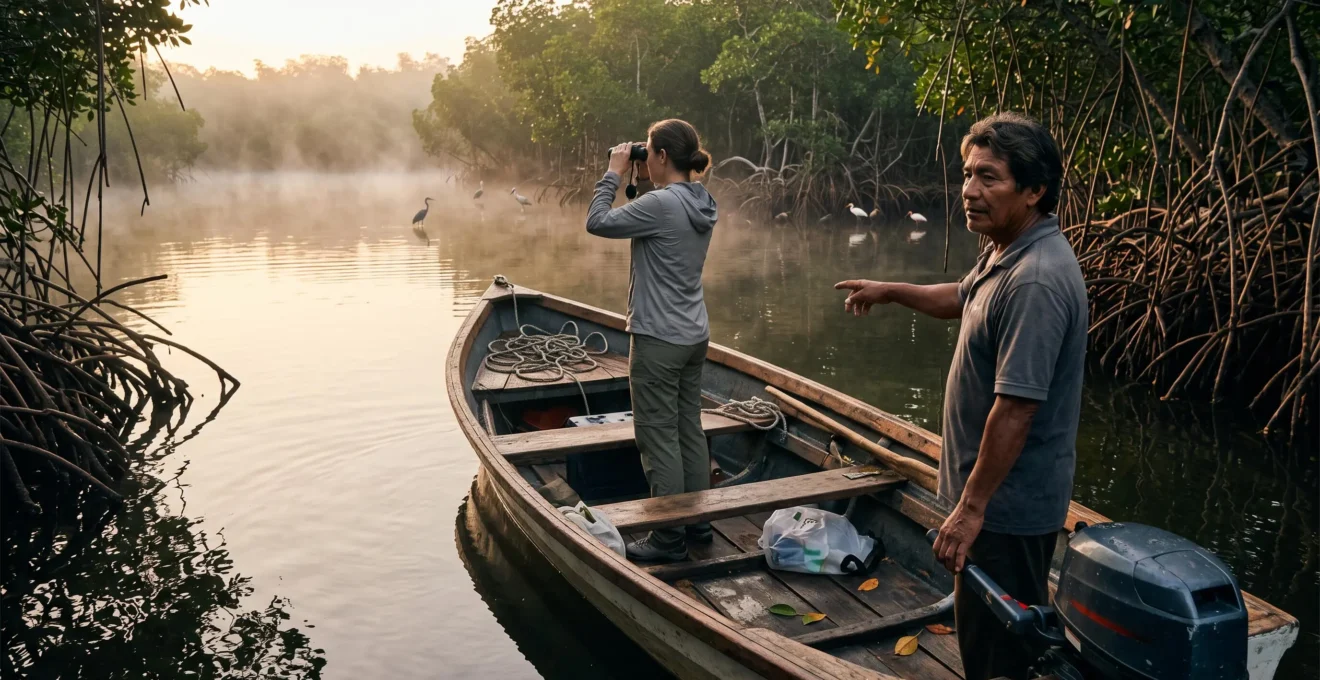
For accessible wildlife watching, coastal mangroves are often a practical first choice. Open channels can make birds easier to detect, particularly with a knowledgeable guide. Cloud forests reward visitors seeking mountain habitats and distinctive birdlife, while tropical jungles offer immersive forest experiences for travellers comfortable with humidity, uneven trails and wildlife that may remain hidden.
The right choice depends on your travel month, physical tolerance, target species and actual access to the protected area. A reserve can be ecologically important without providing reliable visitor access or sightings during your available dates.
Before committing your three nature days, compare what wildlife is seasonally present, how much effort observation requires and whether local operators can provide the experience you want.
Choosing your first Mexican ecosystem
- Choose mangroves if you prefer guided wildlife observation, relatively open views and potentially less walking, especially when your dates suit local bird activity.
- Choose cloud forest if cooler mountain conditions, distinctive forest birds and patient observation matter more than easy sightings.
- Choose jungle if forest immersion is your priority and you can manage heat, humidity, slippery terrain and unpredictable wildlife visibility.
- Why Do Some Mexican Ecosystems Feel Empty in the Wrong Month Even in a Protected Area?
- How to Choose Between Jungle, Mangrove, and Cloud Forest When Your Body Handles Heat Badly?
- Which Is More Rewarding for Birdwatchers: Coastal Mangroves or Cloud Forests in Mexico?
- The Gear Mistake That Turns a Mexican Jungle Day Into 6 Hours of Misery
- When Should You Visit Cloud Forest vs Mangrove on a Multi-Stop Mexico Trip?
- Which Is Better for Wildlife: Kayaking Through Mangroves or Taking a Quiet Boat Tour?
- How to Plan a Mexican Reserve Visit Without Arriving to Find the Trail Closed?
- How to Choose a Mexican Protected Reserve That Allows Meaningful Access, Not Just a Fence Line
Why Do Some Mexican Ecosystems Feel Empty in the Wrong Month Even in a Protected Area?
A Mexican protected area can appear unusually quiet because wildlife presence and visibility follow seasonal cycles, not the legal status of the land. Migratory birds arrive and depart, breeding events occur during particular months, and weather changes animal behaviour. With only three days, matching your visit to the species’ activity calendar matters more than choosing a famous reserve.
Protection helps conserve habitats and ecological processes. It does not mean every animal associated with a reserve is present, active or easily observable throughout the year.
Mexico offers clear examples of this seasonal variation. The CONANP overview of seasonal wildlife movements in Mexico identifies distinct observation periods for several well-known animals.
November–March
The seasonal period identified by CONANP for monarch butterflies in central Mexico’s oyamel forests. This is a species-specific example, not a universal visiting season for Mexican forests.
Comisión Nacional de Áreas Naturales Protegidas (CONANP), 2025.
The same institutional overview describes December to April for grey whales in Mexican waters and April to September as a relevant period for American flamingos in Yucatán wetlands. Olive ridley sea turtle nesting aggregations at Playa Escobilla have another seasonal calendar. None of these windows guarantees a sighting on a particular day.
For short-trip planning, divide wildlife into three practical categories:
- Resident species: Animals occupying a habitat throughout the year, although their detectability may vary with weather, food availability and behaviour.
- Seasonal visitors: Migratory birds and other animals whose presence is concentrated within particular months.
- Weather-sensitive wildlife: Species whose activity, calls, movements or visibility change during dry, wet, hot or cooler conditions.
The consequences differ between ecosystems. A coastal wetland trip focused on migratory birds may be particularly sensitive to seasonal timing. A cloud forest may offer resident birdlife and plant interest outside migration periods, but rain, fog and forest density still affect what visitors can observe.
There is no reliable blanket rule that Mexican cloud forests always outperform mangroves outside peak wildlife seasons. Local species composition matters.
Seasonality also affects practical access. Heavy rain may damage trails or disrupt waterways. Whether guide availability or boat schedules decline outside popular observation periods must be confirmed locally rather than assumed.
The next decision is equally important: whether the physical conditions required to reach that wildlife suit your body.
How to Choose Between Jungle, Mangrove, and Cloud Forest When Your Body Handles Heat Badly?
If you struggle with heat, choose an ecosystem according to exposure, humidity and physical effort rather than temperature alone. Cloud forests can offer cooler, shaded conditions but involve steep walking. Mangroves may allow seated boat observation, although open water increases sun exposure. Tropical jungle trails combine shade with potentially exhausting humidity and uneven ground.
A traveller accustomed to the UK’s cooler climate may underestimate how quickly exertion becomes difficult in humid environments. Sweat cools the body less efficiently when surrounding air contains substantial moisture.
The CDC Yellow Book chapter on heat and cold illness in travellers explains how high humidity, inadequate acclimatisation, dehydration and strenuous outdoor exercise contribute to heat-related illness.
These physiological factors are more useful for itinerary decisions than a general description such as « tropical but shaded ».
| Factor | Jungle | Mangrove | Cloud forest |
|---|---|---|---|
| Heat exposure | Often warm and humid, even beneath trees | Can be strong on exposed water or boardwalks | Often cooler at elevation, but conditions vary |
| Typical physical demand | Uneven walking, mud and roots | Low on a seated boat; higher when kayaking | Potentially steep or slippery hiking |
| Main comfort challenge | Persistent humidity and exertion | Direct sun, glare and limited shade | Climbing, wet paths and changing weather |
| Possible lower-effort option | Short guided trail | Shaded or early guided boat trip | Short accessible path, where available |
A simple self-assessment starts with the hardest hour of the planned excursion. Could you comfortably walk uphill in damp conditions, sit exposed on a lagoon or negotiate muddy paths after rain?
Time of day changes the answer. A dawn mangrove tour may avoid some of the day’s strongest heat, whereas a jungle route requiring several hours on foot can become demanding as conditions warm. A cloud forest walk may feel relatively cool but still impose substantial cardiovascular effort on slopes.
Altitude is not a substitute for assessing terrain. Higher elevations may bring lower temperatures, yet steep climbs, thin air at sufficiently high altitude and unfamiliar exertion can introduce other difficulties.
For travellers with limited heat tolerance, an early guided boat excursion or a genuinely short, manageable woodland route may be more appropriate than a long mountain trail.
Carry appropriate fluids, allow rest opportunities and select an activity with a realistic escape or turnaround option. Fluid needs depend on circumstances; neither a fixed hourly drinking volume nor forcing excessive water is universally safe.
Once physical comfort is accounted for, birdwatching potential becomes a more useful way to distinguish mangrove habitats from cloud forests.
Which Is More Rewarding for Birdwatchers: Coastal Mangroves or Cloud Forests in Mexico?
Coastal mangroves are often the easier starting point for casual birdwatchers because open channels, shorelines and resting areas can make birds more visible. Cloud forests can be more rewarding for experienced observers seeking distinctive mountain species, but dense vegetation and calls heard without visual contact demand patience. The better choice depends on your target birds and travel month.
A reserve’s total species list is not the same as the number of birds a visitor can realistically identify during a short excursion. For three nature days, the most useful measure combines observation opportunities, visibility and personal interest.
Consider three questions before choosing:
- How readily can birds be detected? Open water, exposed branches and feeding edges can offer clearer observation than thick forest canopy.
- How distinctive are the potential sightings? A committed birder may value a particular forest species more than numerous common wetland birds.
- How much assistance is available? A skilled local guide can identify calls, locate appropriate habitats and help avoid spending hours in unproductive locations.
Mangrove excursions often favour scanning and repeated visual checks. Depending on the site and season, observers may look for herons, egrets and other birds associated with coastal wetlands. Guided boats can cover several viewing locations without requiring long walks.
Cloud forest birdwatching has a different rhythm. Birds may be concealed among branches, heard before they are seen or active along particular forest edges. Quiet movement and familiarity with calls can be especially valuable.
At Corredor Biológico Chichinautzin, the CONANP visitor profile for Corredor Biológico Chichinautzin identifies cloud-forest habitat, migratory birds and opportunities for hiking and nature photography. It also describes limited signage on some access routes.
This illustrates an important distinction: an ecologically valuable bird habitat is not automatically a straightforward independent birdwatching destination.
| Your priority | Likely better fit | Important condition |
|---|---|---|
| Visible birds with relatively little walking | Coastal mangrove | Appropriate seasonal activity and a suitable boat route |
| Distinctive mountain forest species | Cloud forest | Local species knowledge and a suitable observation window |
| Beginner-friendly guided observation | Mangrove | A guide experienced in identifying local birds |
| Specific target species or a first-ever sighting | Whichever holds the target | Verified presence and realistic detection opportunities |
The relative advantages shift with migration. A coastal wetland may be particularly appealing during a relevant seasonal concentration, while a forest site may offer other observation opportunities at the same time. Neither habitat guarantees more sightings per hour without site-specific evidence.
Once you know which habitat suits your interests, appropriate footwear and clothing become essential to enjoying the hours spent there.
The Gear Mistake That Turns a Mexican Jungle Day Into 6 Hours of Misery
The most damaging jungle gear mistake is preparing for an ordinary warm-weather walk rather than a prolonged, humid excursion on potentially muddy terrain. Unsuitable shoes, insufficient drinking capacity and clothing that remains damp can compound discomfort. In a remote reserve, these problems may shorten or end a wildlife excursion long before the planned route is complete.
Imagine a hypothetical six-hour guided jungle outing after recent rain. A visitor arrives wearing lightweight everyday trainers and a cotton T-shirt, carrying little water because the route is mostly shaded.
Wet roots make footing uncertain, the shoes become saturated and the shirt remains uncomfortable as exertion continues. The traveller slows down, misses scheduled observation stops and may need to turn back if the guide judges conditions unsuitable.
This is a planning scenario, not a documented incident. Its purpose is to show how several avoidable shortcomings can interact.
Footwear should match trail conditions. On muddy routes, appropriate grip and secure fit matter more than whether a shoe is marketed specifically for tropical travel. Waterproof footwear is not automatically ideal in every humid environment because water entering from above can be difficult to remove.
Clothing should allow comfortable movement, suitable coverage and moisture management. Lightweight, loose-fitting fabrics are generally useful in hot conditions, although fabric performance varies with construction, fit and humidity.
For a three-day itinerary covering several ecosystems, organise equipment around the most demanding planned activity rather than packing three complete sets. Jungle hikes may call for grippy footwear and a practical hydration system; mangrove trips benefit from secure waterproof storage; cooler mountain visits may require additional layers and rain protection.
Useful small items include a dry bag for electronics, insect protection appropriate to the location and activity, and a headlamp for genuinely necessary early departures. Check whether guides supply lifejackets, binoculars or other specialist equipment before adding unnecessary weight.
The key test is simple: What happens during the worst realistic hour? If heavy rain begins, the route becomes muddy or a boat splashes your bag, can you continue safely without relying on a shop or immediate return transport?
Before departure, confirm the expected walking time, available drinking-water facilities, weather exposure and whether the operator has a clear plan for changing conditions.
Good equipment preserves flexibility, allowing you to plan the order of different habitats around their strongest wildlife-viewing opportunities rather than around avoidable comfort problems.
When Should You Visit Cloud Forest vs Mangrove on a Multi-Stop Mexico Trip?
Visit cloud forest or mangrove first according to your main wildlife target, local seasonal conditions and actual transfer times. Schedule species-specific encounters when the animals are most likely to be present and active, then organise easier excursions around them. For a three-day trip, avoid spending your best observation hours travelling between distant habitats.
Mexico’s geography makes this decision more complicated than simply choosing the nearest reserve. Cloud forests generally occur in suitable humid mountain environments, while mangroves occupy coastal wetlands. Moving between them may require substantial overland travel.
A sensible itinerary therefore begins with the exact sites you want to visit, not with broad ecosystem labels.
If your priority is a particular migratory bird, check its local seasonal presence before finalising travel dates. If you mainly want landscape variety, select accessible habitats within a practical travel corridor and build in time for changes in weather.
The two ecosystems can complement each other. Coastal wetlands may offer seasonal concentrations of particular birds, while mountain forests offer different communities of resident and migratory wildlife. However, combining them does not guarantee continuous peak wildlife activity throughout the year.
Use this hypothetical sequence to understand the planning logic rather than treating it as a universally workable route:
| Day | Main activity | Decision behind it |
|---|---|---|
| Day 1 | Early mangrove observation | Use a suitable local activity window before stronger daytime exposure |
| Day 2 | Transfer and short mountain habitat visit | Allow realistic travel and adjustment time |
| Day 3 | Guided cloud forest walk | Reserve an appropriate observation period for forest wildlife |
This sequence makes sense only if the selected sites are close enough, road conditions allow the transfer and local activity windows support the plan. In many parts of Mexico, visiting both ecosystems within three days would consume too much time.
Altitude also deserves consideration. Some mountain destinations involve substantial elevation changes, and travellers should account for their own fitness, health and acclimatisation needs.
For a single target species, prioritise the relevant habitat and consider spending more than one observation period there. For variety, alternating habitats can be appealing, but only when transfers do not overwhelm the available time.
One successful morning with a capable guide can be more valuable than several rushed habitat changes. The aim is to maximise meaningful observation, not the number of ecosystems ticked off.
If mangroves are part of your itinerary, the next important choice is how to move through them without unnecessary disturbance or physical strain.
Which Is Better for Wildlife: Kayaking Through Mangroves or Taking a Quiet Boat Tour?
A guided boat tour is often the more practical wildlife-viewing option for first-time visitors with limited time because a local guide can locate observation areas while passengers concentrate on watching. Kayaking offers quieter movement and access to some narrow waterways, but requires paddling effort and careful control. Neither method automatically delivers closer or more frequent sightings.
Wildlife encounters depend on the route, operator behaviour, local conditions and the animals themselves. Reduced engine noise may be useful, but silent movement does not remove the possibility of disturbing wildlife.
The NOAA Fisheries marine wildlife-viewing guidelines emphasise responsible observation from motorised and non-motorised craft alike.
The guidance advises against chasing, surrounding or trapping wildlife and recommends avoiding disruptive speed or direction changes near marine animals. These are useful general principles, not a substitute for Mexican regulations or species-specific rules at the reserve you visit.
For birdwatching in Mexican mangroves, the advantages are practical rather than guaranteed.
| Criterion | Guided boat | Kayak |
|---|---|---|
| Physical effort | Usually lower for seated passengers | Requires sustained paddling and balance |
| Access | May cover wider waterways | May enter permitted narrow channels |
| Wildlife detection | Benefits from the guide’s local knowledge | Depends on the paddler or accompanying guide |
| Noise and disturbance | Depends on engine use and operator behaviour | Less engine noise, but disturbance remains possible |
| Heat exposure | Depends on departure time and available shade | Potentially substantial during exposed paddling |
A skilled guide provides value beyond steering. Local knowledge can help visitors interpret calls, distinguish species and identify suitable observation areas without pursuing animals.
Kayaks can provide an appealing alternative for confident paddlers who value slow exploration. Nevertheless, the ability to enter a narrow waterway does not establish permission to do so. Some channels may be restricted to protect wildlife or because navigation conditions are unsafe.
A combined approach is worth considering where explicitly permitted: join a guided orientation excursion, then arrange a separate guided or authorised kayak outing suited to conditions. Confirm that both activities are actually available; this is a possible itinerary strategy, not a standard service in every reserve.
For either option, ask about lifejackets, current, wind, weather exposure, wildlife distances and cancellation procedures. Do not assume that a quieter vessel allows closer approaches to animals.
Once you have selected the activity, verify that the route, departure point and protected-area access will still be available on your intended day.
How to Plan a Mexican Reserve Visit Without Arriving to Find the Trail Closed?
To avoid losing a nature day to a closed Mexican reserve, confirm the specific trail, entrance or boat route shortly before visiting rather than relying on the reserve’s general open status. Check official communications, contact the local operator or managing community, and ask about weather-related restrictions. Keep a nearby alternative ready in case conditions change.
A protected area may remain legally open while individual activities are unavailable. Heavy rainfall can damage paths, water conditions can affect navigation, and conservation work or sensitive wildlife periods may require temporary restrictions.
Some destinations also depend on community-managed entry points, local staffing or limited daily visitor arrangements. Rules and procedures differ between reserves.
The most useful distinction is between three levels of confirmation: whether the protected area accepts visitors, whether your intended activity is permitted and whether the exact access route is usable on your chosen date.
For example, a general visitor-information page may identify hiking as an activity without confirming the current state of every trail. The official profile for Corredor Biológico Chichinautzin describes access routes with limited signage, illustrating why route-specific local information matters.
For a short stay, do not interpret an institutional listing of visitor facilities as proof that each facility or trail is currently operating.
Five checks before committing a reserve day
- Locate the official reserve information. Record the protected area’s full name, the responsible authority and the available official contact channel in your itinerary notes.
- Identify the exact entry point. Write down the trailhead, visitor centre or boat departure location rather than saving only the reserve name.
- Confirm activity access directly. Obtain a dated message or note from the managing operator or local community confirming whether your chosen route is accessible and whether a guide or permit is required.
- Check current conditions. Record a recent weather and trail or water-condition update, including any restrictions affecting your planned activity.
- Prepare an alternative. Save a second realistically reachable site or low-risk activity, with its own verified access information and transport plan.
When possible, make the final confirmation close to departure, especially during unsettled weather. A phone conversation or direct operator message may identify recent local changes that have not appeared on an institutional webpage.
Accommodation flexibility also helps. Avoid making every day dependent on a single non-refundable excursion when local conditions are uncertain.
Choose fallback activities that preserve the purpose of the trip. If a forest trail is unsuitable, a permitted shorter nature walk or guided observation point may still offer a useful experience.
The final step is choosing a protected area whose visitor infrastructure is genuinely suited to a three-day itinerary in the first place.
What matters before choosing a reserve
- Official protected status establishes a conservation framework, not automatic permission to enter every habitat or trail.
- Reliable visitor entry, useful guiding and manageable routes can matter more than the length of a reserve’s species list.
- A short trip benefits from verified access and an achievable observation plan, with an alternative if conditions change.
How to Choose a Mexican Protected Reserve That Allows Meaningful Access, Not Just a Fence Line
Choose a Mexican protected area by examining what visitors can actually do there, not simply its designation or reputation. Look for identifiable entrances, permitted trails or waterways, dependable local guides and clear access arrangements. For three nature days, a moderately biodiverse site with usable visitor routes may deliver more meaningful encounters than a famous reserve with restricted access.
Mexico’s protected areas operate under different designations and management arrangements. National parks, biosphere reserves, flora and fauna protection areas and other conservation territories do not all offer the same visitor activities.
Some areas contain zones where access is restricted for conservation purposes. Others provide specific recreational routes, community-managed experiences or established visitor facilities.
Ecological importance and tourist accessibility are separate qualities. A reserve can be highly significant for habitat protection while offering limited direct entry into sensitive areas.
For a traveller with only three days, meaningful access should satisfy four practical tests:
- Defined entry: You can identify where visitors enter, when access is available and whether prior authorisation is required.
- Usable observation routes: There are permitted paths, channels or viewpoints appropriate to your fitness and wildlife interests.
- Local knowledge: Guides or authorised operators can explain where and when observation is practical without disturbing protected species.
- Realistic logistics: Transfers, operating arrangements and excursion duration leave substantial time for nature observation.
Consider two hypothetical options. Reserve A is widely recognised for biodiversity, but the only accessible visitor area is a distant viewpoint requiring a lengthy transfer. Reserve B has less prominent publicity but offers an authorised short trail, clear operating arrangements and experienced local guiding.
For someone wanting to identify birds during a brief visit, Reserve B may provide the more useful experience. This does not imply it is ecologically superior; it simply matches the traveller’s access needs better.
Community-managed conservation and tourism initiatives deserve particular attention. Local cooperatives may offer knowledgeable guiding, established routes and information about recent conditions. However, their accessibility and service quality should be evaluated individually rather than assumed from community management alone.
Before booking, request a description of the actual visitor experience. Ask how long you spend observing wildlife rather than travelling, how physically demanding the route is and what happens if the intended habitat cannot be reached.
Also establish whether photographs, wildlife viewing and independent walking are permitted in the areas you hope to visit. A destination described as a reserve may include conservation zones that visitors should never enter.
Choose one accessible reserve as your main nature experience, confirm the visit with its authorised local provider and build the remaining days around realistic wildlife windows. Three carefully planned days are more valuable than an ambitious itinerary that leaves little time to observe anything.
Is it better to spend all three days in one Mexican ecosystem?
Often, yes, especially when reaching different ecosystems involves long transfers. Staying within one accessible region allows repeated observation opportunities, flexibility around weather and more time with local guides. Combining habitats is worthwhile when distances and activity windows genuinely support it.
Can you see wildlife in Mexican nature reserves during the rainy season?
Yes. Rainy conditions do not mean wildlife is absent. However, visibility, animal activity and access vary by habitat and species. Heavy rainfall can also affect paths, boat operations and safe travel. Check local seasonal information and current access conditions before choosing a reserve.
Do you need binoculars for a three-day Mexican wildlife trip?
Binoculars are particularly useful for watching birds from wetland channels, forest edges and viewpoints without approaching animals. They are not mandatory for every nature activity. Ask your guide whether binoculars are supplied before packing or purchasing equipment.
Can a beginner visit a Mexican cloud forest without a specialist guide?
Some visitor routes may permit independent access, but this depends on the protected area and the specific trail. Limited signage, changing weather and the difficulty of identifying concealed forest birds can make guided visits more useful. Always verify whether independent entry is authorised.
What should UK travellers check before booking a Mexican reserve excursion?
Confirm the correct entrance, current opening arrangements, guide or permit requirements, physical demands and seasonal wildlife prospects. Check the transport plan, expected weather exposure, operator safety arrangements and cancellation conditions. For remote or high-elevation visits, account for personal fitness and relevant travel-health needs.