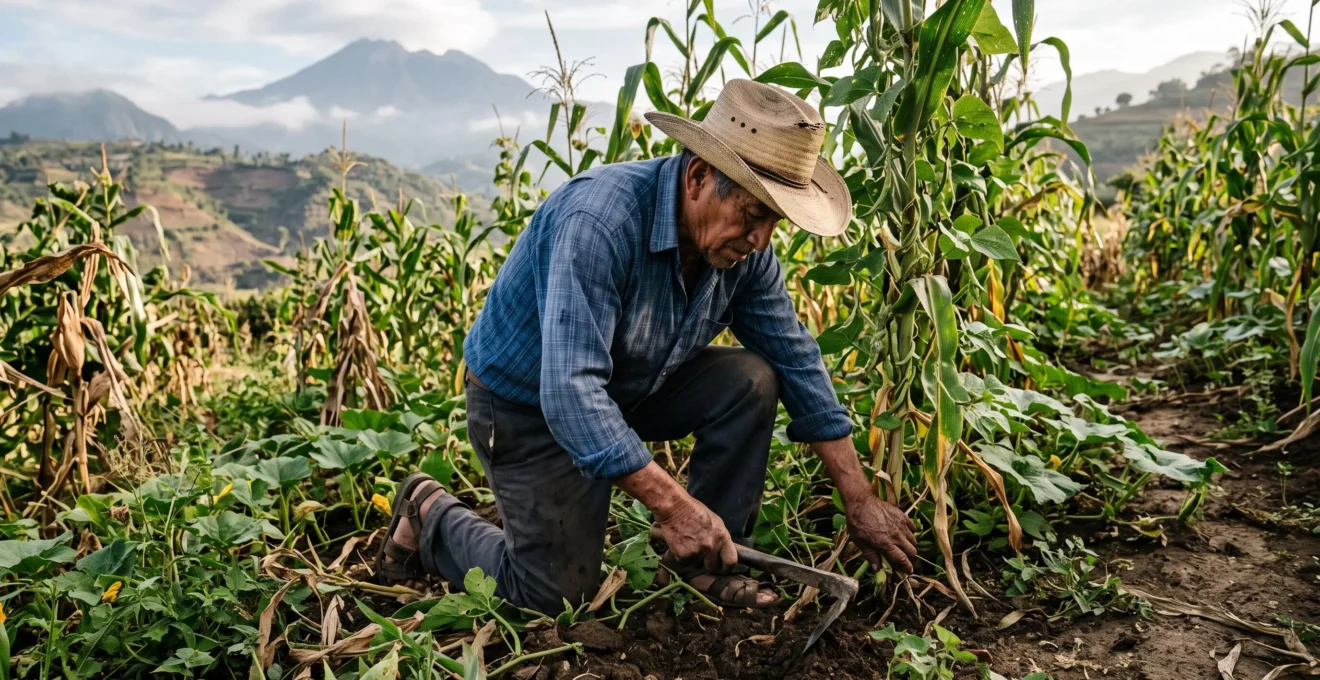
A field of maize, beans and squash growing together might look unfamiliar to a traveller accustomed to monoculture. Yet Mexico’s milpa farming system reflects generations of experimentation with soils, plant interactions, local climates and food production. It is not simply an old custom preserved for visitors.
Across Mexico, Indigenous communities maintain ecological knowledge through cultivation, observation, adaptation and relationships with their territories. Chinampa agriculture in Xochimilco, traditional plant knowledge and diversified coffee-growing landscapes offer different examples of how practical expertise connects environmental conditions with community life.
For travellers, particularly those arriving from the UK with an interest in herbal remedies, farming or cultural tourism, the challenge is recognising this expertise without treating it as freely available information or a performance to purchase.
Respectful encounters begin with a different assumption: the people practising and transmitting this knowledge determine what may be shared, who may share it and under what conditions. Understanding that principle changes how visitors choose tours, ask questions, photograph places and spend money.
Understanding Indigenous ecological knowledge before travelling
- Mexican agricultural systems such as milpa and chinampas demonstrate sophisticated, continuing ecological knowledge rather than static folklore.
- Community-led learning experiences are generally preferable to unsolicited questioning, staged performances or visits arranged without clear local participation.
- Permission to hear an explanation does not automatically include permission to record, publish or commercially reuse the knowledge shared.
- Why Are Scientists Now Studying the Same Farming Methods Indigenous Mexicans Have Used for Centuries?
- How to Learn From Indigenous Farming in Mexico Without Turning It Into a Theme-Park Experience?
- Which Feels Less Intrusive: An Ethnobotanical Walk or a Market Chat About Local Plants?
- The Knowledge-Sharing Mistake That Damages Trust Between Travellers and Indigenous Communities
- When Should You Schedule a Farm or Botanical Visit to See Indigenous Practices in Action?
- How to Find the Coffee and Cacao That Mexico Exports Without Leaving the Country?
- How to Choose a Community-Led Visit in Mexico Without Accidentally Funding the Wrong Operator?
- How to Visit Indigenous Villages in Mexico Respectfully Without Turning It Into ‘Human Tourism’?
Why Are Scientists Now Studying the Same Farming Methods Indigenous Mexicans Have Used for Centuries?
Researchers and agricultural organisations study Indigenous Mexican farming because systems such as milpa and chinampas offer practical insights into crop diversity, ecological interactions and productive land management. Their significance is not that modern science has finally made them legitimate, but that established knowledge systems can inform contemporary agricultural research and environmental policy.
A milpa is more than a field of maize. Its familiar combination of maize, beans and squash can include numerous additional edible or useful plants. Different crops occupy different spaces, develop at different rates and interact with the surrounding soil and environment.
Beans may contribute nitrogen through biological fixation under suitable conditions, squash foliage can help cover exposed ground, and maize offers vertical structure. These are useful mechanisms to investigate, but their effects depend on crop varieties, soil conditions, management and local ecology. No single explanation captures the diversity of milpa practices across Mexico.
The FAO report on traditional agrifood systems in Mexico documents the importance of diversified farming for agrobiodiversity, crop diversification and climate resilience. It also describes farmers experimenting with different varieties and agricultural approaches.
That experimentation matters. Traditional knowledge is not a frozen collection of instructions inherited unchanged. It is continually tested against environmental conditions, household needs, available resources and the experience of practitioners.
77 seed-bank projects
A FAO-GEF-CONABIO agricultural biodiversity initiative supported 77 community and family seed-bank projects involving more than 1,444 farmers. These are results of a particular conservation initiative, not figures representing every Indigenous agricultural community in Mexico.
Food and Agriculture Organization of the United Nations, institutional report published in May 2024.
Another significant example is the chinampa landscape of Xochimilco, where agricultural cultivation developed around human-made islands and canal environments.
The UNESCO World Heritage listing for Mexico City and Xochimilco describes chinampas as an exceptional agricultural system shaped by environmental conditions and human ingenuity. The landscape forms part of a broader World Heritage property inscribed in 1987; chinampa farming was not separately inscribed as an individual World Heritage site.
UNESCO also identifies pressures from contamination, development, groundwater extraction and changing agricultural practices. Historical productivity does not mean that every contemporary chinampa operates sustainably or without synthetic inputs.
These examples show why researchers examine biodiversity, productivity and land management within Indigenous agricultural systems. They do not establish that every traditional method outperforms every modern alternative, or that any practice can be transferred unchanged to another environment.
There is also an important historical and intellectual distinction. Institutional interest can bring resources, documentation and wider recognition, but it can repeat older hierarchies when Indigenous expertise is considered credible only after external scientific endorsement.
For a visitor, the essential lesson is that local farmers are practitioners and knowledge holders, not illustrations of a theory developed elsewhere. That perspective should shape the encounters chosen on the ground.
How to Learn From Indigenous Farming in Mexico Without Turning It Into a Theme-Park Experience?
Choose agricultural experiences designed and guided by the people who practise the farming methods being discussed. A worthwhile visit should explain what is happening on the land during the actual season, respect working schedules and show how the host community benefits. It should not require residents to perform an invented version of everyday life.
Consider two hypothetical visits to a chinampa. In the first, a guide leads visitors through a fixed programme of supposedly traditional activities, regardless of what the farmers are currently doing. In the second, a working grower explains the planting beds, current maintenance tasks and environmental pressures affecting cultivation.
The second offers a clearer connection to living practice. This does not mean that every demonstration is necessarily exploitative: communities may deliberately create educational activities that fit their own priorities. The decisive questions are who controls the programme and whether the activity is presented truthfully.
Ask what visitors will observe in their travel month. A farm may be preparing beds, cultivating crops, managing water or carrying out maintenance. There may be little visible activity at other times.
The danger of authenticity theatre arises when visitor expectations begin to dictate how local knowledge must appear. If an operator promises that every departure will include the same ceremonial activity, farming task and cultural performance, ask whether these events genuinely belong to that calendar or have been organised specifically for tourism.
Participation can be appropriate when it is invited, safe and compatible with the farm’s needs. Watching and listening may be more respectful than expecting hands-on work. A farmer should not have to interrupt an essential task simply because a visitor wants a memorable photograph.
A useful second test is reciprocity. What does the community receive beyond the immediate admission fee? Depending on the arrangement, benefits might include locally paid guiding work, support for agricultural activity, community enterprises or locally chosen cultural initiatives.
Such benefits should be described specifically by the operator. Claims about environmental protection or cultural preservation are not evidence of actual investment unless the organisation can explain what it does.
During the visit, let the practitioner decide which methods, challenges and stories are relevant. Asking why a particular crop arrangement works may produce a more meaningful discussion than requesting a dramatic demonstration of ancestral wisdom.
A valuable visit need not reveal anything rare or visually spectacular. Understanding ordinary agricultural decisions, environmental constraints and the limits of what hosts wish to share can be a substantial learning experience.
Which Feels Less Intrusive: An Ethnobotanical Walk or a Market Chat About Local Plants?
A properly organised ethnobotanical walk is generally the safer choice for travellers seeking detailed explanations about plants and their uses. It provides an agreed setting for learning and clearer opportunities to establish boundaries. A market conversation can be welcome, but buying something does not automatically entitle a visitor to someone’s time, expertise or personal knowledge.
Ethnobotany explores relationships between people and plants, including classification, cultivation, food, healing and cultural uses. In Mexico, these relationships differ across communities, languages and ecological regions. There is no single Indigenous plant tradition that a visitor can learn in one afternoon.
A guided walk can create space for a practitioner to decide which plants may be discussed, what information is appropriate for outsiders and whether photography or recording is permitted.
However, the label itself guarantees nothing. A commercial tour advertised as an Indigenous herbal walk may not be led by someone authorised by the relevant community to share specialised knowledge. Ask who designed the activity and what the guide is prepared to discuss.
Market interactions have a different purpose. Vendors are working, serving customers and managing their businesses. Some may enjoy explaining how a familiar culinary herb is used; others may prefer a straightforward transaction.
The difference becomes particularly important when questions concern medicinal or ceremonial plants. Some knowledge may belong to particular practitioners, families or community roles. Restrictions vary, and visitors should not assume that information is either universally public or universally secret.
For British travellers accustomed to markets where conversation is part of shopping, the practical distinction is between friendly interest and an impromptu interview. Neither a purchase nor a smile should be interpreted as consent to document a person’s expertise.
The following comparison offers a useful way to choose between these settings.
| Consideration | Organised ethnobotanical walk | Market conversation |
|---|---|---|
| Best purpose | Learning about plants within a structured educational activity | Shopping and observing everyday uses |
| Permission | Learning boundaries can be discussed before booking | Permission must emerge through each interaction |
| Time and compensation | Guiding time is normally part of a paid arrangement | A sale does not necessarily compensate extended questioning |
| Specialised knowledge | Discuss only what the authorised guide chooses to share | Avoid requesting restricted remedies or ceremonial details |
| Photography | Confirm separately what may be photographed or published | Ask vendors before photographing their stalls, goods or people |
A market is an excellent place to appreciate ordinary plant diversity without expecting explanations. Purchasing goods, learning local names that sellers volunteer and respecting the pace of trade can be enough.
Photographs deserve separate consideration. Permission to look at a plant or hear its name is not necessarily permission to photograph a stall, identify the seller online or circulate details about its cultural use.
When uncertain, choose the interaction that asks least of the other person. Curiosity remains valuable, but it does not create an obligation for anyone else to teach.
The Knowledge-Sharing Mistake That Damages Trust Between Travellers and Indigenous Communities
One of the most damaging mistakes is assuming that ecological knowledge shared during a personal encounter can be published or redistributed without further permission. A conversation, guided walk or private explanation does not automatically authorise a blog post, video, plant-use tutorial or location tag. The audience and consequences change when information moves online.
Imagine a hypothetical traveller learning about a locally significant plant during a community visit. The host explains its role in a particular practice but does not invite public documentation.
If the traveller later publishes detailed instructions, photographs and a precise location, information shared with one person has become available to an uncontrolled audience. The original conversation no longer determines who can access or reuse it.
Possible consequences include unsolicited visits, unwanted attention to sensitive places or attempts to exploit commercially useful knowledge. These are risks, not evidence that every travel post causes biopiracy or measurable harm.
The WIPO glossary on traditional knowledge and prior informed consent distinguishes publicly accessible information from knowledge that is necessarily free for unrestricted use. Its discussion of consent, documentation and traditional knowledge protection provides an important framework for understanding why disclosure matters.
These international principles should not be mistaken for a universal rule making every tourist photograph or ordinary conversation unlawful in Mexico. Legal requirements depend on the circumstances, while respectful conduct can call for greater caution than the minimum legal standard.
The safest practice is to distinguish three permissions:
- Permission to learn: the host agrees to explain something in the present setting.
- Permission to record: the host specifically agrees to photography, audio or video capture.
- Permission to publish: the relevant people agree to the intended audience, attribution and disclosure of information.
These permissions are not interchangeable. Someone may welcome questions yet decline recording, or allow a photograph for personal use but not public publication.
Attribution also requires care. Naming a community may provide deserved recognition in one context while revealing an unwanted association or location in another. Ask whether and how the people concerned wish to be identified.
When knowledge is described as private, restricted or inappropriate to discuss, accept the boundary without asking another guide or resident to disclose the same information.
There are also forms of useful travel writing that do not require sensitive disclosure. Travellers can describe their own changed understanding, discuss publicly available agricultural principles and recommend authorised educational experiences without publishing restricted details.
A meaningful account of travel need not contain every fact discovered. Sometimes the most respectful evidence of learning is knowing what to leave unpublished.
When Should You Schedule a Farm or Botanical Visit to See Indigenous Practices in Action?
Schedule a farming or botanical visit around the work that local practitioners expect to undertake, rather than assuming a particular month guarantees a demonstration. Planting, weeding, harvesting and water management depend on region, elevation, rainfall and crop selection. Contact the community or operator beforehand to learn what visitors can realistically observe during their stay.
Mexico encompasses varied agricultural environments. A milpa in a highland area does not necessarily follow the same calendar as one in a warmer lowland setting. Rainfall patterns, local varieties and farming decisions influence when different activities take place.
The familiar stages of cultivation provide a starting point for questions, but not a national visitor timetable.
- Before planting: land preparation, seed selection and planning may be important activities, even when little is growing.
- During establishment: planting decisions and the relationships between crops may be easier to discuss on site.
- During active growth: visitors may encounter weeding, crop management and observation of plant conditions.
- During harvest: harvesting, seed selection and crop handling may be relevant, subject to the host’s workload and permission.
- Between productive stages: maintenance, soil management or preparation may remain essential parts of the agricultural system.
Chinampa cultivation introduces additional considerations because canals, planting beds and water management form part of the working landscape. Their activities cannot be reduced to the same calendar used for a rainfed milpa.
A botanical walk also changes with the seasons. Different plants may be flowering, fruiting, dormant or less visible. Some practitioners may organise visits around observation rather than collection, particularly where removing plants would be inappropriate.
When contacting a host, ask: “What agricultural or botanical activities are normally happening at this time of year, and which can visitors observe without interrupting your work?”
That question allows the host to explain what is possible. It avoids requesting an activity outside its normal schedule simply to satisfy an itinerary.
Festival periods require separate attention. A public celebration is not proof that all ceremonies, locations or community activities are open to visitors. Some observances may be private or have specific attendance conditions.
Timing also affects tourism pressure. Visiting outside a popular travel period may help spread demand, but this benefit is conditional: community enterprises might operate only on particular dates or prefer not to receive guests during quieter months.
Checking availability and preferences is therefore more useful than treating shoulder-season travel as automatically responsible.
The best date is the one that works for the people managing the land as well as the visitor. That same principle can guide decisions about purchasing the crops and products grown through these knowledge systems.
How to Find the Coffee and Cacao That Mexico Exports Without Leaving the Country?
To find distinctive Mexican coffee and cacao while travelling, look for producer cooperatives, origin-focused shops and specialist cafés that identify the growers behind their products. Oaxaca, Chiapas and Veracruz are useful regions to explore, but origin alone does not guarantee quality, equitable payment or Indigenous ownership. Transparent information about producers matters more than a premium-sounding label.
Mexico produces coffee and cacao for different markets, including domestic consumption and export. Travellers may encounter internationally promoted products abroad while finding that local retail choices depend on distribution networks, processing capacity and regional demand.
It would be misleading to assume that all the best harvests leave Mexico. Rather, the practical challenge is identifying where traceable, carefully produced lots are sold within the country.
In a speciality coffee shop, ask where the beans were grown, who produced them and whether the seller works directly with a cooperative or another identifiable supplier.
For cacao, distinguish raw agricultural origin from the finished product. A chocolate bar made or sold in Mexico does not necessarily contain cacao grown in Mexico, while a producer-based outlet may be able to explain both the origin and processing.
Labels naming a community, cooperative or producer can be useful indicators of traceability. They are not, by themselves, proof of fair compensation or consent to use a community’s identity for marketing.
The connection with ecological knowledge becomes clearer when producers discuss cultivation. Shade-grown coffee, for example, may be part of a diversified agricultural landscape where trees, crops and other vegetation interact. Such arrangements deserve attention for their ecological management, not merely because they make an attractive product story.
However, not every shaded coffee farm is Indigenous-managed, and not every Indigenous coffee grower uses the same methods. Similarly, cacao production and processing vary considerably. Avoid presenting either crop as a single traditional system.
Buying closer to producers can support local enterprises, but an equitable outcome depends on actual commercial arrangements. A cooperative identity offers a useful starting point for questions about ownership, decision-making and payment, not an automatic guarantee.
A practical purchasing approach is to choose a modest quantity of a well-identified product instead of buying large amounts of generic coffee or chocolate solely because it appears inexpensive.
For a UK visitor, it is also worth considering whether the product can be transported and stored appropriately, rather than buying more than will be used. Check applicable UK import and customs requirements separately, especially for unprocessed agricultural goods.
The most valuable conversation may concern the producer’s crop, processing method or collective organisation. It need not include private planting techniques or other knowledge that the seller has not offered to share.
Buying thoughtfully is one practical expression of respect, but it cannot replace checking whether the wider tourism experience is genuinely directed by the community it claims to represent.
How to Choose a Community-Led Visit in Mexico Without Accidentally Funding the Wrong Operator?
Choose a community-led visit by verifying who owns or manages the experience, who employs the guides and how local participants benefit financially. The phrase “community tourism” alone is insufficient: an outside agency may market an experience while retaining most of the booking revenue. Seek direct community contact where possible and ask specific questions before paying.
Community participation takes several forms. Some experiences are run by cooperatives or locally controlled organisations; others involve partnerships between communities, public institutions and external businesses.
An intermediary is not necessarily exploitative. It may provide transport, translation, bookings or other valuable services. The relevant issue is whether the relationship is understood and accepted by the people whose land, labour and knowledge make the experience possible.
A useful example of institutional support comes from UNESCO’s Maya community-based tourism initiative, reported in April 2025. Working with communities, cooperatives and other organisations across five Mexican states, the initiative emphasised capacities for autonomous and sustainable tourism management.
Community-based tourism development in Mexico’s Maya region
UNESCO reported work in Campeche, Chiapas, Quintana Roo, Tabasco and Yucatán alongside communities, cooperatives and institutional partners.
More than 100 tourism initiatives were identified, and 42 experiences were validated against sustainability, identity and tourism viability criteria during the initiative reported in 2025. These figures describe programme activity, not an independent audit of financial fairness or a guarantee that every listed experience is community-owned.
For travellers, the practical distinction is between an operator that can describe its local arrangements and one relying entirely on vague statements about authentic cultural exchange.
Ask who employs the guide. Is the guide a resident of the community? Is the community a partner in setting the itinerary? Does it have a role in deciding visitor numbers and permitted activities?
Revenue distribution matters, but there is no universal percentage that proves ethical tourism. An operator should be willing to explain the arrangement in a form that respects legitimate commercial and community confidentiality.
Where an identifiable community-run cooperative accepts direct bookings, its own contact channel may provide a clearer route than a third-party platform. Local visitor offices, cooperative contact details or community-authorised booking channels can help establish that relationship.
Third-party platforms remain useful for discovering experiences and comparing descriptions, provided visitors investigate who actually operates the visit.
Five checks before booking a community-led experience
- Identify the local organisation. Record the name of the community, cooperative or locally authorised host responsible for the experience.
- Verify who leads the visit. Obtain confirmation of whether the guide belongs to or works directly with the host community.
- Clarify where payment goes. Request a description of the local payment or benefit arrangement and keep the operator’s reply.
- Confirm the programme and boundaries. Save the agreed activities, visitor limits and any restrictions on photography or access.
- Check the booking channel. Compare the proposed booking route with any available community-authorised contact details and retain the confirmation.
These five checks form a traveller’s due-diligence method, not a certification system. A smaller organisation may lack a polished website while maintaining a legitimate and carefully managed experience.
Conversely, impressive branding, awards or sustainability language cannot substitute for evidence of how an experience operates.
The result should be a booking relationship in which local people retain meaningful control. Once that relationship is established, respectful behaviour during the visit matters just as much as the operator chosen.
Key takeaways before visiting an Indigenous community
- Access is conditional. An invitation to visit one activity or public area does not extend automatically to homes, ceremonies, fields or sacred spaces.
- Local authority matters. Community guides and hosts are better placed than visitors to define appropriate conduct and boundaries.
- Respect is observable. Photography, clothing, purchases, questions and willingness to accept refusal all influence how a visit affects residents.
How to Visit Indigenous Villages in Mexico Respectfully Without Turning It Into ‘Human Tourism’?
Visit Indigenous villages in Mexico as places where people live and work, not as attractions organised around visitors’ curiosity. Choose authorised experiences, follow local guidance and ask before photographing people or entering sensitive spaces. Respect also means accepting that some communities, events and locations are not open to outsiders, regardless of what a tour advertisement suggests.
Mexico’s Indigenous communities are diverse. They have different languages, institutions, histories, livelihoods and expectations regarding visitors. Behaviour appropriate in one locality may not be welcome elsewhere.
The line between visiting and treating people as spectacles often becomes visible in ordinary actions. Photographing residents without permission, approaching private homes because they appear picturesque or asking people to perform cultural practices on demand turns everyday life into material for someone else’s experience.
Even apparently positive language can contribute to this dynamic. Describing people as untouched by modernity, living in the past or preserving a culture unchanged for centuries overlooks contemporary choices, social complexity and economic realities.
The agricultural systems discussed earlier provide a more accurate starting point. Farmers who manage diverse crops, make decisions about seeds or maintain complex wetland landscapes exercise practical expertise. Their work is not cultural decoration.
Respectful behaviour is therefore both ethical and practical:
- Ask before photographing. Obtain permission from identifiable people and clarify whether images may be published. Follow any restrictions on photographing places, objects or activities.
- Follow local expectations. Ask hosts about appropriate clothing, access routes and conduct, particularly around religious or ceremonial settings.
- Learn how to greet people. Where appropriate, ask a host how to say a simple greeting in the local language, without expecting residents to provide language lessons.
- Support local enterprises. Purchase goods or services when genuinely useful, without treating every interaction as a commercial exchange.
- Respect boundaries. Do not enter homes, agricultural areas or ceremonial spaces without permission, even when they appear accessible.
Some travellers worry that asking permission repeatedly will make an encounter feel awkward. Yet a brief, clear question is usually preferable to making assumptions about another person’s image, property or work.
If a request is declined, acknowledge the answer and move on. Avoid asking for explanations, offering more money or seeking someone else who might override the refusal.
The same applies when a host explains that a village or ceremonial space does not welcome outside visits. A booking payment cannot create a right of access that the community has not granted.
Visitors can still learn about Indigenous ecological practices through public educational resources, community-authorised experiences and products sold by the people who cultivate or make them.
It is also worth reflecting on what is being sought from the journey. A desire to witness unfamiliar traditions is not inherently disrespectful, but it becomes problematic when the visitor’s expectation of discovery takes priority over residents’ choices.
Meaningful cultural exchange requires room for the host to decide what, if anything, should be exchanged.
Before visiting, identify an authorised local host, confirm what is open to visitors and decide what you genuinely want to learn. Then allow the community’s boundaries, work and priorities to shape the encounter, including the possibility that the respectful choice is not to visit at all.
Is Indigenous ecological knowledge the same as scientific knowledge?
Indigenous ecological knowledge and contemporary academic science can both involve systematic observation, experimentation and accumulated evidence, but they are not identical knowledge systems. They may differ in their methods, institutions, ways of transmitting knowledge and relationships with territory. Mexico’s milpa and chinampa systems demonstrate why researchers can learn from established agricultural practice without assuming that institutional validation is what makes it valuable.
Can visitors learn about Mexican medicinal plants without buying or using herbal remedies?
Yes. An authorised botanical or ethnobotanical walk can focus on plant identification, cultivation, ecology and cultural relationships without recommending treatments. Traditional medicinal use is not, by itself, clinical evidence of safety or effectiveness. Avoid collecting plants, reproducing restricted preparations or using unfamiliar remedies without appropriate professional advice.
Does paying for a community tour give permission to photograph everything?
No. Payment covers whatever activities and access have actually been agreed. Photography, recording and publication can require separate permission, especially when identifiable people, private property or culturally sensitive knowledge are involved. Ask the host what is permitted and respect individual refusals.
Are all Indigenous farming practices in Mexico environmentally sustainable?
No agricultural practice should be assumed sustainable solely because it is traditional or Indigenous. Outcomes depend on local environmental conditions, resources and management. The FAO documents biodiversity-related benefits associated with diversified agricultural systems, while UNESCO also identifies environmental pressures threatening Xochimilco. Evaluating practices requires attention to their particular context.
What if a community does not offer tours or does not welcome visitors?
Respect that decision rather than attempting to arrange informal access through another person. Travellers can explore publicly available educational materials, visit appropriate public institutions or support authorised community enterprises elsewhere. An Indigenous community does not owe visitors access to its territory, ceremonies or knowledge.