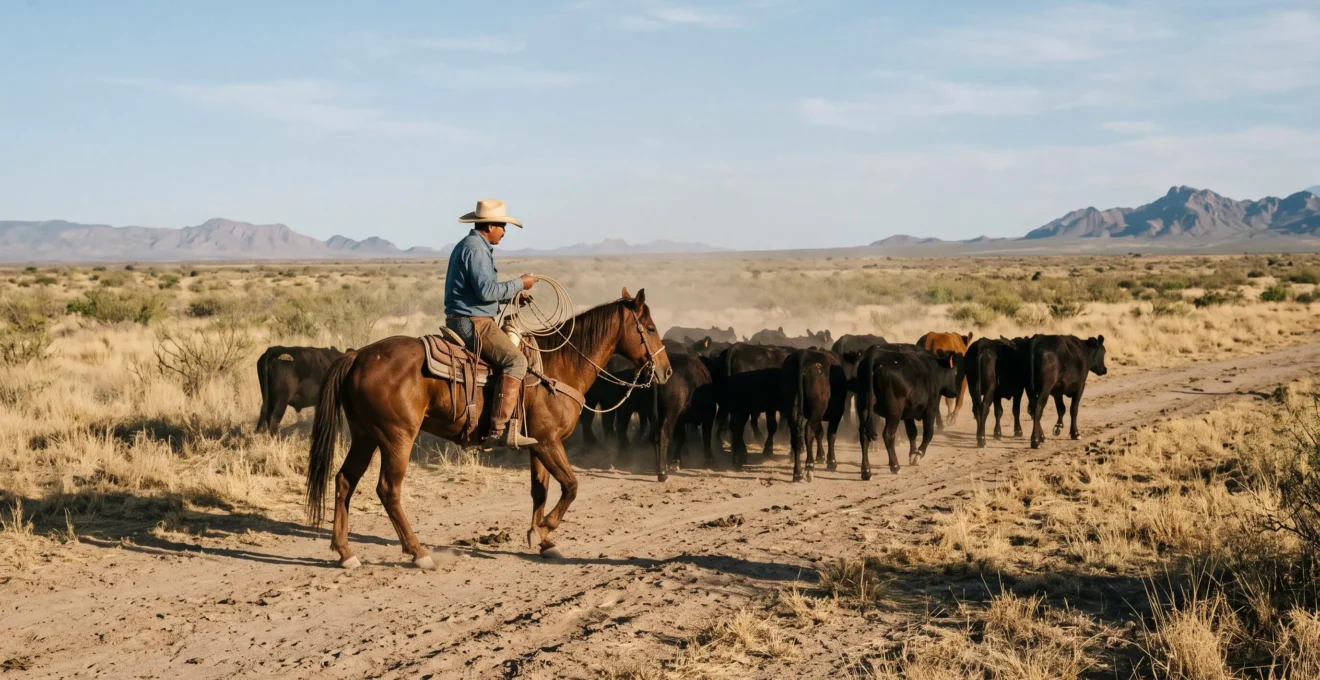
Travel north through Mexico and the landscape begins to explain things that a guidebook photograph cannot. Distances widen. Dry grassland replaces humid valleys. Restaurants serve enormous plates of grilled beef with flour tortillas, and a battered pickup outside a café may say more about the local economy than the town’s monuments.
In Chihuahua, Sonora, Coahuila and Nuevo León, cattle ranching has shaped regional identity for generations. The connection reaches beyond food and clothing into land ownership, family histories, horse-handling traditions and the rhythms of rural work. It also helps explain why northern Mexico sometimes feels culturally closer to parts of the American Southwest than to the tropical image of Mexico familiar to many British travellers.
Yet treating the north as simply a Mexican version of Texas misses the historical relationship between the two. Mexican vaqueros helped establish the working practices that later became central to American cowboy culture. Understanding that lineage changes how visitors interpret a ranch, a local rodeo or even an ordinary roadside meal.
Northern Mexico’s ranching identity at a glance
- The north’s extensive grazing landscapes encouraged cattle economies and a distinctive regional food culture.
- A working ranch and a community rodeo reveal different aspects of vaquero life; neither is automatically more authentic.
- For outdoor events, consider autumn or spring, check local schedules and weather, and learn which equestrian tradition you are watching.
- Why Is Beef Culture So Strong in Northern Mexico Compared to the South?
- How to Experience Northern Mexican Ranch Culture Without Booking a Gimmicky ‘Cowboy Day’?
- Which Feels More Real: A Working Ranch Visit or a Local Rodeo in Northern Mexico?
- The Assumption About Mexican Cowboys That Annoys Locals and Gets the Culture Wrong
- When Should You Visit Northern Mexico for Rodeo Events Without Facing 40°C Heat?
- Which Is Better for First-Timers: A Formal Charreada or an Informal Village Rodeo?
- How to Find the Coffee and Cacao That Mexico Exports Without Leaving the Country?
- Why Mexican Roping Is Nothing Like American Rodeo and What You’re Actually Watching
Why Is Beef Culture So Strong in Northern Mexico Compared to the South?
Beef occupies a particularly prominent place in northern Mexican food culture because large stretches of the region historically favoured extensive livestock grazing. In contrast, much of central and southern Mexico developed around older, intensive agricultural traditions, especially maize cultivation. These different landscapes and economic histories help explain regional preferences without dividing Mexico into rigid cultural categories.
Across parts of Chihuahua, Coahuila, Sonora and Nuevo León, dry grasslands and scrub-covered plains provided space for grazing animals over considerable distances. Spanish colonial livestock enterprises expanded into these landscapes, followed by ranches and larger estates whose cattle economies continued to evolve after independence.
Ranching demanded people capable of travelling long distances, managing herds and handling horses. It also encouraged the development of equipment, clothing and local expertise adapted to open-country work.
The legacy remains visible today. Wide-brimmed hats offer practical sun protection. Boots are associated with riding and rural work. The term ranchero carries meanings connected to countryside life, land and regional identity, though its precise social significance varies.
The culinary evidence may be easiest for travellers to recognise:
- Carne asada: grilled beef, particularly associated with gatherings in the north, where cooking meat can be as much a social occasion as a meal.
- Machaca: shredded or traditionally dried beef, associated with preservation practices and regional cooking.
- Flour tortillas: especially prominent in many northern food traditions, often accompanying grilled meat and beans.
These foods are not exclusive to northern Mexico, just as cattle ranching has never been absent from the south. Regional cuisine reflects several overlapping influences, including climate, wheat cultivation, trade and migration.
It also helps to distinguish the working vaquero tradition from charrería, Mexico’s formal equestrian tradition. Their histories overlap, but their modern expressions are not interchangeable.
UNESCO‘s recognition of Mexico’s charrería tradition describes practices developed among livestock-herding communities and transmitted through families, associations and schools. Public charreada competitions are an important expression of that heritage.
Start at a neighbourhood grill rather than a themed attraction. The meal may reveal how ranching history remains part of daily life, even in cities far removed from active cattle work.
How to Experience Northern Mexican Ranch Culture Without Booking a Gimmicky ‘Cowboy Day’?
The best way to experience northern Mexican ranch culture is to arrange a visit with people who actually raise livestock and ask what their working day permits. Look for locally operated ranches, clearly described activities and realistic expectations. An ordinary morning observing cattle management can provide more cultural understanding than a package built around costumes and photographs.
Working ranches are businesses and family homes, not permanent visitor attractions. Their priorities change according to livestock needs, staffing, weather and season. Some may welcome guests by prior arrangement; others have neither the facilities nor the interest in doing so.
When contacting a potential host, ask what happens on the property throughout the year. Feeding animals, inspecting fences, monitoring water supplies and maintaining equipment may be more representative than the dramatic branding or cattle-driving scenes associated with cowboy films.
Not every visitor can safely participate in livestock handling. A responsible host may allow observation but restrict physical involvement because of animal behaviour, insurance or safety considerations. Watching skilled workers is still a genuine experience.
To find suitable opportunities, investigate regional tourism offices in Sonora or Coahuila, locally recommended rural accommodation and direct introductions through community contacts. In some towns, feed stores or shops selling riding equipment may be useful places to ask for general local information, although they are not booking agencies.
Evaluate an advertised experience through its relationship to everyday ranch life. A business offering a horse ride, a staged photograph and a buffet may provide an enjoyable recreational outing, but should not automatically be described as an introduction to cattle work.
Duration matters too. A longer visit may allow guests to understand how tasks connect: animals need water before the heat intensifies, equipment requires repair, and workers adjust their routines to conditions that rarely fit a tourism timetable.
Basic Spanish, patience and permission before taking photographs can make the encounter more respectful. Rural hospitality should not be confused with an obligation to entertain strangers.
Five checks before arranging a ranch visit
- Identify the operator: record the ranch’s name, location and the person responsible for hosting visitors.
- Confirm the activity: obtain a written description of what guests can observe and whether any hands-on participation is permitted.
- Clarify the arrangements: request confirmation of the visit duration, accommodation if offered, transport and total price.
- Check safety: record the host’s guidance on clothing, animal proximity, weather and emergency arrangements.
- Agree on boundaries: confirm photography permissions and the activities or areas that remain private.
A good host does not need to promise excitement. The willingness to explain what visitors will actually see is a more useful signal than elaborate marketing.
Which Feels More Real: A Working Ranch Visit or a Local Rodeo in Northern Mexico?
Both a working ranch visit and a local rodeo can offer authentic encounters with northern Mexican culture, but they reveal different things. A ranch exposes the routines, skills and relationships behind livestock production. A community rodeo or jaripeo turns selected riding skills into a public occasion, with spectators, celebrations and regional pride.
On a ranch, the important moments are often quiet: a worker noticing an animal’s condition, a conversation about grazing, or an early start before temperatures rise. At a community event, visitors see skills displayed in front of neighbours and relatives, accompanied by music, food and public reactions.
The practical differences are significant.
| Consideration | Working ranch | Community rodeo or jaripeo |
|---|---|---|
| Main experience | Livestock work and rural routines | Competition, celebration and spectatorship |
| Typical duration | Several hours or potentially several days | One event or part of a local festival |
| Planning | Advance permission and arrangements essential | Attendance arrangements depend on the organiser |
| Spanish | Especially useful for detailed conversations | Helpful but not essential for watching |
| Physical conditions | Dust, uneven ground and potentially early starts | Crowds, noise and sometimes exposed seating |
| Visitor involvement | Observation or agreed activities | Generally spectatorship |
For British travellers with limited time, a community event may be the simpler introduction. It allows visitors to observe local relationships without requiring access to private property.
For those especially interested in cattle management, land use or rural family histories, an arranged ranch stay may offer a deeper understanding. It requires more preparation and flexibility.
Authenticity is not determined by how obscure an event looks. A locally popular rodeo may still be commercially organised, and an established visitor ranch may still conduct genuine agricultural work.
Community noticeboards, local recommendations and municipal announcements can help establish who organises an event and who normally attends. Tourist advertising alone neither proves nor disproves authenticity.
Where possible, experience both settings. Watching a roping competition becomes more meaningful after seeing how horses and livestock are handled outside the arena.
Neither experience gives a complete picture of northern Mexico. Together, they connect the demanding work behind the tradition with the social occasions that celebrate it.
The Assumption About Mexican Cowboys That Annoys Locals and Gets the Culture Wrong
One misleading assumption is that a Mexican vaquero is simply an American cowboy in different clothing, or a charro dressed for a performance. Mexican cattle-working traditions have their own history, and they helped shape cowboy culture north of the border. Treating ranch workers as decorative characters overlooks the knowledge and labour behind their profession.
The distinction matters because the familiar Hollywood cowboy is often presented as an American invention. The historical relationship runs much deeper.
The National Park Service‘s history of cowboys identifies Mexican vaqueros as the first cowboys and traces elements of later American cowboy culture to earlier Mexican livestock-working practices.
Even the vocabulary carries that history. Terms such as buckaroo, lariat, chaps and remuda have roots in Spanish or Mexican ranching terminology.
Modern northern Mexican ranch workers should not, however, be treated as representatives of one unchanged historical identity. Ranches vary enormously in scale, equipment, employment arrangements and technology. Motor vehicles and modern livestock management coexist with horse-based skills.
Another mistake is confusing vaqueros with charros. A vaquero generally refers to someone associated with cattle handling, particularly on horseback. A charro is associated with a distinctive Mexican equestrian tradition that includes formal competitive and ceremonial practices.
The categories can overlap. A person may have agricultural experience and participate in charrería. What matters is avoiding the assumption that all horse riders perform the same role.
Visitors can show greater understanding through a few simple behaviours:
- Ask about ranch work, animals and local history before asking for photographs.
- Do not assume a hat and boots automatically identify someone’s occupation.
- Avoid treating workers as performers unless they are explicitly participating in a public event.
- Listen when hosts distinguish regional riding traditions or competition rules.
Not every local person will find the same misconception irritating, and there is no basis for claiming that all ranching communities react alike. The practical concern is the same: reducing a complex profession to a costume makes genuine conversation harder.
The comparison with Texas deserves similar care. Northern Mexican roping contests, jaripeos and formal charreadas can differ considerably from American rodeo programmes, even though they share historical influences.
Once that assumption is removed, the questions become more interesting: how do people work with animals here, what has changed across generations, and which practices matter to this particular community?
When Should You Visit Northern Mexico for Rodeo Events Without Facing 40°C Heat?
Autumn and spring are sensible starting points for planning outdoor ranch visits and rodeo experiences in northern Mexico, although the best period depends on the town and its altitude. Lowland desert areas can experience severe summer heat, while mountain communities may be much cooler. Choose a specific destination and check its weather and event calendar before travelling.
There is no single northern Mexican climate. Sonora’s low desert areas, Chihuahua’s high plains and the mountainous parts of Coahuila can have substantially different conditions during the same week.
Extreme temperatures around or above 40°C are possible in hotter northern locations, particularly during the warm season. That does not mean every town regularly experiences those temperatures or that one month is consistently the hottest across the entire region.
Desert environments also introduce pronounced differences between daytime and nighttime conditions. A pleasant evening may follow a tiring afternoon, and exposed venues can feel hotter than nearby shaded streets.
For travellers prioritising outdoor comfort, compare three factors:
- Season: consider autumn through spring as a starting point, while allowing for cold winter nights in higher-altitude areas.
- Elevation: examine the actual town rather than relying on temperatures for a distant state capital.
- Event timing: distinguish afternoon competitions from evening gatherings, and check whether shaded seating or indoor facilities exist.
Local festivities can help determine a useful travel window. Town patron-saint celebrations, September independence festivities and regional fairs may include equestrian events, but programmes vary. A fiesta does not necessarily feature a rodeo or jaripeo.
Contact a municipal cultural office, event organiser or local accommodation provider to confirm the schedule. Do not assume that an older festival advertisement establishes the programme for your travel dates.
Travellers visiting during hotter periods should check the forecast shortly before each outdoor activity. The National Weather Service’s summer heat safety advice recommends hydration, suitable clothing and regular breaks in cooler places. This is general heat-safety guidance, not a forecast for Mexico.
Sun exposure, limited shade, alcohol and long periods standing in crowded arenas can complicate the experience. If temperatures are extreme, changing the activity or attending a safer evening event may be preferable to persevering with an uncomfortable afternoon programme.
The ideal trip balances confirmed local events with tolerable conditions. A smaller gathering in comfortable weather can be considerably easier to appreciate than a major outdoor festival in dangerous heat.
Which Is Better for First-Timers: A Formal Charreada or an Informal Village Rodeo?
A formal charreada is particularly rewarding for first-time visitors who want to understand Mexico’s codified equestrian skills, especially with someone available to explain the events. A village rodeo or jaripeo may be easier to approach through its social atmosphere. The better choice depends on whether structured competition or community celebration interests you more.
Charrería has established sporting traditions, specialised attire and recognised competitive disciplines known as suertes. Public competitions showcase horse control and livestock-handling techniques, with participants demonstrating skills developed from ranching practices.
Understanding what each discipline requires makes the event easier to follow. Without that context, a spectator might notice a fast horse or dramatic movement but miss the skill being evaluated.
A village jaripeo is a different proposition. Depending on local practice, its programme may focus on bull riding, other riding displays or activities held alongside community festivities. Roping contests are not necessarily part of every jaripeo, and the terms used for local events are not interchangeable across Mexico.
At a village event, food stalls, conversations between families and the way spectators react can be as culturally revealing as the arena itself.
Neither format is automatically more traditional, spontaneous or authentic. Formal charreadas are living community practices rather than theatrical reconstructions, while village events can be commercially promoted and professionally organised.
The geographical distinction is not absolute either. Although charrería is strongly associated with central Mexican history, charro associations and competitions also exist in northern states. A northern town may host several kinds of equestrian activities.
Before attending, ask the organiser what the event is called locally, whether it involves a charro association or federation, and which activities are scheduled.
Etiquette depends on the venue rather than a universal rule. At a formal competition, avoid obstructing views during events and follow the announcer’s or organisers’ instructions. At a village gathering, cheering and socialising may be central to the atmosphere, but respect designated seating, private areas and animal-handling zones.
For visitors concerned about animal welfare, ask about the specific disciplines involved and the event’s handling practices. Neither a formal classification nor a community label guarantees the same welfare conditions at every venue.
For a first encounter, pick the programme that genuinely interests you and find out enough about its format to understand what participants are attempting. That is more valuable than selecting an event solely because it looks picturesque.
How to Find the Coffee and Cacao That Mexico Exports Without Leaving the Country?
To taste Mexican-grown coffee and cacao while travelling within Mexico, look for specialty cafés, independent roasters and chocolate makers that identify the agricultural origin of their ingredients. Ask for the producing state, and preferably the producer or cooperative. This offers a useful contrast with northern cattle culture: many important coffee and cacao regions lie further south.
Mexico’s agricultural diversity is one reason the country’s regional identities differ so much. Extensive grazing areas in parts of the north contrast with the wetter environments that support coffee and cacao cultivation elsewhere.
According to Mexico’s Agriculture Ministry figures on coffee and cacao production, Chiapas, Veracruz and Puebla were major coffee-producing states in 2023, while Tabasco and Chiapas accounted for most reported cacao production.
29,047 metric tonnes
Mexico’s reported cacao production in 2023. Tabasco contributed 17,822 tonnes and Chiapas 10,937 tonnes, according to the Mexican federal agriculture authority.
Secretaría de Agricultura y Desarrollo Rural, figures for 2023.
Those figures describe a specific year, not present-day production volumes or the quality of individual products. Nor do they imply that coffee and cacao are cultivated exclusively in southern Mexico.
For visitors spending time in Monterrey, Mexico City or Guadalajara, sourcing Mexican-grown products does not require travelling to a plantation. A café or specialist retailer may be able to identify coffee from Chiapas, Veracruz, Puebla or Oaxaca, depending on its current supply.
For chocolate, look for makers using identifiable Mexican cacao, particularly from Tabasco or Chiapas. Traditional drinking chocolate and contemporary bean-to-bar products offer different ways to explore cacao’s culinary importance.
Marketing can be misleading. A chocolate labelled Mexican-style may describe a recipe, preparation or flavour rather than the origin of its beans. Likewise, roasting coffee in Mexico does not prove that the coffee was grown there.
Useful questions include:
- Which Mexican state produced the coffee or cacao?
- Does the seller identify a cooperative, farm or producing community?
- Is the product grown in Mexico, processed there, or both?
- Can the seller explain the current supply rather than relying on a generic origin claim?
Smallholder agriculture and traditional preparations are important parts of Mexican coffee and cacao culture, but neither a particular production system nor a prestigious origin guarantees quality. Taste, processing and transparent sourcing deserve attention in their own right.
This north–south contrast adds another dimension to travelling through Mexico. The country’s food traditions are the products of different environments, agricultural histories and local expertise rather than one uniform national cuisine.
A good trip can move from grilled beef and flour tortillas in Sonora to coffee from Chiapas or chocolate made with Tabasco cacao without leaving Mexico. The connection lies in recognising the people and landscapes behind each ingredient.
Key takeaways before watching Mexican roping
- Identify whether the event is a formal charreada, a northern roping contest or a jaripeo before interpreting the rules.
- Watch how the rider controls the horse and handles the rope or livestock, rather than assuming every event is decided by speed.
- Remember that Mexican and American cowboy competitions share historical roots, even when modern disciplines and scoring differ.
Why Mexican Roping Is Nothing Like American Rodeo and What You’re Actually Watching
Mexican roping and American rodeo share a historical foundation, but modern competitions can emphasise different skills and rules. In formal charrería, several events assess particular combinations of horsemanship, livestock handling and technical execution. American rodeo prominently features timed roping disciplines, although it also includes judged riding events. The specific Mexican competition matters more than the broad national label.
Start by identifying the event before trying to interpret the action. A charreada follows recognised charrería disciplines, while an independently organised northern roping contest may use another format.
One particularly recognisable charrería discipline is the coleadero, in which a mounted charro brings down a steer by taking hold of its tail under the rules of that event. Despite being grouped with livestock-handling disciplines, it is not a lasso-roping event. Confusing the two makes the entire programme harder to understand.
Other charrería events involve ropes and livestock control, including piales and manganas. Their techniques, scoring and permitted actions depend on the relevant rules.
American rodeo also contains considerable variety. Events such as tie-down roping and team roping are timed, whereas saddle bronc riding and bull riding use different judging systems. It would therefore be misleading to say that every American rodeo event is purely about speed or that every Mexican event is judged solely on style.
In a charreada, observe the relationship between rider, horse and livestock. Horse positioning, timing, rope control and execution may all be significant, but the precise scoring depends on the particular suerte.
Do not assume that an apparent successful catch automatically earns full points. A technical fault, an incomplete manoeuvre or another rule-specific detail may change the result.
For a visitor unfamiliar with the programme, asking a knowledgeable spectator what the competitors are trying to achieve can be more useful than trying to interpret the scoreboard without context.
The history behind these skills also changes their meaning. Mexican vaquero practices influenced cattle handling throughout North America, including the development of the American cowboy. Contemporary rodeo traditions subsequently developed their own sporting structures and regional variations.
That means the comparison is not between an original Mexican sport and a simple American imitation. It is between several living practices connected by centuries of shared agricultural history.
For the most useful first experience, concentrate on one discipline. Find out what competitors must accomplish, follow the horse’s movements and observe how experienced spectators respond. A local explanation may reveal details invisible to someone watching only the most dramatic action.
Animal welfare is another aspect worth understanding. Handling methods and permitted techniques vary between events, and a competition’s formal rules do not by themselves establish how every animal is treated in practice.
Before attending your next rodeo or charreada, ask the organiser for the event programme and the names of the disciplines. Then choose one to follow closely. Understanding a single manoeuvre, its purpose and its relationship to ranch work can reveal more than an entire evening watched as an unfamiliar spectacle.
Do you need to know Spanish to visit a working ranch in northern Mexico?
Fluent Spanish is not always necessary, particularly if a host provides interpretation. However, basic Spanish makes it easier to discuss animals, schedules, safety and local customs. Before booking, confirm which languages your host speaks and whether interpretation is available.
Can you visit a Mexican ranch without knowing how to ride a horse?
Yes, if the ranch offers suitable non-riding visits. Guests may be able to observe livestock care or learn about rural operations without mounting a horse. Participation depends on the host, the type of property and safety arrangements. Never assume access to working areas without permission.
Are charreadas held only in central Mexico?
No. Although charrería has important historical associations with central Mexico, the tradition extends into northern states as well. Check local charro associations and event organisers for competition information, and verify the precise format before travelling.
Is a jaripeo always a roping competition?
No. Jaripeo commonly refers to forms of bull-riding entertainment and associated local festivities. Roping may appear at certain events, but it is not a defining feature of every programme. Ask the organiser whether the event includes bull riding, roping, charrería disciplines or other activities.
What should British travellers check before visiting remote ranching areas?
Check current UK Foreign, Commonwealth & Development Office travel advice for the specific Mexican state and intended route. Confirm transport, road conditions, mobile coverage, accommodation and access arrangements with your host. Also check the weather and ensure any planned riding or agricultural activities are covered by appropriate travel insurance.