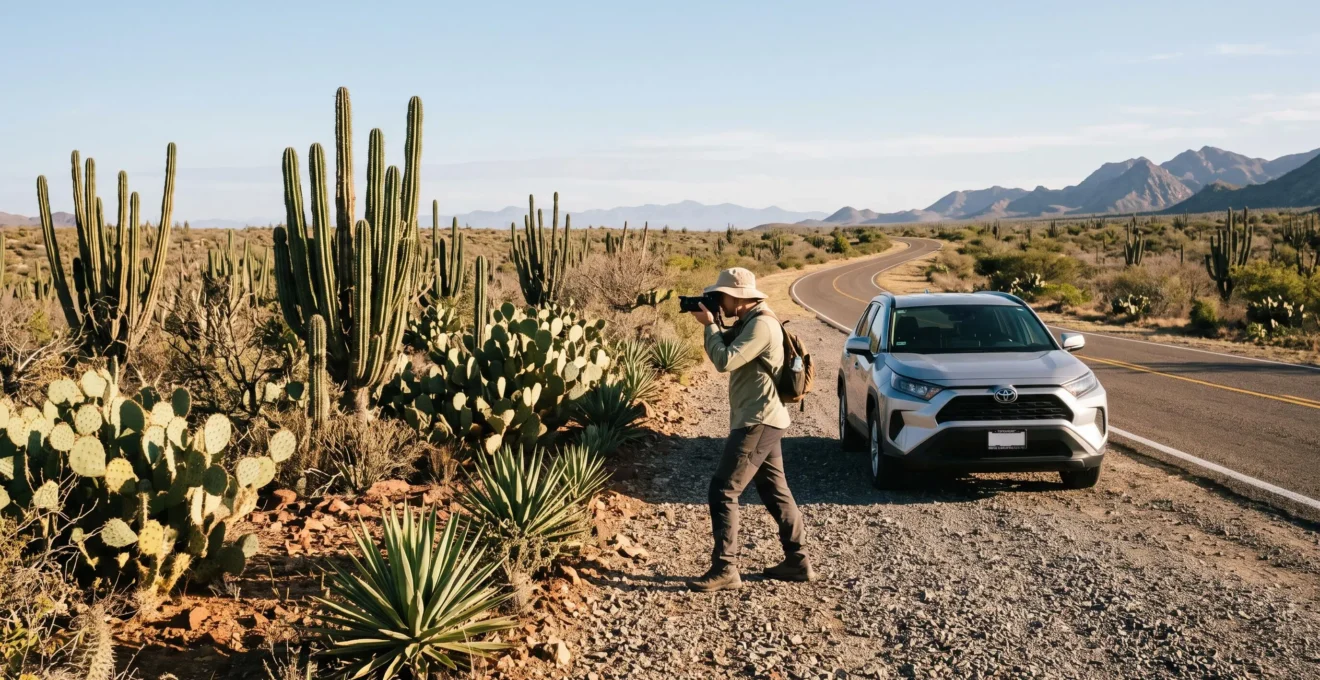
A Mexican desert can look almost empty through a car window. Stop somewhere safe, however, and the landscape becomes an extraordinary collection of living survival machines. Towering cacti store water inside their stems, agaves arrange sharp leaves into architectural rosettes, and apparently lifeless shrubs can produce fresh foliage after rain.
These plants are far more interesting than oversized versions of the succulents displayed in a British garden centre. Their shapes tell stories about scarce rainfall, intense sunlight, unpredictable seasons and the animals that depend on them.
For travellers crossing Baja California, Sonora or the Chihuahuan Desert, recognising just five plant forms can transform an otherwise forgettable drive. The secret is knowing what to look for, when flowers might appear and where it is safe to stop.
Desert exploration also demands restraint. Fragile soils, protected species, sharp spines and remote roads mean that the best encounters happen with a camera, a little patience and no disturbance to the plants themselves.
Mexican desert plants: what travellers should know
- Many desert plants survive prolonged drought through water storage, reduced leaves, protective surfaces and specialised photosynthesis, but their resilience varies considerably by species.
- Five distinctive shapes—columns, barrels, paddles, rosettes and woody canes—provide an accessible introduction to identifying desert vegetation.
- Spring is often promising for wildflowers in some desert regions, but rainfall, local climate, road safety and conservation restrictions matter more than a fixed travel date.
- Why Can Some Mexican Desert Plants Survive 18 Months Without Rain and Still Flower?
- How to Identify 5 Mexican Desert Plant Types on a Roadside Stop Using Shape Alone?
- Which Is Better for Learning: A Roadside Desert Stop or a Botanical Garden in Mexico?
- The Desert Plant Mistake That Can Mean Spine Injuries or a Fine You Didn’t See Coming
- When Should You Visit Mexican Deserts to Catch Rare Flower Blooms Without Facing Extreme Heat?
- How to Spot Hidden Wildlife in Mexican Scrublands Without Binoculars or a Guide?
- How to Check if a Mexican Road Is Safe to Drive Before Committing Your Itinerary?
- Why a 100-Mile Drive in Mexico Can Take 4 Hours in One Region and 90 Minutes in Another
Why Can Some Mexican Desert Plants Survive 18 Months Without Rain and Still Flower?
Some Mexican desert plants can endure exceptionally long dry periods because they store water, limit evaporation and slow their metabolism when conditions become harsh. Flowering after drought may be triggered by rainfall or seasonal biological rhythms. However, surviving 18 months without rain is not a universal capability: species, soil conditions, temperature and water reserves determine how long any individual plant persists.
Start with a cactus stem. Unlike the thin stems of many familiar garden plants, a cactus may possess substantial water-storing tissue surrounded by a protective outer surface. Its waxy skin helps reduce moisture loss, while spines replace the broad leaves that would otherwise expose more surface area to drying air.
Many cacti also use Crassulacean Acid Metabolism (CAM), a specialised form of photosynthesis. Instead of opening their stomata primarily during the day, these plants can take in carbon dioxide at night, when temperatures are generally lower and water loss is reduced.
The carbon dioxide is temporarily stored in chemical form and used during daylight for photosynthesis. This strategy comes with physiological trade-offs, including relatively slow growth, but it makes efficient use of scarce moisture.
The National Park Service’s explanation of desert succulents describes these adaptations in Big Bend National Park, part of the Chihuahuan Desert ecosystem that extends into Mexico.
Not every desert plant follows the same strategy. Agaves and other succulents store water in different tissues, while some woody plants reduce their foliage or become dormant during drought. Others survive unfavourable conditions as seeds until rainfall permits germination.
Flowering is a separate survival decision. A rainstorm may activate flowering in certain species, but other cacti and shrubs follow more regular seasonal schedules. Ocotillo, for example, can produce flowers without requiring the same rainfall sequence that triggers widespread annual wildflower displays.
This explains why a seemingly lifeless landscape can suddenly contain vivid flowers. It does not mean that every plant flowers immediately after rain, nor that every cactus can survive an uninterrupted drought lasting 18 months.
In a UK garden centre, a cactus is often protected from prolonged exposure to environmental extremes. Regularly managed watering, temperatures and growing conditions can make its survival adaptations less obvious. In the Mexican wilderness, those same structures and physiological processes are essential to life.
Once these mechanisms become visible, a cactus stops looking like a curious ornamental object and starts looking like an exceptionally specialised solution to a difficult environment. Its shape is the first clue to how it survives.
How to Identify 5 Mexican Desert Plant Types on a Roadside Stop Using Shape Alone?
You can recognise five common Mexican desert plant forms without knowing their scientific names: towering columnar cacti, rounded barrel cacti, paddle-shaped prickly pears, rosette-forming agaves and woody plants with slender upright canes. Focus on the overall silhouette before examining finer details. Shape will identify a useful group, although confirming the exact species usually requires additional evidence.
Choose a safe, designated stopping area with a clear view of the vegetation. From firm ground, scan the landscape from tall structures to low-growing plants. The differences become easier to recognise when you compare several individuals rather than studying one isolated specimen.
These five visual categories provide a practical starting point:
- Columnar cacti: Look for tall, vertical, often ribbed stems. Cardón and organ pipe cacti are striking examples in northwestern Mexico. Branching patterns can help distinguish them, but a distant saguaro-like silhouette does not automatically identify a saguaro.
- Barrel cacti: Look for compact, rounded or cylindrical bodies with pronounced ribs and spine clusters. Some grow taller with age, so a barrel is not necessarily perfectly spherical.
- Prickly pears: Look for flattened, paddle-like stem segments. These belong to the Opuntia group and may carry both obvious spines and tiny, difficult-to-see barbed glochids.
- Agaves: Look for a dense rosette of stiff, pointed leaves emerging from a central base. Unlike most cacti, their prominent structures are leaves rather than swollen green stems.
- Woody shrubs and cane-forming plants: Look for thin stems or branches rather than thick succulent bodies. Ocotillo is a particularly memorable example, with long upright canes that can develop small leaves following suitable rainfall.
Agaves are sometimes confused with aloes because both can form pointed rosettes, although the two groups have different botanical structures. Many agaves also have a remarkable reproductive strategy: after years of vegetative growth, a mature rosette typically produces a major flowering stalk and then dies, potentially leaving offsets or seedlings behind.
Ocotillo offers another useful lesson. Its leaf-covered canes can look surprisingly lush after rain, while the same plant may appear almost dead in a dry period. Despite its dramatic appearance, ocotillo is not a cactus.
Identification becomes more rewarding when repeated across different landscapes. A columnar cactus in Baja California may differ substantially from plants encountered farther inland, even where the broad growth form appears similar.
Try taking one photograph of each shape in every region you visit, including enough surrounding habitat to document the setting. Compare proportions, branching, spacing and neighbouring plants later rather than relying on uncertain roadside guesses.
A final precaution concerns the ground itself. What looks like an empty, crusty patch of soil may contain biological soil crusts or tiny plants vulnerable to trampling. Remain on established surfaces, avoid entering vegetation and use a zoom lens instead of moving closer.
Once these basic forms become familiar, a botanical garden can help turn visual recognition into more confident identification, particularly when several species share similar shapes.
Which Is Better for Learning: A Roadside Desert Stop or a Botanical Garden in Mexico?
A botanical garden is generally better for learning species names and comparing unfamiliar plants, while a carefully chosen roadside stop is better for understanding how desert vegetation grows naturally. Gardens provide labels and organised collections; wild habitats reveal plant spacing, exposure, soil conditions and ecological relationships. For curious travellers, combining both experiences usually teaches more than choosing only one.
Imagine standing beside a tall cardón in its natural habitat. Its height becomes meaningful when compared with nearby shrubs and rocky ground. You can observe how large plants are distributed across slopes, where smaller species establish themselves and how different forms occupy the same landscape.
That ecological context is difficult to reproduce fully in a curated collection. The surrounding vegetation, exposed soil and natural variation help explain why desert plants look the way they do.
A botanical garden offers a different advantage: reliable identification and structured comparison. Labelled collections allow visitors to examine several plant groups without travelling between distant habitats. A specialist collection may also include rare or threatened species that visitors would be unlikely to encounter responsibly on an ordinary roadside stop.
Gardens and specialist plant collections in regions such as Oaxaca and Baja California can be worthwhile additions to a botanical itinerary, provided their current collections, access conditions and opening arrangements are checked in advance.
The comparison becomes clearer when time, comfort and learning objectives are considered together.
| Criterion | Roadside desert stop | Botanical garden |
|---|---|---|
| Plant identification | Visual recognition without guaranteed labels | Usually supported by labels or curated information |
| Ecological context | Natural plant communities and terrain | Managed collections with selected growing conditions |
| Accessibility | Depends on safe and permitted stopping locations | Defined visitor access and opening arrangements |
| Cost | Often no admission charge, though travel costs remain | Possible entrance or guided-visit fees |
| Facilities | Frequently no toilets, shade or drinking water | May provide paths, facilities and visitor information |
| Best learning outcome | Understanding natural survival and distribution | Building botanical knowledge and comparing species |
The most productive approach is to visit a garden before a desert drive. Identify five or six broad plant types, photograph their labels where permitted and learn their distinguishing features. During subsequent road stops, try to recognise those forms growing naturally.
This reverses the usual sequence of discovering something unfamiliar and searching for its name afterwards. It also reduces the temptation to leave safe viewing areas simply to investigate an interesting plant more closely.
Neither experience is inherently superior in every circumstance. A specialist garden may offer more learning during a short visit, whereas a safe stop in a distinctive wild habitat can be unforgettable even without detailed species identification.
Whichever setting you choose, avoid treating plants as interactive exhibits. The same spines, sharp leaf margins and protective rules that preserve desert vegetation can also make careless photography an expensive mistake.
The Desert Plant Mistake That Can Mean Spine Injuries or a Fine You Didn’t See Coming
The most avoidable desert plant mistake is moving too close, touching unfamiliar vegetation or collecting a specimen as a souvenir. Cholla segments, prickly pear glochids and sharp agave leaves can injure visitors, while taking protected plants or plant material may violate conservation or collection rules. Photograph plants where they grow, check your footing and leave every specimen undisturbed.
Desert plants rarely need to be handled to cause trouble. A traveller stepping backwards for a photograph can brush against a cactus that was hidden outside their field of vision. Loose clothing or a backpack strap can also catch on spiny vegetation.
Cholla cacti are particularly troublesome because some species have readily detached segments covered in barbed spines. A casual brush can leave part of the plant attached to clothing or skin.
Prickly pears present a subtler hazard. Their tiny glochids may be much less visible than large cactus spines, yet can lodge in skin and prove difficult to remove.
Agaves pose a different risk. Their rigid terminal points and sharp leaf edges can cause punctures or cuts when someone leans into a rosette.
Prevention starts before the photograph: identify a stable place to stand, check the vegetation around your feet and legs, then compose the image without moving backwards into unfamiliar plants.
If a superficial cactus spine becomes embedded, avoid rubbing the area or grabbing barbed spines with bare fingers. Visible, accessible spines may sometimes be removed carefully with clean tweezers. Clusters of fine glochids or deeply embedded material may require medical assistance; improvised removal methods can push fragments farther into the skin or worsen irritation.
For a large attached cholla segment, avoid direct finger contact. A comb or suitable tool may help separate a loosely attached segment while keeping hands away from the spines, but embedded spines and significant injuries should be assessed professionally.
Seek medical help for deep punctures, injuries near the eyes, persistent embedded spines, significant bleeding or signs of infection. A first-aid kit is useful, but it does not replace professional assessment when a wound is serious.
There is also a legal dimension. Mexico maintains official conservation-risk categories for native wild flora and fauna through Mexico’s official NOM-059 endangered-species standard record.
This does not mean every Mexican cactus or agave has the same protected status. Requirements depend on the species, the location, applicable collection rules and any necessary authorisations. Protected plant material may also be subject to international trade controls and destination-country import requirements.
Consequently, taking seeds, cuttings or whole plants should never be treated as an ordinary souvenir activity. A photograph provides a far better record without creating conservation damage or uncertainty at a border.
The safest botanical encounters leave no physical trace. That approach becomes particularly rewarding during flowering periods, when plants can be observed alongside the insects and birds that visit them.
When Should You Visit Mexican Deserts to Catch Rare Flower Blooms Without Facing Extreme Heat?
Late winter through spring can offer a rewarding combination of flowering plants and more comfortable outdoor temperatures in parts of Mexico’s northern deserts. However, the best period depends on the particular desert, its recent rainfall and the species you hope to see. Summer rains also stimulate flowering in some regions, while exceptional mass wildflower displays cannot be guaranteed in advance.
The central mistake is assuming that Mexico’s deserts share one flowering calendar. Baja California includes areas influenced strongly by winter rainfall, while parts of the Sonoran and Chihuahuan deserts receive substantial summer precipitation. Elevation and local temperature patterns add further variation.
For spring wildflowers, rain during the preceding growing season can be critical. Seeds may remain dormant until suitable moisture and temperature conditions allow germination, followed by enough favourable weather for the plants to mature and flower.
The Arizona-Sonora Desert Museum’s plant ecology chapter explains how flowering in the Sonoran Desert differs between annual wildflowers, perennial shrubs and cacti.
In the Arizona Upland subdivision of the Sonoran Desert, the documented spring flowering period generally extends from mid-February to mid-June, with a typical peak between mid-March and late April. These dates describe a particular ecological region and should not be applied automatically to the whole Mexican desert landscape.
Some cacti and shrubs flower relatively predictably according to their species-specific cycles. Other species respond quickly to rainfall, and seasonal summer rains can produce another period of flowering.
Exceptional displays of annual wildflowers require more particular conditions. An unusually wet period alone may not be enough if germination temperatures, rainfall timing or subsequent growing conditions are unfavourable.
Treat a spectacular bloom as a possibility, not a booking guarantee. Travellers who plan around the scenery, plant forms and broader desert ecology can enjoy the experience even when the wildflowers are sparse.
Mid-March to late April
The typical spring flowering peak described for the Arizona Upland subdivision of the Sonoran Desert. Timing varies with rainfall, temperature and location; this is not a nationwide Mexican flowering forecast.
Arizona-Sonora Desert Museum, Plant Ecology of the Sonoran Desert Region.
Timing within the day is equally important. Early morning generally offers more comfortable conditions for walking and observing plants before strong sunshine increases heat exposure. Some flowers open at particular times of day or night, however, so not every cactus bloom is best viewed at dawn.
Flowering plants may also attract pollinators, making a short observation stop worthwhile. Keep a respectful distance and avoid disturbing insects, birds or other animals visiting the flowers.
Before committing to a particular date, examine the rainfall pattern of the exact region, check recent local flowering reports where available and consider the forecast temperature for the planned viewing hours.
Even outside the main flowering windows, fruiting cacti and perennial vegetation support wildlife. Learning to recognise these relationships opens another way to appreciate landscapes that initially seem empty.
How to Spot Hidden Wildlife in Mexican Scrublands Without Binoculars or a Guide?
The easiest way to find wildlife in Mexican scrublands is to look for evidence of animals before searching for the animals themselves. Burrows, tracks, chewed fruit, nests and holes in cactus stems reveal activity that may otherwise remain invisible. Early morning, late afternoon and several minutes of quiet observation can improve your chances of seeing wildlife without specialised equipment.
A desert shrub may appear motionless, but the ground beneath it can tell a different story. Tracks crossing a dusty patch suggest recent movement, while an opening beneath vegetation may indicate a burrow or shelter.
Look for five especially useful signs:
- Tracks in sand or fine dust, particularly along natural movement corridors.
- Burrow entrances near shrubs, rocks or protected patches of ground.
- Partly eaten cactus fruits or scattered plant material.
- Cavities in large cacti that may be used by birds or other animals.
- Spider webs stretched between branches, sometimes most visible in angled morning light.
These signs do not identify an animal with certainty. Old tracks can remain visible after the animal has moved elsewhere, and different species may use similar shelters. Treat them as clues rather than proof of a particular encounter.
Plants provide another useful guide. Flowering cacti, agaves and other desert vegetation can attract insects and nectar-feeding animals. Fruiting plants may draw birds and small mammals, while shaded vegetation can offer shelter to lizards during warmer parts of the day.
Instead of walking continuously, choose a safe observation point and remain still for several minutes. Movement and conversation can cause animals to retreat or freeze, whereas patient observation sometimes reveals activity that was present all along.
Watch the edges of vegetation and the transitions between shade and open ground. Small changes—a bird landing, a lizard moving across a stone or an insect visiting a flower—are often easier to detect than an animal concealed inside dense cover.
Never reach into burrows, beneath rocks or inside cactus cavities. These are potential shelters for snakes, scorpions and other animals that should not be disturbed. Avoid lifting rocks, moving dead wood or approaching occupied nests.
Desert wildlife can also be vulnerable to heat and stress. Keep your distance, do not feed animals and resist the temptation to pursue an individual for a closer photograph.
For travellers without binoculars, a phone camera with optical zoom may help document an encounter, but observation should always take priority over obtaining a perfect image.
A short wildlife stop is worthwhile only if the location itself is suitable. Before leaving the vehicle, consider whether the road, shoulder and surrounding area are genuinely safe for an unplanned break.
How to Check if a Mexican Road Is Safe to Drive Before Committing Your Itinerary?
Check a Mexican road in two separate ways before including it in your itinerary: assess current regional security conditions and verify the physical condition of the specific route. Then confirm fuel availability, mobile coverage, vehicle suitability and daylight driving time. A paved road is not automatically secure, and a region with acceptable security conditions can still contain difficult or damaged roads.
Begin with official travel advice relevant to your nationality. For UK travellers, the Foreign, Commonwealth & Development Office is the appropriate starting point for British government travel guidance. Other national advisories can provide useful additional perspectives, but they may differ in scope and recommendations.
The U.S. State Department’s Mexico travel advisory distinguishes security conditions by region and recommends daytime intercity driving. It also generally favours toll roads over free roads and warns that mobile reception and roadside assistance can be unreliable in remote areas.
These recommendations are useful reference points, not guarantees that every toll road is safe or that conditions remain unchanged. Restrictions applying specifically to U.S. government employees should not be mistaken for general Mexican traffic laws.
Next, examine the actual road. Mexican federal road authorities and the Guardia Nacional may publish relevant information about closures, incidents or travel conditions. Check current official updates, then compare them with recent route-specific reports and navigation information.
Look separately for surface damage, roadworks, seasonal washouts, flooding, unpaved sections and potential security concerns. Recent traveller comments can help identify questions worth checking, but they are not substitutes for authoritative safety information.
Remote desert roads require particular care. A route that appears straightforward on a map may include long distances between reliable fuel stations, limited telephone signal and sections unsuitable for an ordinary rental car.
Five checks before approving a Mexican desert driving route
- Verify regional security: consult current official travel advice and record the date checked, the route’s states and any relevant warnings.
- Confirm the road condition: review official road updates and recent route-specific information; save the identified closures, surface concerns or unresolved uncertainties.
- Mark essential services: identify fuel stops and possible assistance points along the intended route, producing a map with planned refuelling locations.
- Check the vehicle and timing: verify whether the route includes unpaved sections and whether the vehicle is suitable; record an intended daylight arrival time.
- Approve safe stopping options: identify one or two legal, established pull-offs where vegetation can be viewed without obstructing traffic; save their locations before departure.
The goal is not to eliminate every possible travel risk through a checklist. It is to identify problems early enough to choose another road, adjust the schedule or abandon an unsuitable botanical stop.
For desert travel, daylight has two advantages: obstacles and livestock are easier to see, and a mechanical problem is generally easier to address before nightfall. Carry drinking water, ensure your phone is charged and avoid relying on continuous network coverage.
Once a suitable route has been identified, the next challenge is allocating realistic travel time. On Mexican roads, distance alone can be surprisingly misleading.
Key takeaways before planning your driving day
- Choose roads using current security assessments, surface conditions and available services—not simply the shortest mapped distance.
- Allow time for slower roads, town crossings and weather-related changes before adding optional desert plant stops.
- Make botanical stops only where parking is permitted, the shoulder is suitable and the surrounding terrain can be observed without entering fragile habitat.
Why a 100-Mile Drive in Mexico Can Take 4 Hours in One Region and 90 Minutes in Another
A 100-mile journey in Mexico can take dramatically different amounts of time because road type, terrain, traffic and settlement patterns vary substantially. A modern toll motorway may allow efficient travel, while a winding free road through mountains and villages can be much slower. The four-hour versus 90-minute comparison is illustrative, not a verified journey-time estimate for any particular Mexican route.
Mexico’s principal road network includes toll roads, commonly called cuotas, and free roads, known as libres. The two can offer very different driving experiences even when they connect broadly similar destinations.
A major toll motorway may provide divided carriageways, more consistent road geometry and fewer direct crossings through towns. A free road may follow older alignments, pass through settlements and require frequent changes of speed.
Topes, the speed bumps commonly encountered on Mexican roads, can slow journeys through villages and built-up areas. Curves, steep gradients, local traffic and heavy vehicles can add further delays.
Terrain matters just as much. A road crossing an open desert plain may provide a completely different driving experience from one climbing through rugged mountains. Even short distances can involve substantial elevation changes and narrow winding sections.
For travellers interested in desert plants, this creates an important planning distinction: the fastest road is not necessarily the most botanically interesting road, but an attractive landscape does not justify choosing an unsafe or unsuitable route.
Free roads may pass closer to natural vegetation and rural landscapes, making it easier to notice changing plant communities. However, stopping opportunities must be assessed individually. A narrow road without a safe shoulder is not an appropriate place to pull over, regardless of the surrounding scenery.
Consider a hypothetical journey of 100 miles. If one route uses a largely uninterrupted high-standard motorway and another passes through repeated settlements and mountainous sections, their estimated times could differ substantially. The actual figures must come from current routing information rather than an assumed national average speed.
Use a mapping application to compare the available routes for each journey leg, including whether toll roads are selected. Examine the road geometry, likely stopping points and the route’s expected duration at the intended departure time.
Then allow additional time for fuel, meals, rest and any optional nature observations. Navigation estimates do not necessarily account for the time spent photographing a flowering cactus or watching birds around a fruiting prickly pear.
A sensible botanical itinerary might include one planned natural-history stop and leave room for a second only if the day is progressing comfortably. This creates flexibility without making travellers dependent on unpredictable roadside opportunities.
Before your next Mexican desert drive, choose a verified daylight route, identify a suitable stopping place and learn the silhouettes of five local plant groups. A few minutes of careful observation can reveal an extraordinary living landscape without touching, collecting or disturbing a single plant.
Can you identify a Mexican cactus reliably from a photograph?
A photograph can often establish a broad cactus group, especially when the whole plant, its branching pattern, ribs and spines are visible. Exact species identification may require additional characteristics, habitat information or specialist verification. Avoid naming a species confidently from silhouette alone.
Are all Mexican desert plants cacti?
No. Mexican desert vegetation includes cacti, agaves, yuccas, woody shrubs, drought-adapted trees, grasses and seasonal wildflowers. Some unrelated plants have evolved similar shapes because they face comparable environmental pressures. Agaves and ocotillos, for example, are not cacti.
Should visitors bring a specialist camera for desert plant photography?
No specialist camera is essential for introductory desert photography. A smartphone can capture silhouettes, flowers and wider landscapes. Optical zoom is useful when a plant cannot be approached safely. Good lighting, stable footing and respectful distance matter more than expensive equipment.
Can cactus seeds or cuttings be brought back to the UK?
Do not collect seeds or cuttings from wild Mexican plants without establishing that collection is lawful and properly authorised. International movement of plant material may involve phytosanitary requirements, conservation controls and permits, depending on the species and material. UK import rules and applicable international protections should be checked through the relevant authorities before any purchase or transport. Leaving wild plants undisturbed is the safest approach.
Are Mexican deserts worth visiting when no wildflowers are blooming?
Yes. Columnar cacti, sculptural agaves, drought-adapted shrubs and distinctive geological settings remain interesting outside flowering periods. Plant shapes, natural spacing, traces of wildlife and differences between regional desert habitats can make a visit rewarding even when seasonal flowers are absent.