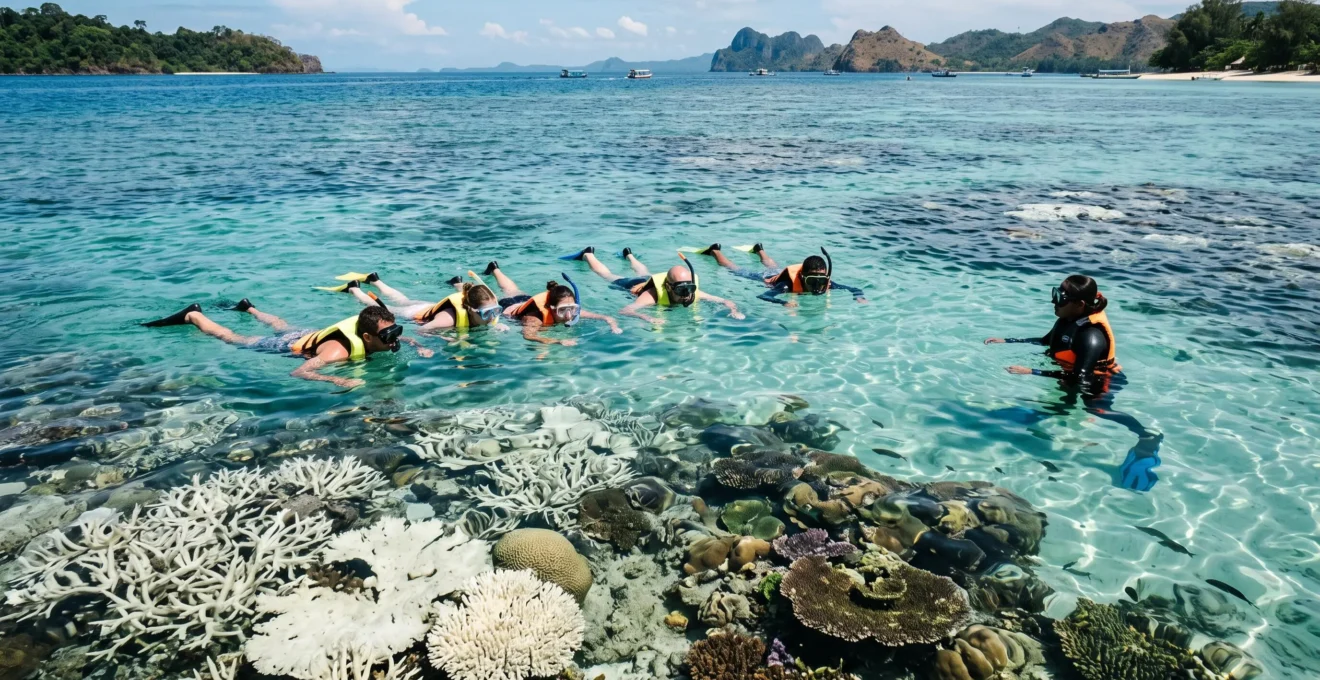
The coral reef beneath your snorkelling mask may look spectacular, yet its appearance reveals surprisingly little about its long-term survival. Across the Caribbean, rising sea temperatures, coral disease, pollution and poorly managed tourism are placing overlapping pressures on ecosystems that cannot recover quickly from every disturbance.
Mexico’s reefs are especially important to travellers visiting Cozumel, Puerto Morelos and other Caribbean coastal destinations. National-park boundaries offer legal protections, but their effectiveness also depends on local management, operators and visitor behaviour.
There is no scientific basis for guaranteeing that a particular Mexican reef will disappear within ten years. The danger is nevertheless substantial. The International Coral Reef Initiative reported that bleaching-level heat stress had affected 84% of the world’s reefs between January 2023 and March 2025. That figure describes global heat exposure, not coral mortality or Mexico’s individual reefs.
For travellers who want to experience marine wildlife without contributing unnecessarily to its decline, the most useful response is practical: choose operators whose practices can be checked, maintain distance from coral, plan around local conditions and understand protected-area rules before arriving.
Responsible reef snorkelling in Mexico: the essentials
- Protected status is not a guarantee of reef health. Verify operator authorisation and conservation practices rather than relying on an eco-friendly label.
- Keep hands, feet and fins away from coral. Select a guided experience that matches your swimming ability and offers appropriate flotation support.
- Check the specific site’s access restrictions, weather conditions, sunscreen rules and official visitor requirements before booking.
- Why Are Mexico’s Coral Reefs Declining Despite Being « Protected » on Paper?
- How to Pick a Reef-Friendly Snorkel Operator in Mexico Using 4 Non-Obvious Checks
- Which Is Less Damaging to Coral: Shore-Access Snorkelling or a Boat Trip to an Offshore Reef?
- The Single Snorkelling Habit That Destroys More Coral Than Boat Anchors in Mexico
- When Should You Snorkel Mexican Reefs for the Clearest Water and Fewest Tour Groups?
- How to Vet a Reef Snorkel Tour in Mexico in 10 Minutes Without Overpaying
- How to Prepare for a Protected Lagoon Visit in Mexico Without Getting Turned Back at Entry
- How to Visit Mexico’s Protected Lagoons Without Breaking the Rules You Didn’t Know Existed
Why Are Mexico’s Coral Reefs Declining Despite Being « Protected » on Paper?
Mexico’s coral reefs can deteriorate despite national-park protection because legal designation cannot eliminate ocean warming, disease, polluted runoff or every damaging visitor activity. Protected-area rules provide an essential framework, but their effectiveness depends on implementation and compliance. A protected reef may therefore remain ecologically vulnerable even when tourism is formally regulated.
Consider Arrecifes de Cozumel National Park. Its official regulations require visitors to remain at least 1.5 metres from coral, prohibit anchoring and reef contact, and require authorised boats and guides. These are specific, enforceable conservation requirements rather than general environmental aspirations.
However, the existence of rules cannot establish how consistently every vessel or visitor follows them. Neither does it prove that protection has removed the threats originating beyond the park’s boundaries.
According to ICRI’s April 2025 report on the fourth global coral bleaching event, the extent of bleaching-level heat stress reflects a major worldwide environmental threat. Bleaching occurs when stressed corals lose their symbiotic algae, although bleached coral is not necessarily dead and may recover if conditions improve.
84%
Of the world’s coral reefs were affected by bleaching-level heat stress between 1 January 2023 and 30 March 2025. This is a global measure of heat exposure, not a Mexican coral mortality rate.
International Coral Reef Initiative, April 2025, reporting NOAA Coral Reef Watch monitoring.
Another threat is stony coral tissue loss disease, which affects numerous Caribbean coral species and can cause rapid loss of living tissue. Its precise cause remains unresolved. Coastal development, sediment, wastewater and other pollutants can further degrade reef conditions.
Some problems are obvious underwater: broken branches, exposed skeletons or widespread bleaching. Others are difficult to recognise during a short snorkelling excursion. A visually colourful reef is not necessarily free from disease, ecological imbalance or declining resilience.
Tourism is therefore one manageable pressure among several. Visitors cannot reverse ocean warming through careful snorkelling, but they can avoid adding direct physical damage and support businesses that operate within conservation rules.
The practical question is not whether a destination calls itself protected, but whether the people taking visitors onto the reef demonstrate responsible conduct.
How to Pick a Reef-Friendly Snorkel Operator in Mexico Using 4 Non-Obvious Checks
A reef-friendly snorkel operator in Mexico should demonstrate four observable practices: avoiding coral anchoring, delivering a specific conservation briefing, supervising manageable groups and holding the necessary local authorisations. Certifications may provide additional reassurance, but no badge replaces direct evidence of what the crew does before and during an excursion.
Check 1: Find out exactly how the boat stays in place.
Ask whether the operator uses established mooring buoys where permitted or follows another authorised method that avoids reef contact. A reassuring answer describes a real procedure, not simply a commitment to protecting nature.
At Cozumel’s protected reefs, anchoring is prohibited. An operator who suggests dropping an anchor onto the reef is not offering a responsible alternative.
Check 2: Judge the briefing before anyone enters the water.
A worthwhile briefing explains how to avoid standing on coral, keep fins elevated, prevent accidental contact and refrain from feeding fish. It should also explain how guests can rest safely and what to do if their equipment needs adjusting.
Detailed instructions are a useful signal, but the decisive test is whether the guide acts when someone behaves unsafely near coral.
Check 3: Look beyond group size to active supervision.
There is no universally established ideal snorkeller-to-guide ratio for every Mexican reef. Conditions differ according to water depth, currents, experience levels and site restrictions.
Ask how many guests enter the water with each guide, whether beginners receive additional assistance and how the group is managed around shallow coral.
Recent reviews can reveal whether guides actively intervene when visitors touch or approach the reef. Descriptions of actual behaviour are generally more informative than an overall star rating.
Check 4: Verify permissions and interpret eco-certifications cautiously.
Official authorisation matters wherever protected-area regulations require it. At Cozumel, for example, visitors must use boats and guides authorised by the Mexican protected-area authority, CONANP.
An environmental certificate or conservation affiliation may be valuable supporting evidence. However, its significance depends on the issuing organisation, its scope, current validity and whether operating practices match the claims.
Neither certification nor authorisation guarantees flawless conduct on every trip. Both should be paired with the first three checks.
The right operator also depends on the nature of the excursion. A carefully managed boat trip may be preferable to unrestricted shore access, but that distinction requires examining the actual reef conditions.
Which Is Less Damaging to Coral: Shore-Access Snorkelling or a Boat Trip to an Offshore Reef?
Neither shore-access snorkelling nor a boat trip is automatically less damaging to coral. Shore entry can harm shallow reefs through trampling, fin contact and disturbed sediment. Boats introduce other pressures, including anchoring, fuel use and concentrated visitor traffic. The lower-impact choice depends on site rules, habitat depth, visitor experience and operator practices.
Shore snorkelling initially appears environmentally attractive because it can avoid a dedicated boat journey. Yet shallow coral may lie directly beneath an entry route or within easy reach of someone who needs to stand.
Repeated disturbance at a popular access point can turn an apparently harmless choice into sustained local pressure.
Boat access can offer more suitable water depth for competent swimmers and allow guides to supervise an organised group. But this advantage disappears if the vessel anchors on coral, the group is overcrowded or participants cannot stay comfortably afloat.
The following comparison is a practical decision framework, not a scientific ranking of environmental damage.
| Decision factor | Shore-access snorkelling | Guided boat excursion |
|---|---|---|
| Coral-contact risk | Potentially high at shallow entry points | Depends on water depth, supervision and swimming ability |
| Transport pressure | Can avoid a dedicated boat trip | Includes vessel operations and associated impacts |
| Beginners and children | Suitable only where entry, conditions and reef separation are safe | May offer flotation and close supervision, if properly organised |
| Visitor concentration | May crowd a small accessible area | May concentrate groups at popular offshore sites |
| Protected-area compliance | Allowed only where site access rules permit | May require authorised vessels, guides and designated locations |
For confident swimmers, an appropriately managed deeper-water site may reduce accidental contact. For beginners, choosing an accessible location with sufficient depth, designated entry areas and reliable supervision may be more important than avoiding a boat.
Families should also consider whether children can remain afloat without standing. A child who needs a break should have a safe resting option away from coral, regardless of how the group reached the site.
Local access restrictions always take priority. Never assume that reaching a beach grants permission to swim over adjacent protected habitat.
Crowding complicates the decision further. If many visitors use the same narrow entry route, repeated contact may become a problem even when each individual believes their impact is negligible.
Whichever route you choose, the most immediate avoidable danger often comes from how snorkellers position their bodies above the reef.
The Single Snorkelling Habit That Destroys More Coral Than Boat Anchors in Mexico
Standing on coral or grabbing the reef to rest is one of the most preventable damaging snorkelling habits. Repeated contact can break fragile structures and injure living tissue. Although cumulative visitor contact may be substantial at busy sites, available evidence does not establish that snorkellers cause more total coral damage than boat anchors across Mexico.
The habit is often unintentional. A mask fills with water, someone becomes tired, a fin slips or a beginner feels uncomfortable away from the seabed. Reaching for a solid-looking coral formation may seem like a natural response.
But coral is not ordinary rock. Living colonies contain delicate animals whose tissues can be damaged by contact. Branching structures may break under relatively small forces, while fin movements can disturb sediments that settle over surrounding organisms.
The consequences extend beyond the instant of contact. Physical damage can reduce the amount of living coral and create additional stress. Recovery depends on species, environmental conditions and the severity of injury; substantial structural regrowth may take years or longer.
That does not mean touching coral has been proven to transmit stony coral tissue loss disease. NOAA’s disease research describes complex transmission mechanisms and unresolved causes. Direct contact should be avoided without exaggerating what the disease evidence establishes.
Prevention begins before entering the water. Adjust your mask and fins, check that flotation equipment fits properly, and ask the guide where you should rest if necessary.
Once snorkelling, maintain a horizontal position with fins clear of the coral. If you need to stop, float on your back when conditions and your ability allow, or use a designated flotation line or guide-supported resting method where available.
NOAA Fisheries explicitly recommends keeping hands and fins away from reefs, avoiding sediment disturbance and preventing boats from anchoring on coral. These practices are explained in NOAA Fisheries’ shallow coral reef conservation guidance.
Social situations matter too. If someone repeatedly touches the reef, a calm question to the guide is preferable to an argument underwater: « Could you help us keep everyone clear of the coral? »
After the tour, report any persistent failures to intervene. Specific feedback about what happened is more actionable than simply describing an excursion as environmentally unfriendly.
Reducing direct contact is an immediate responsibility. Choosing when to visit can also influence crowding and the conditions in which visitors interact with fragile habitat.
When Should You Snorkel Mexican Reefs for the Clearest Water and Fewest Tour Groups?
The best snorkelling time in Mexico depends on whether you prioritise underwater visibility, calmer conditions or fewer visitors. Rainfall, wind, waves and runoff influence clarity, while cruise schedules and holiday periods influence crowding. An early departure can be useful, but the safest and clearest conditions must be checked locally rather than assumed from a calendar.
On Mexico’s Caribbean coast, seasonal rainfall, tropical storms and changes in wind direction can affect water conditions. The Atlantic hurricane season generally runs from June through November, but it does not follow that every day during those months is unsuitable for snorkelling.
Likewise, a relatively dry period does not guarantee excellent underwater visibility. Recent wind, swell, disturbed sediment and local runoff can alter conditions even when the weather above the surface looks pleasant.
Separate visibility from crowd avoidance. These are related but different planning questions.
- For clearer water, ask about recent visibility, wind exposure and local sea conditions rather than relying exclusively on seasonal averages.
- For fewer groups, investigate cruise-ship arrival days, school holidays and how many excursions visit the same reef.
- For a less crowded experience, consider early departures when weather and site conditions are suitable, while recognising that popular operators may still arrive together.
Early excursions may benefit from calm morning conditions at some sites. However, wind and current patterns are location-specific, and there is no universal guarantee that the first departure has the clearest water.
Timing also has a conservation dimension. Heat stress can cause coral bleaching during periods of unusually warm water. A reef experiencing substantial thermal stress may have less capacity to cope with additional disturbances.
Travellers should check recent reef-status notices, operator updates and protected-area closures before booking. These sources are more useful for immediate decisions than a generic promise of perfect conditions in a particular month.
A responsible operator should explain when an excursion needs to change or be cancelled because conditions are unsuitable. A willingness to avoid unsafe or sensitive areas is a positive operational signal.
Once the destination and timing are reasonably clear, a short verification routine can help identify a suitable tour without paying extra for unsupported environmental claims.
How to Vet a Reef Snorkel Tour in Mexico in 10 Minutes Without Overpaying
You can assess a Mexican reef snorkel tour in roughly ten minutes by checking its advertised practices, reading recent reviews, confirming protected-area requirements and asking two direct questions. The goal is not to find the cheapest or most expensive excursion, but to establish whether the price includes meaningful supervision, lawful access and observable reef protection.
Start with the operator’s own description. Look for specifics such as the use of approved moorings, guides accompanying swimmers, appropriate flotation equipment and clear rules about coral contact.
Descriptions dominated by words such as sustainable, exclusive or eco-conscious without explaining how the excursion operates should prompt further questions.
Next, examine recent reviews. Search for accounts of the safety briefing, group management, interactions with wildlife and whether guides corrected unsafe behaviour. Avoid treating an isolated complaint or a high average rating as definitive proof.
Then check whether the destination requires authorised guides, vessels or protected-area entry arrangements. Rules can differ between locations, so information for one marine park should not automatically be applied elsewhere.
For Cozumel, CONANP’s visitor regulations for Arrecifes de Cozumel provide a practical example of the requirements to verify. They include authorised guides and boats, restrictions on anchoring and reef contact, and site-specific visitor conditions.
Your five-step, ten-minute reef-tour screening checklist
- Minutes 0–2: Read the tour description and record two concrete conservation practices mentioned by the operator.
- Minutes 2–5: Examine recent reviews and record one relevant observation about briefings, supervision or coral contact.
- Minutes 5–7: Check the destination’s official protected-area information and note any permit, guide or access requirement requiring confirmation.
- Minutes 7–9: Ask: « How do you keep the boat off the reef? » Save the operator’s answer, including the method used.
- Minutes 9–10: Ask: « What do you do when a guest touches the coral? » Record the response before deciding whether to book.
Price comparison comes next. A small guided group, active supervision and appropriate equipment can involve additional operating costs. Nevertheless, there is no evidence here establishing that cheaper Mexican tours systematically disregard conservation or that mid-priced excursions consistently perform better.
Compare the actual inclusions: number of guides, duration in the water, equipment, park-entry arrangements and cancellation conditions. An expensive eco-branded excursion should meet the same verification standard as a conventional one.
If two operators provide similar services and conservation evidence, a higher advertised price alone is not a reason to favour either.
Tour selection becomes particularly important at protected lagoons, where access requirements may differ from ordinary reef excursions and can affect whether visitors are admitted.
How to Prepare for a Protected Lagoon Visit in Mexico Without Getting Turned Back at Entry
Before visiting a protected Mexican lagoon, confirm its official access arrangements, permitted activities, visitor capacity, operating hours and equipment restrictions. Some destinations may require authorised guides, specific entry procedures or advance booking. Requirements vary, so following rules from a different lagoon—or relying on an outdated travel blog—can lead to unnecessary refusal or disruption.
The first task is to identify the exact protected area. Similar-looking lagoons can fall under different management authorities and conservation rules.
Find its current official visitor information and check whether access is restricted to designated entrances, regulated tours or specified activity zones.
Next, confirm whether visitors need a ticket, permit, wristband or other proof of authorised entry. Where identification is required, ask what documents are accepted before leaving your accommodation.
Daily capacity limits should also be checked where relevant. Some sensitive destinations may restrict visitor numbers or access during particular periods, but such arrangements cannot be assumed for every Mexican lagoon.
Sunscreen restrictions deserve special attention. Do not assume a product labelled reef-safe, biodegradable or mineral-based will be accepted everywhere.
For example, the published visitor rules for Arrecifes de Cozumel prohibit sunscreen use. Although this is a marine national park rather than a lagoon, it illustrates why generic sunscreen advice cannot replace site-specific regulations.
Also confirm whether drones, fishing, wildlife feeding or swimming outside marked zones are prohibited, and whether a guide must accompany visitors.
Practical preparation includes suitable footwear where allowed, securely fitted equipment, drinking water and an understanding of where personal belongings can be carried or stored. Follow local instructions rather than assuming ordinary beach-tour rules apply.
If entry is refused, first establish the reason. A capacity restriction or arrival outside permitted hours may require choosing another authorised time. An incorrect entrance, missing document or unauthorised booking may require clarification with the official site office.
Avoid paying an unofficial intermediary who promises to bypass restrictions. Confirm alternatives through the protected area’s legitimate visitor arrangements.
Being admitted is only the first step. Once inside, understanding the different layers of conservation rules helps visitors avoid accidental harm and conflicts with local guides.
What matters before entering a protected lagoon
- Check the rules for the exact destination, not simply the region or nearest national park.
- Expect conservation instructions to address both where visitors may go and how they must behave around wildlife and sensitive habitats.
- Treat an authorised guide’s restrictions as part of protecting the area, while distinguishing official requirements from additional tour conditions.
How to Visit Mexico’s Protected Lagoons Without Breaking the Rules You Didn’t Know Existed
Visiting Mexico’s protected lagoons responsibly means following several possible layers of rules: national protected-area requirements, site-specific management measures and instructions issued by authorised operators. Restrictions may govern swimming areas, wildlife contact, sunscreen, drones and access routes. Because these rules differ between reserves, the correct approach is to verify them locally and follow the strictest applicable condition.
Protected-area designation is only the starting point. A particular lagoon may have designated visitor zones, restrictions intended to protect mangroves or wildlife, or operational conditions that apply to guided groups.
Tour operators may also impose sensible additional safeguards, such as maintaining greater distances from wildlife or limiting where guests can enter the water. These additional conditions should not be confused with laws that necessarily apply throughout Mexico.
Some restrictions surprise travellers because the prohibited activity can appear harmless.
- Sunscreen and other products: Site-specific restrictions may aim to reduce chemical contamination. Products marketed as environmentally friendly are not automatically permitted.
- Touching or collecting natural material: Coral, shells, mangrove roots and other habitat features should be left undisturbed. Removing or disturbing them may be restricted by local regulations.
- Leaving designated routes: Marked paths and swimming zones can protect sensitive seabeds, vegetation and wildlife habitats.
- Feeding animals: Feeding can alter natural wildlife behaviour and may be expressly prohibited.
- Flying drones: Unauthorised flights may disturb wildlife and can be subject to protected-area restrictions and other applicable aviation requirements.
Not every restriction is identical at every protected lagoon. A product, route or recreational activity allowed at one destination may be restricted elsewhere.
Enforcement also varies. Depending on the applicable rules and authority, violations may result in instructions to stop an activity, removal from a site or administrative penalties. Particular consequences and amounts should not be assumed without checking the relevant regulations.
An authorised guide who intervenes when a visitor approaches sensitive habitat is performing a useful conservation function, not necessarily being unnecessarily strict.
There may also be consequences for operators that fail to follow their authorisation conditions. This gives responsible tour companies an additional reason to explain and enforce visitor rules.
For travellers, the most useful habit is to ask before acting. Confirm whether swimming is allowed in the intended area, whether anything can be touched or collected, and which instructions apply to photography, sunscreen and wildlife encounters.
These decisions connect directly to the broader reef-conservation challenge. Choosing responsible operators, preventing physical contact, avoiding unnecessary crowding and respecting protected-area rules can reduce pressures within a traveller’s control.
They cannot guarantee the survival of any individual reef over the next decade. Climate change, disease, pollution and ecosystem management remain decisive factors beyond the actions of a single visitor.
For your next trip, choose a site with confirmed access arrangements, ask the operator how the reef is protected, check current conditions and enter the water prepared to keep clear of coral. These four decisions provide a practical standard worth carrying from one Mexican reef or lagoon to the next.
Does reef-safe sunscreen mean I can use it in every Mexican marine park?
No. Reef-safe is not a universal permission to use a sunscreen product in protected waters. Mineral-based products may be preferable under some general conservation guidance, but individual areas can impose stricter rules. Cozumel’s published national-park regulations, for example, prohibit sunscreen use. Confirm the destination’s current requirements before visiting.
Can beginners enjoy coral reefs without damaging them?
Yes, provided the excursion matches their abilities and the conditions are safe. Beginners should receive suitable flotation equipment, clear instruction and active guidance. They must be able to rest without standing on coral. If a shallow site makes accidental contact likely, a more suitable location or postponing the activity is preferable.
Is coral bleaching proof that a reef is already dead?
No. Bleaching indicates stress and the loss of symbiotic algae, but affected coral may remain alive and recover when conditions improve. Severe or prolonged heat stress can lead to mortality. Visitors should therefore avoid treating either a white reef or a colourful-looking one as a complete assessment of ecosystem health.
Should I avoid snorkelling altogether to protect Mexican reefs?
Not necessarily. Responsible, permitted snorkelling can provide opportunities to learn about reefs without direct physical contact. However, visitors should avoid activities that breach local restrictions or exceed their ability to remain clear of fragile habitat. Choosing not to enter the water when conditions are unsuitable is a valid conservation decision.
Can an eco-certified snorkel operator still damage coral?
Yes. Certification or affiliation may signal environmental commitments, but neither guarantees responsible conduct during every excursion. Verify current authorisation where required, ask how the vessel avoids coral anchoring, and look for evidence of detailed briefings and active supervision. Observable operating practices are essential alongside credentials.