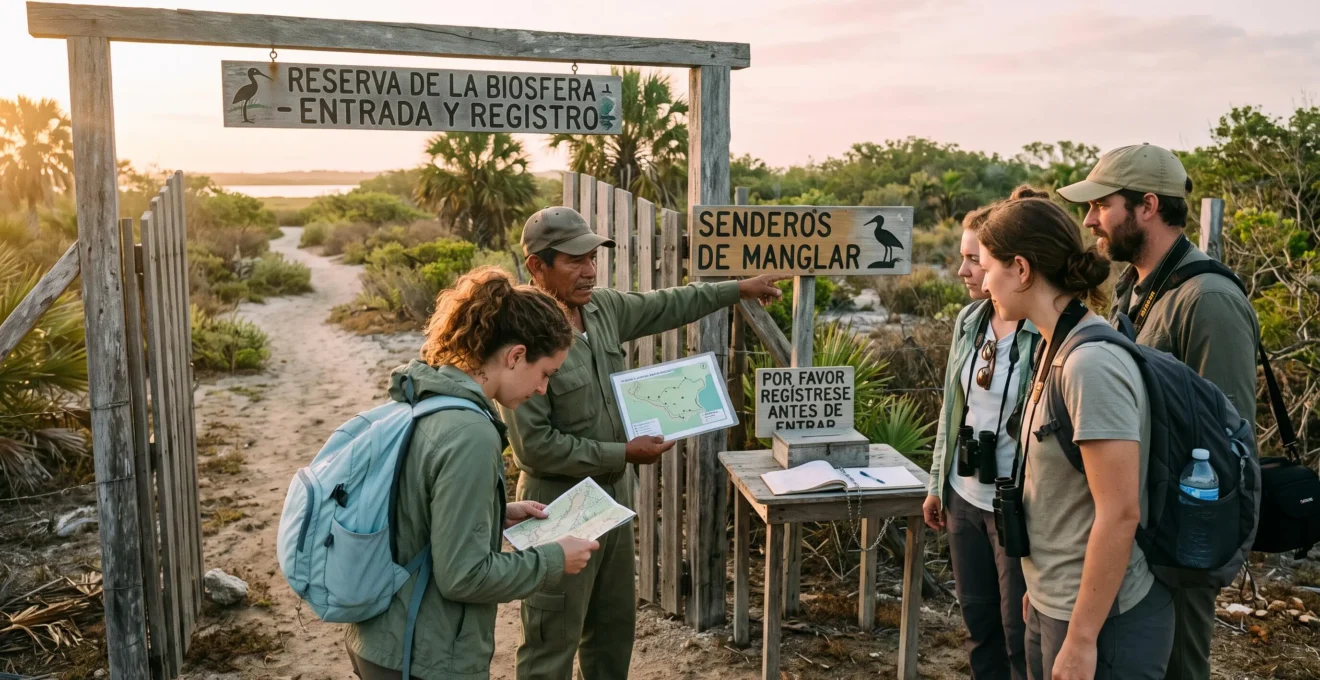
A protected area on a map does not necessarily mean a nature experience you can actually have. In Mexico, an apparently accessible forest trail might cross community-controlled land, a mangrove lagoon may require an authorised guide, and a beautiful stretch of coastline may belong to a conservation zone where visitor entry is restricted.
For UK travellers hoping to encounter wildlife rather than simply photograph a boundary sign, the distinction matters. The most rewarding reserve is not automatically the largest, wildest or most heavily protected. It is one where the accessible habitat matches your interests, the restrictions are understandable, and your presence does not undermine the species you came to see.
Meaningful access means knowing exactly where you can go, under what conditions, and why. That requires checking governance, seasonal closures, walking conditions, wildlife timing and operator practices before making a booking. These checks can prevent wasted travel and make a genuine contribution to responsible conservation tourism.
Choosing a Mexican reserve: the essentials
- Verify the specific visitor zone, land-management arrangements and guide requirements rather than assuming an entire protected area is open.
- Match the accessible habitat, opening arrangements and seasonal restrictions to the wildlife you actually want to encounter.
- Choose operators who enforce wildlife distances, respect closures and can explain how local conservation benefits from visitor payments.
- Why Can You Walk Freely in Some Mexican Reserves but Need a Guide and Permit in Others?
- How to Plan a Mexican Reserve Visit Without Arriving to Find the Trail Closed?
- Which Is Better for Wildlife: Community-Managed Reserves or Strict Federal Protected Areas?
- The Reserve Behaviour That Gets Trails Closed and Wildlife Displaced in Mexican Protected Areas
- When Should You Visit Mexican Reserves for Early-Morning Wildlife Without Competing for Space?
- How to Choose Between Jungle, Mangrove, and Cloud Forest When Your Body Handles Heat Badly?
- How to Pick a Reef-Friendly Snorkel Operator in Mexico Using 4 Non-Obvious Checks?
- Why the Reef You’re Snorkelling Today Might Not Exist in 10 Years Without Better Tourist Choices
Why Can You Walk Freely in Some Mexican Reserves but Need a Guide and Permit in Others?
Access differs because Mexican protected areas combine conservation zoning with different landownership and management arrangements. A federal designation does not automatically create public walking rights, and community land is not necessarily open to independent visitors. Whether you need a guide, registration or specific authorisation depends on the particular location, its permitted activities and the people or institutions controlling entry.
Mexico’s federal protected natural areas, known as Áreas Naturales Protegidas (ANP), are administered within a national conservation framework involving the Comisión Nacional de Áreas Naturales Protegidas (CONANP). State-managed protected areas operate under their respective authorities. Some destinations also include communal or ejido land, where community decisions and applicable land rights affect practical access.
These arrangements can overlap. A federal protected-area boundary does not imply that every parcel inside it is federally owned, nor does it automatically grant visitors a right to cross community land.
Zoning adds another layer. In biosphere reserves, core zones (zonas núcleo) are associated with stricter conservation objectives, while buffer zones (zonas de amortiguamiento) can accommodate specified activities. However, a buffer-zone designation is not itself permission to hike anywhere. The applicable management programme and subzone rules still matter.
Cumbres de Majalca National Park in Chihuahua demonstrates the importance of checking precise access provisions. The CONANP visitor information for Cumbres de Majalca National Park identifies signposted trails and describes tourism as permitted in its public-use subzone, rather than throughout the entire park.
Before paying for a tour, establish three things:
- Who controls access? Identify the managing authority, landowner or community cooperative responsible for the intended entrance.
- Which zone can you enter? Ask for the relevant trail, visitor subzone or approved route, not simply confirmation that the reserve is open.
- Why is a guide required? Determine whether guidance is a formal condition of entry, a local management requirement or an optional commercial service.
Also distinguish free movement from self-guided access with registration. A visitor may be allowed to walk independently but still need to sign in, pay an entrance charge or remain on designated trails. Conversely, a permit to enter one restricted zone does not authorise access to adjoining areas.
Ask for written confirmation if the distinction is unclear. An operator advertising an exclusive guided experience should be able to explain whether exclusive refers to the service or to the legal conditions of access.
Checking those rights before arrival prevents disputes at entrances and reduces pressure on managers to respond to unauthorised access with more restrictive controls. Once the permitted route is established, the next question is whether it will actually be available on your chosen date.
How to Plan a Mexican Reserve Visit Without Arriving to Find the Trail Closed?
Confirm the current status of the specific trail or visitor zone, not merely whether the reserve is generally open. Restrictions may reflect wildlife breeding periods, damaged infrastructure, community decisions or excessive visitor pressure. Check official communications first, then confirm local operating arrangements directly and keep a comparable alternative habitat in reserve.
Mexican protected areas face different seasonal pressures. Coastal sites may restrict entry near nesting turtles or breeding birds. Tropical routes may become unsafe following heavy rain, flooding or hurricane damage. Community-managed sites can also suspend access because of local decisions or activities that take precedence over tourism.
Visitor pressure creates another potential source of restrictions. If a sensitive route develops repeated disturbance problems, managers may limit groups, redirect visitors or close sections while conditions are assessed. Such measures should not be interpreted automatically as poor management: they can be evidence that conservation priorities are being enforced.
Verify access through three channels, in this order:
- Consult the current CONANP or state protected-area information for the destination, including notices and visitor regulations.
- Contact local operators or their associations to establish which routes they are currently using.
- For community-managed areas, ask the relevant cooperative or community contact to confirm the entrance, visiting conditions and any local closure.
An English-language booking page can describe a tour that was possible when it was originally published. It is not reliable evidence that a trail, jetty or landing point remains accessible today.
Partial openings require particular attention. A reserve may admit visitors to its public-use zone while keeping a nesting beach, forest track or marine sector closed. Compare the current trail list with the relevant zoning map, and ask your contact to identify the exact accessible route.
Your five-step pre-arrival access check
- Identify the managing authority and intended entrance; save the official contact details and location.
- Request the current permitted route or zoning map; keep a copy with the accessible section marked.
- Confirm guide, registration, permit and fee requirements; retain the operator’s written response or booking conditions.
- Ask specifically about seasonal restrictions and recent closures for your travel date; record the date and source of the confirmation.
- Select one comparable backup habitat and confirm its own access conditions; save a second workable itinerary.
For the fallback, replace like with like where possible. If a mangrove lagoon is unavailable, another accessible mangrove system may preserve your intended birdwatching experience. A cloud forest entrance closure calls for a similarly suitable forest route, not automatically a landscaped nature attraction.
The alternative must be verified independently. Similar ecosystems do not necessarily share the same regulations, wildlife conditions or visitor facilities.
Once two viable routes are identified, compare who manages them and what your visit supports. The governance behind a reserve can be as important as the scenery inside it.
Which Is Better for Wildlife: Community-Managed Reserves or Strict Federal Protected Areas?
Neither management model is automatically better for wildlife. Strict federal protection can restrict damaging activities and prioritise ecologically sensitive zones, while community-managed tourism can create local incentives to conserve habitat and maintain responsible visitor access. The stronger choice depends on actual enforcement, monitoring, ecological condition and whether tourism revenue benefits the people protecting the land.
For travellers, the difference often becomes visible through the experience. A community cooperative may offer locally knowledgeable guiding, accessible trails and explanations of seasonal wildlife patterns. A strictly protected federal zone may provide stronger limitations on human activity but few opportunities to enter its most sensitive habitats.
These outcomes are possibilities, not guarantees. A legal designation alone does not demonstrate effective enforcement. Likewise, an ecotourism label does not prove that tourism income supports conservation.
The following grid helps compare particular destinations rather than treating either category as universally superior.
| Criterion | Community-managed reserve | Strict federal protected zone |
|---|---|---|
| Legal protection | Depends on land status, applicable protected-area designations and local rules | Formal conservation restrictions under the applicable federal framework |
| Guiding and interpretation | Potentially strong local ecological knowledge; training and quality vary | May offer authorised guides or interpretation, depending on visitor access |
| Destination of visitor payments | Ask what proportion stays with the cooperative or habitat managers | Verify applicable official charges and any separate community-guiding payments |
| Verifiable conservation outcomes | Look for monitoring records, habitat activities and credible partnerships | Look for management information, ecological monitoring and evidence of enforcement |
Follow the visitor fee. Where local people depend partly on responsible nature tourism, payments can strengthen the incentive to maintain habitat, manage access and protect wildlife. But that mechanism depends on how revenue is distributed and how decisions are made.
Ask a community operator whether entrance and guiding payments contribute to trail maintenance, local employment, habitat protection or monitoring. Request concrete examples rather than accepting a broad statement that the tour is sustainable.
Equally, avoid assuming federal protection excludes communities. Local residents may participate in guiding, monitoring and other forms of co-management within federally designated areas.
A small community venture might offer thoughtful interpretation but lack the resources to prevent illegal activity outside its visitor routes. Conversely, a federally protected area might demonstrate effective conservation through cooperation with local residents, although access remains limited.
The best evidence is operational: clear visitor boundaries, enforceable behaviour rules, credible monitoring and transparent management arrangements.
Ultimately, the most useful guide is one who can explain both where wildlife may be observed and where visitors should not go. Those decisions also reveal how everyday tourist behaviour affects continued access.
The Reserve Behaviour That Gets Trails Closed and Wildlife Displaced in Mexican Protected Areas
Wildlife disturbance is not limited to litter or obvious habitat damage. Leaving marked paths, approaching nests, feeding wild animals, using intrusive lighting and flying drones without the required authorisation can undermine protection measures. Where repeated incidents threaten sensitive habitats, managers may respond by restricting routes, limiting visitor activity or closing access.
Walking outside an approved trail can disturb nesting or resting areas even when no animal is visible. Repeated incursions may create informal paths, damage vegetation or make sensitive sites harder to protect.
Feeding wildlife changes the encounter itself. Animals may become conditioned to approach people or food sources, creating risks for both visitors and wildlife. This concern is especially relevant when an operator advertises unusually close encounters with animals such as monkeys or crocodiles.
Flash photography around nocturnal wildlife is another warning sign. Its acceptability depends on the site and species, but responsible operators should be able to explain their lighting restrictions rather than treating every encounter as a photographic opportunity.
Drones require separate scrutiny. A general willingness to admit tourists does not imply permission for drone flights, particularly over nesting areas or wildlife concentrations. Obtain the relevant authorisations before assuming an aerial photograph is possible.
The progression from individual behaviour to restricted access is not automatic, but the mechanism is important: repeated disturbances can lead to monitoring concerns, complaints, revised visitor conditions and, where managers consider it necessary, closures.
Before booking a wildlife experience, ask the operator about:
- Maximum group size and the number of guides accompanying visitors.
- Required distances from animals, nests and sensitive habitats.
- Rules on feeding, baiting, flash photography and drones.
- What happens when wildlife moves towards visitors or enters a restricted zone.
- How guides respond when someone repeatedly ignores instructions.
During a visit, baiting animals, crossing a clearly marked exclusion boundary or encouraging visitors to touch wildlife are serious reasons to question the operator’s practices.
If an incident occurs, prioritise stopping your own participation and avoiding further disturbance. Raise the concern calmly with the guide or cooperative when appropriate. If the conduct appears serious or continues, provide a factual account to the protected-area management office, including the location, date and behaviour observed.
Not every weakness reflects deliberate misconduct. A small cooperative may need better equipment or training. Constructive feedback can be appropriate for minor shortcomings, while repeated or dangerous rule-breaking warrants escalation.
Responsible behaviour also affects the quality of the present visit: allowing animals to move naturally often produces more informative observations than attempting to force a close encounter. Choosing the right time further improves that opportunity.
When Should You Visit Mexican Reserves for Early-Morning Wildlife Without Competing for Space?
Early morning can provide rewarding wildlife encounters, but sunrise is not automatically the quietest or best available visiting window. The right time depends on the target species, habitat, official entry arrangements and competing visitor demand. Check when access actually begins, then choose a route and arrival slot that match wildlife activity without concentrating unnecessary pressure on sensitive areas.
Birds and other wildlife can be conspicuous early in the day, while some species are more active at different times. A dawn departure therefore needs a biological purpose, not merely an attractive sunrise.
Start with the species or behaviour you want to observe. For mangrove birdwatching, ask a knowledgeable local guide about recent activity and suitable viewing conditions. For forest mammals, seek advice on the species’ normal activity patterns and whether observation is realistic from approved trails.
Next, compare the wildlife window with the actual visitor schedule. A reserve may have an early opening time while a particular trail, boat departure or guided route begins later.
At Cumbres de Majalca, published information identifies no established general visiting schedule, while CONANP staff availability is specified separately. These are different forms of information: an absence of fixed visiting hours should not be interpreted as unrestricted access or guaranteed staffing at dawn.
In contrast, the official information for Arrecifes de Cozumel National Park publishes visitor hours beginning at 6:00 a.m., but the availability of any particular reef still depends on applicable restrictions and operating arrangements.
For a quieter experience, compare a recognised hotspot with a less-promoted site in the same habitat type. Evaluate the alternative against three conditions: confirmed access hours, similar ecological characteristics and evidence of responsible wildlife monitoring or management.
For example, a hypothetical traveller planning mangrove birdwatching could compare two accessible lagoons rather than replacing a crowded bird habitat with an unrelated forest attraction. The less famous lagoon is only a good substitute if its wildlife opportunities and visitor rules genuinely fit the plan.
Season, weather and habitat conditions can change the answer:
- Cloud forests: rain, mist and weather fronts can affect visibility, trail safety and wildlife observation.
- Mangroves: tide levels can influence boat access, exposed feeding areas and viewing opportunities.
- Nocturnal wildlife: moon phase and transitions between night and daylight may matter for particular species, although their relevance must be checked locally.
- Seasonal conditions: breeding cycles, migrations and temporary restrictions may alter accessible observation points.
Build a personal visiting window by identifying the target species, confirming when its habitat is accessible and choosing an approved route suited to that period. Do not rely on a generic recommendation for the best month in Mexico.
Early or off-peak access can also mean fewer rangers, guides or interpretation services. A quieter trail may offer solitude but less support, while a guided slot may deliver better wildlife understanding at the cost of sharing the experience.
Timing is only part of a successful encounter. Your physical comfort determines how long you can observe wildlife calmly, making habitat choice particularly important for travellers who struggle with heat.
How to Choose Between Jungle, Mangrove, and Cloud Forest When Your Body Handles Heat Badly?
Cloud forest may be the more comfortable starting point for heat-sensitive travellers because its higher-elevation environments can be cooler than lowland tropical habitats. However, elevation brings its own challenges, including steep or slippery trails. Mangroves may offer flatter routes but intense humidity and sun exposure, while shaded jungle can still be hot and physically demanding.
Choose the habitat according to the combined effects of temperature, humidity, terrain, shade and access to assistance, not merely its reputation as an easy walk.
The three environments present different practical challenges:
| Factor | Jungle | Mangrove | Cloud forest |
|---|---|---|---|
| Thermal conditions | Often warm and humid, particularly in lowland forests | Can feel hot and humid, especially over exposed water | Higher-elevation sites are often cooler, though conditions vary |
| Shade and airflow | Closed canopy may provide shade but limit airflow | Vegetation and routes vary; boats and open lagoons can be exposed | Canopy shade, mist and changing mountain weather |
| Physical effort | Varies from short paths to uneven, demanding trails | Boardwalks may be flat; water-based excursions have different demands | Can involve substantial slopes, steps and slippery ground |
| Exit and assistance | Remote trails may limit quick evacuation | Boat-dependent access can complicate an early return | Steep or remote routes may slow access to assistance |
The assumption that mangroves are easiest because they are flat can be misleading. A low-effort boat trip may still expose passengers to direct sun, reflected heat and prolonged humidity. Insects and limited opportunities to disembark can add discomfort.
A shaded forest walk might feel more tolerable under comparable conditions, although humidity, uneven footing and travel distance can make it challenging. Cloud forest can reduce heat exposure while increasing exertion.
Medication use deserves individual consideration. The CDC guidance on heat and medications explains that certain medicines may affect sweating, thirst, hydration or temperature regulation. Relevant examples include some diuretics, anticholinergic medicines and psychotropic medications.
Anyone concerned about medication-related heat sensitivity should discuss their travel plans with an appropriate healthcare professional. Do not independently stop or change prescribed medication to accommodate an excursion.
Before booking, consider your typical tolerance for sustained walking, the availability of drinking water and shade, whether you can turn back independently, and the time required to reach transport or assistance.
Ask operators about the actual walking surface, elevation changes, duration away from shelter and options for shortening the route. A short trail with difficult terrain may be less manageable than a longer, level route with reliable stopping points.
Comfort supports conservation-minded observation. When you are not struggling with heat or fatigue, it is easier to remain patient, respect wildlife boundaries and avoid rushing an encounter. Similar attention to practical conditions is essential when selecting a marine wildlife operator.
How to Pick a Reef-Friendly Snorkel Operator in Mexico Using 4 Non-Obvious Checks?
Choose a snorkel operator by checking four operational behaviours: whether guides enforce wildlife-distance rules, how boats secure themselves without damaging coral, how many swimmers each guide supervises, and whether the business contributes to legitimate local conservation activities. These checks reveal more about daily practice than environmental marketing claims or a general promise to use reef-friendly sunscreen.
Marine protected areas can establish detailed rules for visitors and operators. At Arrecifes de Cozumel National Park, the CONANP’s Arrecifes de Cozumel visitor regulations require authorised boats and guides, prohibit anchoring and reef contact, and instruct visitors to remain 1.5 metres from reefs.
The same official information identifies mooring buoys and a reef rest calendar. These are destination-specific requirements, not universal rules for every Mexican snorkelling site.
Use four checks when comparing operators:
- Behaviour briefing: Ask what guides say about touching coral, chasing marine wildlife, feeding animals and maintaining appropriate distances. Check whether those rules are enforced in practice.
- Boat positioning: Ask whether vessels use approved mooring buoys where provided and how they avoid anchoring on sensitive seabeds. For Cozumel’s national park, the stated anchoring prohibition is especially relevant.
- Group management: Request the planned number of swimmers, guides and boats at the site. Ask how guides supervise inexperienced participants and prevent congestion near coral.
- Conservation contribution: Ask about official park charges, mooring maintenance, habitat monitoring or other identifiable local conservation arrangements. Verify participation rather than accepting a vague sustainability claim.
The mooring question is particularly revealing because it tests a concrete operating procedure. Correctly using an established buoy can prevent the direct physical damage associated with anchoring on reef habitats.
However, buoy use alone does not prove that an operator follows every other conservation rule. Treat it as one important indicator, not a certification of overall performance.
Before booking, ask the operator to describe these arrangements in a written reply. Request an itemised explanation of the advertised price, including applicable protected-area charges and any separately payable entrance fees.
Recent reviews can provide useful supplementary evidence, especially when they describe crowding, guide behaviour and safety briefings. Sightings of turtles or colourful fish do not, by themselves, demonstrate responsible operation.
The cheapest advertised trip is not necessarily the best value. Compare the complete cost with the level of supervision, likely crowding, included services and compliance information. There is no basis for assuming that every inexpensive operator cuts conservation standards or that every premium-priced excursion maintains them.
For example, if two operators visit the same permitted reef, the meaningful difference may be whether one can clearly explain its group-management and mooring procedures while the other cannot. Price is relevant, but verifiable operating standards should carry greater weight.
These decisions matter beyond the immediate excursion. Repeated small disturbances add to other pressures on reef ecosystems, making the longer-term consequences of tourism choices worth understanding.
Key takeaways before making your final choice
- A genuine conservation experience begins with lawful access to a specific habitat, not simply a famous protected-area name.
- Visitor payments, guiding standards and respect for restricted zones should support habitat protection rather than pressure managers to accommodate every requested encounter.
- The best choice combines personal suitability with credible ecological safeguards; neither cheap access nor exclusive access is an environmental benefit in itself.
Why the Reef You’re Snorkelling Today Might Not Exist in 10 Years Without Better Tourist Choices
Mexican coral reefs face overlapping pressures from ocean warming, pollution, coastal development and direct physical disturbance. Poorly managed tourism can add avoidable damage through contact, sediment disturbance, anchoring and concentrated visitation. Individual choices can reduce these local pressures, but they cannot guarantee reef survival or replace broader climate and environmental action.
The ten-year framing expresses a genuine concern about rapid ecological change, not a scientifically established deadline for the disappearance of any particular Mexican reef.
Coral bleaching can occur when excessive heat stresses corals and disrupts their relationship with the microscopic algae that supply much of their energy. Bleaching does not always mean immediate coral death, but prolonged or repeated stress can have severe consequences.
The NOAA Fisheries information on shallow coral reef habitats identifies warming, ocean acidification, runoff, sediment and direct physical damage among the threats facing reef ecosystems.
Anchors can damage coral structures, while contact from hands or fins can cause injury or disturb the surrounding seabed. Sediment and polluted runoff introduce additional stresses that a careful snorkeller cannot eliminate simply by behaving responsibly in the water.
It is useful to distinguish what tourists can directly control from what requires collective action. Travellers can select compliant operators, avoid contact with marine life, respect reef rest periods and decline experiences that deliberately crowd sensitive wildlife. Wider climate change and coastal pollution require actions well beyond individual excursions.
Visitors may notice signs that warrant concern:
- Pale or whitened coral: potentially consistent with bleaching, although colour alone does not establish cause or survival prospects.
- Extensive algal growth: sometimes associated with altered ecological conditions, but not a diagnosis without site-specific evidence.
- Cloudy or sediment-filled water: a possible concern for coral habitats, with causes that require investigation.
- Apparently fewer fish: an observation worth recording, not proof of a population decline without comparable monitoring data.
These observations can inform questions about local conservation management. They should not be turned into unsupported claims about a reef’s condition based on one visit.
Choosing a less-crowded site can reduce pressure at a heavily visited location, provided the alternative is genuinely suitable, formally accessible and managed to accommodate visitors. Redirecting tourism towards a fragile, previously quiet habitat without appropriate safeguards merely transfers the disturbance.
The same principle applies across Mexico’s terrestrial and marine protected areas. A sustainable encounter depends on knowing the permitted route, respecting sensitive zones, choosing appropriate timing and supporting operators who manage their environmental impact.
For a practical final decision, evaluate each candidate reserve using five questions:
- Access clarity: Can the managing authority or operator confirm exactly where visitors may go and under which conditions?
- Governance: Who manages the habitat, enforces the rules and benefits from tourism payments?
- Habitat fit: Does the accessible ecosystem offer realistic opportunities for your chosen wildlife experience without exceeding your physical limits?
- Timing: Are the intended trails or marine sites available during an appropriate observation window?
- Operator quality: Can the provider demonstrate responsible group management, wildlife behaviour standards and compliance with local restrictions?
Compare the answers before committing. A celebrated reserve with unclear access, incompatible visiting conditions or inadequate operator information may be a poorer choice than a less famous site where all five questions have credible answers.
Meaningful access is therefore not the freedom to enter every part of a protected landscape. It is the opportunity to experience its natural systems without weakening the arrangements that protect them.
Choose one primary reserve and one suitable alternative, obtain current access confirmation, and book only when the habitat, visiting window and operator standards align. That approach turns a hoped-for wildlife encounter into a realistic, responsible travel plan.
Can you visit a Mexican protected area without booking a tour?
Sometimes. Certain visitor zones accommodate independent activities, while others require authorised guides, registration or specific permissions. Check the rules for the exact entrance and trail. A protected-area designation alone does not establish a right to explore independently.
Does paying a reserve entrance fee give access to every trail?
No. An entrance payment does not override zoning, seasonal restrictions or closures. Confirm which routes and activities the fee covers, whether a separate guide or permit is required, and whether any intended visitor areas are temporarily unavailable.
Are English-speaking guides available at all Mexican reserves?
English-language guiding should not be assumed. Availability depends on the destination and operator. Ask before booking whether interpretation will be provided in English, whether the guide is appropriately authorised where required, and whether the service includes explanations of wildlife protection rules.
What should you do if wildlife approaches you on a protected-area trail?
Do not feed, touch, pursue or deliberately attract the animal. Follow the reserve’s instructions and your guide’s advice, maintain an appropriate distance and allow the animal room to move naturally. Species-specific safety requirements take precedence over any general desire for a closer view.
Is a quieter reserve necessarily better for conservation?
No. Lower visitor numbers may reduce some forms of disturbance, but a quiet site may also lack visitor infrastructure, monitoring or permission for tourism. Evaluate the destination’s management arrangements and ecological sensitivity before treating solitude as an environmental advantage.