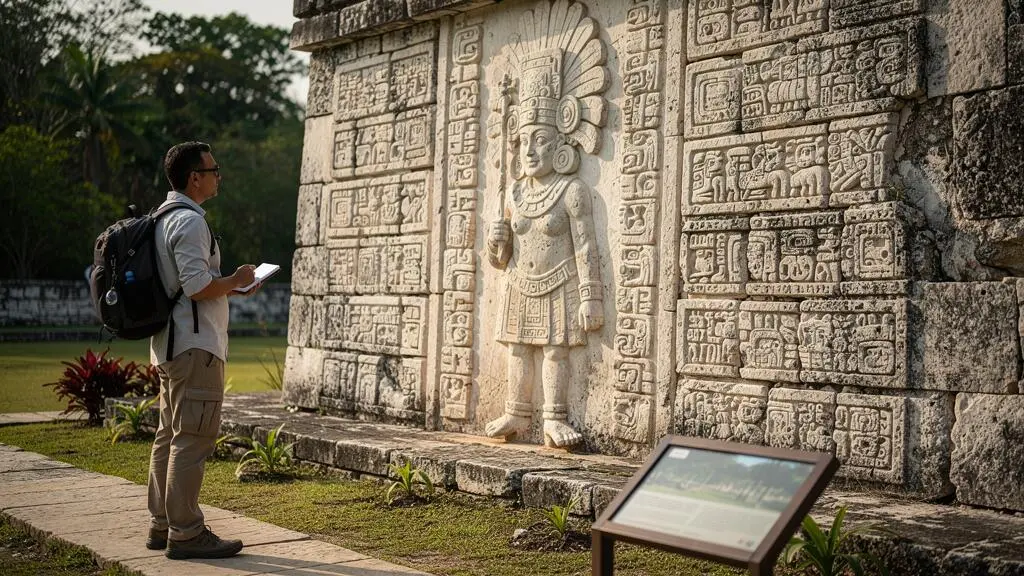
A weathered limestone panel shows a figure wearing an elaborate headdress. Beside it, strange-looking shapes appear in neat groups. The information plaque offers almost nothing. Is this a king, a god, a ceremony or simply decoration?
The most reliable way to understand a Maya stone carving is to identify what is physically visible before deciding what it means. Look for human figures, gestures, objects, organised glyph blocks and the monument’s architectural setting. Then distinguish observations from interpretations supported by archaeological evidence.
This approach is particularly useful at Yucatán archaeological sites such as Uxmal, Ek Balam and Chichén Itzá, where monumental architecture, inscriptions and decorated façades can appear together. Some details have well-established historical interpretations; others remain uncertain because inscriptions are damaged or their contexts are incomplete.
Maya art is neither a collection of interchangeable mystical symbols nor a visual language that beginners can translate by recognising a handful of shapes. With a few careful questions, however, even a short visit can become considerably more informative.
Maya carvings: what to recognise first
- Identify the object: distinguish carved reliefs, hieroglyphic inscriptions, architectural ornament and stucco decoration before attempting interpretation.
- Read the context: examine figures, gestures, objects, glyph arrangements and the monument’s location together. Never assign a fixed meaning to a symbol based on appearance alone.
- Check the evidence: use monument-specific archaeological documentation to separate established readings from plausible suggestions and unsupported claims.
- What You’re Actually Looking At When You Visit a Limestone Pyramid in the Yucatán
- How to “Read” a Maya Limestone Pyramid Site in 30 Minutes Without a Tour Guide
- Why Do Maya Carvings Look “Worn Out” Up Close, and Does That Mean They’re Less Important?
- How to Spot 5 Common Patterns in Maya Stone Carvings Without Studying Archaeology
- The Myth About Maya Carvings That Makes Travellers Misread Everything They See
- When Is the Best Time to Photograph Maya Stone Carvings Without Losing the Detail in Glare?
- Which Will You Enjoy More: Carving-Rich Sites or Pyramid-Heavy Sites on a Short Yucatán Trip?
- Which Is Better for You: a Big Famous Pyramid Site or a Smaller Jungle-Covered Complex?
What You’re Actually Looking At When You Visit a Limestone Pyramid in the Yucatán
A Maya pyramid site contains several kinds of visual evidence, not just pyramids and mysterious carvings. Relief sculptures may represent people or events, hieroglyphic inscriptions record language, and architectural ornaments communicate ideas through their placement and imagery. Understanding which kind of object you are examining is the first step towards a defensible interpretation.
The distinction matters because a repeated façade pattern does not necessarily contain readable words, while an inscription may preserve precise historical information that a decorative sculpture cannot provide.
Start by identifying four broad categories:
- Carved stone relief: imagery cut into or raised from stone, potentially depicting human figures, animals, ceremonies or supernatural beings.
- Hieroglyphic inscription: organised signs representing language, sometimes including names, titles, events and dates.
- Architectural ornament: decorative features integrated into a building, such as geometric patterns or sculpted elements around an entrance.
- Modelled stucco decoration: designs shaped in plaster applied to an architectural surface, rather than carved directly from a limestone block.
At Ek Balam, these categories overlap. The INAH‘s archaeological profile of Ek’ Balam documents carved stelae, decorated architectural elements and limestone walls incorporating stone reliefs covered with stucco. Material and architectural context are therefore essential to describing what survives.
Next, examine the object’s position. A figure beside a doorway may contribute to an architectural programme. A freestanding stela may commemorate an individual or event. Imagery on a ceremonial façade may communicate authority or religious ideas through its relationship with the building.
Location does not prove meaning, but it provides evidence that an isolated close-up cannot.
Also remember that Maya buildings were frequently modified over time. Earlier structures could be enclosed within later construction phases, while architectural elements were sometimes reused. The surface visible today may not represent the entire building’s original appearance.
Apply a simple hierarchy: first, record directly observable details; second, identify conclusions supported by archaeological research; third, label uncertain interpretations as possibilities.
For example, describing a seated figure wearing an elaborate headdress is an observation. Identifying that figure as a named ruler requires further evidence. Claiming that the headdress represents a specific deity requires an additional interpretive argument.
Once the object and its context are established, the next challenge is deciding what to inspect first when visiting time is limited.
How to “Read” a Maya Limestone Pyramid Site in 30 Minutes Without a Tour Guide
You can make a meaningful first assessment of a Maya pyramid site in 30 minutes by locating one accessible decorated monument, studying its overall composition, recording visible details and checking them against reliable documentation. This will not explain an entire archaeological complex, but it can help you interpret one feature without inventing a story.
Treat the following schedule as a flexible observation routine, not a promise that every monument can be understood within half an hour.
- Minutes 0–5: examine the entrance map, identify the principal structures and select one accessible carving or decorated building.
- Minutes 5–10: establish whether your subject is a stela, wall relief, lintel, inscription panel or architectural ornament. Note its location.
- Minutes 10–20: scan the overall composition, locate the main figure, observe gestures and objects, and identify separate glyph blocks.
- Minutes 20–25: note damaged areas, uncertainties and details worth photographing from permitted positions.
- Minutes 25–30: compare your observations with the available plaque, site map or previously saved archaeological documentation.
Distances, crowds, inaccessible monuments and complex inscriptions can make this schedule impractical. At a large site, walking to a relevant structure may consume much of the available time.
When you reach a carving, begin with the entire scene. Is one person larger than the others? Are figures facing each other? Does someone hold a staff, bundle or ceremonial object? Are the glyphs positioned beside the figures or within a separate panel?
Recording these relationships is more useful than guessing the meaning of an isolated animal or headdress.
Your five-action Maya carving field checklist
- Identify the monument: write down the site, structure and monument number if available. Deliverable: a location record.
- Classify the surface: note whether it contains relief sculpture, glyphs, architectural decoration or stucco. Deliverable: a one-line material description.
- Record five visible features: describe figures, postures, objects, recurring motifs or glyph arrangements. Deliverable: five observation notes.
- Mark uncertainty: identify at least one eroded, obscured or ambiguous feature. Deliverable: an explicit uncertainty note.
- Verify one interpretation: compare the monument and its visible features with a reliable archaeological publication. Deliverable: a supported identification or a clear statement that confirmation remains unavailable.
The four questions underlying this method are straightforward: What can I see? Where is it located? What evidence supports an interpretation? What remains uncertain?
For later research, the Smithsonian’s Living Maya Time resources explain the relationship between glyphs, language and calendars. Specialist drawings and photographic archives can then help identify specific monuments. Match the site, structure, monument number and distinctive features rather than relying on resemblance alone.
A successful visit produces a short, defensible description rather than an elaborate translation. That remains worthwhile even when erosion has removed much of the original surface.
Why Do Maya Carvings Look “Worn Out” Up Close, and Does That Mean They’re Less Important?
Maya stone carvings often look worn because exposed limestone has experienced long-term weathering, moisture, biological growth and surface loss. Other marks may result from damage, ancient modification or conservation work. Their condition does not establish their historical importance: even a badly eroded inscription can preserve valuable information about a person, date or event.
Limestone is a workable building and sculptural material, but exposed surfaces can gradually lose their sharp edges and fine detail. Rainwater, environmental conditions and biological activity may contribute to deterioration, although the causes and extent vary by monument.
Not every irregular mark is natural erosion. A damaged corner, modified relief or repaired surface may have a different history. Without conservation documentation, visitors should avoid confidently diagnosing individual marks.
Visual completeness and archaeological significance are different questions. A crisp ornamental pattern may be visually impressive but provide little direct chronological information. A fragmented inscription, by contrast, may still contain identifiable glyphs associated with a ruler or historical date.
Ek Balam provides a particularly useful comparison. Its protected architectural stucco decoration demonstrates how shelter and construction history can influence preservation. However, stucco is a modelled plaster material, not simply another name for limestone relief carving.
Surfaces enclosed by later building phases or protected from prolonged exposure may survive differently from exterior monuments. This does not mean every unusually sharp detail is modern or every damaged surface was neglected.
To inspect a difficult carving without interfering with it, try a simple visibility test:
- Observe the surface from different permitted viewpoints.
- Compare raised outlines with recessed grooves.
- Notice whether changing natural light reveals additional contours.
- Compare the visible surface with published drawings or historical photographs when available.
Archaeological drawings can be especially useful because specialists may combine observation, photography and interpretation to document difficult signs. They are not, however, perfectly neutral copies of the stone. Drawn outlines may reflect scholarly decisions, particularly where surviving traces are ambiguous.
A useful field note might read: « The central figure remains recognisable, but the adjacent inscription is too eroded to identify individual signs confidently. »
That statement preserves what the monument communicates without pretending to recover lost information.
Once erosion is treated as an evidence problem rather than a sign of insignificance, recognising recurring visual patterns becomes much easier.
How to Spot 5 Common Patterns in Maya Stone Carvings Without Studying Archaeology
Five useful patterns to recognise in Maya carvings are elaborately dressed human figures, animals and animal attributes, organised glyph blocks, numerical bars and dots, and repeated geometric or architectural motifs. These are observation categories, not five symbols with universal meanings. Their interpretation depends on the objects, inscriptions and architectural settings surrounding them.
Use the following guide to recognise what you are looking at before assigning significance.
| Pattern | What to look for | What you can reasonably infer |
|---|---|---|
| Human figures and regalia | Headdresses, jewellery, clothing, posture, gestures and held objects | The scene may communicate status, identity, ceremony or interaction; a specific role requires supporting evidence. |
| Animals and animal attributes | Birds, serpents, feline features or animal elements incorporated into human dress | Animal imagery may contribute to identity, mythology or religious symbolism, but its precise meaning is contextual. |
| Hieroglyphic blocks | Organised groups of complex signs, often within rectangular or approximately square spaces | The surface may contain written language, including names, titles, dates or events. |
| Bars and dots | Distinct groupings of linear bars and circular dots | These may represent numerical notation, particularly when associated with calendrical inscriptions. |
| Geometric and architectural motifs | Repeated angular, stepped or mask-like forms integrated into façades | They may belong to an architectural decorative programme rather than a readable inscription. |
Human figures deserve particular attention. Relative size, direction of gaze, seating position, posture and objects held may reveal relationships within a composition. Yet a large headdress does not automatically identify a king, and a smaller figure is not necessarily a captive.
For inscriptions, pay attention to organised sign arrangements. The British Museum‘s educational exhibition on Maya hieroglyphs explains how Maya writing combines logograms, representing words, with syllabograms, representing syllables.
Glyphs are commonly organised into blocks, with texts often read in paired columns from left to right and top to bottom. The precise reading sequence depends on the monument and inscription.
Recognising the arrangement is therefore a useful beginning, not proof that the inscription has been deciphered.
Numerical notation provides another recognisable feature. In Maya numerals, a dot represents one and a bar represents five. However, a numerical element should not automatically be interpreted as a complete calendar date. Its position among other signs and the broader inscription must be considered.
Animal and architectural motifs require similar restraint. A serpent incorporated into a headdress, an animal image beside an inscription and a mask-like façade ornament may have different functions. A familiar shape alone cannot establish a universal translation.
The strongest beginner observation describes relationships: « A seated figure faces a second person, with glyph blocks beside the scene and a bird-like element in the principal headdress. » That is substantially more informative than assigning each feature an unsupported symbolic meaning.
Recognising patterns should lead to better questions, not more confident guesses. That distinction becomes especially important when encountering sensational interpretations of Maya imagery.
The Myth About Maya Carvings That Makes Travellers Misread Everything They See
The most misleading myth about Maya carvings is that they form a universal collection of mystical symbols revealing extraterrestrial visitors, modern technology or hidden prophecies. Maya hieroglyphs are part of a documented writing system, while sculptural imagery expresses historical, political and religious ideas. Reliable interpretation depends on linguistic, archaeological and artistic evidence, not resemblance to modern objects.
The distinction between writing and symbolism is fundamental. Maya inscriptions can record names, titles, dates and events. Other images may represent supernatural beings, cosmological ideas or rituals without forming a written sentence.
A serpent associated with a ceremonial figure, for example, may have religious or mythological significance. That does not make it evidence of an unknown machine or technological device.
Similarly, an elaborate headdress may encode status or religious relationships. Describing it as a spacesuit simply because its shape resembles modern equipment ignores the monument’s cultural context.
The Smithsonian‘s interactive explanation of Maya calendar glyphs demonstrates why language matters. Maya writing combines whole-word and syllabic signs, and much of its decipherment rests on linguistic analysis developed through sustained scholarly research.
One tangible historical example comes from Ek Balam’s Stela 1. INAH identifies Ajchan Naah on the front of the monument and associates it with a Maya date corresponding to 18 January 840 CE. The surviving inscription on the reverse also identifies Ukit Kan Lek Tok.
A documented example: Ek Balam Stela 1
Ek Balam’s Stela 1 combines figural representation and surviving inscriptions associated with named historical individuals. Its documented date and identifications come from archaeological and epigraphic interpretation, not from isolated visual resemblance.
The monument demonstrates the value of connecting images, text and historical context. It does not imply that every Maya stela preserves equally complete information or that visitors can independently recognise all its names.
When a video or informal explanation proposes an extraordinary interpretation, apply four questions: Which exact monument is being discussed? What evidence connects its details to the proposed meaning? Is that evidence published by an identifiable specialist? Are there documented alternative readings?
A claim unsupported by inscriptional, linguistic or archaeological context should remain speculation rather than established history.
Another persistent misconception is that the Maya vanished, leaving an undecipherable civilisation. Living Maya communities continue to speak diverse Mayan languages and maintain cultural traditions. Archaeologists and epigraphers also continue to refine interpretations through research, including collaboration with contemporary Maya peoples.
Respecting that continuity changes how archaeological art is approached: these are works produced by historical societies, not mysterious objects detached from living cultural histories.
Once unsupported interpretations are set aside, the next priority is documenting what the stone actually shows, including details that difficult lighting can hide.
When Is the Best Time to Photograph Maya Stone Carvings Without Losing the Detail in Glare?
The best time to photograph Maya stone carvings is when light reaches the surface at a shallow angle, creating shadows that reveal carved contours. Morning or late-afternoon sunlight may help, but neither is universally preferable. The monument’s orientation, surrounding buildings, vegetation and permitted viewing positions matter more than a fixed time of day.
Direct frontal illumination can make shallow reliefs appear flat because raised and recessed features produce fewer visible shadows. Strong overhead light may similarly reduce the apparent depth of worn surfaces.
Sideways illumination, often called raking light, can emphasise surviving grooves and edges. However, the ideal direction depends on the individual carving and may be blocked by surrounding structures.
Before photographing, examine where natural light falls and whether you can move safely along the permitted path to improve the angle.
Different materials and locations create different photographic challenges:
- Exposed limestone reliefs: look for directional light that reveals shallow contours without excessive bright highlights.
- Recessed inscriptions: use a steady, reasonably frontal viewpoint to preserve glyph arrangements; moderate side lighting may help distinguish individual signs.
- Sheltered stucco façades: account for deep shade and contrasting bright areas without treating modelled plaster as identical to stone carving.
On a smartphone, tapping the relevant surface to control focus and adjusting exposure can improve the visibility of surviving details. Where available, a wider dynamic-range capture may help retain information in both highlights and shadows.
These techniques cannot recover features that have physically disappeared through erosion.
For archaeological comparison, take three complementary photographs: a contextual image showing the monument within its setting, a frontal image recording the complete composition, and a closer view of the feature you want to examine.
The contextual photograph helps identify the monument later. The frontal image preserves relationships between figures and inscriptions. The detail photograph supports closer inspection without losing the wider reference.
Always respect site restrictions. Remain behind barriers, avoid touching or wetting the stone, and never apply chalk or substances intended to increase contrast. Check current site rules before using tripods, flashes or specialist equipment.
Digital processing also has limits. Aggressive sharpening and AI enhancement may create plausible-looking lines that are not present on the original surface. Such results should never be presented as archaeological evidence.
Photographs become more valuable when the chosen site offers accessible, identifiable carvings. That makes selecting the right archaeological complex an important part of the interpretation process.
Which Will You Enjoy More: Carving-Rich Sites or Pyramid-Heavy Sites on a Short Yucatán Trip?
Choose a carving-rich archaeological site if your main interest is examining figures, inscriptions and intricate decoration. Choose a monumental pyramid site if you prefer architectural scale, ceremonial spaces and understanding an ancient city’s layout. Many Yucatán sites offer both experiences, so the better choice depends on which features you can actually access and study.
For a short trip, the difference is primarily about how you want to spend your attention.
Studying a relief rewards slower observation. You may spend several minutes examining a headdress, locating glyph blocks or comparing a scene with an archaeological explanation.
Exploring monumental architecture offers a different perspective: spatial organisation, relationships between plazas and buildings, construction scale and the experience of moving through a historic urban environment.
Three Yucatán destinations illustrate the overlap between these interests.
| Site | Visual features | Best suited to travellers interested in |
|---|---|---|
| Uxmal | Elaborate stone façades, architectural patterns and major monumental structures | Understanding how architectural decoration contributes to monumental design |
| Ek Balam | Notable stucco decoration, carved monuments and architectural reliefs | Comparing sculptural imagery, materials and documented historical information |
| Chichén Itzá | Large ceremonial buildings, monumental pyramids and carved architectural features | Experiencing monumental architecture while identifying meaningful decorative and sculptural elements |
These are visitor-oriented distinctions, not rigid archaeological categories. Uxmal is not merely a site of decorative façades, and Chichén Itzá is not a carving-free collection of pyramids. Similarly, Ek Balam’s prominent stucco work should not be described indiscriminately as limestone carving.
When narrowing your choice, identify your principal goal. Is it recognising human figures and glyphs, photographing detailed reliefs, appreciating monumental buildings, or exploring the broader layout of an ancient city?
Then consider practical constraints: travel distance from your overnight base, total time available, heat and weather exposure, permitted viewing distance, and whether the specific monument you want to examine is accessible.
Official site information is more useful for assessing access than an attractive photograph that may show a restricted viewpoint or an earlier stage of conservation.
There is also a trade-off between visiting several sites and spending enough time with individual monuments. One carefully chosen site with documented details may teach you more about carving interpretation than a rushed sequence of famous locations.
If the itinerary allows, pairing a site selected for its detailed decorative features with a contrasting monumental complex can provide a broader understanding of Maya architecture and visual culture.
The remaining decision is not simply which destination has the most spectacular structures, but which environment makes reliable observation possible.
What to remember before choosing a Maya archaeological site
- A famous or visually impressive monument is not necessarily the easiest place to examine an identifiable carving.
- Access, viewing distance and monument-specific documentation matter more than the site’s size or the density of its vegetation.
- A rewarding visit should leave you able to describe at least one feature accurately and explain which parts of its interpretation remain uncertain.
Which Is Better for You: a Big Famous Pyramid Site or a Smaller Jungle-Covered Complex?
A large, famous Maya site is often better for travellers who value recognised monuments, established visitor infrastructure and accessible interpretive information. A smaller jungle-covered complex may offer a quieter, more atmospheric experience, but identifying carvings can be harder. Neither size nor setting reliably indicates archaeological richness or how much you will understand during a visit.
The crucial distinction is between what archaeologists have documented and what visitors can currently observe.
A well-known complex may contain extensively studied inscriptions and architectural sculptures, yet crowds, protective barriers or restricted areas can limit opportunities for close observation.
Conversely, a less visited site may contain important archaeological remains without offering easily readable panels, comprehensive signage or published explanations suitable for beginners.
Vegetation and partial excavation also affect the experience. Jungle surroundings can create a memorable sense of place, but irregular lighting, obstructed sightlines and dispersed monuments may make features difficult to identify.
Before selecting a site primarily for its carvings, check four criteria:
- Monument access: are identifiable decorated structures or sculptural monuments currently open to visitors?
- Viewing conditions: can the relevant surface be seen clearly from permitted paths or observation areas?
- Documentation: are reliable descriptions, drawings or photographs available for the specific monuments?
- Independent navigation: can you locate the relevant buildings using official maps and established visitor routes?
These checks matter especially when planning a self-guided visit. An image of an extraordinary carving does not establish that the original remains visible, accessible or situated where the photograph suggests.
A useful final decision test is to picture what you want to know when leaving the site.
Can you identify one documented monument? Can you describe its surviving figures, inscriptions or decorative elements? Can you explain one interpretation supported by research while acknowledging what remains uncertain?
If the answer is likely to be yes, that site may be better suited to your goal than a taller pyramid or a more mysterious-looking jungle setting.
For travellers with limited time, this evidence-based approach also helps avoid disappointment. The most rewarding archaeological visit need not involve deciphering a complete inscription. Recognising the difference between a human figure, a written passage and architectural symbolism is already meaningful progress.
Choose one accessible monument, save its official identification if available, and take three careful photographs during your visit. Afterwards, compare your observations with reliable archaeological documentation. That small exercise will reveal considerably more than treating every unfamiliar carving as an unsolved mystery.
Can you identify a Maya ruler from a carving without reading hieroglyphs?
You may recognise visual features associated with high status, such as elaborate regalia, a prominent position or ceremonial objects. However, identifying a specific ruler generally requires supporting inscriptional, archaeological or comparative evidence. Costume and posture alone are not reliable proof of personal identity.
Are Maya hieroglyphs the same as decorative symbols on temple walls?
No. Maya hieroglyphs are signs within a writing system that represents language. Decorative motifs and figurative imagery may communicate religious, political or cultural ideas without forming readable sentences. Some monuments combine writing and imagery, so their different components should be examined separately before being interpreted together.
Why do published drawings sometimes show details missing from the carving today?
Archaeological drawings may document details recorded when a surface was more legible, or clarify faint contours through specialist interpretation. Differences can also reflect recording methods and scholarly judgement. A drawing should therefore be considered alongside photographs, publication details and the monument’s conservation history rather than treated as a perfectly objective copy.
Can a phone app automatically translate Maya inscriptions from a photograph?
A photograph may help document the arrangement of glyph blocks, but visual recognition alone cannot establish a reliable translation. Maya inscriptions can include complex sign combinations, variant forms and damaged passages. Any automated interpretation should be checked against specialist epigraphic research, especially when it supplies specific names, dates or historical claims.
Should visitors trust a reconstruction of missing Maya carved details?
Reconstructions can be useful when they distinguish surviving evidence from restored or conjectural elements. However, a proposed reconstruction is not equivalent to an original carving. Check whether the reconstruction is attributed to an archaeological institution or identifiable researcher and whether uncertain sections are clearly marked. Digital enhancements that invent plausible-looking contours should not be treated as evidence.